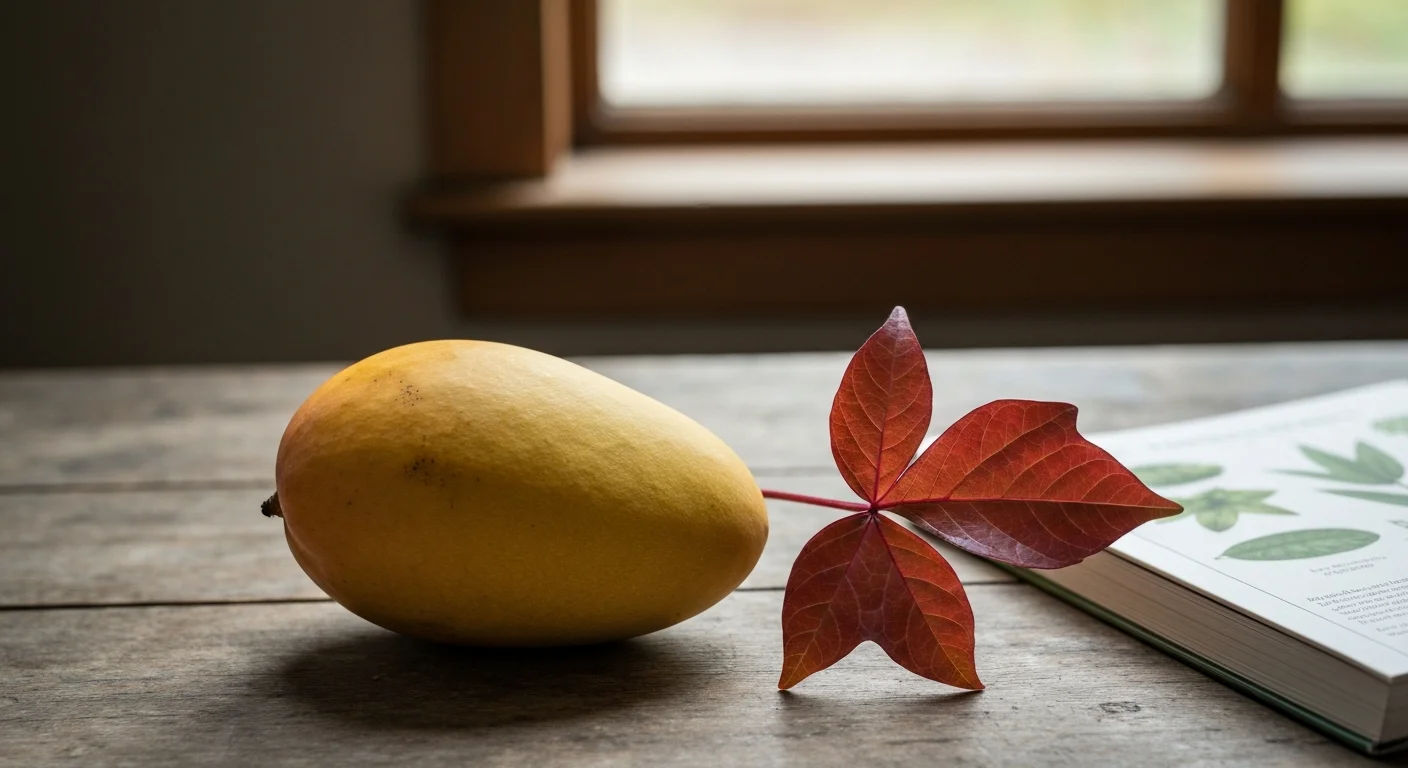
Mangoes can trigger the same itchy, blistering rash as poison ivy because both plants belong to the Anacardiaceae family and both contain urushiol, the oily compound responsible for allergic contact dermatitis. The urushiol in mangoes is concentrated in the skin, sap, and leaves, and roughly 1 to 2 percent of the general population reports a reaction, with higher rates among people already sensitized to poison ivy or poison oak. For our Texas customers, who often spend weekends hiking the Hill Country or the Piney Woods where poison ivy is abundant, understanding this botanical connection can prevent an unpleasant surprise when a fresh box of Alphonso or Kesar arrives at the door.
Our team at Swadeshi Mangoes has fielded enough questions about itchy lips and rashy fingers over the years that we decided to put together a thorough, evidence-based explainer. This post draws on peer-reviewed dermatology research, the American Academy of Allergy, Asthma & Immunology, and USDA food-safety guidance to help you enjoy the nine Indian varieties we ship across Texas without the itch.
What Is Urushiol and Why Does It Matter?
Urushiol is a mixture of catechols, specifically alkyl-substituted 3-n-pentadecylcatechols and related compounds. It is the same irritant that causes roughly 50 million cases of poison ivy, oak, and sumac dermatitis every year in the United States, according to the Centers for Disease Control and Prevention. When urushiol contacts skin, it binds to proteins in the outer epidermis and triggers a Type IV delayed hypersensitivity reaction in sensitized individuals.
A 2019 review published in the Journal of the American Academy of Dermatology noted that urushiol is remarkably stable and can remain allergenic on surfaces, clothing, or even dried plant material for years. That same stability is why a mango left on the counter for three days can still produce a reaction if the sap from the stem end contacts sensitive skin.
The Anacardiaceae Family Tree
Anacardiaceae is a botanical family of about 860 species that includes some of our favorite foods and some of our worst allergens. Cashews, pistachios, sumac spice, pink peppercorns, mangoes, and poison ivy are all cousins. The family shares biochemistry, which means urushiol-like compounds appear across the clan. If you react to cashew shells or raw pistachio skins, there is a plausible biological reason you may also react to mango peel.
Where Is Urushiol Found in a Mango?
Research from the Journal of Agricultural and Food Chemistry (2014) mapped the distribution of urushiol-related compounds in Mangifera indica and found the highest concentrations in the peel, the stem, the sap that weeps from the stem end after picking, and the leaves. The flesh itself contains only trace amounts. This matters because most reactions happen when people peel a mango with their bare hands or bite into the fruit with skin still attached, not when they eat the cut flesh.
How Much Urushiol Is in Each Variety?
There is no published varietal comparison for the nine varieties we carry, but anecdotally our team has noticed Banginapalli and Totapuri tend to weep more sap at the stem than Alphonso or Mallika. Kesar, Himayath, Chinna Rasalu, Suvarna Rekha, and Dasheri fall somewhere in the middle. Across all varieties, the risk profile is similar once the fruit is peeled and the flesh is separated.
Symptoms of a Mango-Urushiol Reaction
Reactions typically appear 12 to 72 hours after contact, which is classic for Type IV hypersensitivity. Common symptoms include:
- Red, itchy patches around the lips, chin, and cheeks
- Small fluid-filled blisters that may weep
- Swelling of the lips or perioral skin
- Rash on hands, forearms, or anywhere the peel or sap touched
- Burning or tingling at first contact in highly sensitized individuals
True IgE-mediated mango allergy, which causes hives, throat tightness, or anaphylaxis within minutes, is far rarer. A 2017 case series in Annals of Allergy, Asthma & Immunology documented fewer than 50 published cases worldwide, and most involved people with concurrent latex allergy, known as latex-fruit syndrome.
Cross-Reactivity Data: What the Research Shows
Cross-reactivity between poison ivy and mango has been studied since the 1930s. A landmark 1998 study in Contact Dermatitis patch-tested 85 poison-ivy-sensitive volunteers with mango peel extract; 18 of them, or 21 percent, showed a positive reaction. The researchers concluded that prior poison ivy sensitization is the single biggest risk factor for mango dermatitis.
| Population Group | Reported Reaction Rate | Source |
|---|---|---|
| General US population | 1 to 2 percent | AAAAI 2020 review |
| Poison-ivy-sensitized adults | 17 to 21 percent | Contact Dermatitis 1998 |
| Latex allergy patients | 33 to 47 percent (any mango reaction) | J Allergy Clin Immunol 2003 |
| Cashew-allergic children | Limited data, estimated 10 to 20 percent | Pediatric Allergy Immunol 2016 |
| No prior sensitization | Less than 1 percent | AAAAI 2020 review |
Safe Handling: A Texas Mango Lover’s Checklist
Because we deliver thousands of mango boxes across Austin, Dallas, Houston, and San Antonio every season, we have refined a simple handling protocol that dramatically reduces contact risk:
1. Rinse the Fruit First
Run each mango under cool tap water for 20 to 30 seconds and gently rub the surface. This removes surface sap, pesticide residue, and any particulate matter picked up during the Texas summer heat.
2. Use a Paring Knife, Not Your Teeth
Biting into an unpeeled mango is the single most common way people expose perioral skin to urushiol. Always peel first.
3. Wear Nitrile Gloves If You Are Sensitized
If you know you react to poison ivy or cashews, wear disposable nitrile gloves while peeling. Latex gloves are not recommended because of the latex-fruit syndrome overlap.
4. Wash Hands and Knives with Dish Soap
Urushiol is an oil. Plain water will not remove it. Dish soap or a dedicated urushiol wash like Tecnu cuts the oil effectively.
5. Store Cut Mango Separately
Once peeled and cubed, the flesh is essentially urushiol-free. Keep peels in a sealed bag and discard within 24 hours.
What to Do If You React
Mild contact dermatitis usually resolves in 1 to 3 weeks. Over-the-counter 1 percent hydrocortisone cream, cool compresses, and oral antihistamines like cetirizine can reduce itching. See a physician if blistering is extensive, if the rash affects the eyes or genitals, or if you develop systemic symptoms such as hives or difficulty breathing. For our Texas customers, urgent care clinics across the major metros can prescribe oral prednisone for severe cases.
Why We Still Recommend Mangoes
The overwhelming majority of our customers across Texas, probably 98 percent, eat our mangoes season after season with zero issues. Mango-urushiol dermatitis is real but uncommon, and it is entirely preventable with basic handling hygiene. The nutritional and cultural value of a ripe Alphonso or Kesar, particularly for the Indian diaspora in Texas who wait all year for the April-to-July harvest window, far outweighs a small, manageable risk for most people.
If you are unsure whether you are sensitized, try a small test: peel a mango wearing gloves, wash your hands thoroughly, then eat a single cube of flesh. If no reaction develops within 72 hours, you are almost certainly fine to continue.
FAQ
Can I be allergic to mango but not poison ivy?
Yes, though it is uncommon. True IgE-mediated mango allergy is distinct from urushiol contact dermatitis and can occur in people who have never encountered poison ivy. It typically presents with hives, swelling, or anaphylaxis within minutes of eating the flesh, not a delayed rash. If you suspect this type of reaction, see an allergist for skin prick or specific IgE testing before ordering more mangoes in Texas.
Is the mango flesh itself safe for poison-ivy-sensitive people?
Generally, yes. Urushiol is concentrated in the peel, stem, and sap, with only trace amounts in the ripe flesh. Most poison-ivy-sensitive people can eat peeled, cubed mango without issue. Our Texas customers who react only to the peel simply ask a household member to do the peeling or use nitrile gloves. The cut flesh stored separately almost never causes problems.
Does cooking or drying mango destroy the urushiol?
Heat does not reliably break down urushiol. Dried mango, mango pickle, and even mango chutney can retain allergenic activity if peel fragments are present. Commercial aamchur powder, which is ground dried green mango, has caused documented reactions. If you are highly sensitized, stick to clearly peeled and de-skinned products and avoid unpeeled dried slices.
Can children develop mango dermatitis?
Yes, though it is rare under age five. Sensitization usually requires prior exposure to urushiol from poison ivy or related plants, which children often have not had. That said, children with cashew or pistachio allergy may cross-react. In Texas, where poison ivy is widespread, we recommend introducing mango in peeled, cubed form and monitoring for any delayed rash.
Will repeated exposure make my mango allergy worse?
For urushiol contact dermatitis, repeated exposure can intensify future reactions, a phenomenon called priming. Each episode can make the immune system more reactive. If you have had even a mild reaction, we recommend using gloves or having someone else peel. True IgE-mediated food allergy is different and can also worsen with exposure, which is why testing with an allergist is valuable.
For more on variety selection, see our mango varieties guide, and for storage best practices visit mango care. Ready to order this season? Our order form covers Austin, Dallas, Houston, and San Antonio pickup from April through July 2026.
Not medical advice. Consult your doctor for specific conditions. For peer-reviewed sources, see PubMed, USDA FoodData Central, and the National Mango Board.