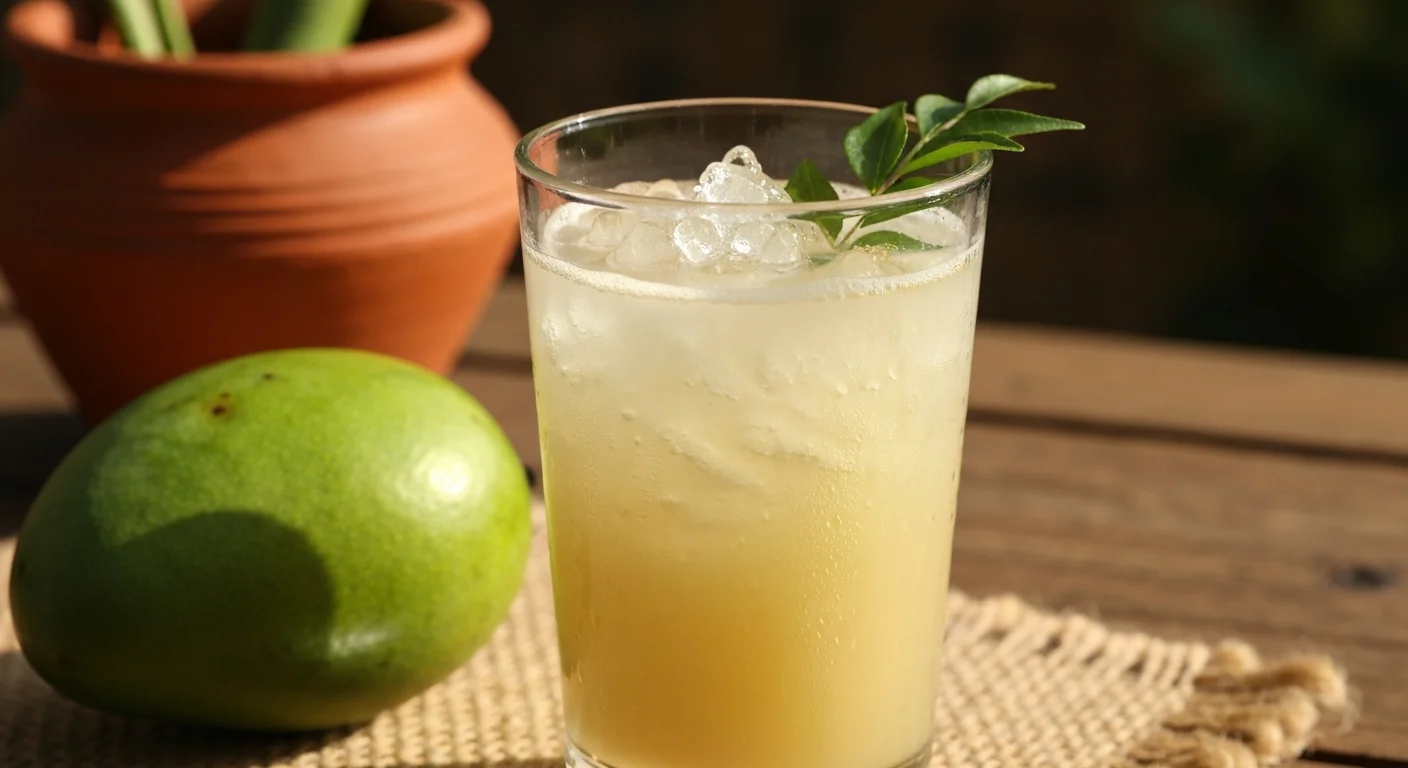
Quick answer: Mango ambli is a traditional Andhra summer drink made by slow-fermenting raw green mango pulp with water, cumin, curry leaves, green chile, and rock salt. It takes 2 hours of passive fermentation, is vegan and gluten-free, and is one of the most effective traditional coolers for the kind of oppressive heat we get in Texas summers. Lightly sour, slightly spicy, naturally probiotic, and nearly forgotten outside of rural Telugu households. This post brings it back to your kitchen.
History and Origin
Before refrigerators and bottled electrolyte drinks, Andhra farmers who worked in 110 degree summer fields carried earthen pots of ambli wrapped in wet cloth to the fields. The drink did three things at once: rehydrated heat-stressed bodies, restored lost salt, and supplied a burst of energy from fermented carbohydrates. Every household had a slightly different version, some using ragi flour, others jowar, some using just raw mango as the souring agent. Our version, the Coastal Andhra one my amma made in Vijayawada, uses raw Totapuri mango as both the sour base and the flavor driver.
Ambli quietly disappeared from urban Indian kitchens during the 1980s as bottled drinks flooded cities. Today it survives mostly in rural Rayalaseema and Telangana homes. When I moved to Austin and lived through my first 105-degree Texas July, I remembered my grandmother pouring ambli from a clay pot and I decided this drink belongs in every Texan kitchen. It hydrates better than coconut water, costs almost nothing, and takes 15 minutes of hands-on work. Our customers across Houston, Dallas, San Antonio, and Fort Worth have told us it changed their summer hydration routine. The forgotten drink is back.
Beyond its coastal Andhra form, ambli has cousins across the Deccan plateau. In Telangana villages, farmers add crushed ragi flour for extra body and energy. In Rayalaseema, some households pound a single raw green chile and a knob of ginger into the base, producing a fiery midday version that cuts through even the worst heatstroke symptoms. Older Tamil grandmothers make a related drink called neer mor with buttermilk and curry leaves, but without the mango. Ambli is distinctly Telugu, and that distinction is worth preserving. When our Austin and Dallas customers come back to tell us they have started making this drink weekly for their children through Texas’s brutal June and July, I feel the quiet satisfaction of a tradition traveling forward through one more generation.
Ingredients
This is the classic Andhra coastal version. Rayalaseema variations with ragi flour noted below.
- 1 medium raw green mango, peeled and cubed (about 1 cup or 200 g)
- 4 cups cold filtered water, divided (950 ml)
- 1 teaspoon rock salt or pink Himalayan salt (more to taste)
- 1 teaspoon roasted cumin powder
- 1 green Thai chile, finely chopped
- 15 fresh curry leaves, finely chopped (or blended)
- 1 tablespoon fresh cilantro, chopped
- 1 teaspoon grated fresh ginger (optional but traditional in Rayalaseema)
- 1 tablespoon lemon juice (to boost tartness if mango is not sour enough)
- 1/4 teaspoon hing (asafoetida)
- 2 tablespoons cooked soaked sabja (basil seeds), optional but lovely
Prep time: 15 minutes. Rest/ferment time: 2 hours. Serves: 4 tall glasses. Dietary: vegan, gluten-free.
Method
- Steam the mango (10 minutes). Place cubed raw mango in a small pot with 1/2 cup water. Cover and steam on medium heat for 8 to 10 minutes until completely soft. You can also pressure cook for 1 whistle. Alternatively, roast a whole raw mango over an open flame until blackened, then peel. Roasted gives smokier ambli.
- Cool and mash (5 minutes). Let steamed mango cool completely. Mash with a fork or pulse briefly in a blender. The texture should be pulpy, not smooth.
- Build the base (3 minutes). In a large pitcher, combine mashed mango pulp with 3 1/2 cups cold filtered water. Stir well. Add rock salt, roasted cumin, green chile, chopped curry leaves, cilantro, grated ginger, and hing.
- Rest and ferment (2 hours). Cover the pitcher loosely with a clean cloth. Leave at room temperature for 2 hours. The natural wild yeasts on curry leaves and mango skin begin a mild fermentation that deepens flavor and creates mild effervescence. In a hot Texas kitchen at 85 degrees, 90 minutes is often enough. Do not over-ferment or it becomes too sour.
- Taste and finish (2 minutes). Stir well. Taste. If it is not sour enough, add the lemon juice. Adjust salt. If using sabja seeds, stir them in now.
- Serve (immediate). Strain through a wide-mesh sieve or serve unstrained for more fiber. Pour over crushed ice in tall glasses. Garnish with a curry leaf and a sprinkle of cumin powder.
Variety Recommendations
Ambli needs raw green mango. Period.
Best: Raw Totapuri. The parrot-beak mango has exactly the tartness, low fiber, and clean mango aroma ambli needs. Our first-season raw Totapuri shipments across Texas in April and May are specifically requested by customers making ambli. Pre-order raw Totapuri.
Second best: Raw Banginapalli. Slightly less sour but a cleaner flavor. Many Telugu households use raw Banginapalli interchangeably.
If desperate: Frozen raw mango chunks. Thaw, drain, and proceed. The result is acceptable but lacks the full aromatic complexity of fresh.
Avoid: All ripe varieties (Alphonso, Kesar, Chinna Rasalu, Himayath, Dasheri, Mallika, Suvarna Rekha). Ripe mango turns ambli into a weird sweet mango lassi instead of the traditional cooling tonic.
Tips
- Roasted cumin makes or breaks it. Toast whole cumin seeds in a dry skillet for 2 minutes, cool, and grind fresh. Pre-ground cumin has half the flavor.
- Rock salt, not table salt. Rock salt (sendha namak) adds minerals and a rounder flavor. Table salt makes ambli taste sharp and medicinal.
- Hing is not optional. A pinch of asafoetida provides the savory depth that distinguishes ambli from a simple sour drink.
- Serve same day. Ambli is a live drink. Flavor peaks at 2 to 4 hours post-ferment. By day two it tilts too sour.
- Mistake to avoid: over-blending. Smooth puree makes thick lassi-like ambli. The traditional drink is thin, pulpy, and drinkable.
Serving Suggestions
Traditional Andhra service: a tall steel tumbler, no ice (rural villages did not have it), sipped mid-afternoon between long field shifts. In our Texas summer kitchens, I serve ambli chilled over crushed ice with a sprig of curry leaves on top. Pair with pakoras and mirchi bajji for a post-work rainy-day Austin snack. It is also a brilliant hydrator before or after outdoor Texas gardening, a round of backyard cricket in Dallas, or a long brisket smoke session in Fort Worth. Our family drinks a small glass before lunch on the hottest July afternoons in Houston, and the difference in afternoon energy levels is genuinely noticeable. Ambli is probiotic, mineral-rich, and lower in sugar than any bottled sports drink you can buy at a Texas gas station.
Storage
Ambli is best consumed within 4 hours of preparation. Refrigerated in a glass pitcher, it will keep for 24 hours, but continues to ferment slightly and becomes more sour. After 48 hours it is too sharp to drink pleasantly, though some Rayalaseema households prize day-two ambli for its stronger probiotic punch. Do not freeze. See the USDA FoodData Central for mango nutritional data.
FAQ
Can I use ripe mango for ambli? No. Ambli depends entirely on the tartness of raw green mango. Ripe mango makes a sweet fruit drink, which is delicious but is not ambli. If you want a ripe-mango summer drink, try our mango lassi recipe instead, which uses ripe Alphonso or Kesar.
How long does mango ambli keep? Best within 4 hours, acceptable up to 24 hours refrigerated. After that, continued fermentation makes the drink unpleasantly sour. This is a same-day drink. Make a single pitcher for your Texas afternoon and drink it before dinner.
Is ambli spicy? Mildly, about 3 out of 10. The single green chile and hint of ginger provide warmth without real heat. Skip the chile entirely for children or heat-sensitive family members, or add a second chile for a bolder Rayalaseema-style ambli.
Does ambli have alcohol from fermentation? No. The 2-hour rest produces only trace wild-yeast activity, which creates mild fizz and tang but no measurable alcohol. Longer fermentation (8 to 12 hours) can produce very low alcohol, similar to kombucha, but the traditional Andhra recipe stops well before that.
What is the difference between ambli and panakam? Panakam is a sweet South Indian drink made with jaggery, lemon, and dry ginger, served during Sri Rama Navami. Ambli is savory, sour, and made with raw mango and cumin. Different purpose entirely. Panakam celebrates; ambli hydrates. Both belong in a Texas summer kitchen.
Recipe Card
Mango Ambli (Andhra Summer Drink)
Prep: 15 minutes. Ferment: 2 hours. Serves: 4. Diet: Vegan, gluten-free.
Ingredients: 1 cup cubed raw green mango, 4 cups cold water, 1 tsp rock salt, 1 tsp roasted cumin, 1 green chile, 15 curry leaves, 1 tbsp cilantro, 1 tsp ginger, 1/4 tsp hing, 1 tbsp lemon juice (if needed), optional sabja seeds.
Steps: Steam raw mango until soft, cool, mash. Combine with water, salt, cumin, chile, curry leaves, cilantro, ginger, hing. Rest 2 hours at room temperature. Adjust seasoning. Strain or serve pulpy over ice.
Browse more Andhra mango recipes or order raw Totapuri for authentic ambli across Texas.