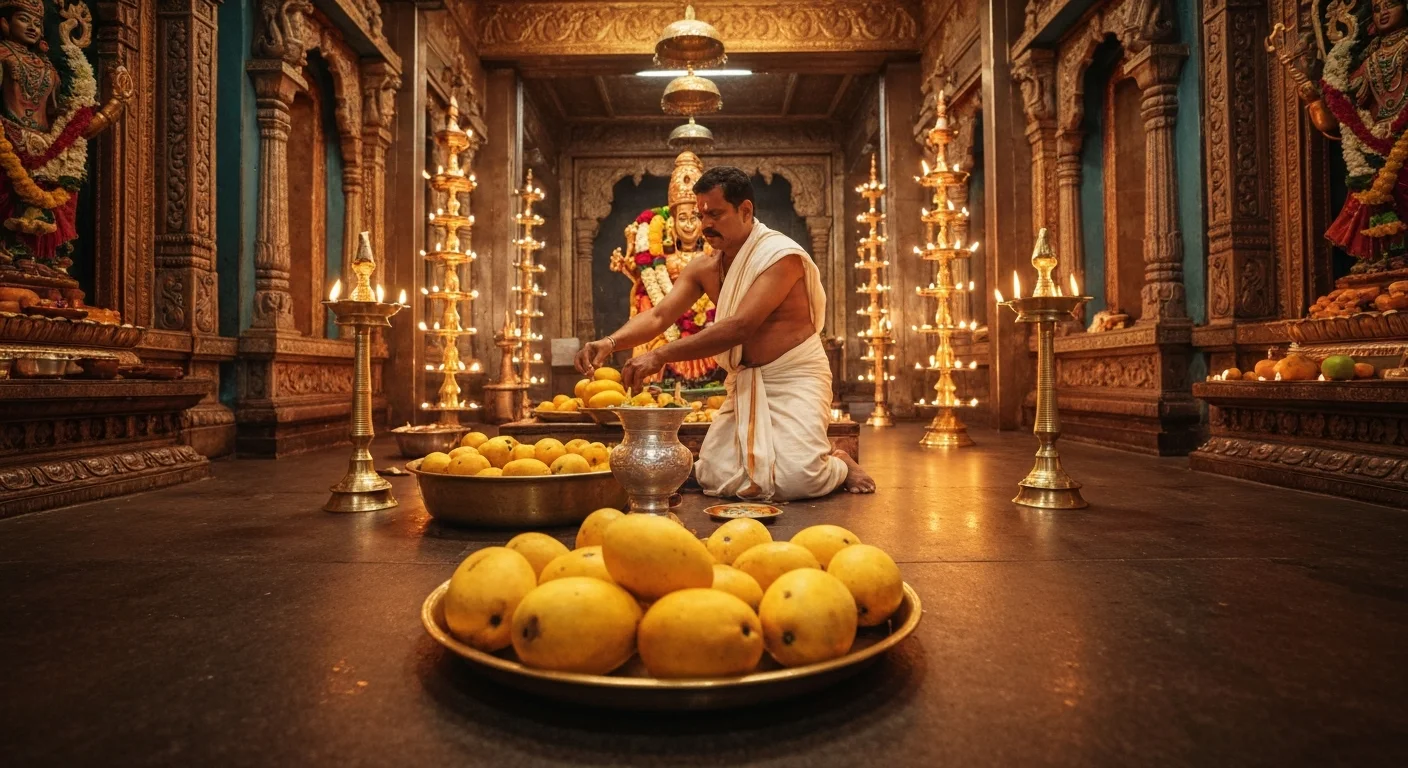
During mango season, Texas Hindu temples from the Sri Meenakshi Devasthanam in Pearland to the BAPS Swaminarayan Mandir in Stafford and the Hindu Temple of Greater Austin offer fresh mangoes to deities, distribute them as prasad, and host community meals built around the fruit. The tradition links the Texas diaspora directly to practices described in the Vedas and continued across Indian temples for thousands of years.
Why Mangoes Belong in the Temple
The mango is considered one of the most auspicious fruits in Hindu tradition. The Upanishads reference the mango in teachings on cause and consequence. The fruit appears on altars dedicated to Lakshmi, Ganesh, Hanuman, and Krishna. In Vaishnavite traditions, Lord Vishnu is sometimes offered a plate of ripe mangoes as part of the bhoga (food offering) during summer months.
I remember my first year in Texas. I was living in an apartment in Austin, and I drove nearly three hours to the Sri Meenakshi Devasthanam in Pearland because I had heard they did an elaborate summer offering. When I walked in and saw a brass plate of Banganapalli mangoes at the feet of Lord Venkateswara, I felt, for the first time since moving to Texas, completely at home.
Sri Meenakshi Devasthanam, Pearland
Sri Meenakshi Devasthanam is one of the oldest and most traditional South Indian-style temples in the United States. Founded in the 1970s by a community of Tamil and Telugu families, it follows Agama shastra strictly, meaning rituals are conducted according to ancient South Indian temple texts.
During mango season, which typically runs June through August, the temple priests incorporate mangoes into daily naivedya offerings. Banganapalli, being the flagship variety of Andhra Pradesh where many of the priestly lineages originate, is the dominant fruit on the altar.
The Annual Mango Abhishekam
One of the lesser-known rituals at Sri Meenakshi is an annual abhishekam that uses mango juice as one of the sacred substances bathed on the deity. This follows a tradition described in older temple manuals where fruits of the season are offered in liquid form during the summer months. The juice is then distributed as prasad to devotees, who receive it in a small leaf cup.
BAPS Shri Swaminarayan Mandir, Stafford
The BAPS Mandir in Stafford, near Houston, serves a predominantly Gujarati community. Mango season there centers on Kesar, the iconic Gujarati variety. During annual festivals like Jagannath Rath Yatra, Janmashtami, and Ram Navami that fall during mango season, Kesar mangoes are offered at the altar and distributed as prasad to visitors.
I have attended Janmashtami at BAPS Stafford three times. The community meal after the midnight arati typically includes aamras, a Gujarati preparation of fresh mango pulp eaten with puri. Several hundred families share this meal in the temple hall. For many children born in Texas, this is their first introduction to real Kesar mango flavor.
The Gujarati Tradition of Aamras
Aamras is not simply pureed mango. It is a ceremonial food. Gujarati families traditionally prepare it only with fully ripe Kesar or Alphonso, mixed with a touch of ghee, cardamom, and sometimes saffron. The temple preparation follows these same principles. When I bring my cousins visiting from Ahmedabad to BAPS Stafford, they agree the aamras there tastes exactly as it does in Gujarat. That continuity, built and maintained by temple volunteers, is a cultural achievement worth celebrating.
Hindu Temple of Greater Austin, Pflugerville
The Hindu Temple of Greater Austin, located in Pflugerville and serving the entire Central Texas region, takes a pan-Indian approach to mango season. Because its community draws from Telugu, Tamil, Gujarati, Punjabi, Bengali, and Marathi families, the altar during summer often features a mixed plate of varieties.
I spoke with one of the temple trustees a few years ago, who told me they intentionally rotate mango varieties through the season to honor all regional traditions. “We cannot always offer the specific variety each devotee grew up with, but we can honor the diversity of our community,” he said. Swadeshi Mangoes has occasionally donated boxes of Kesar and Banganapalli for their festival meals.
The Small Mango Grove
A fun fact about the Pflugerville temple is that volunteers planted a small mango grove on the temple grounds about a decade ago. Texas winters limit how well these trees produce, but a handful of leaves from those trees are used each year for kalash and torana during major pujas. The grove is a small but powerful symbol of rooting the sacred fruit in Texas soil.
Karya Siddhi Hanuman Temple, Frisco
The Karya Siddhi Hanuman Temple in Frisco, consecrated by a lineage from Andhra Pradesh, draws thousands for Hanuman Jayanti and weekend abhishekams. During mango season, Banganapalli mangoes appear in most offerings because of their Andhra origin.
Hanuman, in addition to being the beloved monkey god, has a specific love for mangoes in folklore. Several jataka-style stories describe his childhood attempts to eat the sun, mistaking it for a ripe mango. This story is told and retold at the Frisco temple, and children there grow up associating Hanuman with the fruit itself.
Festival Meals and Annadanam
The temple conducts annadanam (free community meal) regularly, and during mango season, the meal often concludes with slices of ripe Banganapalli as dessert. This is one of the most egalitarian temple traditions: anyone, regardless of background, can sit and eat. The mango is not a symbol here. It is food shared between strangers.
Texas Cultural Associations and Community Events
Beyond the temples, Texas-based Indian cultural associations also center mango season in their events. Here are a few that regularly incorporate mangoes:
- Telugu Cultural Association of Austin: Summer potluck events consistently feature Banganapalli slicing stations and mango lassi.
- Gujarati Samaj of Houston: Hosts a summer gathering where Kesar aamras is prepared for hundreds of families.
- Tamil Sangam of Austin: Summer event typically features raw mango pachadi (chutney) and ripe mango sliced with salt.
- Dallas Gujarati Society: Annual Kesar mango celebration during Ashadhi.
- India Association of North Texas: Pan-Indian cultural events that incorporate multiple mango varieties across dishes.
Table: Major Texas Temples and Their Mango Traditions
| Temple | Location | Primary Mango Used | Key Festivals |
|---|---|---|---|
| Sri Meenakshi Devasthanam | Pearland | Banganapalli | Summer abhishekam, Vaikasi Visakham |
| BAPS Swaminarayan Mandir | Stafford | Kesar | Jagannath Rath Yatra, Janmashtami |
| Hindu Temple of Greater Austin | Pflugerville | Mixed varieties | Rama Navami, Ganesh Chaturthi |
| Karya Siddhi Hanuman Temple | Frisco | Banganapalli | Hanuman Jayanti, weekend abhishekam |
| DFW Hindu Temple | Irving | Mixed | Satsang, Janmashtami |
| Shirdi Sai Parivaar | Plano | Kesar, Alphonso | Guru Purnima |
The Role of Prasad
Prasad, the sanctified food distributed after an offering, is one of the most emotionally resonant aspects of temple visits for the diaspora. When a mango is offered to the deity and then handed to you as prasad, the fruit is no longer simply food. It carries the grace of the deity and the blessings of the ritual.
A few years ago, a customer named Deepak from Sugar Land told me that his elderly mother, who could not travel back to India, kept a small piece of mango prasad from BAPS Stafford in her refrigerator for a week. She ate it slowly, one small bite a day, because each bite felt like a connection to her home temple in Ahmedabad. Stories like this remind me why we do this work.
How Swadeshi Participates
Each season, Swadeshi Mangoes donates boxes to several Texas temples and cultural associations. We do this quietly, without promotion, because it is not marketing. It is a small way of saying thank you to institutions that have held the Indian community together through decades of migration and settlement. If your temple or cultural organization in Austin, Dallas, Houston, or San Antonio would like to discuss a seasonal donation, please reach out through our contact page.
Explore our mango varieties, read about proper ripening, or see more community stories on our blog.
FAQ
Which Texas temples offer mangoes during seasonal pujas?
Most major Texas Hindu temples incorporate mangoes during summer pujas. Sri Meenakshi Devasthanam in Pearland, BAPS Shri Swaminarayan Mandir in Stafford, Hindu Temple of Greater Austin in Pflugerville, Karya Siddhi Hanuman Temple in Frisco, and DFW Hindu Temple in Irving all feature mango offerings in their June through August calendars, with specific varieties tied to regional traditions.
Can I donate mangoes to my local Texas temple?
Yes, most temples welcome fresh fruit donations for daily naivedya and festival meals. Call ahead to confirm the temple’s preferred variety, quantity, and timing. Many temples have specific protocols about how fruit should be washed, presented, and delivered. Swadeshi Mangoes has donated to several Texas temples over the years and can help coordinate bulk orders for community events.
What is the significance of mango juice in abhishekam?
Abhishekam is the sacred bathing of a deity in substances like milk, honey, curd, ghee, and fruit juices. Mango juice, used seasonally, represents the sweetness and abundance of summer. It is one of the panchamrit-adjacent offerings, recommended in Agama texts for specific summer rituals. After the abhishekam, the juice is distributed as sanctified prasad.
Why does each Texas temple use a different mango variety?
Temples generally use varieties tied to the regional Indian origins of their founding community. Sri Meenakshi in Pearland (South Indian) uses Banganapalli. BAPS in Stafford (Gujarati) uses Kesar. Pan-Indian temples like Hindu Temple of Greater Austin rotate varieties to honor the diversity of their community. This maps directly onto the regional diaspora patterns in Texas.
When is the best time to visit a Texas temple for mango-related festivals?
The peak window is mid-June through late July, when Alphonso, Kesar, and Banganapalli are all available. Specific festivals to watch for include Jagannath Rath Yatra at BAPS Stafford, summer abhishekams at Sri Meenakshi Pearland, and Hanuman Jayanti observances at Karya Siddhi Hanuman Frisco. Check individual temple calendars for exact dates each year.