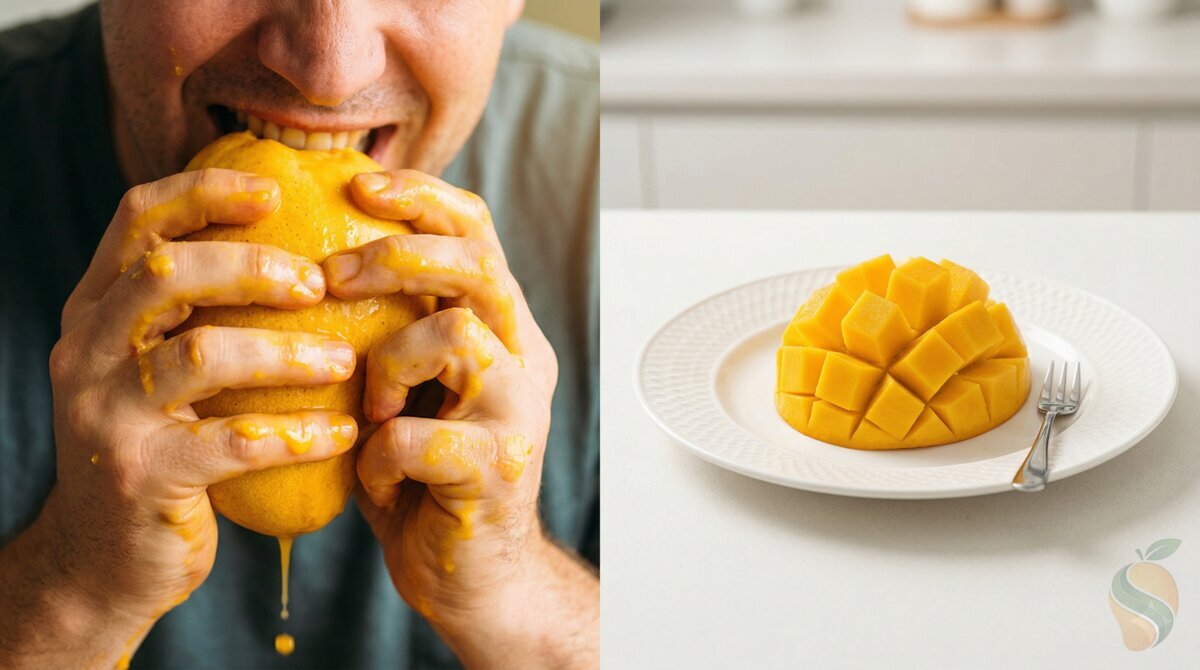
This is the debate that has divided Indian families for generations. It cuts across state lines, income levels, and education. There is no neutral position. You are either a sucker or a cutter. And before you dismiss this as trivial, understand that this debate has ended friendships, derailed dinner parties, and produced more passionate arguments than most political disagreements. The mango does not care. But its people do.
Team Suck: The Traditionalists
The method: Roll the mango between your palms until the flesh inside breaks down into pulp. Bite off the tip. Suck the juice directly from the skin like a tropical juice box.
This is the method that most Indians learn as children, sitting on the floor of a kitchen or veranda with newspaper spread underneath, wearing clothes that were already designated as mango-eating clothes. There is a specific physical memory associated with this method — the give of the skin as the flesh softens under your rolling palms, the resistance of the seed inside, and then the rush of sweet pulp when you bite through the tip. It is not just eating. It is an experience.
Arguments in favor:
- This is how God intended mangoes to be eaten
- Zero dishes to wash
- Maximum juice extraction — nothing left behind
- The texture changes with each squeeze and suck — pulpy, then juicy, then stringy near the seed
- Deeply satisfying on a primal level that cutting cannot replicate
- It is the only honest way to eat a mango — no pretense, no cutlery, just you and the fruit
- The warmth of your hands on the fruit releases more aroma, making the flavor more intense
- You taste the entire mango, including the parts near the skin that are slightly different in flavor from the center
Arguments against:
- You will need a shower afterward
- Cannot be done in public without judgment
- Not all varieties are suckable — large Banganapalli does not cooperate
- Your shirt will not survive
- Urushiol in the mango skin can irritate sensitive lips and cheeks
Best varieties for sucking: Neelam, Chinna Rasalu, Dasheri — smaller mangoes with soft, juicy flesh that breaks down easily. Chinna Rasalu is perhaps the ultimate sucking mango — small enough to fit in one hand, thin-skinned, intensely sweet, and the flesh breaks down into pure liquid pulp with almost no fiber.
The technique matters more than people think. You do not just squeeze randomly. You start at the bottom of the mango and work upward, rolling and pressing the flesh away from the seed in a systematic way. Experienced suckers can reduce an entire mango to a flat, empty skin pouch in under two minutes. There is a skill to it. Children learn it from older siblings, who learned it from cousins, who learned it from grandparents. It is passed down like a family recipe — except messier.
Team Cut: The Civilized
The method: Slice the mango cheeks off the seed with a knife. Score the flesh into cubes. Invert the skin and eat the cubes or scoop with a spoon.
This is the method that the rest of the world learned from cooking shows and food blogs. It produces beautiful, photogenic results. The inverted mango cheek with its grid of golden cubes is one of the most recognizable images in food photography. It is clean, controlled, and repeatable.
Arguments in favor:
- Clean, elegant, shareable
- You can actually see and appreciate the color and texture of the flesh
- Consistent pieces for recipes, salads, and serving
- Can be done in professional settings without destroying your reputation
- Better for photography (Instagram does not like sticky faces)
- Allows you to add lime, chili, or salt to individual pieces
- Easier to combine with other foods — yogurt bowls, salads, salsas
Arguments against:
- Wasteful — pulp left on the seed is the best part
- Too formal. You are eating a mango, not performing surgery
- The knife changes the experience from intimate to clinical
- You miss the textural journey from outer flesh to seed
Best varieties for cutting: Alphonso, Kesar, Banganapalli — larger mangoes with firm, sliceable flesh. Banganapalli is the cutting champion: large, flat seed, firm flesh that holds its shape, and clean separation from the skin. It was practically designed to be cubed.
The cutting technique has its own skill ceiling. The key is knowing where the seed is. Indian mangoes have a flat, oblong seed. You want to slice as close to the seed as possible on each side to maximize the flesh you get. A good cutter can remove both cheeks and the two thin side strips with minimal waste, then scrape the seed clean with a knife. The seed scraping, by the way, is where cutters become honorary suckers — most people eat those last bits of flesh directly off the seed over the kitchen sink, when nobody is watching.
The Regional Divide
This debate is not random. It follows regional and varietal lines across India, and those preferences travel with families to Texas.
South India leans heavily toward sucking. Varieties like Chinna Rasalu, Neelam, and Raspuri are small, juicy, and purpose-built for the sucking method. Growing up in Andhra Pradesh or Karnataka, you suck mangoes. It is not a choice. It is how it is done. The varieties are too small and too juicy to cut elegantly, and the flavor is concentrated in a way that is best experienced through direct extraction.
West India — Maharashtra, Gujarat — is more of a cutting region, largely because the dominant varieties (Alphonso, Kesar) are larger and have firmer flesh. A ripe Alphonso can absolutely be sucked — and many people do — but the flesh is dense enough that cutting produces better results. The Alphonso puree you scoop from a cheek is a different texture from the pulp you suck through a hole in the skin.
North India splits both ways. Dasheri and Langra are classic sucking mangoes in UP and Bihar. Chausa, which becomes impossibly soft and juicy when ripe, is one of the great sucking mangoes of the world. But Dussheri and Safeda are commonly cut.
In Texas, you get all of these traditions colliding in one place. A Telugu family and a Marathi family at the same dinner table will eat the same Alphonso in completely different ways. Neither is wrong. Both are right.
The Secret Third Option: The Hedge Bite
For the politically moderate: Cut the cheeks off for clean eating, then take the seed to the sink and suck the remaining flesh off privately. Best of both worlds. No witnesses.
Most Indian adults do this. Few will admit it publicly.
The hedge bite is the compromise position that satisfies nobody and everybody. You get the clean presentation of cutting — cubes on a plate, civilized, shareable. And then you get the primal satisfaction of sucking the seed clean — the sweetest flesh on the mango is always right next to the seed, a bit fibrous, intensely flavored, the part that cutting can never fully claim. Standing at the sink with mango juice running down your wrists, eating the seed like a cave person, then washing your hands and returning to the table as though nothing happened — this is the adult mango experience.
Teaching the Next Generation in Texas
Here is something that matters to Indian families in Texas: how you eat a mango is cultural memory. Kids who grow up cutting mangoes with a knife and fork are not doing anything wrong. But there is something valuable about teaching them the sucking method — it connects them to a way of eating that their grandparents practiced, that their great-grandparents practiced, that carries the physical memory of Indian summers across generations.
The newspaper on the floor. The old t-shirt pulled on specifically for mango eating. The competition between siblings over who can drain a mango fastest. These are rituals, and rituals matter. If you want your children to understand what mangoes meant to you growing up, you cannot just hand them a plate of cubes. You have to give them the full experience, mess and all.
Order a box of Chinna Rasalu or Neelam for the sucking experience. Order a box of Alphonso or Banganapalli for cutting. Or do what most families do: order both and let the debate continue at your own dining table.
The Verdict
There is no wrong way to eat a mango. There is only your way. The mango does not judge you. It just wants to be eaten.
But if you grew up sucking mangoes and switched to cutting because society told you to grow up — consider this your permission to go back. Close the curtains. Roll that Alphonso. Bite the tip. Remember who you are.
And if you have always been a cutter and the sucking people make you uncomfortable — that is fine too. Your scored Alphonso cheek is a work of art. The golden cubes catching the light. The clean lines. The spoon. There is dignity in precision.
The only truly wrong way to eat a mango is to not eat one at all.
Order your mangoes and eat them however you want. Browse all Indian mango varieties to find the right ones for your preferred method.
However You Eat Them in Texas
Swadeshi delivers mangoes perfect for both sucking and cutting to Austin, Dallas, Houston, and San Antonio. Small varieties like Chinna Rasalu and Neelam are ideal for sucking. Large Banganapalli and Alphonso are perfect for cutting. Check our ripening guide to get them to the perfect stage for either method. Order yours.
Frequently Asked Questions
What is the best way to eat an Indian mango?
There are two main methods: sucking (rolling the mango to break down the pulp, then biting off the tip) and cutting (slicing cheeks off the seed and scoring into cubes). Both are valid. Sucking is traditional, cutting is cleaner. Most people use a combination depending on the variety and setting.
Which mango varieties are best for sucking vs cutting?
Small, juicy varieties like Neelam, Chinna Rasalu, and Dasheri are best for sucking. Larger varieties like Alphonso, Banganapalli, and Kesar are better for cutting and slicing. See our varieties page for the full selection.
What is the hedge bite method?
The hedge bite is a compromise: cut the cheeks for clean eating, then take the seed to the sink and suck the remaining flesh off in private. Most Indian adults practice this method. It combines the presentation of cutting with the satisfaction of sucking.