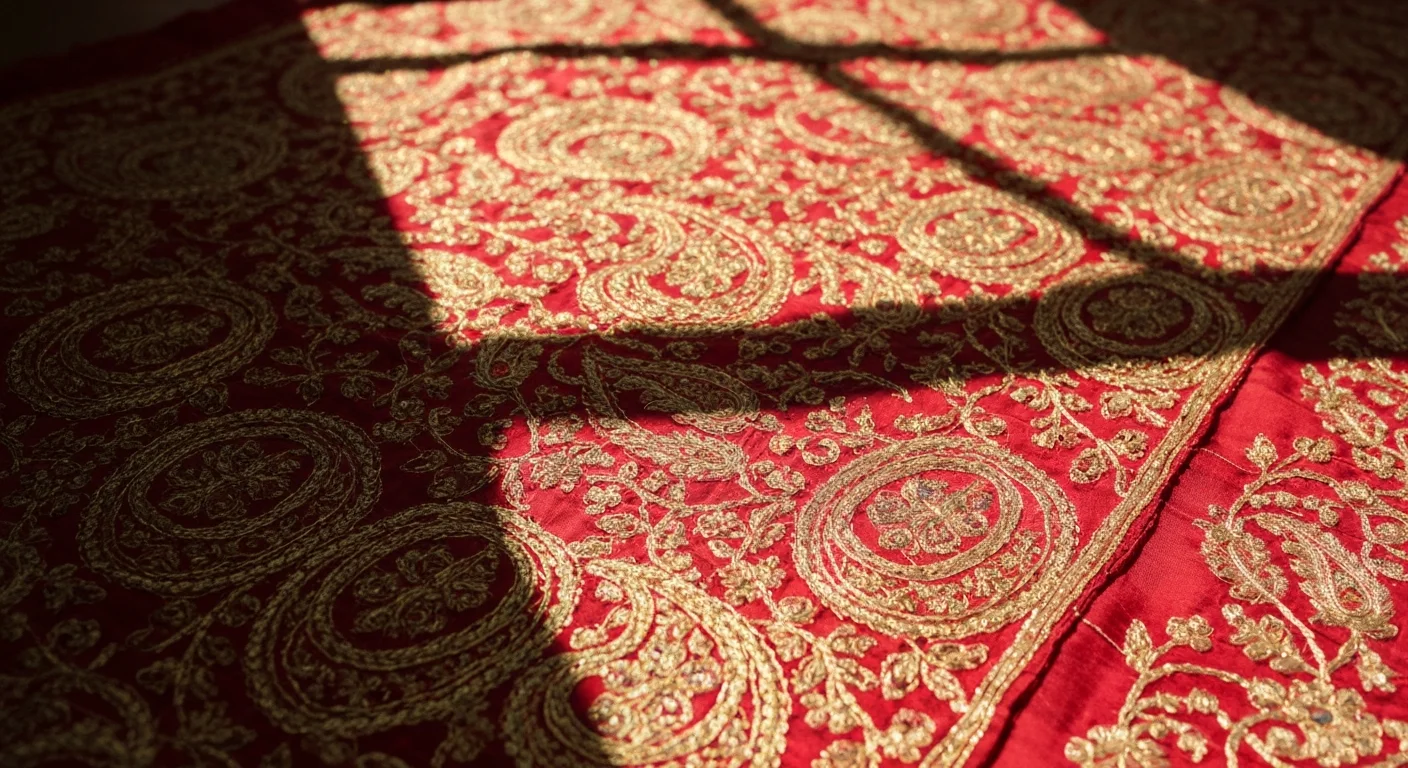
The paisley pattern, known around the world as a teardrop curl found on Kashmir shawls, Iranian carpets, and Victorian fabrics, originated as a stylized representation of the mango called buta or boteh in Persian and Sanskrit sources. The motif spread from Mughal-era Kashmir to Iran, then to Paisley, Scotland, which gave the design its English name in the nineteenth century. Today, descendants of that same mango-shaped motif decorate everything from bandanas to boutique textiles in Austin and Houston, a silent reminder that Indian mangoes have shaped not just taste but visual culture.
The Mango as Motif
The mango’s elegant teardrop shape made it a natural candidate for decorative abstraction. South Asian artisans working in textiles, metalwork, and miniature painting developed the buta as a stylized mango curl centuries before European eyes ever saw it. The form combined the fruit’s profile with a gentle flame-like curve, suggesting fertility, abundance, and auspiciousness.
Sanskrit and Persian Roots
The word buta in Sanskrit refers to a flower or ornament, while boteh in Persian carries similar connotations. Scholars including the textile historian Jasleen Dhamija have traced the motif through pre-Mughal Indian artifacts and into the court arts of Safavid Iran, where it flourished in carpet design and illuminated manuscripts.
Kashmir Shawls: The Golden Age
By the seventeenth and eighteenth centuries, Kashmir’s shawl weavers had elevated the buta to extraordinary sophistication. Woven from the fine undercoat of the Himalayan mountain goat in a technique called kani, Kashmir shawls could take years to complete and cost the price of a small estate.
Royal Patronage
Mughal emperors, Sikh maharajas, and later British officers all prized Kashmir shawls. Maharaja Ranjit Singh of the Sikh Empire was particularly known for his collection, and his shawls were gifted to European royalty in the early nineteenth century, helping spread the buta motif far beyond the subcontinent.
The Journey to Paisley, Scotland
In the early 1800s, Kashmir shawls became fashionable among European upper classes following Napoleon’s Egyptian campaign and the subsequent orientalist vogue. Demand vastly outstripped supply. British weavers in several towns, most famously the town of Paisley southwest of Glasgow, began producing imitations on Jacquard looms.
Why Paisley Gave the Pattern Its Name
Paisley became so dominant in European production that the buta motif became synonymous with the town. By the mid-nineteenth century, English-speaking markets simply called the pattern paisley. The original Indian and Persian names faded from common use outside specialist circles, though textile historians continue to emphasize the mango origin.
Timeline: From Kashmir to Global
| Period | Development |
|---|---|
| Pre-15th century | Buta motif appears in pre-Mughal Indian and Safavid Persian arts |
| 16th-17th century | Kashmir shawl weavers refine kani technique with buta as central motif |
| 1799-1839 | Maharaja Ranjit Singh’s patronage; shawls gifted to European royalty |
| 1800-1820 | European demand soars; British weavers begin imitating Kashmir patterns |
| 1840s-1870s | Paisley, Scotland dominates imitation market; English name takes hold |
| 1960s | Paisley revival via the Beatles and counterculture fashion |
The Counterculture Revival
In the mid-1960s, paisley returned to prominence through rock-and-roll fashion. The Beatles, after their 1968 trip to Rishikesh to study with Maharishi Mahesh Yogi, helped catapult paisley into Western youth culture. Pop artists wore paisley shirts, guitars were painted in paisley finishes, and the motif became a visual shorthand for psychedelic aesthetics.
Fender Paisley Telecaster
Fender’s 1968 Pink Paisley Telecaster, introduced for James Burton, remains one of the most visually distinctive guitars in rock history. Burton played it behind Elvis Presley, and the design became iconic. Texas guitar players from Austin to Dallas still seek out vintage Fender paisleys at music stores on South Lamar and in Deep Ellum.
Paisley in Modern Texas
Texas has a long relationship with paisley through multiple cultural channels. Western wear incorporates paisley bandanas, cowboy shirts, and scarves. The Austin music scene continues the 1960s paisley association. Indian-American families in Houston, Dallas, and Round Rock wear paisley embroidery on bridal outfits, saris, and sherwanis that preserve the motif’s original cultural meaning.
Diaspora Weddings
A Hindu or Sikh wedding in Houston or Dallas often features dozens of paisley patterns in silk, zari embroidery, and even mehndi designs. For diaspora families, the motif carries layered meanings: it is both ancient and modern, both Indian and globally recognized, both formal and familiar.
The Mango Connection Remains
Despite centuries of abstraction and global travel, the paisley remains recognizably a mango. Cut any ripe Alphonso or Kesar in half, look at the seed profile, and the shape is unmistakable. When Texas families receive a box from Swadeshi Mangoes during the April-July season, they hold in their hands the living original of a design that now decorates ties in London, scarves in Milan, and quilts in Round Rock.
From Fruit to Fabric and Back
Visit our varieties page to see the specific cultivars whose profiles inspired the ancient buta. Order through our order form for delivery anywhere in Texas, and consult our mango care guide to ripen your fruit properly. The fruit you eat is the ancestor of the pattern on your grandmother’s shawl.
Why Design History Belongs in Food Writing
The paisley story illustrates a broader truth about mangoes. The fruit is not merely agricultural produce; it is a thread in the fabric of world culture. Its taste sustains bodies, its shape decorates cloth, and its cultivation has occupied human labor and imagination for more than four thousand years.
The Jacquard Loom Revolution
Part of what allowed Scottish paisley to overtake Kashmir production was the Jacquard loom, invented by Joseph Marie Jacquard in Lyon, France in 1804. The Jacquard used punched cards to automate complex patterning that had previously required expert weavers. When Paisley mills adopted the Jacquard in the 1820s and 1830s, they could produce elaborate buta-patterned shawls at a fraction of the cost of handwoven Kashmir originals. The technology eventually influenced early computer science, with Charles Babbage and Ada Lovelace citing the Jacquard as an inspiration for programmable machines.
Indian Weavers and Economic Disruption
The Scottish paisley boom had devastating consequences for Kashmir weavers. Traditional kani shawl production employed thousands of artisans in the Srinagar valley, and the flood of European imitations depressed prices and collapsed livelihoods. By the late nineteenth century, many Kashmir weavers had switched to other crafts or migrated. Textile historians including Frank Ames, in his book The Kashmir Shawl and Its Indo-French Influence, have documented this economic disruption as one of the earliest examples of industrial globalization undercutting traditional craft economies. Today’s revived Kashmir pashmina industry represents a partial reconstruction of that lost heritage.
Paisley in American Western Wear
Paisley entered American cowboy culture through multiple routes. Bandanas, originally produced in the eastern United States from printed cotton in the nineteenth century, adopted paisley motifs early because the pattern hid dirt and wear effectively. The bandana became a utility garment for ranch hands across Texas, and by the early twentieth century, paisley prints were a standard element of Western wear. Visit any Western store in Fort Worth or San Antonio today and paisley scarves, yokes, and pocket squares remain ubiquitous.
Nathan Turk and the Nudie Suit Era
Custom Western tailors like Nathan Turk and Nudie Cohn incorporated elaborate paisley into the stage costumes of country music stars including Hank Williams, Porter Wagoner, and later Elvis Presley. This tradition continued through the Texas honky-tonk scene, and contemporary Americana artists in Austin and Waco still commission paisley-embellished stage wear from custom tailors. The motif’s journey from Kashmir to Austin via Paisley, Scotland and Hollywood tailoring is one of the more remarkable migrations in textile history.
The Buta in Indian Wedding Culture
For Indian-American families planning weddings in Texas, paisley remains central to sartorial tradition. A Banarasi sari purchased for a Houston wedding may feature zari-embroidered buta motifs woven into the fabric. Sherwanis for grooms often incorporate paisley in gold thread. Even the mehndi patterns applied to brides’ hands routinely feature mango-shaped motifs. The visual vocabulary of the Indian wedding preserves the buta’s original cultural meaning as an emblem of fertility, abundance, and auspiciousness.
FAQ
Did the paisley pattern really come from a mango?
Yes. Textile historians including Jasleen Dhamija have documented the origin of the paisley motif, known as buta in Sanskrit and boteh in Persian, as a stylized mango shape. The motif flourished in Mughal-era Kashmir and Safavid Iran before reaching Europe, where Scottish weavers in Paisley gave the design its modern English name.
Why is it called paisley and not buta?
The town of Paisley in Scotland became the largest producer of imitation Kashmir shawls during the early nineteenth century, when European demand for the genuine article outstripped supply. The town’s name became a metonym for the pattern in English-speaking markets, replacing the older Indian and Persian terms.
What is a Kashmir shawl?
A Kashmir shawl is a finely woven garment traditionally made from the fine undercoat of the Himalayan mountain goat using the kani weaving technique. Classic shawls prominently feature the buta or mango motif and could take months or years to complete. Genuine antiques are preserved in museums including the Victoria and Albert Museum in London.
How did paisley become associated with the 1960s counterculture?
After the Beatles traveled to Rishikesh in 1968 to study meditation, Indian fashion elements including paisley became emblematic of psychedelic rock and the broader counterculture. Fender’s 1968 Pink Paisley Telecaster guitar and the widespread use of paisley shirts cemented the association in popular memory.
Can I find paisley in Texas culture today?
Yes. Paisley appears throughout Texas culture, from Western-wear bandanas and cowboy shirts to Indian-American bridal outfits worn at weddings in Houston, Dallas, and Austin. Vintage Fender paisley guitars remain sought after in Austin music stores. Diaspora families often decorate homes with paisley-motif textiles.
External references: Wikipedia: Paisley design, Victoria and Albert Museum, Wikipedia: Kashmir shawl.