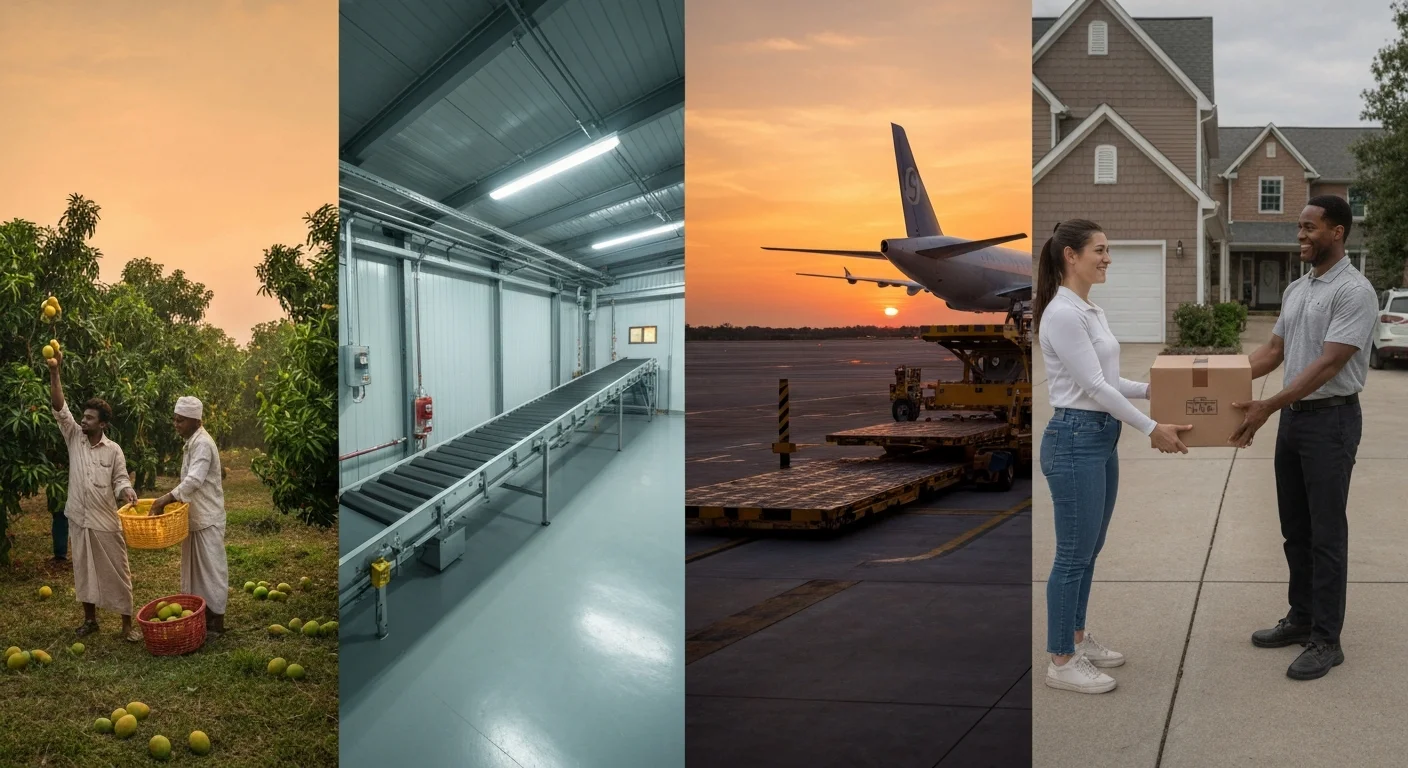
A Swadeshi Mangoes pickup agent starts their day before sunrise, sorting sealed mango boxes in their garage, checking a WhatsApp group of 40 to 100 customers, and preparing to host neighbors from Austin, Dallas, Houston, or San Antonio who will come collect their seasonal fruit. What looks like a simple logistics job is actually a community ritual that rebuilds village life inside Texas suburbs.
Why We Use Pickup Agents Instead of Door-to-Door Delivery
When I first started Swadeshi Mangoes from my home in Round Rock, I assumed we would deliver every box door-to-door. Mango season taught me otherwise. Mangoes are fragile. They are temperature-sensitive. They ripen unpredictably. A single day in a hot Texas delivery truck can destroy a premium Alphonso box.
Instead, we built a network of more than 30 pickup agents across Austin, Cedar Park, Pflugerville, Georgetown, Dallas, Frisco, Plano, Houston, Sugar Land, Katy, Pearland, and San Antonio. Each agent is a volunteer from their neighborhood, usually someone who placed a large family order and agreed to host their neighbors’ orders too. What started as a logistics workaround turned into the heart of our company.
Agents Are Not Employees
Every pickup agent is a customer first. They are paid a modest thank-you for their time and effort, but none of them do it for the money. They do it because they love mangoes and because they enjoy the small community that forms in their driveway every June. This distinction matters. It changes the tone of every interaction.
5:30 AM: The Agent’s Morning Routine
Let me walk you through a real day. Our agent Meera, who hosts pickups for a neighborhood in Frisco, gave me permission to share her story.
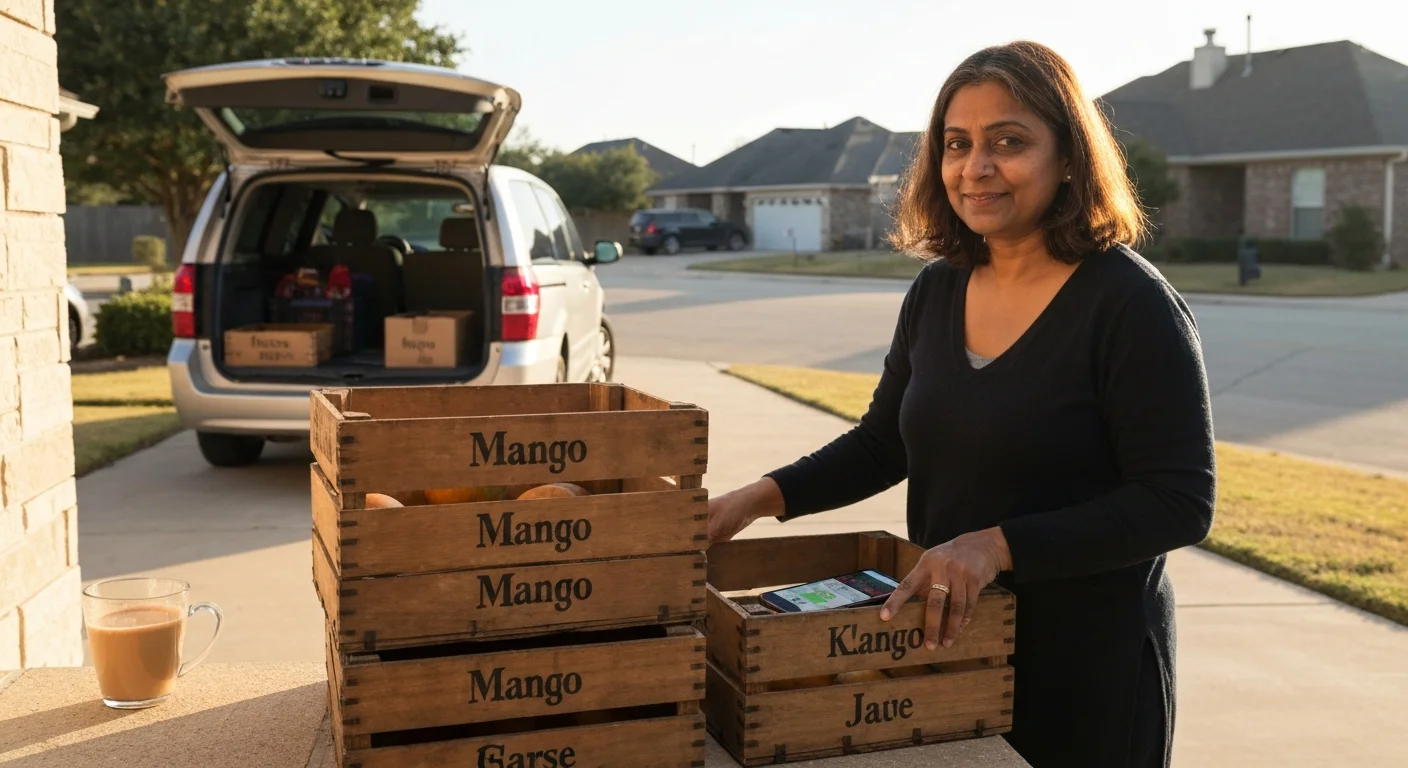
Meera’s alarm goes off at 5:30 AM. Her husband is still asleep. She makes a cup of chai in the kitchen, checks the Swadeshi agent dashboard on her phone, and confirms that today’s inbound shipment has cleared quality control at our sorting facility. The truck is scheduled to arrive at her house between 6:30 and 7:00 AM.
She walks into her garage and sweeps it clean. She sets up four folding tables, each labeled with a time slot: 9 AM, 11 AM, 1 PM, 3 PM. This lets her stagger pickups across the day so her driveway never gets chaotic.
The WhatsApp Group
By 6:00 AM, Meera has sent her first message of the day to the neighborhood WhatsApp group. “Good morning Frisco family. Boxes arriving shortly. Please pick up at your scheduled slot. Ripening guide attached.” The group has 83 members. Within minutes, there are 20 thumbs-up emojis and three people asking if they can come early.
This WhatsApp group is, in my opinion, the single most important innovation of Swadeshi. It turns a transaction into a conversation. People share photos of their mango cut-up plates, ask ripening questions, swap pickle recipes, and occasionally meet in person.
7:00 AM: The Truck Arrives
Our refrigerated truck pulls into Meera’s driveway at 6:55 AM. The driver, who also started as a Swadeshi customer, helps unload the boxes while Meera checks each order against her manifest. Today she has 47 boxes: 22 Alphonso, 14 Kesar, 8 Banganapalli, and 3 mixed variety cases.
Each box is sealed with the customer’s name, phone number, and a small QR code we use for pickup verification. Meera scans each box into her agent dashboard. If a box is missing or damaged, the system flags it automatically and I get an alert on my phone in Round Rock within seconds.
Sorting by Family, Not Variety
Meera learned early that sorting by family name is more useful than sorting by variety. Many families order multiple boxes at once. The Patel family in Frisco ordered three Kesar and two Alphonso cases. Meera stacks them together so the Patels do not have to search.
9:00 AM: The First Wave of Pickups
At 9:03 AM, Meera’s doorbell rings. It is Kiran, a software engineer who lives two streets away. He is in his Toyota Sienna with his two kids in the back. This is his fourth year picking up from Meera. They hug briefly, she hands him a cup of chai, and his kids run around the driveway while he loads his two Kesar boxes into his trunk.
This is the scene that repeats dozens of times throughout the day. Neighbors show up, spend five to fifteen minutes chatting, collect their boxes, and leave. Meera estimates that about 70 percent of her pickups involve a conversation that extends beyond the transaction. People ask about each other’s kids, upcoming Diwali plans, and temple visits.
The Cultural Function of the Driveway
Several of our agents have told me something striking. The driveway pickup has become the closest thing to an Indian village square they have experienced in Texas. In a culture where HOA-controlled suburbs actively discourage public gathering, the mango pickup gives people a legitimate reason to loiter, chat, and reconnect.
Rakesh, our agent in Sugar Land, told me that during the 2023 season, two families in his pickup group realized they grew up in the same town in Gujarat. They had been neighbors in Texas for five years and had never spoken. The mango line broke the ice.
12:00 PM: Problem Solving
No day is without a problem. By noon, Meera has usually dealt with at least one of the following:
- A customer who cannot come on their assigned day and needs to reschedule.
- A customer who wants to add on an extra box at the last minute.
- A question about ripening or fiber content.
- A customer whose box arrived with two soft mangoes that need to be replaced.
The Swadeshi system is designed to handle these gracefully. Meera can log a replacement request in her dashboard, and the next day’s truck will include a replacement box for that customer. Customer service is not centralized. It lives in Meera’s driveway, in real time, face to face.
When Things Go Wrong
Last year, our Pearland agent had a truck delay of four hours due to a highway accident. Forty-two customers were waiting. Instead of panic, the agent turned her driveway into a temporary social hour. She brought out snacks, played Bollywood music, and kept everyone calm. When the boxes finally arrived, people were laughing. That is what happens when logistics is built on relationships.
3:00 PM: The Afternoon Lull
By 3 PM, the last pickups are trickling in. Meera takes a break, eats lunch, and does a quick reconciliation. She counts unclaimed boxes and messages those customers. Most pick up by 7 PM. Any leftover boxes are either delivered personally by Meera to elderly customers within a few miles, or held for the next day.
6:00 PM: Closing the Day
Meera closes her garage at around 6:30 PM. She files her reconciliation in the agent dashboard, which automatically updates my system in Round Rock. She sends a final message in the WhatsApp group: “Thank you everyone. Enjoy the mangoes. Here is a photo of my daughter tasting her first Alphonso of the season.” The group erupts in replies.
Table: Our Pickup Agents by Texas Region (Approximate, 2025 Season)
| Region | Agents | Cities Covered |
|---|---|---|
| Austin Metro | 8 | Austin, Round Rock, Cedar Park, Pflugerville, Georgetown |
| DFW Metroplex | 10 | Dallas, Frisco, Plano, Irving, McKinney, Allen |
| Houston Metro | 9 | Houston, Sugar Land, Katy, Pearland, Stafford |
| San Antonio | 3 | San Antonio, Schertz, Boerne |
| Total | 30+ | Greater Texas triangle |
Why Our Agents Are the Heart of Swadeshi
When I am asked what makes Swadeshi different, I always point to our agents. We did not design this system on a whiteboard. We stumbled into it because Texas is too spread out for door-to-door, and because cold chain is too expensive for small routes. The answer was community. Put a trusted neighbor in charge. Let people come to her. Trust her judgment.
This is, in a small way, how commerce worked in Indian villages for centuries. The local store owner knew your grandmother. You did not need a receipt because your name was known. We did not invent this. We just rediscovered it in a Texas suburb. Explore our varieties, check out our mango care tips, or place your seasonal order on the order form.
FAQ
How do I become a Swadeshi pickup agent in my Texas neighborhood?
We recruit agents each year based on customer demand in specific zip codes. Most agents are existing customers who have hosted informal pickups and asked to formalize the arrangement. If you are interested, email us with your neighborhood details. We prioritize areas with at least 30 committed customers and agents with a garage or driveway large enough for staged pickups.
Are Swadeshi pickup agents paid employees?
Pickup agents are independent hosts who receive a modest thank-you payment per season, not a salary. Most do it because they love mangoes and enjoy hosting neighbors. The role combines light logistics, customer service, and community building. It typically requires 4 to 8 hours on a pickup day, which happens every 7 to 10 days during the June to August season.
What happens if my pickup agent is unavailable on the delivery day?
Every Swadeshi pickup agent has a backup agent nearby, usually within a 5-mile radius. If the primary agent is unavailable, your order is rerouted to the backup and you receive a WhatsApp message with the new address. This redundancy is why we have 30 plus agents across Texas rather than a handful of central hubs.
Can I meet my pickup agent before the season starts?
Yes. Many of our agents host informal pre-season meet-ups in April and May, particularly for first-time customers. Join your neighborhood WhatsApp group after placing your first order. Agents typically introduce themselves, share their address, and answer questions about pickup logistics before the first shipment arrives.
What Texas cities have the most Swadeshi pickup agents?
The Dallas-Fort Worth metroplex has the highest concentration with 10 agents serving Frisco, Plano, Irving, and McKinney. Austin has 8 agents spanning Round Rock, Cedar Park, Pflugerville, and Georgetown. Houston has 9 agents across Sugar Land, Katy, and Pearland. San Antonio currently has 3 agents. Visit our order form to see available pickup locations near you.