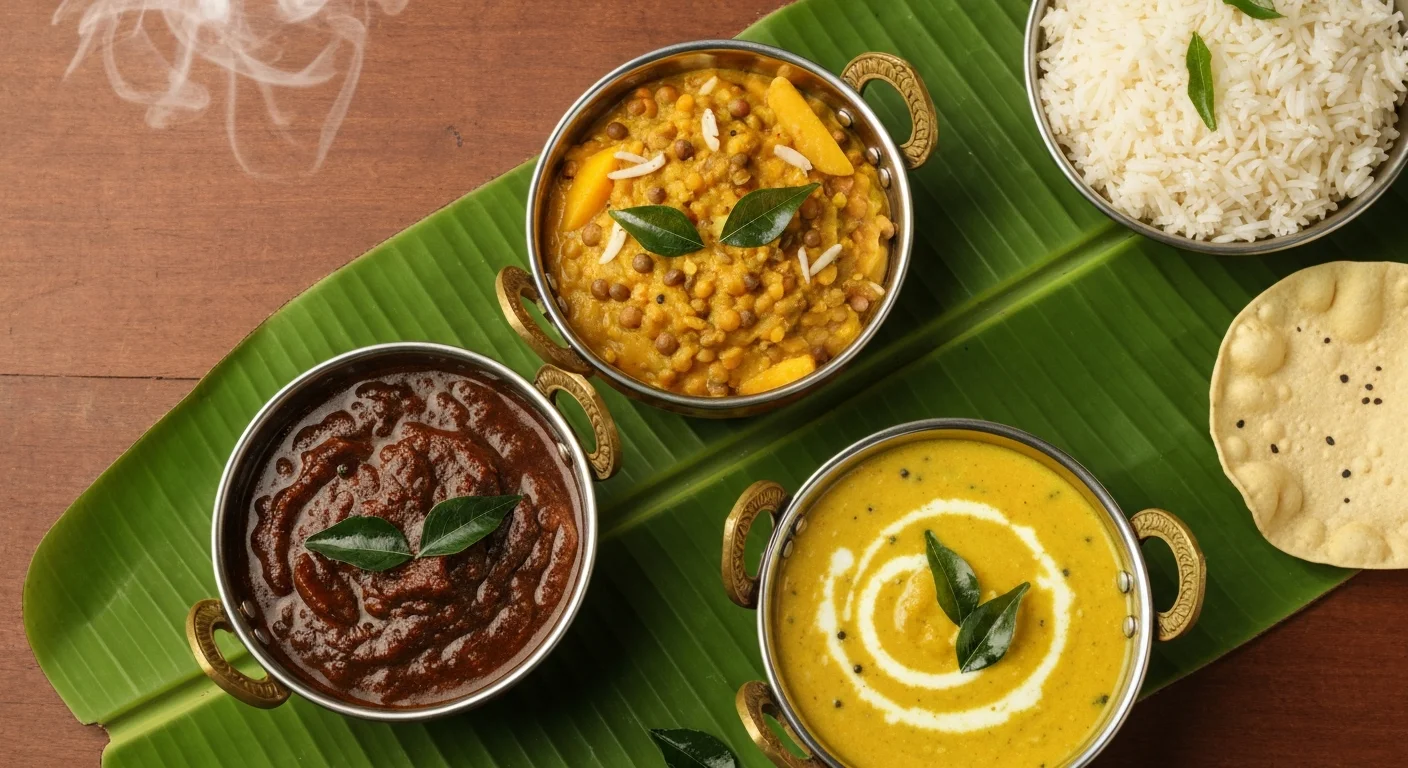
Quick answer: South Indian mango curry is a family of sweet, sour, and spicy dishes that use raw or ripe mangoes with regional bases like tamarind-jaggery, toor dal, or yogurt. You make them because each state delivers a completely different flavor profile from the same fruit, and because they all turn a Texas summer weeknight dinner into a full trip across the South Indian coast.
History and Origin
Most people outside India assume mango curry means one thing. In reality, every South Indian state has its own version, and they taste nothing alike. Andhra Pradesh leans into tamarind and jaggery for a bold sweet-sour pulusu. Tamil Nadu builds flavor around lentils and coconut in a mangai kootu. Kerala whisks yogurt into the gravy for a cooling mambazha pulissery. Karnataka has its own coconut-heavy version, and even Telangana villages make a chili-forward mango curry for summer weddings.
My grandmother made mamidikaya pulusu every April when the first Banginapalli mangoes arrived in Guntur. My mother-in-law, who grew up in Chennai, insists mango curry must include toor dal. My husband’s Kerala friend swears by pulissery. After fifteen years of Texas cooking, I finally stopped picking sides and started making all three, depending on what else is on the table and which mango is ripest in my fruit bowl. At Swadeshi Mangoes we deliver both ripe and raw mangoes across Austin, Dallas, Houston, and San Antonio, which makes all three recipes possible no matter the season.
Ingredients
Variation 1: Andhra Mamidikaya Pulusu (tamarind-jaggery, raw mango, serves 4)
- 1 large raw green mango, peeled and cubed (2 cups / 300 g)
- 1 tablespoon tamarind paste
- 3 tablespoons jaggery (or brown sugar), grated
- 1/2 teaspoon turmeric
- 1 teaspoon red chili powder
- 1 tablespoon sesame oil
- 1/2 teaspoon mustard seeds
- 1/2 teaspoon cumin seeds
- 2 dried red chilies
- 8 to 10 curry leaves
- 1 pinch asafoetida
- 2 cups (480 ml) water
- Salt to taste
Variation 2: Tamil Mangai Kootu (lentil-coconut, half-ripe mango, serves 4)
- 1 medium half-ripe mango, cubed (1 1/2 cups / 225 g)
- 1/2 cup (100 g) toor dal, rinsed
- 1/2 cup (50 g) fresh grated coconut
- 2 green chilies
- 1 teaspoon cumin seeds
- 1/2 teaspoon turmeric
- 1 tablespoon coconut oil
- 1/2 teaspoon mustard seeds
- 1 dried red chili
- 6 curry leaves
- 2 cups (480 ml) water
- Salt to taste
Variation 3: Kerala Mambazha Pulissery (yogurt, ripe mango, serves 4)
- 2 ripe Banginapalli or Alphonso mangoes, cubed (2 cups / 300 g)
- 1 1/2 cups (360 ml) whole-milk yogurt, whisked smooth
- 1/2 cup (50 g) fresh grated coconut
- 2 green chilies
- 1/2 teaspoon cumin seeds
- 1/2 teaspoon turmeric
- 1 tablespoon coconut oil
- 1/2 teaspoon mustard seeds
- 1 dried red chili
- 8 curry leaves
- Salt to taste
Method
Variation 1: Mamidikaya Pulusu
- Simmer the mango (10 minutes). In a pot, combine cubed raw mango, turmeric, chili powder, salt, and 2 cups water. Simmer until mango is tender but holds its shape.
- Add tamarind and jaggery (5 minutes). Stir in tamarind paste and jaggery. Simmer until the gravy thickens slightly.
- Temper and finish (2 minutes). Heat sesame oil in a small pan. Add mustard seeds, cumin, dried chilies, curry leaves, and asafoetida. Pour the sizzling tempering over the pulusu. Serve over hot rice.
Variation 2: Mangai Kootu
- Cook the dal (20 minutes). Simmer toor dal in 2 cups water with turmeric until completely soft. Mash gently.
- Make the coconut paste (3 minutes). Blend coconut, green chilies, and cumin with a little water to a smooth paste.
- Combine (10 minutes). Add cubed mango and coconut paste to the dal. Simmer 8 to 10 minutes until the mango softens but stays intact. Season with salt.
- Temper (2 minutes). In coconut oil, pop mustard seeds, add dried chili and curry leaves. Pour over the kootu. Serve with rice or as a side.
Variation 3: Mambazha Pulissery
- Simmer the mango (10 minutes). Cook cubed ripe mango in 1/2 cup water with turmeric and salt until soft but not fully disintegrated.
- Add coconut paste (3 minutes). Blend coconut, green chilies, and cumin with a splash of water. Stir into the mango pot. Simmer 3 minutes.
- Whisk in yogurt (3 minutes). Turn heat to very low. Whisk yogurt smooth and slowly pour in, stirring constantly. Do not boil or yogurt will split.
- Temper (2 minutes). Heat coconut oil, pop mustard seeds, add dried chili and curry leaves. Pour over the pulissery. Serve with rice.
Variety Recommendations
For Andhra pulusu, use raw Totapuri or firm unripe Banginapalli. The tartness is essential. For Tamil kootu, half-ripe Banginapalli or Mallika works best because they sit between sweet and sour. For Kerala pulissery, you want fully ripe Banginapalli, Alphonso, or Chinna Rasalu for their sweetness to balance the yogurt. See our ripening guide for timing your cooking.
Tips
Taste as you go. Mangoes vary widely in tartness and sweetness even within the same variety. Adjust jaggery, tamarind, and salt batch by batch.
Use a heavy-bottomed pot for pulusu. The jaggery will scorch in thin pans and ruin the flavor with bitterness.
Do not boil pulissery after adding yogurt. Keep the heat gentle and pull from the stove the moment it is warmed through.
Toor dal must be fully soft for kootu. Pressure-cook if your stove is slow; undercooked dal gives a grainy curry.
Tempering is not optional. Curry leaves, mustard seeds, and dried chili sizzled in hot oil and poured over the curry is what makes South Indian cooking taste South Indian.
Serving Suggestions
All three curries are best served with plain basmati or sona masoori rice. Pulusu pairs with a dry vegetable like bhindi fry or aloo fry; pulissery balances a spicier main like chicken chettinad or lamb pepper fry; kootu works as part of a full sadya-style meal with rasam and sambar. For Texas hosts, I set up a South Indian sampler night where we put all three curries on the table and let guests scoop from each; it is always the most talked-about dinner in our Austin neighborhood.
Storage
Pulusu keeps 4 to 5 days in the fridge and the flavor deepens dramatically. It also freezes well for up to two months. Kootu keeps 3 days refrigerated; freeze only if you have not yet added the tempering. Pulissery is best eaten within 24 hours because yogurt curries lose their freshness quickly and can turn too sour. None of these curries reheat well in the microwave; use a stovetop with a splash of water instead.
Dietary Notes
All three curries are naturally vegetarian and gluten-free. Pulusu and kootu are vegan as written. Pulissery can be made vegan by substituting thick coconut yogurt for dairy yogurt. For lower carbohydrate, serve over cauliflower rice. All three are rich in plant protein from dal or coconut, and provide the Vitamin C and A of fresh mangoes.
FAQ
Which South Indian mango curry is easiest for beginners?
Mamidikaya pulusu is the most forgiving. It uses raw mango, which holds up to long simmering, and the tamarind-jaggery base is hard to ruin. Start with pulusu, master the tempering technique, and then move on to kootu and pulissery. All three teach different essential South Indian skills.
Can I use frozen mango for these curries?
Frozen cubed mango works for pulissery and kootu because the texture changes less noticeably in yogurt or lentil bases. For pulusu, use fresh firm mango because the cubes need to hold their shape. Our Texas-delivered fresh mangoes give markedly better flavor across all three versions.
What is the difference between pulusu and sambar?
Sambar uses toor dal and sambar powder as its base; pulusu does not. Pulusu is tamarind-and-jaggery forward with simple spicing, while sambar has a more complex dal-and-spice profile. Both are South Indian classics and often appear together at traditional meals, but they taste completely different side by side.
Can I combine all three flavor profiles in one curry?
You can, but the result tends to taste muddled. The genius of these three dishes is that each commits fully to one flavor principle: sweet-sour, lentil-earthy, or yogurt-cool. Picking one per meal lets each shine. Keep leftovers separate for the same reason.
How do these curries fit into a Texas summer menu?
Pulissery is perfect for hot Texas afternoons because it is cooling. Pulusu with its warm spice and jaggery works well on milder spring evenings in Austin. Kootu is a good comfort-food curry for cooler Dallas fall weeks when mango season is winding down. All three pair beautifully with Texas homegrown tomatoes and okra on the side. Each variation also offers different leftover potential: pulusu makes excellent rice-noodle soup the next day, kootu folds into wraps with flatbread, and pulissery can be thinned with water to become a soothing rasam-like drink served warm before bed.
Recipe Card
Three South Indian Mango Curries
Prep time: 25 minutes (for all three)
Cook time: 35 to 45 minutes each
Total time: varies, 60 to 90 minutes
Servings: 4 per variation
Cuisine: Indian (Andhra, Tamil, Kerala)
Course: Main
Diet: Vegetarian, gluten-free, mostly vegan
Calories per serving: 180 to 260 depending on variation
Browse our recipe blog for more ideas, or order fresh mangoes delivered across Texas. For nutritional data see USDA FoodData Central.