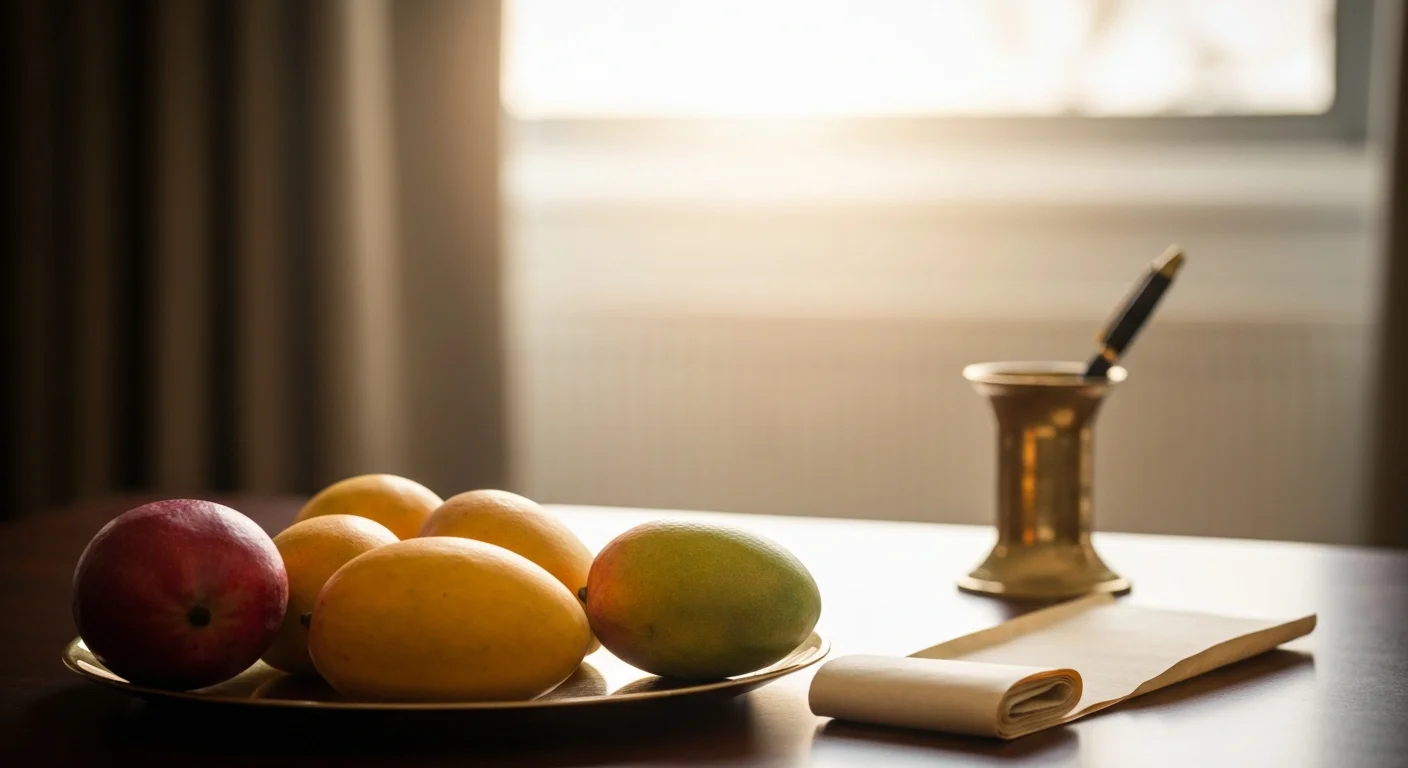
Mangoes have functioned as diplomatic currency for more than four hundred years, moving between courts, heads of state, and trade negotiators with symbolic weight far exceeding their market value. Five documented episodes stand out: Mughal-era exchanges, Aurangzeb’s gifts to the Persian and Ottoman courts, Mao Zedong’s famous 1968 mango crate distribution in China, Pakistan’s decades of mango diplomacy with the Gulf and China, and the 2006 Bush-Singh summit that reopened the US market to Indian mangoes. Each episode shaped trade flows whose descendants reach Texas tables today.
Why Mangoes, and Why Diplomacy
A mango is not just a fruit; it is a compressed message. It signals wealth, seasonality, regional pride, and personal favor. Because the fruit is perishable, sending one is a gesture of urgency and care. Because the fruit is seasonal, sending one is a temporal claim: now is the moment of abundance, and I share it with you.
The Tradition Begins
South Asian rulers had long used fruit gifts to cement alliances. The Mughal practice of sending mango boxes to rival and allied courts was both courtesy and soft power. Abu’l-Fazl’s Ain-i-Akbari records such exchanges under Akbar, and later Mughal rulers expanded the practice across the Islamic world.
Episode One: Aurangzeb to the Shah of Iran
Aurangzeb, the last great Mughal emperor who ruled from 1658 to 1707, sent mango shipments to the Safavid court in Isfahan and to Ottoman officials. Letters between Aurangzeb and Shah Abbas II, preserved in Persian diplomatic archives, reference gifts of preserved mangoes and ambrosial pickles. The exchanges were part of a broader courtship of Islamic-world opinion during Aurangzeb’s controversial reign.
What This Reveals
Pre-modern diplomacy relied heavily on sensory experience. A Persian courtier who tasted an Aurangzeb-sent mango experienced, in one bite, a claim about Mughal wealth, agricultural sophistication, and imperial reach. Words in a treaty were abstract; a ripe Malda was concrete.
Episode Two: Mao Zedong and the 1968 Crate
In August 1968, at the height of China’s Cultural Revolution, Pakistani Foreign Minister Mian Arshad Hussain gifted Chinese Chairman Mao Zedong a crate of mangoes during a state visit. Mao, who rarely accepted foreign gifts publicly, redirected the crate to worker propaganda teams at Tsinghua University in Beijing.
The Mango Cult
What followed became known as the Chinese mango cult. Workers preserved the fruit in formaldehyde, paraded it through factories, and treated it as a sacred object symbolizing Mao’s concern for the working class. Wax replicas were mass-produced. Scholar Alfreda Murck documented this episode in a 2013 Cornell University Press book titled Mao’s Golden Mangoes and the Cultural Revolution, now a standard reference.
Episode Three: Pakistani Mango Diplomacy with the Gulf and China
Pakistan has institutionalized mango diplomacy since the 1980s, with annual shipments of Chaunsa and Sindhri to Saudi royal courts, UAE officials, and Chinese leaders. The tradition continues today, with Pakistani ambassadors routinely sending ceremonial mango boxes at the start of each season.
Soft Power Through Fruit
Pakistan’s Foreign Office and Department of Agriculture have at times coordinated these shipments explicitly as soft-power instruments, reinforcing bilateral relationships with trading partners. The practice extends to European and North American capitals, where Pakistani embassies have hosted mango-tasting receptions for diplomats and journalists.
Episode Four: Bush and Singh, March 2006
Perhaps the most consequential recent episode of mango diplomacy occurred in March 2006 during Prime Minister Manmohan Singh’s state visit to Washington. President George W. Bush publicly announced that the US would allow fresh Indian mangoes into the American market for the first time since the 1989 ban.
Why This Mattered
The announcement was part of a broader US-India civil nuclear agreement and a strategic reset under the second Bush administration. The mango reopening was framed as a symbol of expanded trade and renewed partnership. It took until April 2007 for the first commercial shipments to arrive at JFK, but the diplomatic framing was cemented in 2006.
Timeline of Mango Diplomatic Moments
| Year | Event |
|---|---|
| 1658-1707 | Aurangzeb sends mangoes to Safavid Iran and Ottoman officials |
| August 1968 | Pakistani FM gifts Mao a mango crate; Chinese mango cult begins |
| 1980s-present | Pakistan institutionalizes mango diplomacy with Gulf and China |
| March 2006 | Bush and Singh announce reopening of US market to Indian mangoes |
| April 2007 | First legal commercial shipment of Indian mangoes arrives at JFK |
| 2015-present | Indian and Pakistani mango diplomacy continues across multiple capitals |
Episode Five: Modi-Era Mango Outreach
Since 2014, Indian Prime Minister Narendra Modi’s government has elevated mango diplomacy through the APEDA-coordinated Mango Festivals held annually in various capitals including Seoul, Tokyo, Berlin, and Washington. Indian ambassadors host tasting events featuring Alphonso, Kesar, and Banganapalli, pairing them with Indian classical music performances.
The Washington Mango Festival
The Indian Embassy in Washington has hosted annual mango festivals since 2008, drawing policymakers, journalists, and Indian-American community leaders. Similar events in New York, San Francisco, and Houston have helped normalize Indian mangoes in US diplomatic and cultural circles, feeding directly into Texas consumer markets.
The Diaspora as Diplomatic Ecosystem
Mango diplomacy does not end at embassy receptions. Every diaspora family in Round Rock, Houston, Austin, Dallas, and San Antonio who shares a box of Alphonso with American neighbors, coworkers, or friends is conducting a small, personal act of mango diplomacy. The fruit opens conversations, introduces histories, and builds cross-cultural familiarity.
How Swadeshi Mangoes Participates
By delivering nine Indian mango varieties across Texas during the April-July season, Swadeshi Mangoes enables this grassroots diplomacy. A box shared at a Round Rock potluck or a Houston office introduces colleagues to Kesar or Banganapalli who might otherwise never encounter them. Browse current offerings on our varieties page, place an order via our order form, and consult our mango care guide to ensure each shared fruit is at its best.
The Future of Mango Diplomacy
As the Indian and Pakistani diasporas continue to grow in North America, Europe, and the Gulf, mango diplomacy is likely to expand. APEDA targets suggest Indian mango exports may double by 2030. Pakistani mango exports continue to grow into Chinese and European markets. Each shipment carries not just sugar and aroma but memory, history, and the continuation of a four-century tradition.
Texas as a Diplomatic Hub
Texas, with its growing South Asian diaspora and its role as a major US trade gateway, is an important node in this ecosystem. Mangoes arriving at Houston’s port and Dallas-Fort Worth International Airport feed families across the state and serve as ambassadors of subcontinental agriculture. Explore more history on our blog.
The Ghalib Mango Anecdote Revisited
Mirza Ghalib’s famous mango anecdote is itself a small piece of mango diplomacy. When a friend claimed that Indian mangoes were beneath refined taste, Ghalib reportedly responded with wit that preserved the fruit’s dignity while disarming the critic. That exchange, passed down through nineteenth-century Urdu literary circles, set a tone for how the mango should be defended: with both passion and humor. Modern diplomats representing Indian and Pakistani missions abroad have adopted a similar register when introducing their countries’ mangoes to foreign audiences, including at Texas university campuses and cultural centers that host Indian and Pakistani speakers each year.
Consular Mango Distribution in Houston
The Indian Consulate General in Houston, one of the largest Indian diplomatic posts in the United States, has periodically organized mango-related events in partnership with APEDA and the Federation of Indian Chambers of Commerce and Industry. These events introduce local officials, academics, and business leaders to Indian mango varieties, building commercial relationships and cultural goodwill. Texas audiences at these events often encounter cultivars they have never seen in grocery stores, setting the stage for later retail demand.
When Diplomacy Fails: The 2014 EU Ban
Not all mango diplomacy succeeds on the first attempt. In 2014, the European Union imposed a temporary ban on Indian mango imports after detecting fruit fly larvae in several consignments. The ban created serious political friction, and it took more than a year of bilateral negotiation, expanded APEDA oversight, and additional packhouse certifications before the EU lifted restrictions. This episode, while less famous than the 1989-2007 US ban, illustrates the ongoing diplomatic stakes of premium agricultural trade. Texas importers watched the EU episode closely because similar pest-detection incidents could, in principle, disrupt US imports as well.
Lessons for Current Trade Relationships
The 2014 EU episode reinforced the importance of rigorous chain-of-custody documentation, continuous packhouse upgrades, and proactive diplomatic engagement. Indian exporters now invest more heavily in traceability systems, including QR-code labeling on export cartons, precisely to prevent incidents that could disrupt the delicate US-India mango trade. Every Texas consumer who receives a box of irradiated Alphonso benefits from lessons learned during crises in other markets.
The Digital Era of Mango Diplomacy
Social media has transformed how mango diplomacy plays out. Ambassadors post photographs of seasonal mango shipments on Twitter and Instagram. Diaspora families share unboxing videos of Texas deliveries on YouTube. APEDA maintains active social media accounts promoting Indian mango varieties to international audiences. These digital channels amplify the soft-power effect of mango diplomacy, turning what was once confined to state banquets into a continuously visible public diplomacy campaign that reaches individual Texas households through their smartphones.
FAQ
What was the Chinese mango cult?
In August 1968, after Chairman Mao Zedong redirected a gift of Pakistani mangoes to worker propaganda teams, a nationwide cult developed around the fruit as a symbol of Mao’s concern for workers. Mangoes were preserved, paraded, and replicated in wax. Scholar Alfreda Murck documented this episode comprehensively in her 2013 Cornell University Press book.
Did the 2006 Bush-Singh summit really open the US mango market?
Yes. During Prime Minister Manmohan Singh’s March 2006 visit to Washington, President George W. Bush publicly announced that the US would lift its 1989 ban on fresh Indian mangoes. The formal USDA APHIS rule change followed, and the first legal commercial shipment arrived at JFK in April 2007, ending an eighteen-year freeze.
Does Pakistan practice mango diplomacy today?
Yes. Pakistan’s Foreign Office and Ministry of Agriculture coordinate annual Chaunsa and Sindhri shipments to Saudi royal courts, UAE officials, Chinese leaders, and diplomatic partners across Europe and North America. Pakistani embassies regularly host mango-tasting receptions at the start of each summer season.
Are diaspora families part of mango diplomacy?
Yes, in a grassroots sense. Every time a family in Round Rock, Houston, or Dallas shares a box of Alphonso or Kesar with American neighbors, coworkers, or friends, they participate in cultural diplomacy. The fruit introduces histories, regions, and traditions in ways that treaty language cannot, building cross-cultural familiarity one slice at a time.
How can I participate in mango diplomacy from Texas?
Order Indian mangoes through Swadeshi Mangoes or similar Texas importers during the April-July season, share boxes with friends and coworkers, and tell the story of the fruit’s origins. Each shared Alphonso becomes a small act of cultural exchange, extending a four-century tradition from Mughal courts and Cultural Revolution factories to modern Texas kitchens.
External references: Wikipedia: Mango Cult, APEDA India, USDA APHIS, Wikipedia: Manmohan Singh.