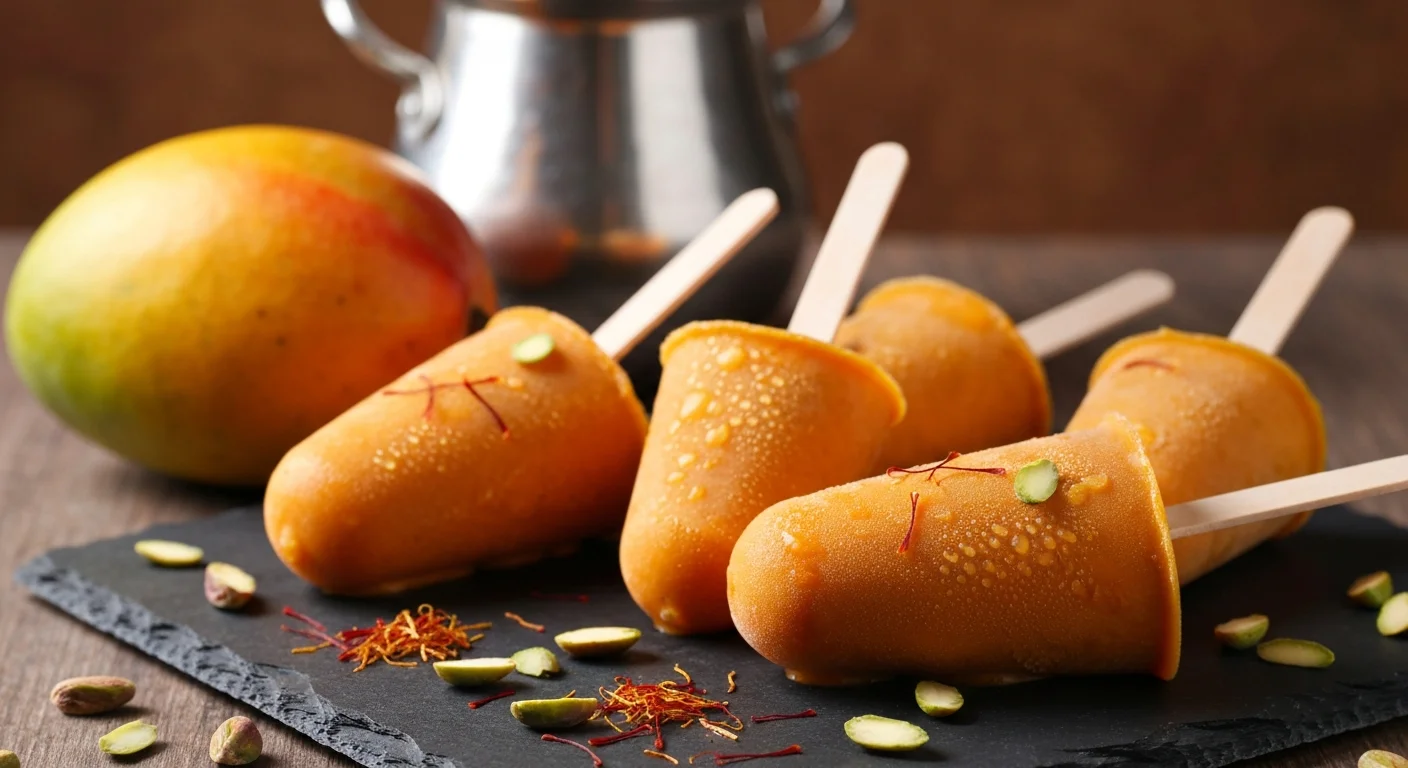
Quick answer: Mango kulfi is a dense, slow-frozen Indian dairy dessert made by reducing whole milk until it thickens into a caramel-scented base, then blending in ripe mango puree and freezing in molds without any churning. You make it because it delivers a chewy, creamy texture no ice cream machine can replicate, and because one batch feeds a dozen people on the hottest day of a Texas July.
History and Origin
Kulfi predates modern ice cream by several centuries. During the Mughal era in the 16th century, cooks in the royal kitchens of Delhi would freeze sweetened, thickened milk inside conical metal molds called kulfi sanchas, which they packed into earthen pots filled with salted ice. The slow freeze and the fat-heavy base gave kulfi its signature dense texture, closer to a frozen custard than a scoopable ice cream. My father grew up eating kulfi from a pushcart vendor in Mumbai who used nothing more than a hand crank, a clay pot, and a block of ice brought down from the Himalayas.
Mango kulfi became a defining summer flavor in the 20th century when Alphonso and Kesar orchards scaled commercially in Maharashtra and Gujarat. Before that, plain malai kulfi flavored with cardamom and saffron was the standard. The fruit version is now the most requested flavor at Indian weddings in Houston, Austin, and Dallas, and I have watched Texas kids who have never tasted mango ice cream become instant converts after a single kulfi stick. The no-machine method in this recipe is the one my father taught me, and it works perfectly in any home freezer in Texas.
Ingredients
- 6 cups (1.4 L) whole milk
- 1 cup (240 ml) heavy cream
- 1/2 cup (120 ml) sweetened condensed milk
- 1/3 cup (80 ml) evaporated milk
- 1/2 cup (100 g) sugar, adjusted to mango sweetness
- 2 cups (480 ml) thick Alphonso mango puree (about 4 medium mangoes)
- 1 teaspoon green cardamom powder
- 1 pinch saffron, soaked in 1 tablespoon warm milk
- 2 tablespoons finely chopped pistachios
- 2 tablespoons almond flour (acts as a thickener and adds body)
- Pinch of salt
Method
- Reduce the milk (45 to 60 minutes). In a heavy, wide pan, bring whole milk to a boil, then reduce to a steady low simmer. Stir every few minutes, scraping the pan sides with a flat spatula. You want the milk to reduce to roughly half its original volume, turning a pale ivory color.
- Add the dairy trio (5 minutes). Stir in heavy cream, condensed milk, and evaporated milk. Simmer five more minutes. This layered dairy approach is what gives hand-churned kulfi its signature chew without requiring a machine.
- Sweeten and thicken (3 minutes). Add sugar, cardamom, saffron milk, almond flour, and a pinch of salt. Stir until every grain of sugar dissolves.
- Cool completely (45 minutes). Pour the base into a wide bowl and let it cool to room temperature. Stir occasionally to prevent a skin from forming on top.
- Fold in the mango (3 minutes). Once cold to the touch, gently fold in mango puree with a silicone spatula. Do not whisk, because air bubbles ruin kulfi texture. Stir in pistachios last.
- Pour into molds (5 minutes). Divide the mixture into kulfi molds, popsicle molds, or small paper cups with wooden sticks. Small disposable cups work beautifully in Texas backyard parties.
- Freeze slow and long (8 hours minimum). Place the molds in the coldest part of your freezer, ideally the back shelf. Freeze at least eight hours, preferably overnight. The slow freeze is the secret to dense kulfi texture.
- Unmold and serve. Dip the molds in warm water for 10 seconds, then twist gently. Serve immediately with a sprinkle of crushed pistachios.
Variety Recommendations
The ideal kulfi mango is Alphonso because its deep orange color, low fiber, and concentrated sweetness translate perfectly into a frozen dessert. Kesar is my second pick because it has a thicker, less watery flesh that reduces ice crystal formation in the freezer. Himayath offers an aromatic, almost citrusy note that works beautifully if you like your kulfi a touch less sweet. Avoid juicy, fiber-heavy varieties like Suvarna Rekha and Totapuri because they introduce water that freezes into ice shards. If your mangoes arrived firm, our ripening guide will help you time this recipe.
Tips
Reduce the milk further than you think you should. A common mistake is stopping at a slight thickening, which gives you ice milk instead of kulfi. You want the milk to visibly coat the spoon and taste subtly caramelized.
Do not whip the cream. Kulfi is not ice cream, and air is your enemy. A dense, silky base is the goal.
Use small molds. Large kulfi molds take longer to freeze, giving ice crystals more time to form. Aim for 2 to 3 ounce servings.
Almond flour is not optional. It absorbs excess water from the mango and keeps the kulfi chewy rather than crunchy. In a pinch, cornstarch cooked into the milk base works too.
Texas summer kitchens get hot. If your countertop is above 80 degrees, cool the milk base in an ice bath before adding mango to prevent warm puree from releasing extra liquid.
Serving Suggestions
Classic street-style kulfi is served on a wooden stick with a drizzle of rose syrup and a sprinkle of crushed pistachios. For Texas summer parties I like to pour kulfi into short glasses and top with falooda noodles and basil seeds for a nostalgic Mumbai street-stall presentation. At Diwali dinners in Dallas, a kulfi flight featuring mango, pistachio, and saffron flavors makes a stunning dessert course. Kulfi also pairs surprisingly well with Texas peach slices or a chili-lime tajin rim on the glass for a South Asian-Mexican fusion plate that always gets conversation going.
Storage
Kulfi stores beautifully in the freezer for up to three weeks in airtight molds or wrapped tightly in plastic and then foil. After three weeks the flavor fades slightly and ice crystals begin to form. Unmolded kulfi sticks can be wrapped individually in parchment and stored in a freezer bag, which makes them grab-and-go friendly for Texas backyard pool days. If kulfi develops surface crystals, slice thinly and serve over warm rasmalai for a second-life dessert. For Texas summer road trips to Galveston or South Padre, pack wrapped kulfi sticks in a hard-sided cooler with dry ice; they will stay solid for up to six hours. Never leave kulfi on a counter to soften the way you would with Western ice cream; it becomes grainy when refrozen because ice crystals form irregularly.
Dietary Notes
This recipe is gluten-free as written. For a vegan version, replace whole milk with a mix of full-fat coconut milk and almond milk, substitute coconut cream for heavy cream, and use sweetened condensed coconut milk. The texture remains remarkably close to the original, and the coconut actually enhances the mango aroma. For a lower-sugar version, reduce sugar to two tablespoons and skip the condensed milk, replacing it with unsweetened evaporated milk plus an extra tablespoon of almond flour.
FAQ
Can I make mango kulfi without condensed milk?
Yes, but you will need to reduce the whole milk even further, until about one-third of its original volume, and increase the sugar slightly. Condensed milk shortcuts both steps and adds a caramel depth that is hard to replicate. For a purist, old-school version, reduce the milk for 90 minutes and add a tablespoon of mawa or khoya for authentic flavor.
Why is my kulfi icy instead of creamy?
Icy kulfi usually means three things: not enough fat, too much water from overripe mango, or a too-fast freeze. Fix it by using full-fat dairy only, choosing Alphonso or Kesar mangoes that are ripe but not mushy, and placing molds in the back of the freezer where temperature stays most stable.
How long does mango kulfi need to freeze?
A minimum of eight hours, but overnight is always better. In Texas summer freezers that open frequently, I recommend a full twelve hours. The long, slow freeze is what gives kulfi its signature dense bite, and rushing this step is the number one reason home kulfi disappoints.
Can I use frozen mango pulp for kulfi?
Fresh is always better, but good quality frozen Alphonso pulp works if you thaw it completely, drain excess liquid, and stir in a teaspoon of lemon juice to brighten the flavor. Our fresh Texas-delivered mangoes give noticeably better color and aroma, especially in a dessert where fruit is the star.
What is the difference between kulfi and ice cream?
Kulfi is denser because it is not churned, and its base is reduced milk rather than a custard. Ice cream incorporates air during churning, which makes it lighter and softer. Kulfi is chewier, richer, and melts more slowly, which is a real advantage on a 100-degree Austin afternoon.
Recipe Card
Mango Kulfi Without a Machine
Prep time: 20 minutes
Cook time: 60 minutes
Freeze time: 8 to 12 hours
Total time: about 10 hours
Servings: 12 kulfi sticks
Cuisine: Indian
Course: Frozen dessert
Diet: Vegetarian, gluten-free (vegan adaptable)
Calories per serving: approximately 215
Visit our recipe blog for more mango ideas, or order fresh mangoes delivered across Texas. For nutrition data on dairy and mango, see USDA FoodData Central.