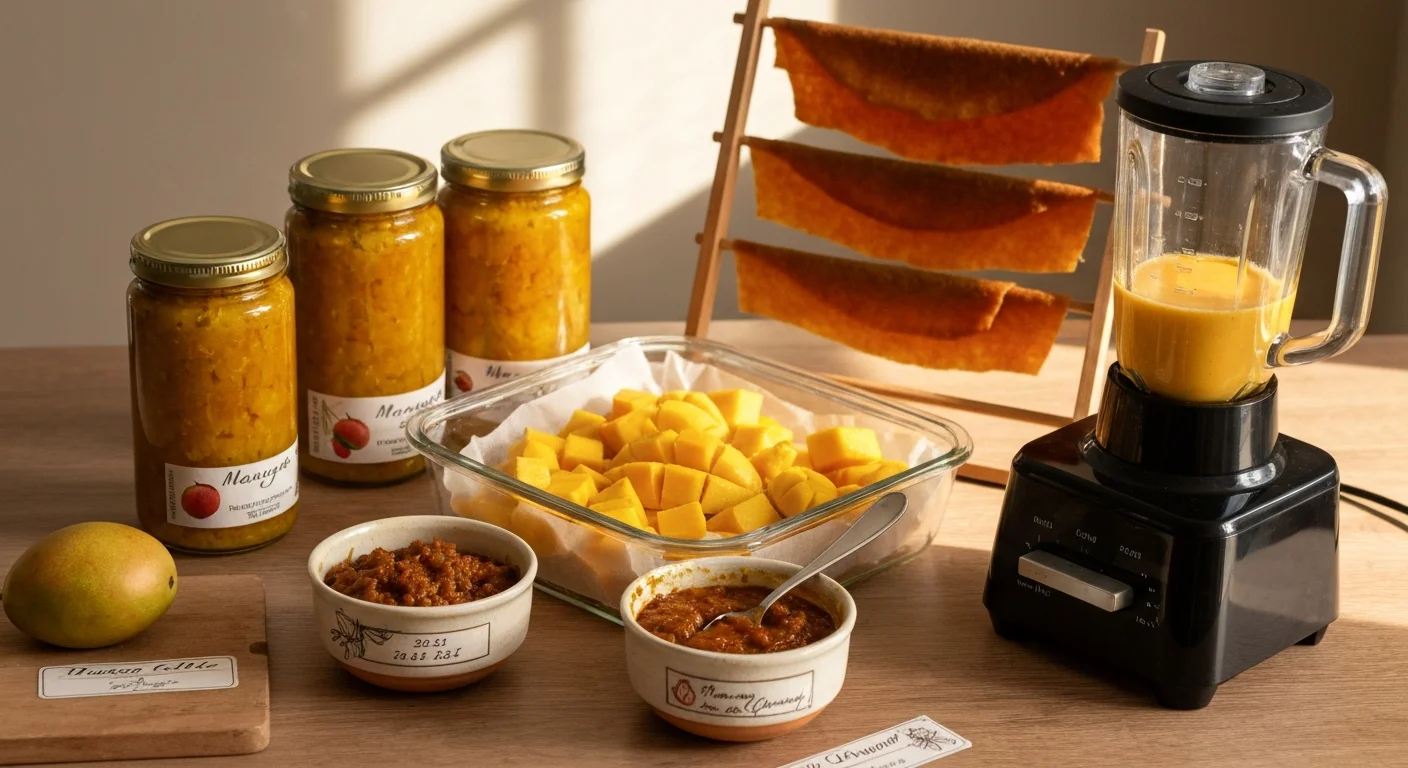
Direct answer: When Texas mango season delivers more fruit than you can eat, preserve the surplus using freezing (whole cubes, puree, or sliced), drying (mango leather, dehydrated slices), fermenting (pickle and chutney), cooking (jam, murabba, gojju), and blending (lassi and sorbet bases). Most Indian mango varieties freeze beautifully for 10-12 months, and properly jarred pickles keep for 12-18 months at Texas pantry temperature. Do not let a single mango go to waste. A ripe Alphonso that softens past peak today can become a jar of chutney that flavors rice dishes into next February.
Every Texas mango season we get the same panicked call. Customer picks up a 6kg box on Saturday, eats like royalty for four days, and wakes up Thursday to find eight mangoes all ripening at once. With temperatures pushing 90°F in Austin, Houston, and San Antonio, the window to act is short. This guide gives you 12 proven methods to capture that flavor before it is lost.
Method 1: Freeze Diced Cubes
Freezing is the simplest and most versatile preservation method.
- Peel ripe mangoes and dice the flesh into half-inch cubes.
- Spread the cubes in a single layer on a parchment-lined baking sheet.
- Freeze for 2 hours until the cubes are firm.
- Transfer to labeled freezer bags, press out air, and freeze flat.
- Use within 10-12 months for best flavor.
Method 2: Mango Puree for Smoothies and Lassi
Puree ripe mango flesh in a blender with a squeeze of lime to prevent browning. Pour into silicone ice cube trays or small freezer containers. Each cube pops into a morning smoothie or a lassi without thawing. Tip: label the date and variety, because Alphonso puree and Kesar puree make very different lassi.
Method 3: Mango Leather (Fruit Roll-Ups)
Mango leather is a Texas pantry favorite, especially for parents packing school lunches.
- Puree 4-6 ripe mangoes with 2 tablespoons of lime juice.
- Spread the puree 1/8 inch thick on a parchment-lined baking sheet.
- Dry in an oven at 170°F with the door cracked for 6-8 hours, or in a dehydrator at 135°F for 8-10 hours.
- Peel off, cut into strips, roll in parchment, and store in airtight jars.
- Keeps 2-3 months at Texas pantry temperature.
Method 4: Aam Ka Achaar (Mango Pickle)
Traditional Indian mango pickle uses unripe or barely ripe mangoes. If you have a mix of hard and soft fruit, use the hard ones here. Mustard oil, fenugreek, fennel, nigella, and chili combine into a pickle that ages beautifully for a year. Use clean glass jars and always use a dry spoon.
Method 5: Mango Chutney
Cook ripe mango flesh with jaggery or brown sugar, ginger, vinegar, chili, and a pinch of salt. Simmer until thickened. Texas home cooks love this as a condiment for samosas, cheese boards, and grilled chicken. Jarred chutney holds 6-8 months refrigerated.
Method 6: Mango Murabba
Murabba is a sweet preserve made by cooking mango chunks in sugar syrup with cardamom and saffron. It pairs with parathas or yogurt and keeps for 8-10 months in a clean jar at room temperature.
Method 7: Mango Jam
Cook 4 cups mango puree with 2 cups sugar and 2 tablespoons lemon juice over medium heat until it thickens to a slow drip from a spoon. Ladle into sterilized jars. Process in a boiling water bath for 10 minutes for shelf-stable jam, or refrigerate for up to 3 weeks.
Method 8: Dehydrated Mango Slices
Slice peeled ripe mangoes into quarter-inch slices. Dehydrate at 135°F for 10-14 hours until leathery but pliable. Store in airtight jars with an oxygen absorber for 6-8 months of shelf life.
Method 9: Mango Lassi Base Concentrate
Blend 4 cups ripe mango puree with 2 cups full-fat yogurt and 1/2 cup sugar. Freeze in pint containers. To serve, thaw overnight, stir in milk and a pinch of cardamom, and you have instant lassi. Great for Texas summer parties.
Method 10: Mango Sorbet Base
Mix 3 cups mango puree with 1 cup simple syrup and 2 tablespoons lime juice. Churn in an ice cream maker or freeze in a shallow pan, scraping with a fork every 30 minutes for a granita texture.
Method 11: Mango Gojju (South Indian Curry Base)
Cook ripe or barely ripe mango with tamarind, jaggery, sambar powder, and tempered mustard seeds. Freeze in meal-size portions. Reheat and serve over rice. This is a Vamsi family favorite that captures Andhra flavors year-round.
Method 12: Mango-Infused Vinegar or Syrup
Steep mango peels and trimmings in white vinegar for 2 weeks, then strain. Or simmer peels with sugar and water for a mango simple syrup that flavors cocktails, tea, and soda. Nothing goes to waste.
Quick-Reference Preservation Table
| Method | Prep time | Shelf life | Best Texas use |
|---|---|---|---|
| Frozen cubes | 15 min | 10-12 months | Smoothies, lassi |
| Puree cubes | 20 min | 12 months | Baking, sorbet |
| Mango leather | 8-10 hrs dry | 2-3 months | Lunchbox snacks |
| Pickle (achaar) | 30 min + cure | 12-18 months | Rice, paratha |
| Chutney | 45 min | 6-8 months fridge | Cheese, grilling |
| Murabba | 1 hr | 8-10 months | Breakfast paratha |
| Jam | 40 min | 12 months sealed | Toast, thumbprints |
| Dehydrated slices | 12 hrs | 6-8 months | Snacking, trail mix |
| Lassi base | 10 min | 6 months frozen | Parties |
| Sorbet base | 15 min | 4 months frozen | Summer desserts |
| Gojju | 45 min | 6 months frozen | Andhra rice meals |
| Mango vinegar | 2 weeks steep | 12 months | Salad dressings |
Food Safety Notes for Texas Kitchens
When canning or preserving, follow the FDA guidelines on produce safety. Always use sterilized jars, process high-acid foods like mango jam in a boiling water bath, and refrigerate anything that is not properly sealed. Texas heat accelerates spoilage, so do not leave preserved items on the counter overnight.
Common Mistake: Freezing Whole Mangoes
Do not freeze mangoes whole in the skin. The skin damages and the flesh separates from the seed, making thawing messy and texture poor. Always peel and dice or puree before freezing. The five extra minutes of prep saves hours of frustration later.
Labeling and Organization
Label every preserved batch with the variety, date, and method. A freezer full of unmarked containers turns into a mystery in October. We recommend masking tape and a Sharpie. Track your inventory so you rotate older batches first.
A Sample Preservation Weekend Plan
Here is how a typical Texas customer processes a 6kg surplus on a Saturday morning. Start with coffee and a cleared counter. Sort mangoes into three piles: rock hard for pickle, yielding-ripe for chutney and jam, and overripe-soft for puree and leather. Spend the first hour peeling and dicing the ripest fruit and starting a batch of puree cubes. In the second hour, start a pot of chutney simmering while you spread mango leather puree on parchment and slide it into a 170°F oven. In the third hour, assemble pickle masala and pack jars. By lunch, your freezer, pantry, and fridge all have neatly labeled batches and you have not wasted a single mango.
Equipment That Makes Preservation Easier in Texas
- Good peeler: A sharp Y-peeler halves the prep time for large volumes.
- Mango splitter: The three-blade tool that cuts around the seed saves flesh on every fruit.
- Silicone ice cube trays: Best for portioned puree.
- Vacuum sealer: Extends freezer life from 10 months to 18 months.
- Dehydrator: Worth the investment if you process more than one box per season.
- Canning starter kit: Boiling water bath canner, jar rack, and funnel for shelf-stable jams and chutneys.
Gift Jars for Texas Friends and Neighbors
Preserved mango also makes thoughtful gifts. A small jar of Devgad Alphonso chutney or a ribbon-wrapped roll of Kesar leather delights Texas neighbors who have never tasted Indian mango. Include a handwritten tag with the variety name and a serving suggestion. We have customers in Austin and Houston who run a small gift circle every August distributing preserved jars from the spring harvest. It is a beautiful way to share the abundance.
Frequently Asked Questions
How long do frozen mangoes actually last?
Properly frozen mango cubes or puree maintain peak quality for 10-12 months in a standard home freezer at 0°F. They remain safe to eat indefinitely if kept frozen, but flavor and texture decline after a year. Texas chest freezers with stable temperatures extend quality compared to refrigerator freezers that cycle warmer.
Can I preserve unripe mangoes?
Yes. Unripe mangoes are ideal for traditional Indian pickle (aam ka achaar), raw mango chutney (pachadi), and aamras-style green mango drink (aam panna). The tartness holds up better under acid and spice than fully ripe fruit. Use the hardest mangoes in your box for these recipes.
Do I need a pressure canner for mango jam?
No. Mango jam is a high-acid preserve, so a boiling water bath canner is sufficient. Process filled jars in boiling water for 10 minutes to create a shelf-stable seal. Pressure canning is only required for low-acid foods like meats and most vegetables.
Why did my mango pickle develop white film?
A white film is usually kahm yeast, which is harmless but indicates your pickle was exposed to air or moisture. Skim the film, add a fresh layer of oil on top, and keep the jar sealed. Always use a dry spoon and store pickle at consistent Texas room temperature below 80°F.
Can I preserve mangoes without sugar?
Yes. Freezing, dehydrating, and pickling (with salt and oil) require no added sugar. Mango leather can be made with just fruit puree and lime juice. Sugar-free preserves have shorter shelf lives, so freeze or refrigerate rather than shelf-storing.
Ready to stock up for preserving? Visit our order form to reserve a larger box, and see our care guide for ripening timing. For more recipe inspiration, browse our full blog and our Texas storage guide.