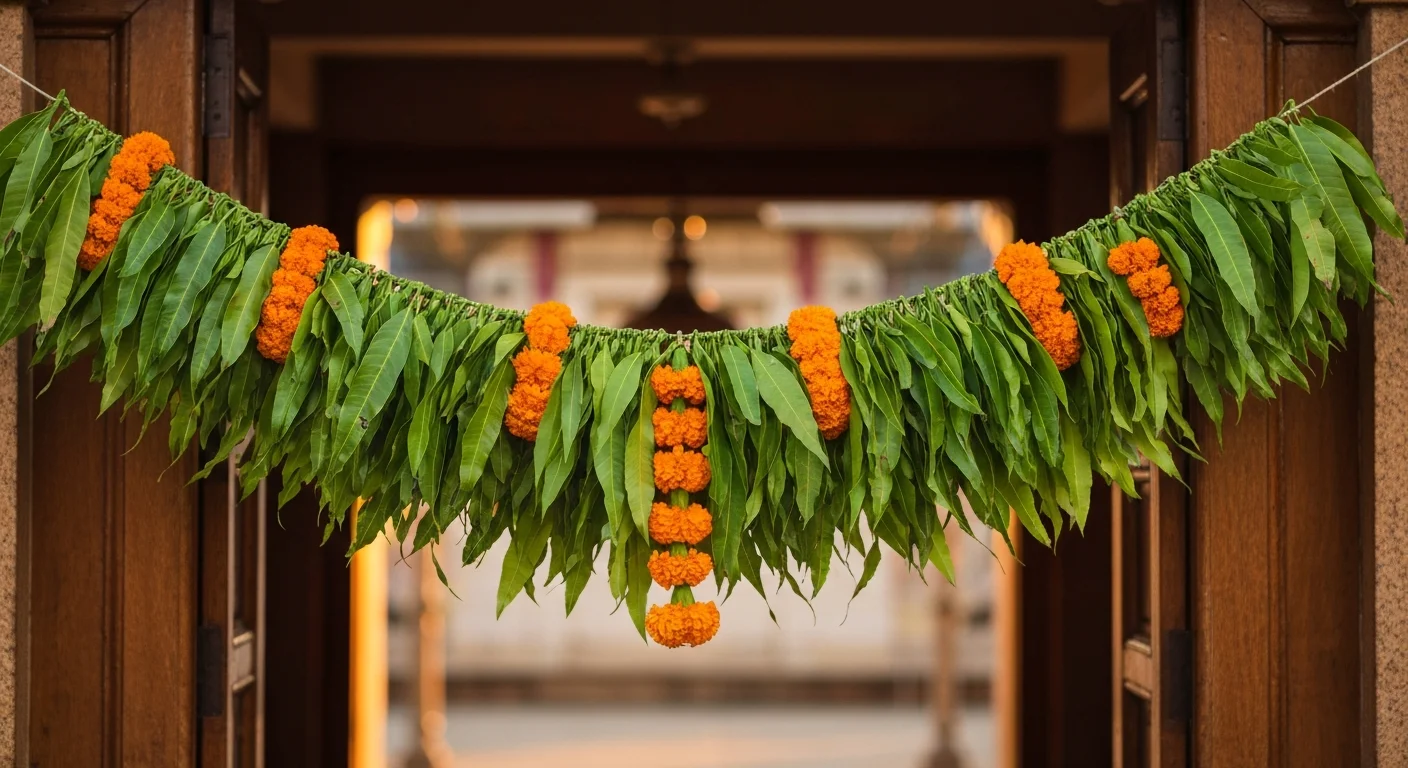
Mango leaves appear in nearly every Hindu ceremony because they are considered living symbols of prosperity, fertility, and auspiciousness rooted in the Vedas and the Ramayana. From the torana strung above a doorway to the five leaves placed on a kalash during puja, the mango tree is regarded as sacred across every major Hindu tradition, and Texas temples from Pearland to Austin continue this practice exactly as it has been done for thousands of years.
The Scriptural Origin of the Sacred Mango Leaf
Long before I started Swadeshi Mangoes from my home in Round Rock, Texas, my grandmother taught me a quiet rule in our village home outside Vijayawada. No puja begins until the mango leaves are fresh. She would send me up the tree at dawn, and I would bring down a bundle of leaves so green they looked wet. I did not know then that what we were doing had been written about for three thousand years.
The Vedas reference the mango tree (amra) as one of the five sacred trees, the Panchavati. The Ramayana describes the forest of Panchavati where Lord Rama, Sita, and Lakshmana stayed during exile as abundant with mango groves. In the Puranas, the mango tree is associated with Prajapati, the creator, and with Kamadeva, the god of love, whose arrows are sometimes described as tipped with mango blossoms.
Why the Leaf Itself Is Considered Pure
Unlike many leaves that wilt within hours, a mango leaf holds its shape, color, and fragrance for days. Traditional Ayurvedic texts describe the leaf as sattvic, meaning pure, clarifying, and fit for offering to the divine. The leaf also releases a subtle vapor that was believed to purify the air in the home, something modern studies on plant volatiles have partially confirmed.
The Torana: A Leaf Garland as Spiritual Boundary
Walk into any Hindu home in Frisco or Sugar Land during Ugadi, Diwali, Pongal, or a wedding, and you will see a torana hanging over the main doorway. This is a string of mango leaves, often alternated with marigolds, bound with cotton thread.
The torana is not decoration. It is a threshold marker. In traditional belief, the leaves invite Lakshmi (the goddess of prosperity) into the home while repelling negative energies. The leaf’s pointed shape is said to deflect the drishti, or evil eye. My neighbor Priya, who moved to Cedar Park from Chennai four years ago, told me she still will not enter a new home without tying a torana first. “My mother would disown me,” she laughed.
How to Tie a Proper Torana
The traditional torana uses an odd number of leaves, usually 11, 21, or 51, strung tip-to-tip. The leaves must be fresh, not brittle, and ideally plucked the morning of the ceremony. The thread is cotton, never synthetic. At Swadeshi, when customers in Plano ask if we supply mango leaves, we point them toward our partner farms and toward the trees at the Hindu Temple of Greater Austin, which generously allows devotees to take leaves for ceremonies.
The Kalash: Five Leaves, One Coconut, Infinite Meaning
Every puja you will witness in a Texas temple, from the BAPS Swaminarayan Mandir in Stafford to the Sri Meenakshi Temple in Pearland, begins with the same setup. A brass or copper pot is filled with water, sometimes with rice, coins, and turmeric. Five mango leaves are arranged around the rim, and a coconut is placed on top. This is the kalash or purna kumbha.
The five leaves represent the Pancha Mahabhutas, the five great elements of creation: earth, water, fire, air, and ether. The pot is the womb of the universe. The coconut is the seed of consciousness. When the priest chants the invocation, he is not performing a symbolic gesture. He is, in the theology of the ritual, literally calling the divine to inhabit that arrangement. Without the mango leaves, the geometry is incomplete.
Why Mango and Not Another Tree
I once asked Venkatesh-ji, a priest at a temple in Houston, why the banyan or peepul leaf was not used for the kalash, since both are also sacred. He smiled and said, “The mango tree gives fruit. The others give shade. The kalash asks for abundance, so we use the tree that understands abundance.” That answer has stayed with me for years.
Ganesh Chaturthi and the Mango Leaf
When Ganesh Chaturthi arrives each August or September, the mango leaf takes center stage in another way. Lord Ganesh, the remover of obstacles, is traditionally offered 21 items, known as patra puja. Mango leaves are among them. In our family home growing up, I remember my father placing a fresh mango leaf at Ganesh’s feet before we lit the first lamp.
Here in Texas, Ganesh Chaturthi has grown into a massive community celebration. The Telugu Cultural Association of Austin hosts one of the largest public Ganesh pujas in Central Texas, and the BAPS Mandir in Stafford draws thousands for its festivities. At both, mango leaves line the murti, adorn the doorway, and are distributed as prasad.
The Leaf as a Symbol of Victory
There is a famous story in the Shiva Purana involving Ganesh and a mango. Parvati placed a celestial mango before her two sons, Ganesh and Kartikeya, and said it would go to whoever circled the world first. Kartikeya flew off on his peacock. Ganesh simply walked around his parents, saying, “You are my world.” He won the mango. This story is retold in homes from Katy to Cedar Park every year during the festival.
Mango Leaves at Texas Hindu Weddings
At every traditional Hindu wedding in Texas I have attended, the mango leaf is woven into the ceremony in at least three places. The wedding mandap itself is often decorated with torana strings. The sacred fire (agni) is surrounded by kalash pots topped with mango leaves. And the bride’s seemantham or baby-shower ritual (if conducted earlier) features a leaf arrangement.
Last summer, a customer named Meera, whose family lives in Round Rock, ordered a case of our Kesar mangoes for her daughter’s wedding reception. She also asked where she could source fresh mango leaves. We connected her with a local Indian grocery in Pflugerville that stocks them seasonally, imported from Mexico or California groves. The leaves traveled less than 30 miles to reach her wedding mandap. That, to me, is the beauty of the Indian diaspora in Texas. We have rebuilt the infrastructure of our ceremonies, leaf by leaf.
Texas Temples That Keep the Tradition Alive
Here is a short list of Texas temples where you will see mango leaves used in daily or festival rituals:
- Sri Meenakshi Devasthanam, Pearland: One of the oldest traditional South Indian temples in the United States, using mango leaves in daily abhishekam.
- BAPS Shri Swaminarayan Mandir, Stafford: Features elaborate torana during Diwali, Janmashtami, and annual festivals.
- Hindu Temple of Greater Austin, Pflugerville: Maintains a small mango grove on temple grounds, used for leaves during major pujas.
- DFW Hindu Temple, Irving: Regular use of mango leaves in weekly Satsang and major festivals.
- Karya Siddhi Hanuman Temple, Frisco: Known for Hanuman Jayanti celebrations featuring torana and kalash.
Table: Mango Leaves Across Major Hindu Ceremonies
| Ceremony | Role of Mango Leaf | Number Used |
|---|---|---|
| Griha Pravesh (Housewarming) | Torana at main door | 11 or 21 |
| Ganesh Chaturthi | Patra puja, decor, prasad | 21+ |
| Wedding Mandap | Kalash, torana, agni perimeter | 50 to 100 |
| Satyanarayan Puja | Kalash placement | 5 |
| Diwali | Home doorway torana | 11 or 21 |
| Daily Abhishekam | Kalash | 5 |
What This Means for Our Community in Texas
When I started Swadeshi Mangoes, my focus was on the fruit. But every mango season, I am reminded that the tree gives us more than fruit. It gives us leaves for our temples, bark for Ayurvedic remedies, flowers for Saraswati puja, and wood for the sacred fire. When we deliver a case of Kesar or Alphonso to a family in San Antonio, we are delivering more than a seasonal treat. We are delivering a piece of cultural continuity that goes back to the Vedas.
If you want to explore the mango varieties we source, visit our varieties page. To place your seasonal order, head to the order form. And if you want to read more stories about the cultural life of mangoes, visit our blog.
FAQ
Why are mango leaves specifically used in Hindu ceremonies instead of other leaves?
Mango leaves are considered sattvic and auspicious in Vedic texts, associated with prosperity and fertility. Their durability, fragrance, and cultural link to Lakshmi and Kamadeva make them the preferred ceremonial leaf. The mango tree’s ability to bear fruit also symbolizes abundance, fitting the invocations of most pujas where the divine is asked to bless the household with plenty.
Can I use dried mango leaves if fresh ones are not available in Texas?
Traditionally, fresh leaves are preferred because they represent life and purity. However, in practical terms, many Texas families keep a small supply of preserved or even plastic leaves as a backup. Most priests will accept this with the understanding that the ceremony’s intent matters most. Indian grocery stores in Plano, Irving, and Sugar Land often stock fresh bundles seasonally.
Where can I source fresh mango leaves in Austin or Dallas?
Several Indian groceries in Austin, Round Rock, Frisco, and Irving stock fresh mango leaves during festival seasons, particularly around Diwali and Ganesh Chaturthi. Some Texas temples, including the Hindu Temple of Greater Austin, maintain small mango trees and allow devotees to collect a modest amount for personal pujas. Always ask temple staff before harvesting.
How many mango leaves do I need for a standard home puja?
For a simple home puja with a kalash, you need exactly five fresh mango leaves arranged around the pot’s rim. For a doorway torana, use 11 or 21 leaves strung with cotton thread. Weddings and larger ceremonies can require 50 or more leaves, often combined with marigolds, neem, or banana leaves depending on regional tradition.
Do Swadeshi Mangoes sell mango leaves with the fruit?
We do not currently ship mango leaves with our fruit orders, since our focus is delivering premium Indian mangoes to pickup agents across Austin, Dallas, Houston, and San Antonio. However, we are happy to recommend Texas Indian grocers and temple networks that supply fresh leaves. Visit our order form to place a seasonal fruit order and message us with sourcing questions.