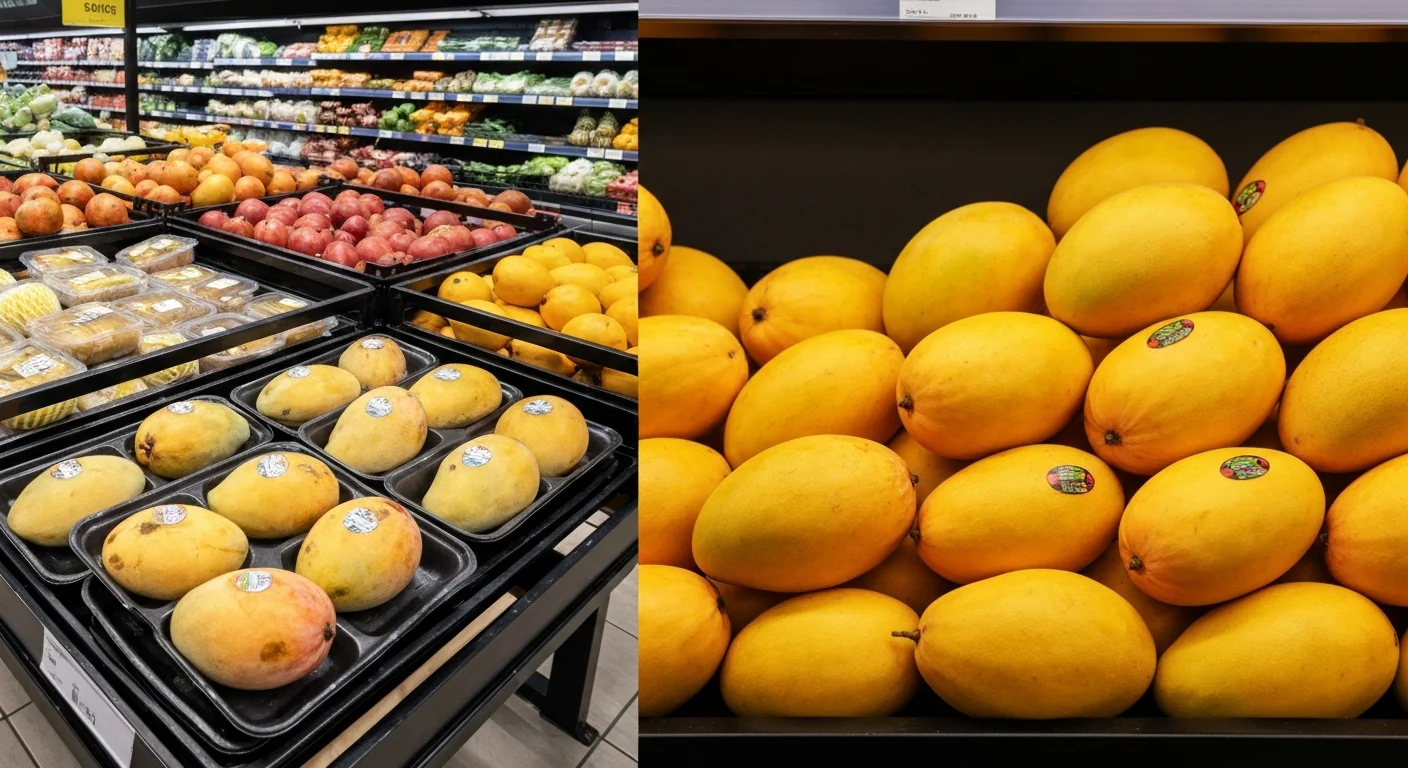
Indian grocery store mangoes in Texas often taste different from Swadeshi Mangoes because of four key factors: cold chain temperature control, transit time from farm to customer, variety selection (often limited to what is shelf-stable), and sourcing philosophy. Swadeshi ships directly from certified farms in India through a controlled cold chain to Texas pickup agents, while most grocery store mangoes pass through multiple warehouses at inconsistent temperatures.
Why I Started Asking This Question
For my first two years in Austin, I bought my mangoes from the Indian grocery stores in Round Rock and Cedar Park. Every summer I came home disappointed. The mangoes looked right. They smelled mostly right. But when I cut one open, the flesh was often pale, stringy, slightly fermented, or oddly firm even after days of waiting. My kids, who were born in Texas, did not understand why I kept complaining. They had never tasted a mango the way I remembered.
That disappointment is why Swadeshi Mangoes exists. I started researching why grocery store mangoes in Texas taste different, and the answers surprised me. This post walks through what I learned.
The Cold Chain Problem
The single biggest factor in mango quality is temperature management from harvest to consumption. Mangoes are fragile tropical fruits. They should be cooled to roughly 54 to 57 degrees F within hours of harvest, kept at that temperature during transit, and only warmed to room temperature during the final ripening phase at the consumer’s home.
This is called the cold chain, and maintaining it is expensive and difficult. APEDA, the Indian agricultural export authority, has strict protocols for mango exports to the United States, including mandatory hot water treatment, irradiation for certain destinations, and refrigerated air or sea transport. When these protocols are followed perfectly, a Ratnagiri Alphonso harvested on Monday can arrive in a Texas cold room by Friday with its flavor almost fully intact.
Where the Chain Breaks
The cold chain breaks at predictable points. Fruit sits on an airport tarmac for too long. A warehouse loses power. A distributor stores fruit at 70 degrees F to save on refrigeration costs. A grocery store displays fruit at room temperature for aesthetic reasons. Each of these breaks degrades flavor. By the time a mango sits in a Texas grocery store bin at 75 degrees F under fluorescent light for three days, much of the aromatic complexity is gone.
Transit Time: Why Days Matter
A mango continues to change after harvest. Enzymes in the flesh break down starches into sugars. Volatile aromatic compounds develop and then decline. The ideal window from tree to table is roughly 7 to 14 days for most premium varieties. Beyond that, flavor starts to flatten.
Most Texas Indian grocery stores buy through distributors who, in turn, buy from importers who, in turn, buy from Indian exporters. Each layer adds days. By the time a box of Alphonso reaches a grocery store in Houston, it may be 18 to 25 days from harvest. The fruit can still look fine, but the peak flavor window has often passed.
How Swadeshi Shortens the Chain
Our model is built to compress transit time. We work directly with partner farms in Maharashtra, Gujarat, Andhra Pradesh, and other regions. Fruit is harvested on a Monday, cleared through quality control within 24 hours, airfreighted to the United States within 48 to 72 hours, and delivered to our pickup agents in Texas within another 2 to 4 days. That means our customers in Austin, Dallas, Houston, or San Antonio are typically receiving mangoes 7 to 10 days from harvest. The difference is dramatic.
Variety Selection: Why Grocery Stores Stock Fewer Options
Walk into an Indian grocery store in Plano or Katy during peak season, and you will usually see two or three varieties: Alphonso, Kesar, and sometimes Banganapalli. That is it. The reason is simple. Grocery stores prioritize shelf stability, which means they stock varieties that hold their shape and color during long transit and display periods.
But the Indian mango repertoire is vast. Dasheri from Uttar Pradesh, Langra from Bihar, Himsagar from Bengal, Chausa from Punjab, Mallika (a Neelum-Dasheri hybrid), Totapuri for chutneys, and regional oddities like Safeda, Imam Pasand, and Raspuri. Each has its own flavor profile, texture, and cultural context. Most grocery stores cannot justify the logistics of stocking these varieties because they do not have enough volume turnover.
Why Variety Matters for Memory
As I wrote in an earlier post, the mango a Telugu family grew up with is not the same mango a Gujarati family grew up with. For a customer from Lucknow, the flavor of childhood is Dasheri. For a Bengali family, it is Himsagar. If the grocery store only carries Alphonso and Kesar, those families are eating fruit that is geographically, and emotionally, wrong. At Swadeshi, we prioritize stocking nine varieties specifically because our customer base is regionally diverse. Visit our varieties page to see what is available.
Sourcing Philosophy: Who You Know Matters
Grocery stores, by the nature of their business, buy from whoever can fulfill a large standing order at a competitive price. This often means buying from aggregators who blend fruit from many farms. The Alphonso in your grocery bag might be a mix of fruit from ten different growers of varying quality.
Our approach is different. We work with a small, repeat network of farms we have visited personally. When I say our Kesar comes from a specific grower in Junagadh district, Gujarat, I have shaken that grower’s hand. I have walked his orchard. I know the year his trees were planted. This relationship-based sourcing is slower and more expensive, but it gives us control over quality in a way a large aggregator cannot match.
The APEDA Certification Layer
All our imports pass through APEDA-certified pack houses and follow the full phytosanitary protocol required for US imports. This includes hot water treatment, irradiation where applicable, and documented cold chain from farm to airport. APEDA publishes its standards publicly, and serious exporters follow them. The problem is that compliance alone does not guarantee flavor. Compliance gets the fruit through customs. Freshness and variety selection get it to taste like your grandmother’s mango.
Table: Grocery Store vs Swadeshi, Key Differences
| Factor | Indian Grocery Store | Swadeshi Mangoes |
|---|---|---|
| Typical transit time | 18 to 25 days from harvest | 7 to 10 days from harvest |
| Cold chain continuity | Variable, often broken at retail display | Continuous until pickup |
| Varieties available | 2 to 3 varieties | 9 regional varieties |
| Farm-to-customer traceability | Usually aggregated, limited traceability | Direct farm sourcing with records |
| Price per box | Often lower | Moderately higher, reflects logistics cost |
| Ripening guidance | Rarely provided | Included with every box |
| Replacement policy | Rare, often final sale | Damaged-fruit replacement standard |
What You Can Expect From a Swadeshi Box
When a customer in Cedar Park, Sugar Land, or Plano opens a Swadeshi box, here is what we build into the experience:
- Fruit arrives firm but fragrant, ready to ripen at room temperature over 2 to 5 days.
- Boxes are opened and ripened carefully using the guide we include (available also on our mango care page).
- Any damaged fruit found at pickup is reported to the agent and replaced on the next cycle.
- The variety ordered is exactly the variety delivered. No substitutions without explicit customer approval.
Why Grocery Stores Still Have a Role
I want to be clear. Indian grocery stores are essential to the Texas Indian community. They stock thousands of ingredients, spices, frozen foods, lentils, and daily staples that simply cannot be replaced. They are also often gathering places, especially in suburbs with few dedicated community spaces. Nothing in this post should be read as a dismissal of grocery stores.
But for premium seasonal fruit, the economics of a grocery store simply do not align with peak-flavor freshness. A grocery store needs to turn inventory quickly across thousands of SKUs. It cannot dedicate cold-chain infrastructure to a three-month seasonal fruit. That is the gap we fill, not a replacement for the grocery store but a specialized complement to it.
The Customer Who Proved This to Me
A customer named Anand in Houston once told me he did a blind taste test with his family. He bought two Alphonsos from a local Indian grocery and ordered one box of Alphonso from Swadeshi. He labeled them A and B, cut them up, and asked his family to vote.
Every single family member, including his eight-year-old son who had no emotional attachment to either source, chose the Swadeshi fruit. The difference was not subtle. The Swadeshi Alphonso had a richer aroma, smoother flesh, and the specific honey-floral note that Ratnagiri fruit is known for. The grocery store fruit was fine. It was just not the same fruit. That is the difference cold chain, sourcing, and freshness make.
Explore our varieties, place your seasonal order through the order form, read ripening tips, or see more customer stories on our blog.
FAQ
Why are Swadeshi Mangoes more expensive than grocery store mangoes?
The price difference reflects the cost of direct farm sourcing, faster airfreight, continuous cold chain, and individual pickup logistics across Austin, Dallas, Houston, and San Antonio. Grocery stores achieve lower prices through aggregated sourcing and slower sea-freight in some cases. The tradeoff is peak-season flavor, variety selection, and traceability.
Do Indian grocery stores in Texas follow APEDA standards?
Yes, any mango imported from India to the United States must comply with APEDA and USDA protocols, including hot water treatment and phytosanitary documentation. Compliance is a baseline legal requirement for import. However, compliance does not guarantee peak flavor. What happens to the fruit after it clears customs, in terms of transit time and cold chain, varies substantially between suppliers.
Can I get Banganapalli or Dasheri at a Texas Indian grocery store?
Occasionally, but rarely consistently. Most Texas grocery stores prioritize Alphonso and Kesar because these varieties have the most reliable demand and shelf stability. Regional varieties like Dasheri, Langra, Himsagar, and Chausa are typically only available through specialty importers like Swadeshi Mangoes or during brief windows at larger ethnic grocery chains.
How should I ripen a mango at home after pickup?
Place firm mangoes at room temperature, ideally in a paper bag or wrapped in newspaper, for 2 to 5 days. They are ready when they yield slightly to gentle pressure and smell sweet at the stem end. Do not refrigerate until fully ripe. See our detailed mango care page for variety-specific ripening guidance.
Is Swadeshi the only cold-chain mango service in Texas?
No. A handful of other specialty importers operate in various Texas cities with varying models. What we believe sets Swadeshi apart is our local pickup agent network across Austin, Round Rock, Cedar Park, Pflugerville, Georgetown, Dallas, Frisco, Plano, Houston, Sugar Land, Katy, Pearland, and San Antonio, which keeps the final-mile logistics community-based rather than commercial.