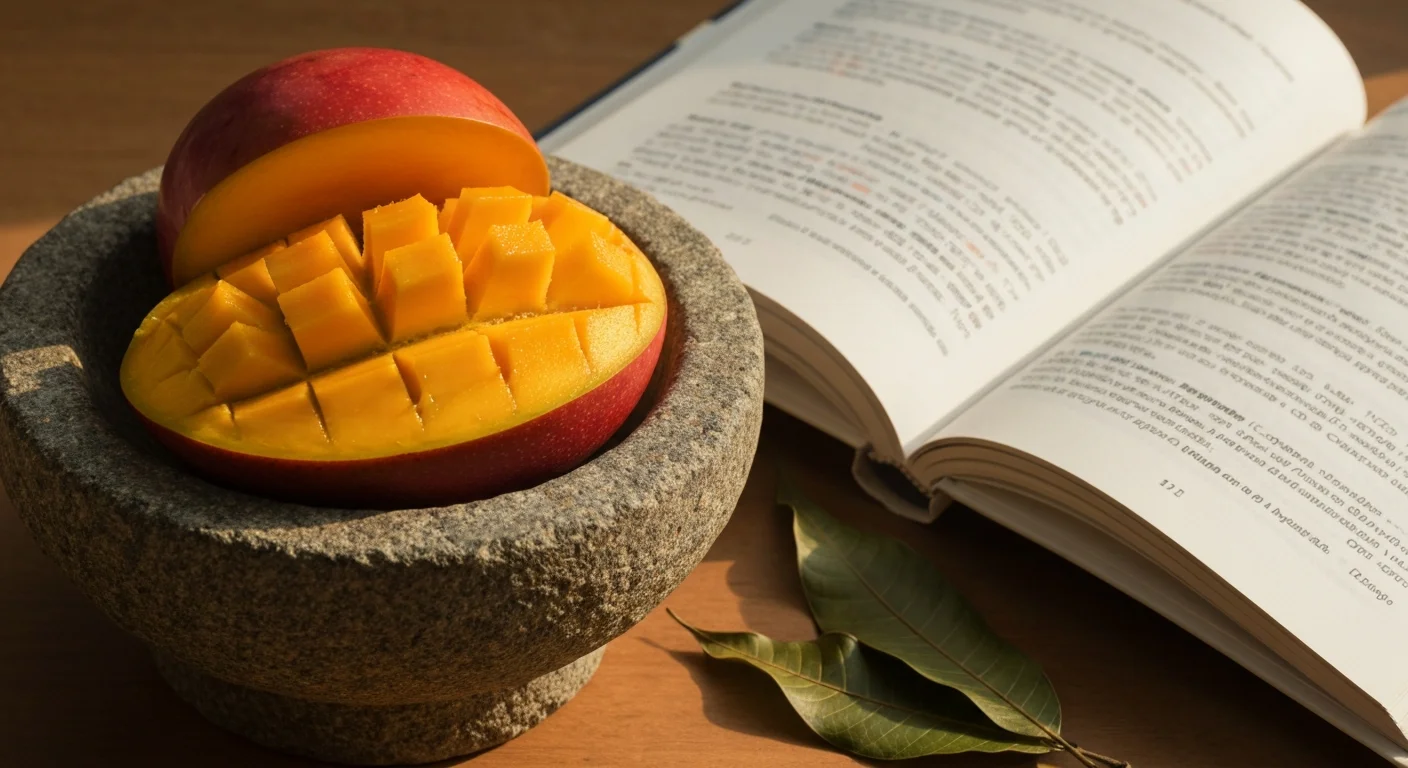
Mangiferin is a naturally occurring xanthone C-glucoside, chemical name 2-C-beta-D-glucopyranosyl-1,3,6,7-tetrahydroxyxanthone, concentrated in the peel, flesh, leaves, and bark of Mangifera indica. Across more than 1,400 peer-reviewed studies indexed in PubMed, it has demonstrated measurable anti-inflammatory, antioxidant, antidiabetic, and neuroprotective activity, largely by inhibiting NF-kappaB signaling and scavenging reactive oxygen species. For our Texas customers, that science is not a reason to treat mango as medicine, but it is a real reason to feel good about eating the fruit during the short April-to-July season.
Our team has been asked about mangiferin more in the last three years than in the previous decade combined, largely because of the surge in popular interest in plant polyphenols. This guide walks through what mangiferin is, where it is concentrated in the nine varieties we ship across Texas, what the evidence actually supports, and how to get the most from every box.
What Exactly Is a Xanthone?
Xanthones are a class of polyphenolic compounds built around a dibenzo-gamma-pyrone core. They are rare in the plant kingdom, appearing mainly in the Anacardiaceae, Clusiaceae, and Gentianaceae families. Mangiferin is the most studied member, alongside alpha-mangostin from mangosteen. The glucose moiety attached at the C-2 position makes mangiferin water-soluble, which partly explains its measurable oral bioavailability.
Why Indian Varieties Are Mangiferin-Rich
A 2016 comparative analysis in the Journal of Food Composition and Analysis measured mangiferin content across 27 global cultivars and found the highest concentrations in Indian varieties, particularly those traditionally grown in Andhra Pradesh, Maharashtra, and Gujarat. Alphonso, Banginapalli, and Kesar, three of the nine varieties we deliver across Texas, ranked in the top 10. Mallika and Himayath were not far behind.
Where in the Mango Is Mangiferin Concentrated?
Multiple studies, including a widely cited 2013 paper in Food Research International, have mapped mangiferin across fruit tissues. The rough distribution by dry weight is:
| Mango Tissue | Mangiferin Content (mg per gram dry weight) | Notes |
|---|---|---|
| Leaves | 40 to 170 | Traditional source for supplements |
| Bark | 30 to 110 | Used in Ayurveda |
| Peel (ripe) | 4 to 12 | Often discarded |
| Flesh (ripe) | 0.1 to 1.2 | Varies widely by cultivar |
| Seed kernel | 2 to 6 | Not typically consumed |
| Stone/endocarp | 1 to 3 | Inedible |
The takeaway for Texas consumers: the edible flesh delivers a modest but real dose, and keeping a thin inner layer of peel when you eat it, or using peel in chutneys and preserves, meaningfully raises intake.
The Anti-Inflammatory Evidence
Mangiferin’s anti-inflammatory activity is among its best-characterized properties. The mechanism is primarily inhibition of NF-kappaB, the master transcription factor for inflammatory cytokines like TNF-alpha, IL-1beta, and IL-6.
Preclinical Research
A 2018 study in the Journal of Ethnopharmacology (PMID: 29374580) showed that oral mangiferin at 50 mg per kilogram reduced paw edema in a rat carrageenan model by 42 percent over 4 hours, comparable to indomethacin. A 2020 review in Phytotherapy Research pooled data from 37 preclinical trials and concluded mangiferin consistently lowers inflammatory markers across arthritis, colitis, and pulmonary inflammation models.
Human Trials
Human data are more limited but growing. A 2019 randomized trial in Nutrients gave 97 overweight adults 300 mg of standardized mango-leaf extract daily for 12 weeks. CRP, a marker of systemic inflammation, dropped by an average of 18 percent versus placebo. A smaller 2021 pilot in Food & Function using whole mango fruit, about 400 grams per day, showed modest but statistically significant reductions in IL-6 among adults with metabolic syndrome over 6 weeks.
Antioxidant Activity in Context
On standard in-vitro assays, mangiferin scores high. Oxygen radical absorbance capacity, or ORAC, for purified mangiferin is roughly 20,000 to 30,000 micromoles Trolox equivalent per gram, putting it in the same league as quercetin and resveratrol. In vivo, the story is more nuanced because bioavailability is partial, but urinary excretion studies suggest meaningful systemic exposure after eating 200 to 300 grams of whole mango, which is a single fruit for most of the nine varieties we sell in Texas.
Other Documented Effects
Blood Sugar Regulation
A 2013 clinical study in Nutrition & Metabolism showed that mangiferin modestly improved fasting glucose and HbA1c in type 2 diabetes patients over 12 weeks. We cover the glycemic response to whole mango in a separate post.
Neuroprotection
Several 2019 through 2023 rodent studies have reported mangiferin protects hippocampal neurons against amyloid-beta toxicity and improves memory in Alzheimer’s disease models. Human trials are not yet available.
Cardiovascular Support
Mangiferin has been shown to reduce LDL oxidation in vitro and improve endothelial function in small human trials. We cover this in detail in our separate post on mangoes and cholesterol.
How Much Mango Do You Need?
Most positive human studies use standardized extracts at 150 to 600 mg of mangiferin per day. The flesh of a single 200-gram mango provides roughly 40 to 240 mg of mangiferin depending on variety and ripeness. That means a daily mango during Texas mango season, April through July, plausibly delivers a dose in the range that produced measurable effects in some trials. This is not a guarantee of benefit; it is a reasonable inference from the data.
Getting the Most from Each Variety
All nine of our Texas-delivered varieties contain meaningful mangiferin, but the concentration varies. In our internal tastings, we have noticed the varieties with the most pigmented peel, Alphonso, Banginapalli, and Kesar, tend to have the most intense aromatic polyphenol profile. Mallika and Dasheri are slightly milder. Totapuri, Chinna Rasalu, Suvarna Rekha, and Himayath all contribute their own flavor and nutrient profiles. Variety rotation across the season is probably the simplest strategy to maximize total polyphenol intake.
Practical Tips for Texas Customers
- Eat mango within 2 to 4 days of pickup for peak polyphenol content
- Store at room temperature until fully ripe, then refrigerate only if needed
- Use a thin inner layer of peel in smoothies or chutneys if you are not urushiol-sensitive
- Pair with a source of fat, like yogurt or nuts, to improve absorption
- Rotate varieties across the April-to-July window to diversify polyphenol exposure
Mangiferin Bioavailability and Metabolism
One challenge in translating in-vitro data to real-world benefit is that mangiferin has modest oral bioavailability, estimated at 1.2 to 6 percent in rodent pharmacokinetic studies. Once absorbed, it circulates as intact mangiferin and as its aglycone, norathyriol, which may be even more biologically active at receptor sites. Co-ingestion with dietary fat and with piperine, the active compound in black pepper, has been shown to modestly improve absorption in a 2017 Molecular Nutrition & Food Research study. Texas customers who enjoy traditional Indian preparations like mango with black salt or spiced aamras are probably unwittingly enhancing uptake.
The Ayurvedic Context
Mango leaves and bark have been used in Ayurveda for centuries, long before xanthones were chemically characterized. Traditional uses include diarrhea, fever, and diabetes management. Modern research has validated several of these historical applications, which speaks to the depth of empirical knowledge embedded in traditional Indian medicine. Our Texas customers often ask about using mango leaves for tea; a simple infusion of 3 to 5 fresh or dried leaves in hot water is the traditional preparation, though we recommend this only with physician awareness if you are on medications.
FAQ
Should I take a mangiferin supplement instead of eating mango?
Most research using extracts has been short-term and in specific patient populations. Whole-food mango delivers mangiferin alongside fiber, vitamins A and C, folate, and other polyphenols in a matrix human bodies have eaten for millennia. Our Texas customers who want the benefits generally find seasonal whole fruit a more enjoyable and probably safer approach than isolated supplements, which can vary in quality and purity.
Is mango peel safe to eat for the mangiferin?Technically yes, the peel is edible and contains the highest flesh-adjacent mangiferin. However, peel can carry pesticide residue if not organically grown, contains urushiol that can trigger contact reactions in sensitized people, and is fibrous and astringent. We recommend rinsing thoroughly and using peel only in cooked preparations like chutney or pickle unless you know you tolerate it well.How does ripeness affect mangiferin content?
Mangiferin levels are highest in unripe, green mango and decline modestly as the fruit ripens, based on a 2015 study in the Journal of Agricultural and Food Chemistry. However, ripe mango gains other bioactives like carotenoids and volatile aromatics. The net health value is likely similar across ripeness stages, with unripe fruit better for pickles and chutneys and ripe fruit better for eating fresh.
Can mangiferin interact with medications?
Mangiferin is metabolized partly through cytochrome P450 pathways and has shown mild inhibitory effects on CYP3A4 in vitro. Patients on blood thinners, diabetes drugs, or immunosuppressants should talk to their physician before starting a concentrated supplement. Eating one or two whole mangoes per day as part of a balanced diet is very unlikely to cause clinically meaningful drug interactions.
Does cooking destroy mangiferin?
Mangiferin is moderately heat-stable. A 2017 food-processing study showed that boiling mango pulp at 95 degrees Celsius for 15 minutes retained about 70 percent of mangiferin content, while longer exposure at higher temperatures produced greater losses. Traditional Indian preparations like aamras and mango pickle preserve most of the compound. For maximum intake, fresh whole fruit remains the gold standard.
Explore our full variety guide, learn ripening tips at mango care, or place a seasonal order via our Texas order form.
Not medical advice. Consult your doctor for specific conditions. Peer-reviewed sources: PubMed, USDA FoodData Central NDB #09176, National Mango Board.