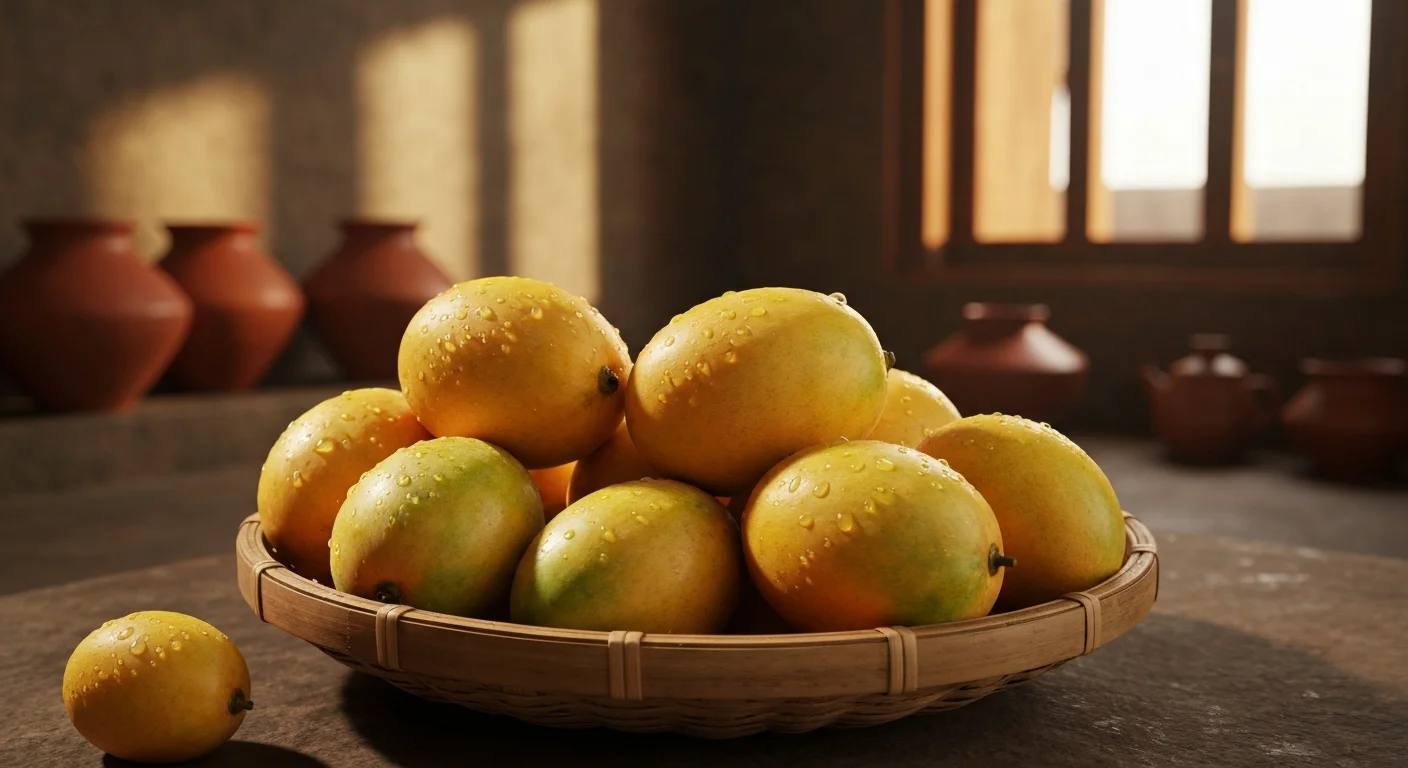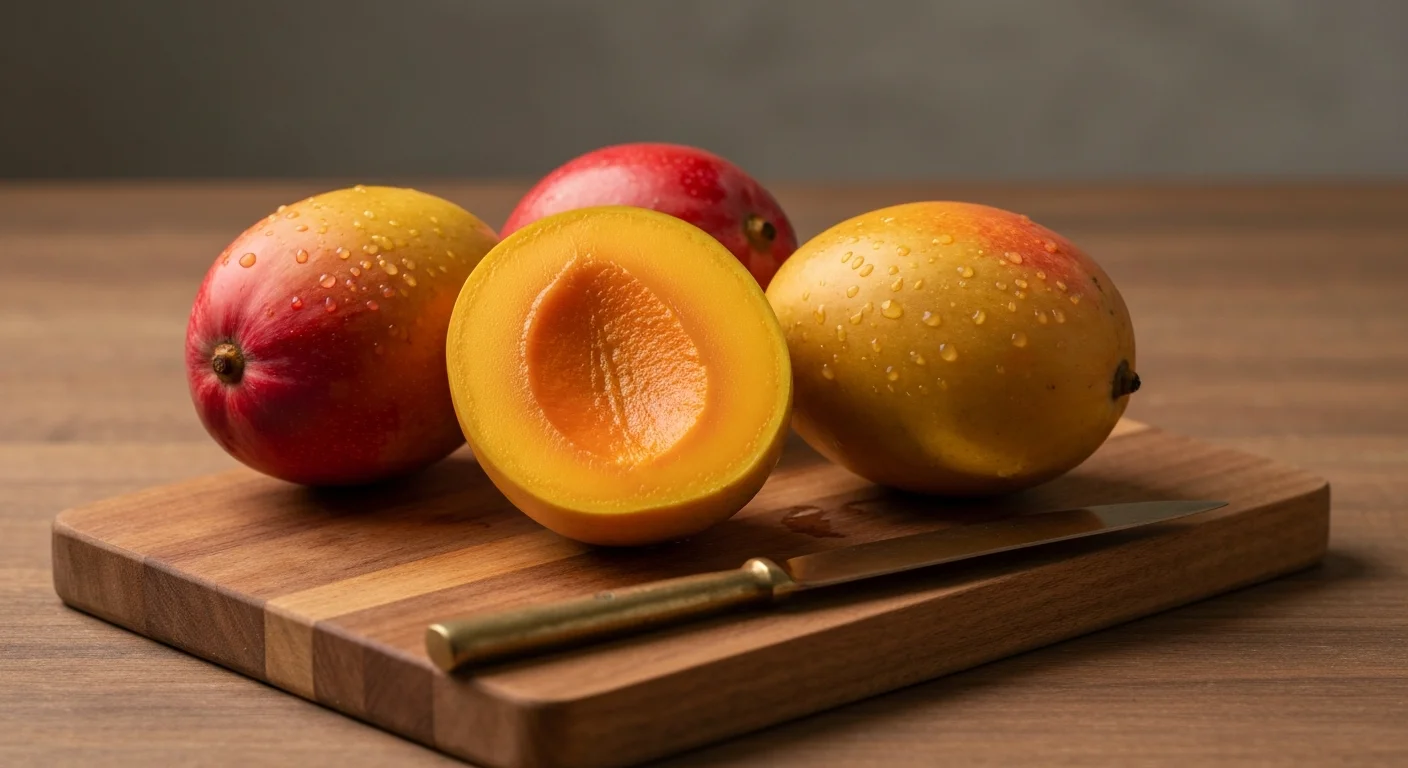
Suvarna Rekha, also known as Sindhura or Swarnarekha, is a medium-sized Indian mango from Andhra Pradesh and Odisha known for its striking golden-yellow skin with a red blush, saffron-orange flesh, and intensely sweet, almost candy-like flavor. The Sanskrit name translates literally to "golden streak," a reference to the bright color that sets it apart from every other Indian variety. Each fruit weighs 200-300 grams with Brix readings of 20-22 at peak ripeness. At Swadeshi Mangoes we deliver Suvarna Rekha to Texas customers from late April through early June, and it is consistently the variety that people buy for gifting because the color alone makes it a statement on any kitchen counter.
The Name and Its Meaning
The Sanskrit word Suvarna means gold, and Rekha means line or streak. Together the name describes the most visually distinctive trait of the variety: the fruit ripens from green to a near-fluorescent yellow-orange with a deep red-pink blush on the sun-exposed shoulder. No other Indian mango carries this combination of colors. Banginapalli ripens to pale yellow, Alphonso to an orange-yellow with minimal red, Kesar to a soft yellow-gold. Only Suvarna Rekha earns the name.
In Odisha the same fruit is called Sindhura, from the Sanskrit word for vermilion, again referencing the red blush. In Telugu households the name Suvarna Rekha is used almost universally. Either way, if you see a mango with a pronounced red cheek on a golden background at an Indian market in Texas, it is almost certainly this variety.
Regional Cultivation Centers
Suvarna Rekha is grown across a wider belt than most Indian mangoes. The heart of production is Vizianagaram and Srikakulam districts of Andhra Pradesh, with significant additional acreage in Ganjam and Gajapati districts of Odisha, and smaller pockets in Maharashtra. This wider geographic spread means the harvest window is longer than varieties like Himayath. The earliest Suvarna Rekha reach markets in late April, and the last fruit ship in early June, giving Texas customers a six-week window.
Flavor Profile: Candy in Fruit Form
Suvarna Rekha is the mango we most often describe as tasting like candy. The flavor is dominated by a very clean, concentrated sweetness with bright tropical fruit notes (pineapple, papaya, a touch of banana) and no bitter or resinous undertones. Brix at peak ripeness reaches 20-22 degrees, and the perception of sweetness is amplified by relatively low acidity, which gives the fruit an almost syrupy impression on the tongue.
Texture is medium-firm, slightly denser than Chinna Rasalu but softer than Banginapalli. Fiber is present but fine and rarely noticeable when the fruit is fully ripe. The saffron-orange flesh color is among the deepest of any Indian variety, an indicator of high beta-carotene content.
A Customer Anecdote from Austin
One of our Austin customers, a pediatrician who immigrated from Visakhapatnam in 2008, told us her children refused all mangoes for years because the American grocery varieties tasted flat. The first year she ordered a Texas box from us, she included two Suvarna Rekha. Her five-year-old took one bite, looked up, and asked if it was candy. The next year’s order was four boxes. She now gifts Suvarna Rekha to her patients’ families during the season as a small act of introducing them to Indian mango culture.
Nutrition: The Carotenoid Champion
Suvarna Rekha is particularly high in beta-carotene, the precursor to vitamin A that gives the flesh its saffron color. A 2022 study in the Indian Journal of Horticultural Research measured carotenoid content across 22 Indian mango cultivars and found Suvarna Rekha ranked in the top five, at approximately 2,800 mcg beta-carotene per 100 g of pulp. For context, that is roughly comparable to a medium carrot.
| Nutrient | Per 250g fruit | % Daily Value |
|---|---|---|
| Calories | 150 kcal | 7.5% |
| Total sugars | 32 g | — |
| Vitamin C | 90 mg | 100% |
| Vitamin A (RAE) | 175 mcg | 19% |
| Beta-carotene | 7,000 mcg | High |
| Fiber | 4.0 g | 14% |
| Potassium | 420 mg | 9% |
According to the National Mango Board, beta-carotene from mango is approximately 30% more bioavailable than from carrots because of the fruit’s natural oil content and water-soluble matrix. A 2020 PubMed-indexed clinical trial in adults found that daily consumption of 200 g of beta-carotene-rich mango for 12 weeks increased serum retinol levels by 18% in the treatment group compared to controls.
How to Identify Ripe Suvarna Rekha
Suvarna Rekha is one of the easier varieties to judge because the color change is dramatic. Unripe fruit is green with a faint yellow undertone. As it ripens, the green recedes from the tip upward, replaced by bright yellow, and the red shoulder blush intensifies. A fully ripe fruit is 80% or more yellow-orange with a vivid red cheek.
The Squeeze and Smell Test
Ripe Suvarna Rekha gives moderately under thumb pressure, similar to a ripe peach but slightly firmer. The aroma at the stem end becomes sweet and tropical, not floral like Alphonso or resinous like Himayath. If the stem end smells strongly of honey and pineapple, the fruit is ready. If the skin still has green patches but smells sweet, give it one or two more days on the counter.
How We Ship Suvarna Rekha to Texas
We source Suvarna Rekha primarily from two orchards in the Vizianagaram district and one in Srikakulam. The fruit is picked at 75-80% maturity, graded for size and skin clarity, packed in six-kilogram boxes with paper dividers to prevent bruising, and air-freighted to Dallas. Total transit time from orchard to our Texas distribution hub is 72-96 hours, and from there our 30-plus agent network distributes across Austin, Dallas, Houston, and San Antonio.
Because Suvarna Rekha has a relatively short shelf life once ripe (5-7 days), we time shipments to arrive in Texas before peak ripeness. Customers receive the fruit at roughly the half-ripe stage, which gives 3-4 days of counter ripening before peak eating window.
Best Ways to Eat Suvarna Rekha
The candy-like sweetness of Suvarna Rekha makes it the best variety in our lineup for mango sorbets and ice creams. The deep orange color carries through to the finished dessert, and the high natural sugar means less added sugar is needed. A simple sorbet made by blending Suvarna Rekha pulp with a squeeze of lime and churning needs almost nothing else.
The variety also works exceptionally well for mango kulfi, the traditional Indian frozen dessert. A 2023 recipe test in our kitchen found that using Suvarna Rekha instead of Alphonso reduced the required added sugar by 40% while producing a more vivid color. For a more savory application, Suvarna Rekha pairs beautifully with soft cheeses like burrata, ricotta, or fresh paneer, and the bright color makes for a photogenic plate.
Gifting in Texas
Suvarna Rekha is our number-one gifting variety. During Ugadi, Akshaya Tritiya, and Ramadan our Texas customers order six-pack and twelve-pack boxes specifically to give as gifts, because the visual impact of the golden-red fruit outshines any other variety. For gifting orders we offer a handwritten note service at no extra charge; details on the order form.
Suvarna Rekha vs. Similar Varieties
| Variety | Skin Color | Flesh Color | Sweetness | Best Use |
|---|---|---|---|---|
| Suvarna Rekha | Yellow + red blush | Saffron-orange | Very high, candy-like | Fresh, sorbet, gifting |
| Alphonso | Orange-yellow | Orange | High, floral | Fresh, desserts |
| Kesar | Yellow-gold | Deep yellow | High, balanced | Lassi, smoothies |
| Totapuri | Green-yellow | Pale yellow | Low-medium, tangy | Pickle, salad |
| Banginapalli | Pale yellow | Pale yellow | Medium-high | Slicing, salads |
Frequently Asked Questions
Why does Suvarna Rekha have such bright colors?
The golden-yellow skin and red blush come from high concentrations of carotenoids and anthocyanins produced during ripening. The Vizianagaram region’s intense sun exposure and cool nights during late April and May drive the pigment synthesis. These compounds are also responsible for the fruit’s high beta-carotene content and antioxidant capacity.
Is Suvarna Rekha the same as Sindhura?
Yes. Suvarna Rekha is the Telugu name used in Andhra Pradesh, and Sindhura is the Odia name used in Odisha. Both refer to the same cultivar with the same flavor, color, and harvest window. Boxes shipped from Andhra will typically be labeled Suvarna Rekha, while boxes from Odisha may carry either name.
When is Suvarna Rekha available in Texas?
Swadeshi Mangoes delivers Suvarna Rekha from late April through early June. Pre-orders open in late March, and the variety is available across Austin, Dallas, Houston, and San Antonio through our pickup agent network. Season timing varies slightly year to year based on monsoon patterns in Andhra Pradesh.
Can I make mango lassi or ice cream with Suvarna Rekha?
Yes, and it is one of the best varieties for both. The intense natural sweetness means you can reduce added sugar by 30-40% compared to less sweet varieties, and the deep orange color produces visually stunning finished desserts. For mango kulfi or sorbet, Suvarna Rekha is our top recommendation.
How does Suvarna Rekha compare to Mexican Ataulfo mangoes?
Ataulfo is a medium-size yellow mango with moderate sweetness (typically 15-17 Brix) and a mild flavor. Suvarna Rekha is sweeter (20-22 Brix), more aromatic, and has a deeper orange flesh with significantly higher beta-carotene. Texas customers who have eaten only Ataulfo often describe Suvarna Rekha as tasting like a completely different fruit.
Order Your Suvarna Rekha This Season
If you want the most visually striking mango in our catalog and one of the sweetest, Suvarna Rekha is the variety to try first. It is also the one we recommend for anyone gifting a box to a Texas friend, family member, or neighbor who has never tasted an Indian mango before. The color alone starts the conversation. Head to our order form to reserve your box, browse the full mango variety list, or read more guides on the Swadeshi Mangoes blog. For ripening tips see our mango care guide.
For research on mango carotenoid content, see the USDA FoodData Central, the National Mango Board nutrition library, and PubMed carotenoid bioavailability studies.