Direct answer: A USDA phytosanitary certificate is an official government document issued by India’s National Plant Protection Organization and verified by USDA APHIS confirming that an Indian mango shipment is free of pests and has been treated to approved standards, including irradiation at a minimum dose of 400 Gy. Every legal Indian mango box entering Texas must carry this certificate plus an irradiation treatment label with a unique batch number. You can verify a certificate by checking the batch number against USDA APHIS records or by requesting a copy from your importer. Without this paperwork, the mango is either smuggled, mislabeled, or sourced from a non-India origin.
Most Texas mango customers have seen the stickers but few understand what they actually certify. This guide walks you through the entire chain from the orchard in Maharashtra to the inspection counter at Houston, Dallas, or Austin-Bergstrom airport, and explains what each document and treatment really means.
The Backstory: Why India Needs Preclearance
Until 2007, Indian mangoes were banned from the US because of concerns about pests including the mango seed weevil, fruit fly, and mango pulp weevil. In 2006, USDA APHIS negotiated a preclearance agreement with India requiring irradiation treatment at specified doses. The first shipments arrived in 2007, and demand has grown every year since.
The preclearance program means the mangoes are inspected and treated in India before shipping. USDA APHIS officers are stationed at approved Indian irradiation facilities to supervise the process. When the shipment arrives at the US port of entry, customs confirms the paperwork is in order and releases the fruit. This is why documentation matters so much.
What Is on a Phytosanitary Certificate
Every certificate contains specific fields. Here is what you should see.
- Exporting country: India
- Importing country: United States of America
- Name and address of the exporter
- Name and address of the consignee (US importer)
- Botanical name of the commodity (Mangifera indica)
- Quantity and type of packaging
- Distinguishing marks (container or pallet IDs)
- Place of origin (Devgad, Ratnagiri, or other Indian region)
- Treatment details (irradiation at 400 Gy minimum)
- Date of treatment and treatment facility name
- Official stamp and signature of the NPPO inspector
The Irradiation Step Explained
Irradiation sounds alarming to many first-time Indian mango buyers in Texas, but it is a well-established food safety practice endorsed by the FDA, WHO, and USDA. Mangoes pass through a shielded chamber where they receive gamma or electron-beam radiation at a minimum dose of 400 Gy. This dose disrupts the reproductive cycle of fruit fly larvae and other quarantine pests while leaving the fruit chemically unchanged.
The FDA has concluded that irradiated fruit is safe for consumption. See the FDA food irradiation fact sheet for details. The treatment does not make the fruit radioactive, does not alter taste or nutritional value significantly, and does not reduce shelf life.
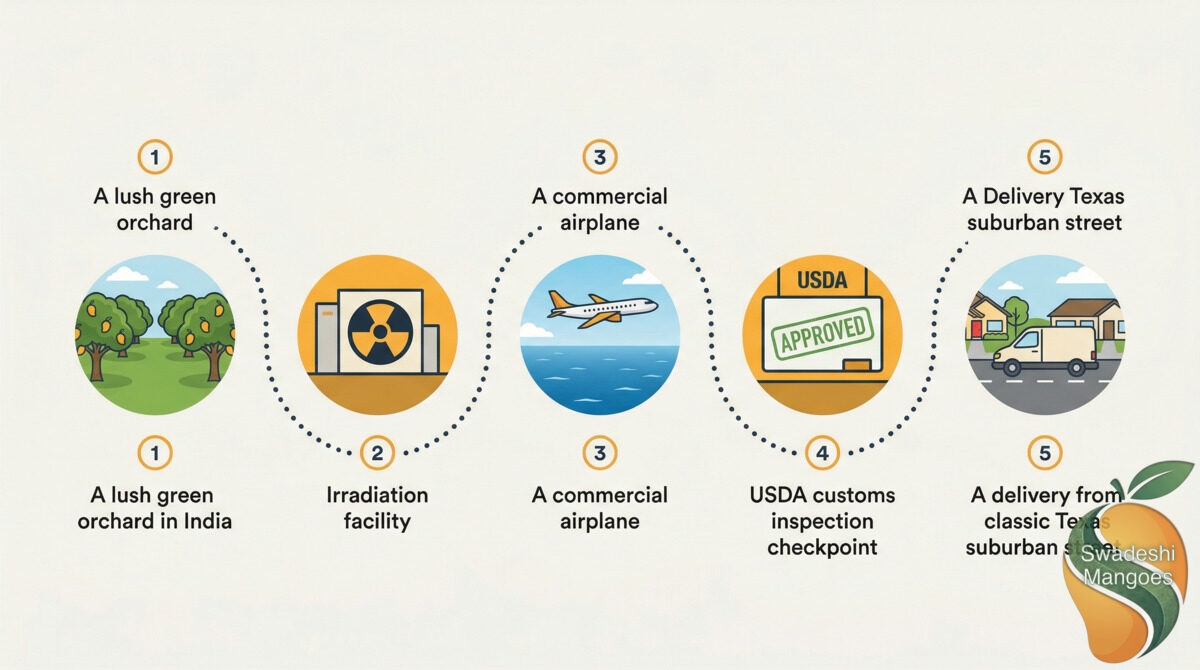
Step-by-Step: From Orchard to Your Texas Door
- Orchard harvest: Mangoes are picked at mature-green stage in Maharashtra, Gujarat, or Andhra Pradesh.
- Pack house sorting: Fruit is graded, washed, and packed in ventilated 3kg or 5kg cartons.
- Hot water fungicidal dip (52°C, 3-4 min): Reduces post-harvest fungal disease like anthracnose and extends shelf life. Important: this is fungal control, NOT a USDA quarantine pest treatment. The quarantine pest treatment for Indian mangoes is irradiation (next step).
- Bubble wash, dry, grade, and pack: Mangoes are bubble-washed, air-dried, sorted by size and quality, and packed in ventilated 3kg or 5kg cartons, then pre-cooled.
- Irradiation: Cartons pass through an approved irradiator at 400 Gy minimum dose under USDA APHIS supervision.
- Certificate issuance: NPPO India inspector signs the phytosanitary certificate.
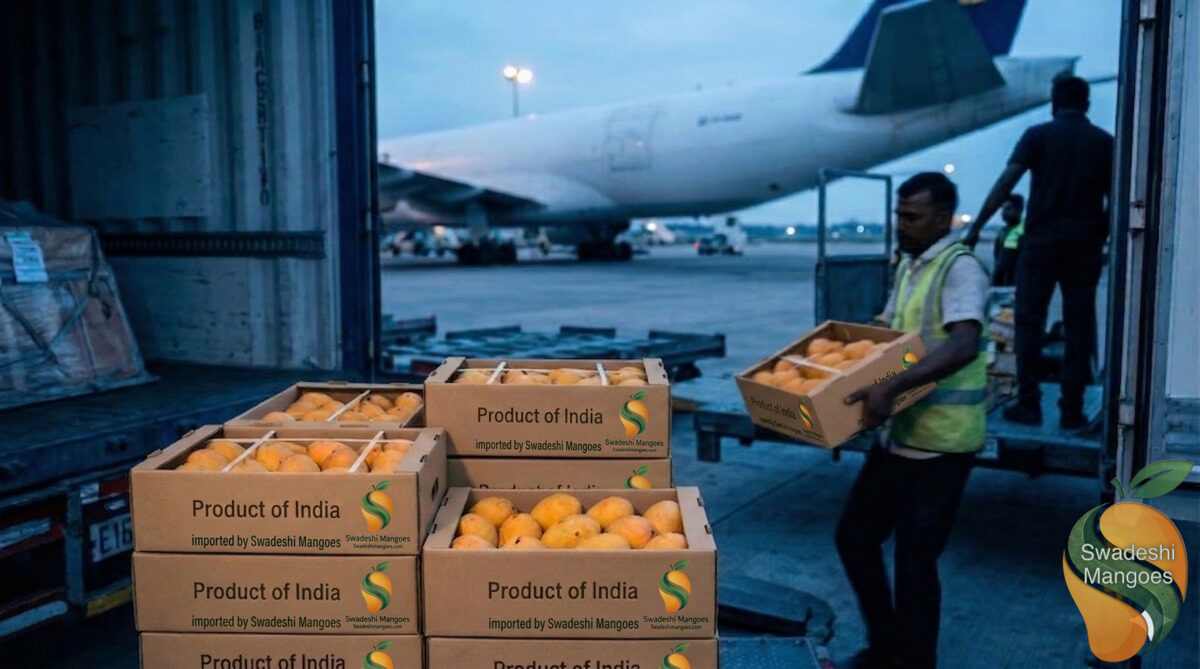
- Air freight: Shipment flies from Mumbai, Delhi, or Chennai to JFK, ORD, or directly to Houston. Total flight time 16-22 hours.
- US port inspection: USDA APHIS verifies paperwork at port of entry. Shipments are typically cleared within 24-48 hours.
- Ground transport: Refrigerated truck from port to Texas distribution hub, usually 1-2 days.
- Agent pickup: Our 30+ Texas agents distribute boxes to customers across Austin, Dallas, Houston, and San Antonio.
How to Verify a Certificate in Texas
If you want to confirm your box is legitimate, follow this five-step verification.
- Locate the phytosanitary certificate number on the outside of the box or on a separate document from your importer.
- Check that the certificate is issued by India NPPO and countersigned by USDA APHIS.
- Verify the treatment date is within the past 14 days. Longer gaps suggest cold storage, which affects quality.
- Match the batch number on the irradiation sticker to the batch on the certificate.
- If anything does not match, contact your importer and request clarification. Legitimate importers answer quickly and provide copies.
Certificate Elements Quick-Reference Table
| Element | What it means | Red flag if missing |
|---|---|---|
| NPPO India seal | Indian government inspection | Possible fake or non-India origin |
| USDA APHIS stamp | US import clearance | Not legally imported |
| Irradiation dose 400 Gy+ | Pest treatment complete | Fails US import rules |
| Treatment date | Timeline from orchard | Fruit may be too old |
| Facility name | Approved irradiator | Treatment unverified |
| Batch number | Traceability ID | Cannot verify origin |
Common Misconception: Irradiation Equals Unsafe
Many Texas customers assume irradiation makes food unhealthy. Decades of FDA, WHO, and CDC research show the opposite. Irradiation reduces foodborne pathogens, extends shelf life, and does not alter nutritional content significantly. The alternative is fumigation with methyl bromide, which is more controversial and banned for many uses. Irradiation is the current gold standard for tropical fruit imports.
What Happens If a Shipment Fails Inspection
If USDA APHIS inspectors at the Texas or East Coast port find paperwork issues, missing treatment stickers, or pest evidence, the shipment is either destroyed, re-exported, or re-treated. Importers absorb massive losses, which is why reputable importers invest heavily in documentation. This is also why grey-market mangoes with missing paperwork are so rare in legitimate Texas retail channels.
Why This Matters for Texas Buyers
When you buy an Indian mango box with full documentation, you get three guarantees. First, the fruit originated in India, not a cheaper lookalike country. Second, it passed US import inspections, so it is legal and pest-free. Third, the treatment and transit timeline are documented, so you know how fresh it is. These guarantees collapse when paperwork is missing.
How We Handle Documentation at Swadeshi Mangoes
Every box we deliver across Texas arrives with the original USDA APHIS phytosanitary certificate information retained in our records. If a customer ever wants to see the paperwork for their specific shipment, we can pull the batch number and share it. Transparency is the entire point of the preclearance program, and we honor it.
Hot Water Treatment vs Irradiation
Different origin countries use different USDA-approved treatments. Mexican mangoes typically receive hot water treatment: immersion in water held at 115°F for 75-110 minutes depending on fruit size. This kills fruit fly eggs but is not approved for Indian mangoes because India’s specific pest profile (including the mango pulp weevil) requires the deeper penetration of irradiation. Pakistan, Taiwan, and some other Asian origins also use irradiation. Each treatment protocol is negotiated bilaterally between USDA and the exporting country’s plant protection agency. Texas customers should know that the treatment type on your certificate reflects the origin country’s approved protocol.
The Port of Entry Experience
When a shipment lands at JFK, O’Hare, Newark, or occasionally directly at Houston IAH, it enters a USDA inspection bay. Officers sample cartons from every pallet, verify the irradiation dose records, check the phytosanitary certificate signatures, and look for damaged cartons that could indicate tampering. A clean inspection releases the shipment within 24 hours. A flagged shipment can be held for 3-5 days for additional testing. Our Texas operations team tracks every shipment through this stage and communicates delays to customers via SMS.
Documentation Retention for Texas Customers
Our records retain phytosanitary certificate numbers, irradiation batch numbers, flight manifests, and cold-chain temperature logs for a minimum of 24 months per USDA guidance. If you ever need documentation for a food safety inquiry, gift traceability, or simple curiosity, we can pull your specific box records. This is part of the service Texas customers receive by ordering direct rather than through untraceable grocery channels.
Frequently Asked Questions
Is irradiated mango safe for pregnant women or children?
Yes. The FDA and WHO classify irradiated food as safe for all consumers including pregnant women, children, and immunocompromised individuals. Irradiation does not make food radioactive or leave chemical residues. The treatment is comparable to pasteurization in its safety profile.
Does irradiation change the taste of Indian mango?
At 400 Gy, there is no detectable change in taste, aroma, or texture compared to untreated mango. Higher doses used for sterilization can affect flavor, but the US import dose is calibrated specifically to preserve eating quality. Blind taste tests show no consumer preference difference.
Can I request the phytosanitary certificate from my importer?
Yes. Any legitimate Indian mango importer in Texas keeps copies and will share them on request. We encourage customers to ask. If a retailer refuses or cannot produce the document within a reasonable time, treat that as a red flag about the origin of the fruit.
Why does the treatment date matter for freshness?The treatment date is the last orchard-side checkpoint before air freight. Most legitimate Texas shipments land within 7-10 days of treatment. Longer gaps suggest the fruit spent time in cold storage, which affects ripening behavior and flavor. Always prefer fruit treated within the past 10 days.Are Pakistani and Mexican mangoes subject to the same rules?
Each origin country has its own USDA APHIS protocol. Mexican mangoes use hot water treatment. Pakistani mangoes require similar irradiation to Indian mangoes. Each carries its own phytosanitary certificate format, but the underlying principle of government-to-government preclearance is the same.
Order documented, traceable Indian mangoes in Texas from our order form. See our care guide and read our companion post on spotting fake Alphonso. More articles on our blog.