It is 1:00 AM in Kurnool, Andhra Pradesh. The temperature has finally dropped below 90°F. A truck pulls into the loading bay of an APEDA-registered pack house carrying 2,000 kilograms of Banginapalli mangoes, picked that morning from orchards 40 kilometers away.
In 30 hours, some of these mangoes will be on a plane to the United States.
This is the story of what happens in between — and why your box of Indian mangoes costs what it costs.
1:00 AM — Arrival and First Sort
Mangoes arrive in plastic crates stacked on open trucks. They were picked at dawn — at the “mature but unripe” stage, when the shoulder of the fruit has filled out but the skin is still firm. This is intentional. A fully ripe mango would never survive the journey.
Workers unload the crates by hand under fluorescent lights. The first sort happens immediately:
- Reject pile: Any mango with visible bruising, insect damage, latex burn, or irregular shape. These go to the domestic market.
- Grade A (Export): Uniform size, clean skin, correct color, no blemishes. Only the top 10–15% of the harvest makes this grade.
- Grade B (Domestic premium): Good fruit that does not meet export standards — slightly uneven size or minor cosmetic marks.
For every 10 mangoes that arrive, only 1 or 2 will end up in a box headed to Texas.
2:00 AM — Washing and Treatment
Export-grade mangoes are washed in a chlorinated water bath to remove field dirt and surface bacteria. They are then dipped in a fungicide solution (within APEDA-approved limits) to prevent anthracnose — a fungal disease that can develop during transit.
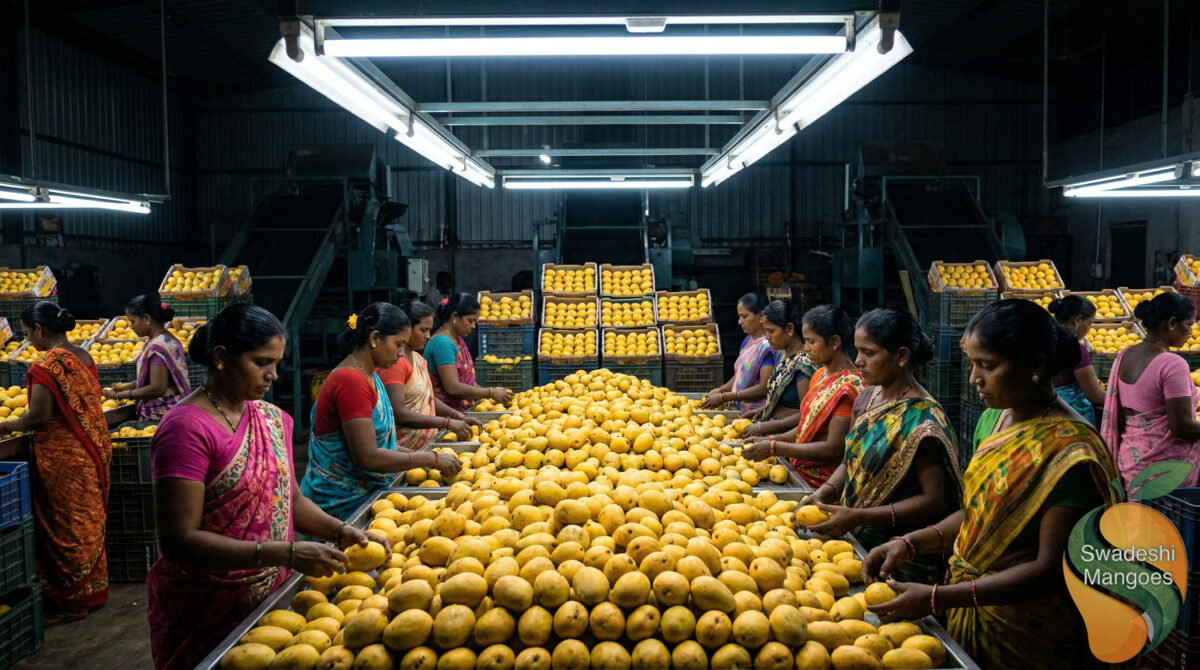
Each mango is handled individually. There are no conveyor belts here. A worker picks up each fruit, inspects it under light one more time, and places it on a drying rack.
3:00 AM — Grading by Hand
This is where the real skill happens. Experienced graders — most of them women who have been doing this for years — sort mangoes by size and weight using their hands.
For Banginapalli:
- Small: Under 250g — not exported
- Medium: 250–350g — standard export
- Large: 350–450g — premium export
- Extra Large: Above 450g — rare, highest price
Each grade goes into its own tray. A good grader can sort 500 mangoes per hour by touch alone. They know, by the weight in their palm, whether a mango is 280g or 320g.
4:00 AM — Wrapping and Packing
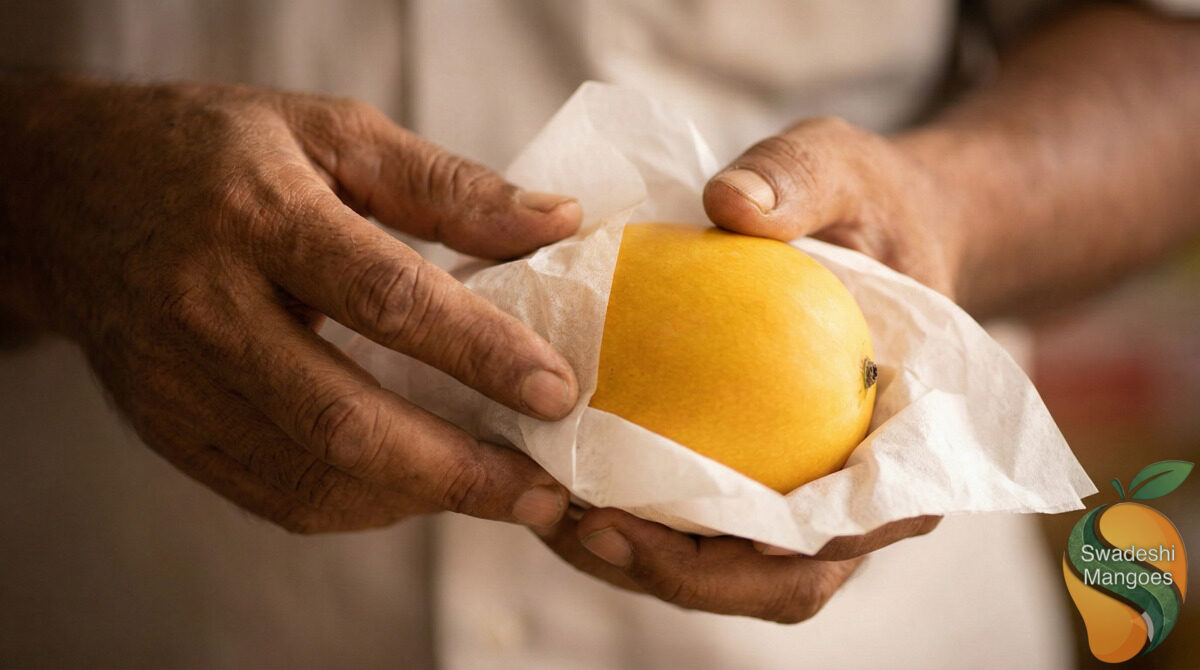
Each mango is individually wrapped in tissue paper or a foam net. This is not for presentation — it is for protection. A single bruise from fruit-to-fruit contact during a 9,000-mile journey will cause that mango to rot before it reaches Texas.
Mangoes are packed into corrugated cardboard boxes designed specifically for air freight. The boxes have ventilation holes for airflow and internal dividers to prevent movement. A standard export box holds 3–4 kilograms, depending on the variety.
Every box is stamped with:
- APEDA registration number
- Exporter details
- Variety name
- Grade and weight
- “Product of India”
5:00 AM — Cold Room Storage
Packed boxes go into a cold room maintained at 12–13°C (about 54°F). This slows the ripening process without stopping it — cold enough to preserve, warm enough to not cause chilling injury.
The mangoes will stay here until the truck leaves for the irradiation facility, usually later that day or the next morning.
The Irradiation Stop
Boxes are transported to a USDA-APHIS approved irradiation facility — facilities like KRUSHAK in Lasalgaon or BRIT in Navi Mumbai. Here, mangoes undergo gamma irradiation at 400 Gray to eliminate quarantine pests (primarily fruit flies).
This step is non-negotiable for any Indian mango entering the United States. It adds cost, time, and a logistical bottleneck (there are only a handful of approved facilities in India), but it is what makes the entire trade possible.
After irradiation, each box receives the Radura symbol and treatment documentation.
The Flight
Irradiated boxes are trucked to the airport — typically Mumbai (BOM) or Hyderabad (HYD). They are loaded into temperature-controlled air cargo containers and flown to the United States.
Flight time: approximately 18–22 hours including layovers.
Common arrival airports: JFK (New York), Newark, or O’Hare (Chicago). From there, they are distributed to regional hubs across the country.
The Last Mile — Texas
When mangoes arrive at our hub in Round Rock, Texas, we open boxes to check quality. We organize by variety and by customer order. Then our network of pickup agents across Austin, Dallas, Houston, and San Antonio distribute to families — often within hours.
From the tree in Kurnool to your kitchen counter in Texas: roughly 72–96 hours. Every step handled by human hands. No automation. No shortcuts.
Why This Matters
Next time you open a box of Indian mangoes and wonder about the price, remember the midnight grading. The hand-wrapping. The woman who sorted 500 mangoes by weight using just her palm. The 9,000-mile cold chain. The irradiation facility. The air freight.
You are not paying for a fruit. You are paying for a small miracle of logistics and human care that gets a perishable, delicate fruit from a farm in rural India to your suburb in Texas — in three days, intact and beautiful.
That is what makes every box worth it.
References
- APEDA (Agricultural & Processed Food Products Export Development Authority): Export guidelines and pack house standards
- USDA-APHIS: Irradiation treatment requirements for Indian mangoes
- National Horticulture Board of India: Post-harvest handling guidelines for mango export
Related Reading
Taste the care that went into every mango.
Directly sourced • USDA inspected • 7 varieties

Swadeshi Mangoes
Swadeshi Mangoes is a community-driven Indian mango pickup network operated by Swadeshi Central TX LLC, headquartered in Round Rock, Texas. We bring authentic, USDA-inspected Indian mangoes — Alphonso, Banginapalli, Kesar, and more — to families through local pickup in multiple US cities, every season since 2025.