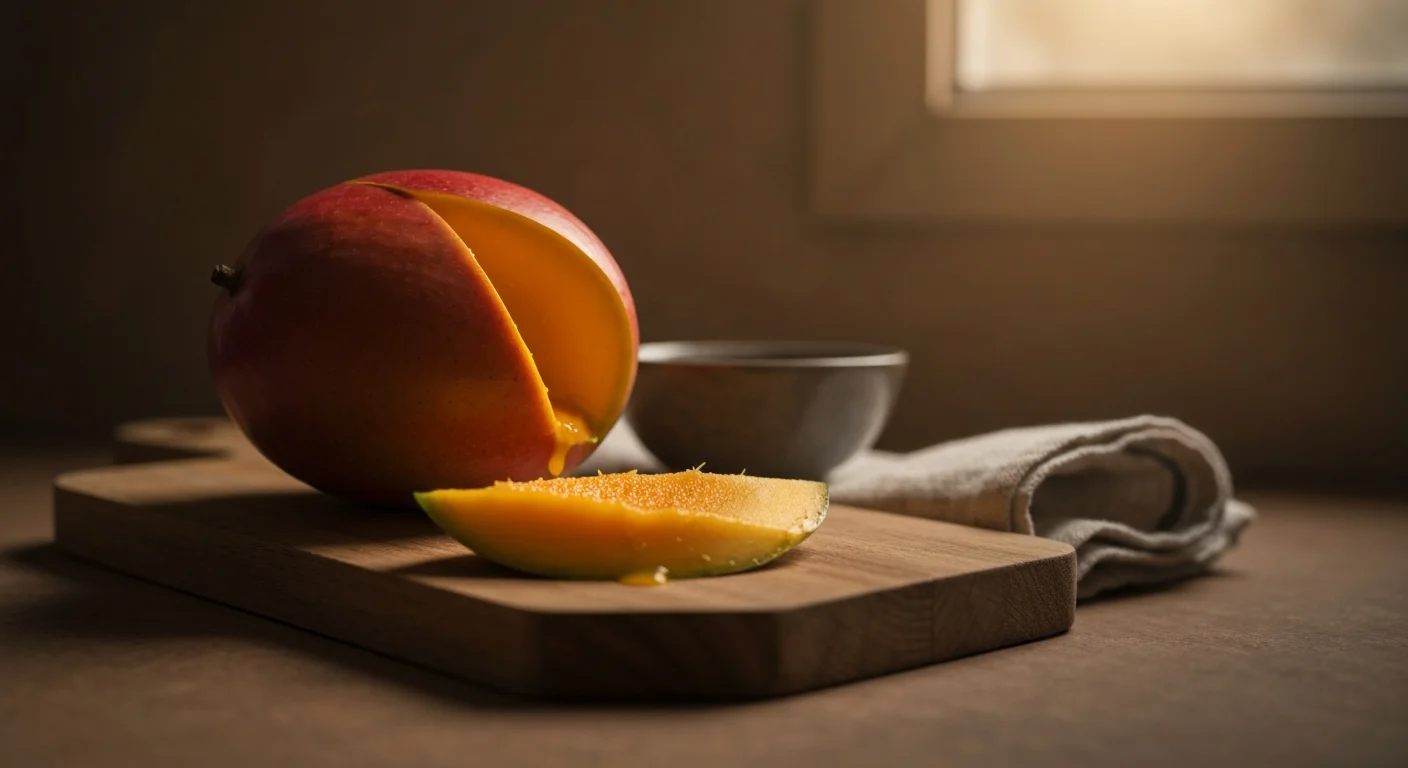
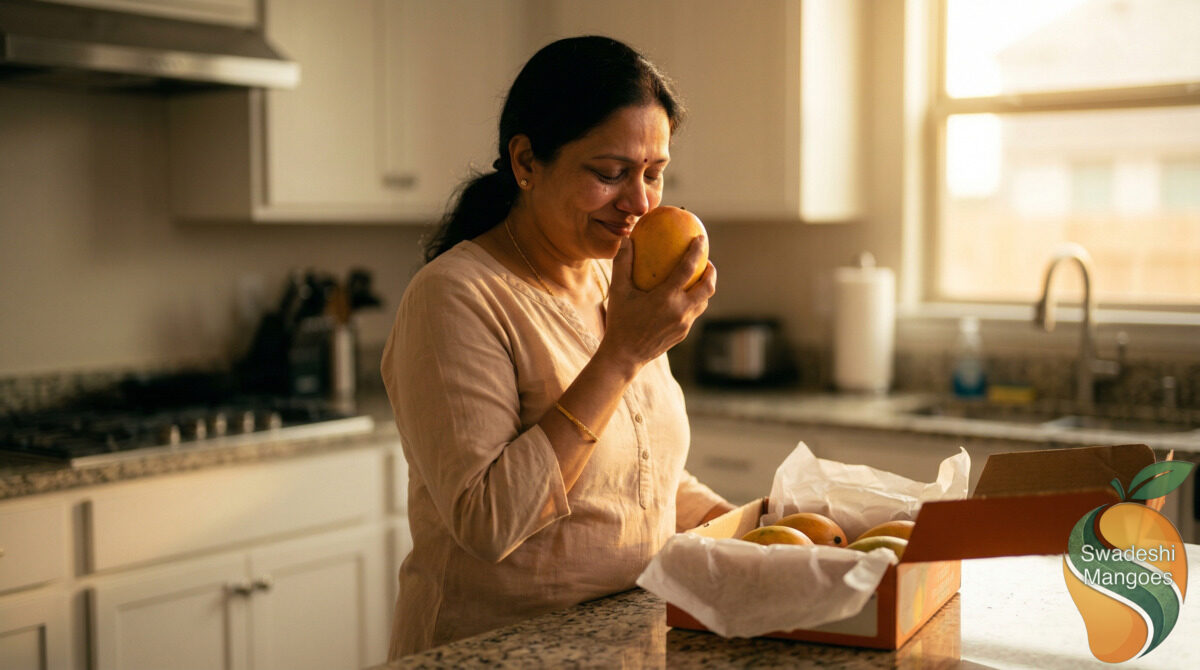
She was standing in the kitchen in Round Rock, Texas. The box had arrived that morning — six Alphonso mangoes wrapped in tissue paper, each one the size of her fist. She picked one up, held it to her nose, and closed her eyes.
Then she started crying.
Not sad crying. The other kind. The kind that happens when something you thought you had lost comes back to you all at once — a smell, a taste, a whole summer compressed into a single breath.
This is a story about mangoes. But really, it is a story about home.
The Newspaper on the Floor
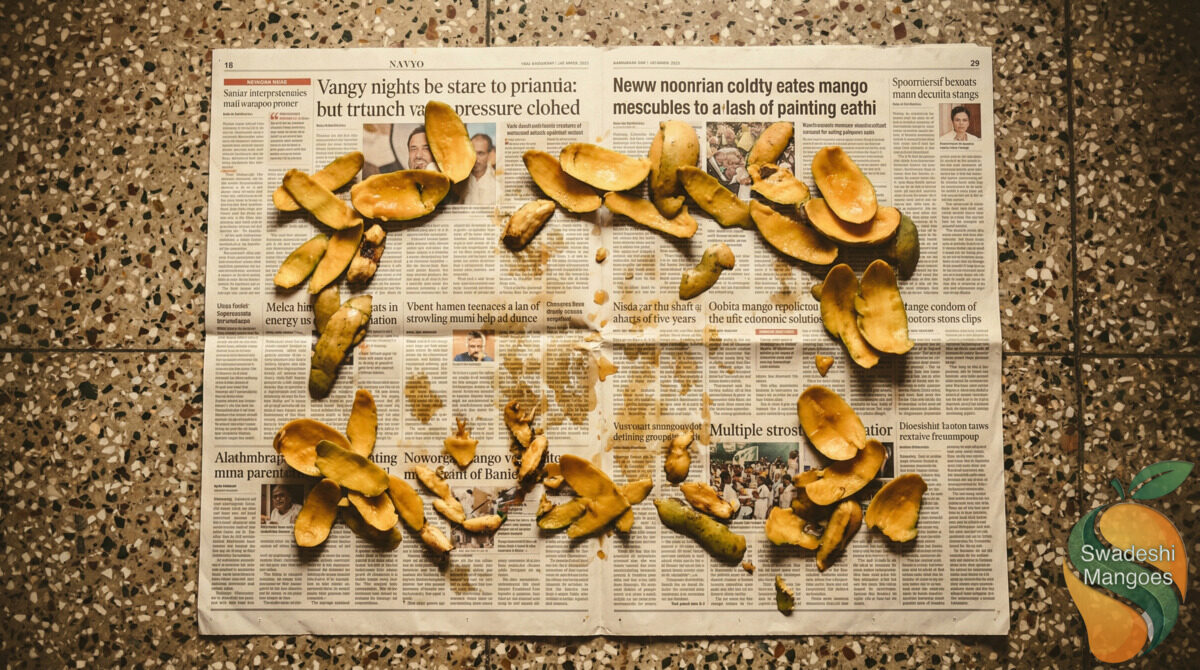
If you grew up in India, you do not need me to explain this. But I will try, for those who did not.
Every April, the mangoes would arrive. Not from a store — from a relationship. Your father knew a vendor. Your uncle had a tree. Someone’s colleague’s cousin had an orchard in Ratnagiri or Kurnool or Junagadh. The mangoes came in wooden crates packed with straw, and the whole house smelled like summer the moment the lid came off.
The eating ritual was specific:
- Spread newspaper on the floor (the dining table was too small for what was about to happen)
- Everyone sits cross-legged
- Each person gets a mango — not a slice, a whole mango
- You squeeze it gently until the flesh loosens inside the skin
- Bite off the tip and suck the juice directly
- The juice runs down your arms to your elbows
- Nobody cares
The ceiling fan whirred overhead. Cricket commentary played on the radio. Someone always said, “This year’s mangoes are not as good as last year’s.” Someone else always disagreed. This was the annual mango debate — as important as any family tradition.
After the mangoes, you washed your hands and face at the kitchen sink, and the drain smelled sweet for the rest of the afternoon.
What You Lose When You Move 9,000 Miles Away
When Indian families move to America, they bring their recipes, their festivals, their languages. They set up temples. They join WhatsApp groups. They find Indian grocery stores. They manage to recreate most of their life.
But the mangoes? The mangoes are the one thing that cannot be substituted.
You go to H-E-B or Kroger. You buy what they call a “mango.” It is red and green and hard and has the word “Mexico” on the sticker. You cut it open. It is pale, fibrous, and tastes like a mango trying to be a mango. It is not the same thing. It is not even close.
A Tommy Atkins mango and an Alphonso are not different levels of the same fruit. They are different fruits that happen to share a name.
So for years — sometimes decades — Indian families in Texas go without. The mango-shaped hole in their summers becomes just another thing they quietly accept about living in America. Another small loss in the long accounting of immigration.
The First Box
Then one day, someone in your WhatsApp group posts: “Fresh Alphonso and Banginapalli available for pickup in Austin this weekend.”
You think it cannot be real. You have been disappointed before. You order anyway — one box, just to see.
The mangoes arrive. You open the box.
And there it is. The smell. Not a hint of it. Not an approximation. The actual smell — the one that has been living in a locked room in your memory for fifteen years. It comes out all at once. The kitchen in your parents’ house. The newspaper on the floor. Your grandmother’s hands.
You cut one open. The pulp is deep saffron-orange. No fiber. You taste it.
It is real. It is the same mango.
And that is when you understand why your amma cried.
It Is Never Just Fruit
For Indian families in America, Indian mangoes are:
- A time machine. One bite and you are seven years old on your grandmother’s terrace in Hyderabad.
- An identity marker. A Maharashtrian family needs Alphonso. A Telugu family needs Banginapalli. A Gujarati family needs Kesar. Your mango is your state, your language, your people.
- A generational bridge. You are not just eating a mango. You are showing your American-born child what summer in India tastes like. You are teaching them to suck the juice from the skin, just like your father taught you.
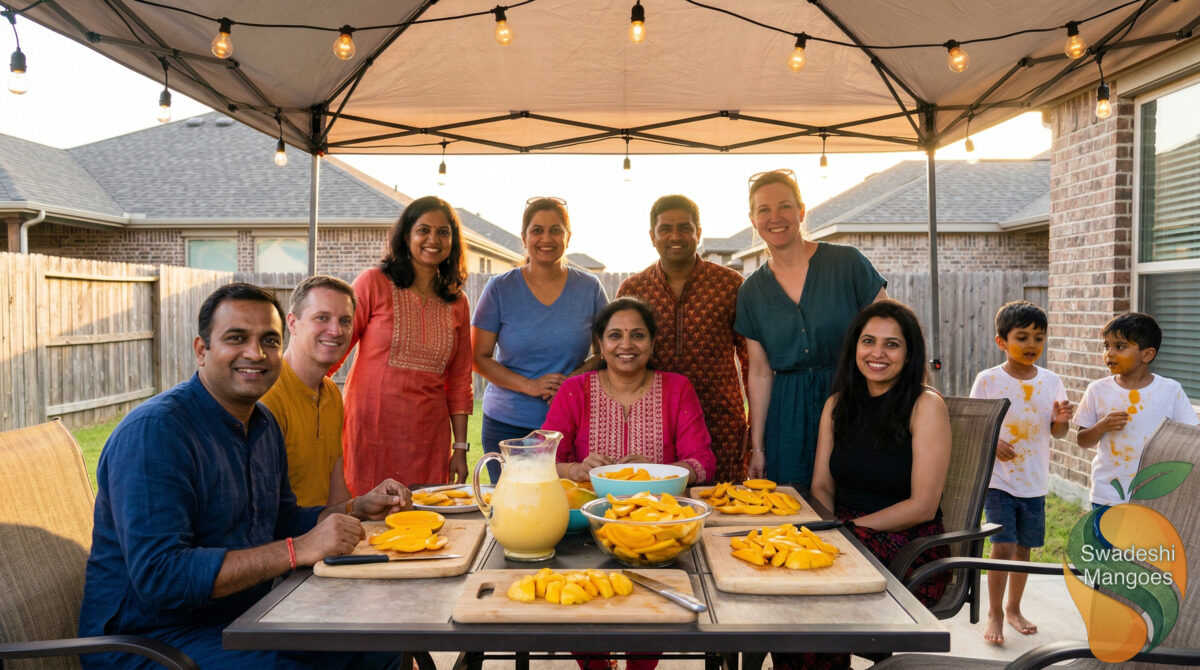
- A community ritual. When the mangoes arrive, you text your neighbors. You bring a box to your friend’s house. You eat them together, standing around the kitchen island, and for twenty minutes nobody is talking about work or school or mortgages.
It is never just fruit. It is proof that 9,000 miles and twenty years cannot erase who you are.
Why We Do This
At Swadeshi Mangoes, we do not think of ourselves as a delivery service. We think of ourselves as the people who bring the box that makes your amma cry.
Every season — April through July — we bring seven varieties of authentic Indian mangoes to families across Texas. We work with orchards in Kurnool, Ratnagiri, and Junagadh. Every mango is USDA-inspected, air-freighted, and delivered through our network of 30+ community pickup agents in Austin, Dallas, Houston, and San Antonio.
We do this because we are the same family. We know what that first bite means. We know what you are really tasting when you close your eyes.
You are tasting home.
This season, bring the memory back.
April–July • 7 varieties • Refer a friend, earn $5

Swadeshi Mangoes
Swadeshi Mangoes is a community-driven Indian mango pickup network operated by Swadeshi Central TX LLC, headquartered in Round Rock, Texas. We bring authentic, USDA-inspected Indian mangoes — Alphonso, Banginapalli, Kesar, and more — to families through local pickup in multiple US cities, every season since 2025.