Tag: climate

  • Texas Climate and Mango Ripening: Why 3 Days Beats 5

    Texas Climate and Mango Ripening: Why 3 Days Beats 5

    Texas climate ripens Indian mangoes in roughly three days during peak summer, compared to five or more days in cooler climates. The combination of 85 to 100F ambient temperatures, low indoor humidity from AC, and warm kitchen microclimates accelerates enzymatic ripening, which means Texas customers should check mangoes daily starting on day two rather than day four.

    I am Vamsi, and I have shipped Indian mangoes to Texas customers for six seasons. The single most common question from new customers in Austin, Round Rock, Cedar Park, Pflugerville, Dallas, Frisco, Plano, Houston, Sugar Land, Katy, and San Antonio is how long the mangoes take to ripen. The honest answer is that the Texas climate cuts ripening time almost in half compared to national averages, and understanding why will save your fruit.

    What Happens Inside a Ripening Mango

    Mangoes are climacteric fruit, which means they continue to ripen after they are picked. Ripening is driven by ethylene gas, which the fruit produces in increasing amounts after harvest. Warm temperatures speed up ethylene production. Cool temperatures slow it down. This is why a banana ripens faster on a kitchen counter than in the fridge.

    The Enzyme Cascade

    During ripening, starch converts to sugar, cell walls soften as pectin breaks down, and volatile aroma compounds develop. These reactions are all temperature sensitive. Every 10F increase in ambient temperature roughly doubles the rate of enzymatic activity, which is why a mango in a 95F Texas kitchen ripens twice as fast as one in a 75F Seattle kitchen.

    Ethylene Feedback Loop

    Ripening mangoes release ethylene, which further accelerates their own ripening and the ripening of nearby fruit. Group three mangoes in a paper bag, and the ethylene concentration rises faster than with a single mango. This is why the paper bag trick works.

    Texas Summer Conditions

    Peak mango season in Texas runs May through July. Average high temperatures during this window:

    CityMay Avg HighJune Avg HighJuly Avg HighHumidity Range
    Austin85F92F97F45 to 70 percent
    Round Rock84F91F96F45 to 70 percent
    Dallas84F92F96F50 to 70 percent
    Frisco83F91F95F50 to 70 percent
    Houston87F91F94F65 to 85 percent
    Sugar Land87F91F94F65 to 85 percent
    San Antonio86F93F96F50 to 75 percent

    Indoor Texas homes with AC sit around 72 to 78F, which is still warm enough to ripen mangoes faster than the national average.

    Why 3 Days Beats 5 in Texas

    Most mango ripening guides written for national audiences assume ambient indoor temperatures of 70F. Texas indoor temperatures during summer routinely run warmer because AC units struggle against outdoor heat and homeowners often set thermostats to 76 or 78F to save on electricity. The result is faster ripening, shorter shelf life, and more missed windows.

    The Day-Two Check

    Starting on day two after pickup, press gently near the stem end. A ripe mango yields slightly, like a ripe avocado. If there is no yield by day two, check again on day three. If it yields, eat it within 48 hours or move it to the fridge.

    The Missed Window Problem

    Our Dallas customer Radha told me in 2024 that she lost a whole box of Alphonso because she followed a YouTube guide that said to wait five days. By day five in her Frisco kitchen, the fruit was overripe. We adjusted her approach to a day-two check, and she has not lost a mango since.

    Variety-Specific Ripening Times in Texas

    Not all varieties ripen at the same pace. Here is what I tell customers:

    • Alphonso: 2 to 3 days in Texas summer
    • Kesar: 3 to 4 days
    • Banginapalli: 3 to 5 days
    • Chinna Rasalu: 2 to 3 days
    • Himayath: 3 to 4 days
    • Suvarna Rekha: 3 to 4 days
    • Mallika: 4 to 5 days
    • Dasheri: 3 to 4 days
    • Totapuri: 5 to 7 days

    Humidity in Houston and Sugar Land slows ripening slightly compared to drier Austin and San Antonio, but the difference is only half a day.

    The Paper Bag Method in Texas

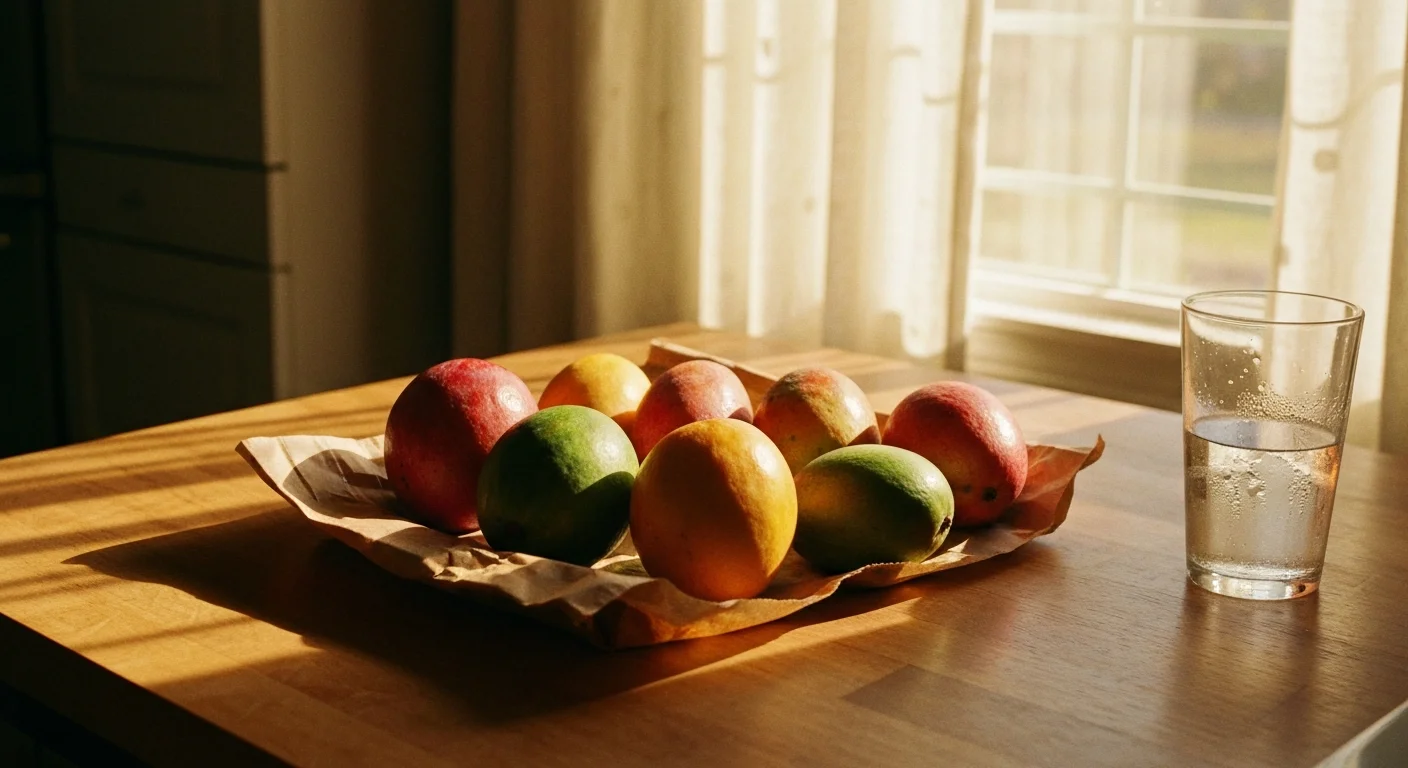
    Place two or three mangoes in a brown paper bag, fold the top loosely, and leave on the counter away from direct sunlight. Check daily. The bag traps ethylene and creates a mild warm microclimate. In Texas, this usually cuts ripening time to 2 to 3 days even for slow varieties.

    Do Not Use Plastic Bags

    Plastic traps moisture and creates condensation, which speeds mold growth in humid Texas summer conditions. Always use paper.

    Do Not Ripen in Direct Sunlight

    A Texas windowsill can hit 110F in July. That is not ripening, that is cooking. Keep bags on the counter away from windows.

    When to Refrigerate

    Once a mango yields to gentle pressure and has a full aroma, it is ripe. At this point, you have two options. Eat within 48 hours, or refrigerate for up to 5 days. Do not refrigerate an unripe mango. Cold arrests ripening permanently and the fruit will never develop full flavor.

    Chill TemperatureStandard home fridge settings between 38 and 40F are ideal for ripe Indian mangoes. Lower temperatures risk chill injury, visible as pitted skin and off flavors.

    Signs of Overripe Fruit

    An overripe Texas mango will show soft wrinkled spots, leaking juice, a fermented alcohol aroma, and dark patches on the flesh. At this stage, blend into a smoothie or lassi immediately, or discard. Do not eat if mold is visible.

    Practical Storage Setup

    In my Round Rock kitchen, I keep a counter ripening station: a wooden bowl holding unripe mangoes, away from the stove and window. Once a mango is ripe, it moves to the middle fridge shelf. I check the bowl every morning at 7am before work. This routine has eliminated loss.

    Climate Considerations by Texas Region

    Central Texas (Austin, Round Rock, Cedar Park, Pflugerville, Georgetown)

    Moderate humidity, high heat. Ripening window 2 to 3 days for most varieties. Check daily starting day two.

    North Texas (Dallas, Frisco, Plano)

    Similar to Central Texas, slightly less humid. Same 2 to 3 day window.

    Houston Metro (Houston, Sugar Land, Katy)

    Higher humidity, slightly slower ripening, more mold risk. Use fresh paper bags daily and check for condensation.

    San Antonio

    Drier than Houston, warmer than Dallas in some summers. Ripening aligns with Central Texas.

    Sourcing and Delivery

    Our mangoes arrive slightly underripe to maximize your ripening window at home. Order through the order form and pick up from one of our agents across Texas. For variety-specific guidance, see the varieties page. For detailed storage tips, visit the mango care guide. For more reading, browse the blog.

    FAQ

    Why do Indian mangoes ripen faster in Texas than in other states?

    Texas summer temperatures, both outdoor and indoor, run warmer than national averages. Enzymatic ripening roughly doubles with every 10F increase, and Texas kitchens often sit at 76 to 78F during peak summer. This accelerates sugar development and cell wall softening, compressing the ripening window from 5 days to 3.

    Can I slow mango ripening in a hot Texas kitchen?

    Yes. Keep mangoes in the coolest part of the kitchen, away from the stove and windows. Do not bag them if you want to slow ripening. Once a mango yields slightly to pressure, move it to the fridge, which halts ripening. Refrigerating unripe mangoes, however, permanently damages flavor.

    What if my Texas mangoes are still hard on day three?

    Wrap in a paper bag with a ripe banana or apple, both of which release ethylene. Leave on the counter for 24 more hours. Texas heat plus the ethylene boost will finish ripening most varieties. Slow varieties like Mallika and Totapuri may need 5 to 7 days regardless of climate.

    How do I know if a Texas-ripened mango has gone bad?

    Look for wrinkled skin, dark leaking patches, a fermented or alcoholic smell, and mold. A mango that has sat on a 95F Texas counter for a week past pickup is almost certainly past its prime. Cut it open, and if the flesh is dark brown or has a sour smell, discard it immediately.

    Should I store Indian mangoes in the fridge during a Texas heatwave?

    Only if they are fully ripe. A ripe mango stores in the fridge for up to 5 days without losing quality. Unripe mangoes must stay at room temperature. During a Texas heatwave when the kitchen is hitting 80F indoors, move ripe mangoes to the fridge immediately to prevent overripening.

    Real Customer Stories from Texas Kitchens

    One of my favorite stories comes from a Pflugerville customer named Divya. She ordered Alphonso for the first time in 2023 and called me worried on day two because the mangoes were still firm. I walked her through the paper bag method over the phone. By day three, she reported the first mango was perfectly ripe. By day four, the rest had ripened, and she had to eat her way through them quickly because Texas July was pushing her kitchen to 80F even with AC. The story ended happily, but it highlighted the need for a better day-two check routine. Another customer in Houston, Ramesh, built what he calls his mango station: a wire basket in the coolest corner of his pantry, a digital thermometer clipped to the basket, and a whiteboard noting the order number and pickup date. Excessive? Perhaps. But he never loses fruit.

    Counter Positioning in a Texas Home

    Not every countertop is equal. The north-facing wall of a Texas kitchen usually stays coolest. Avoid placing ripening mangoes near the oven, microwave, dishwasher, or windows facing south or west. In older Austin homes without good insulation, the kitchen can run 5F warmer than the rest of the house. In newer Frisco and Katy builds, kitchens are often open to living rooms and share AC airflow more evenly. Use your hand as a thermometer. If the counter feels warm, it is too warm.

    Humidity Hacks

    Houston and Sugar Land customers deal with 75 to 85 percent indoor humidity during summer even with AC running. High humidity slows ripening slightly but raises mold risk. Change your paper bags every 48 hours, which prevents moisture buildup. In Austin and San Antonio, humidity is lower and paper bags can stay in place for the full ripening cycle without replacement.

    Closing

    Texas weather is not an obstacle to great mangoes. It is just a variable to plan for. Check daily starting day two. Use paper bags. Move ripe fruit to the fridge. Your three-day window is a feature, not a bug. For external references, the National Mango Board and the USDA publish useful storage guidance.
  • Why Mangoes Taste Better in India (And How to Get Close in Texas)

    Why Mangoes Taste Better in India (And How to Get Close in Texas)

    You ate an Alphonso in India and it was transcendent. You ordered the same Alphonso in Texas and it was very good — but not quite the same. You are not imagining it. There are real scientific reasons why mangoes taste different in India, and understanding them can actually help you get closer to that original experience right here in your Texas kitchen.


    Terroir Is Real for Mangoes

    Winemakers talk about terroir — the unique combination of soil, climate, altitude, and microorganisms that gives a wine its character. The same concept applies to mangoes, and India’s terroir is unmatched.

    Alphonso from Ratnagiri grows in laterite soil near the Arabian Sea, with humid monsoon air and specific temperature ranges. The same Alphonso variety grown in a different region tastes noticeably different. The GI (Geographical Indication) tag on Ratnagiri Alphonso exists for a reason — it is not marketing, it is chemistry.

    The laterite soil in Ratnagiri is iron-rich and well-drained, forcing mango tree roots to push deep for water. This stress, paradoxically, concentrates flavor in the fruit — the same principle that winemakers use when they restrict irrigation to produce more intense grapes. The coastal humidity adds another layer: the moisture in the air during the fruiting season affects how sugars and aromatic compounds develop in the flesh. Remove the tree from this specific environment and you get a different fruit, even though the genetics are identical.

    Kesar from Junagadh tells a similar story. The black soil of the Gir region, the proximity to the limestone hills, and the specific rainfall pattern all contribute to Kesar’s distinctive saffron-like aroma. Kesar grown in other parts of Gujarat is recognizably Kesar, but anyone who has eaten a Gir Kesar side-by-side with a non-Gir Kesar knows the difference. The terroir is embedded in every bite.

    Each of our mango varieties carries the flavor signature of its home region. Banginapalli from Andhra Pradesh, Himayath from Hyderabad, Chinna Rasalu from the Krishna district — these are not just variety names, they are place names written in flavor.

    Tree-to-Mouth Time

    In India, the mango you eat at your grandmother’s house was probably on a tree 24-48 hours ago. In Texas, even with air shipping, you are eating a mango that was harvested 5-7 days ago.

    Mangoes continue producing aromatic compounds after harvest, but the peak aroma is within the first 3 days of ripening. By day 5-7, some of the most volatile flavor compounds have dissipated. The mango is still excellent — but the first-day aroma experience is impossible to replicate at a distance.

    Specifically, the compounds that diminish fastest are the terpenes — myrcene, limonene, and ocimene — which are responsible for that heady, almost intoxicating floral aroma when you first open a box of freshly ripened Alphonso. These molecules are light and volatile. They begin evaporating almost immediately after the mango skin starts softening. By the time a mango has traveled from a farm in Ratnagiri to a kitchen in Austin, a measurable percentage of these top-note aromas has simply floated away.

    The underlying sugars, acids, and heavier flavor compounds remain largely intact. This is why an exported Alphonso still tastes unmistakably like an Alphonso — the core identity is preserved. What you lose is the highest, most ephemeral layer of aroma. Think of it like listening to a beautiful song on excellent speakers versus phenomenal speakers. The song is the same. But the very top end, the shimmer, is slightly different.

    The Irradiation Factor

    All Indian mangoes entering the US must undergo irradiation treatment to eliminate fruit fly larvae. The USDA requires this. While irradiation is safe and does not make the fruit radioactive, some studies suggest it can slightly reduce Vitamin C content and alter certain volatile aroma compounds.

    The difference is subtle — most people cannot detect it in a blind test. But if you have a trained palate for Alphonso, you might notice a slight flattening of the top aromatic notes.

    To put this in perspective: the irradiation doses used for mangoes (400-1000 Gray) are well below the threshold that would cause significant flavor change. The USDA and FDA have studied this extensively. The treatment affects the mango far less than, say, the difference between a mango ripened on the tree versus one harvested mature-green and ripened in transit — which is how virtually all exported mangoes are handled.

    It is worth noting that mangoes exported from India to the Middle East and Southeast Asia do not require irradiation, which is one reason why the same Alphonso you buy in Dubai tastes slightly closer to the Indian original than the same Alphonso in Texas. The geography is closer and the irradiation step is absent. But even so, the difference is small. You would need to taste them side by side to notice.

    Ripening Environment

    In India, mangoes ripen in 85-95 degree ambient temperatures with 60-80% humidity. This is the environment the mango evolved to ripen in over thousands of years. In a Texas kitchen with air conditioning set to 72 degrees and low humidity, the ripening process is slower and the flavor development is subtly different.

    Pro tip: Ripen your mangoes in the warmest spot in your house — near a window that gets afternoon sun, or on top of the refrigerator where the motor generates warmth. Put them in a paper bag to trap ethylene gas and raise local humidity. Visit our mango ripening guide for detailed step-by-step instructions.

    Temperature affects enzymatic activity in the ripening fruit. The enzymes that convert starches to sugars, that break down cell walls to create that melting texture, and that synthesize aromatic compounds all work faster at higher temperatures. When you ripen a mango at 72 degrees instead of 90 degrees, these enzymes work more slowly, and the balance of compounds they produce shifts slightly. The mango still ripens, but the flavor profile tilts a fraction in a different direction.

    Humidity plays a role too. Low humidity causes the mango skin to lose moisture, which can make the flesh slightly less juicy and can affect the concentration of flavor compounds near the surface. In India, where mangoes ripen in ambient humidity often above 70%, the skin stays plump and the flesh retains maximum juice. In an air-conditioned Texas home at 40-50% humidity, the skin dries slightly, and the outermost layer of flesh can become a touch less succulent.

    How to Get the Closest Experience in Texas

    Understanding the science is useful, but what you really want to know is: how do I make this mango taste as close to India as possible? Here is every trick we have learned from years of delivering Indian mangoes across Texas.

    Create a Ripening Microclimate

    Place your mangoes in a paper bag with a ripe banana. The banana emits ethylene gas, which accelerates ripening, while the closed bag traps humidity and warmth. Put this bag in the warmest room in your house — not the refrigerator, not the air-conditioned living room. A garage in Texas during May is actually close to ideal ripening temperature, as long as it does not get above 100 degrees. The sweet spot is 80-95 degrees with moderate humidity.

    Eat Them at the Right Moment

    The window for peak Alphonso flavor is surprisingly narrow — about 12-24 hours after the mango reaches full ripeness. Too early and the sugars have not fully developed. Too late and the aromatic compounds have started breaking down into fermentation byproducts. You know the moment has arrived when the mango yields to gentle pressure, the skin is fully golden with no green patches, and you can smell the aroma through the skin without pressing your nose to it. That is when you eat it.

    Serve at Room Temperature

    Never eat an Alphonso straight from the refrigerator. Cold suppresses aroma. Take the mango out at least 30 minutes before eating and let it come to room temperature. Better yet, set it in a slightly warm spot. Aroma compounds volatilize more at higher temperatures, which is why you can smell a mango from across the room in a warm Indian kitchen but barely detect it in a cold American one.

    Eat It the Indian Way

    Slice the cheeks, score the flesh, and eat it straight — no plate, no fork, no ceremony. There is something about eating a mango directly with your hands that engages more senses and makes the experience more vivid. The warmth of your hands on the fruit releases more aroma. The lack of cutlery means the mango goes straight from flesh to tongue without the intermediary of metal, which can subtly affect taste perception. Indian families have been eating mangoes this way for a reason.

    Memory and Expectation

    There is also a psychological element. The mango you ate at your grandmother’s house during summer vacation was consumed in a specific emotional context — the heat, the family, the anticipation, the newspaper on the floor. Flavor is not just chemistry; it is memory. No mango in any country can fully recreate that.

    Neuroscientists have demonstrated that flavor perception is heavily influenced by context, emotion, and expectation. The same wine tastes better when people are told it is expensive. The same food tastes better when eaten with loved ones. Your grandmother’s mango was wrapped in a complete sensory experience — the sound of the ceiling fan, the texture of the newspaper under your elbows, the voices of cousins in the next room, the particular quality of late-afternoon light in an Indian house during summer. Your brain encoded all of this alongside the flavor, and it replays the full package every time you taste an Alphonso.

    This is not a limitation — it is a gift. It means that every Alphonso you eat in Texas carries a trace of that original experience. The flavor is the key that unlocks the memory. And the closer the flavor gets to the original, the more vivid the memory becomes.

    But a good Alphonso in Texas can come remarkably close. Close enough to make your amma cry.

    What About Texas-Grown Mangoes?

    South Texas, particularly the Rio Grande Valley, can grow certain mango varieties. You will occasionally see mangoes at farmers markets or from backyard trees in the Houston and San Antonio areas. These are typically varieties bred for Florida’s climate — Kent, Tommy Atkins, or Keitt — not Indian cultivars.

    While locally grown mangoes have the advantage of zero transit time, they cannot replicate the flavor of Indian varieties because the genetics are completely different. An Alphonso is not just a mango — it is a specific cultivar developed over centuries for its particular flavor profile. Growing it in Texas soil, with Texas water and Texas climate, would produce a different result even if you could source the rootstock (and getting certified Alphonso rootstock into the US is nearly impossible due to agricultural import restrictions).

    This is why importing directly from India remains the only way to get authentic Indian mango flavor in Texas. The tree, the soil, the climate, and the variety are all part of the package. Change any one of them and you change the mango.

    Order your box and get as close to the India experience as physics allows.

    The Closest Thing to India in Texas

    Swadeshi Mangoes brings air-shipped Indian mangoes to Austin, Dallas, Houston, and San Antonio within days of harvest. It is the closest you can get to eating mangoes in India — without the 20-hour flight. Browse our full variety selection or visit the order page to reserve your box this season.

    Frequently Asked Questions

    Do mangoes taste different in India vs America?

    Yes — subtly. Mangoes in India are consumed within 24-48 hours of harvest with uninterrupted natural ripening. Exported mangoes travel 5-7 days and undergo irradiation. The core flavor is preserved but peak aromatic notes are slightly reduced.

    What is mango terroir?

    Like wine, mango flavor is influenced by soil, climate, and microorganisms. Alphonso from Ratnagiri tastes different from Alphonso grown elsewhere due to unique laterite soil and coastal humidity — hence the GI (Geographical Indication) certification.

    How should I ripen mangoes for the best flavor?

    Ripen at 80-95 degrees in a paper bag with a banana. Avoid the refrigerator until fully ripe. Eat within 12-24 hours of full ripeness for peak flavor. See our full ripening guide for step-by-step instructions.

    Does irradiation affect mango flavor?

    The effect is minimal. USDA-required irradiation may slightly reduce Vitamin C and some volatile aromas, but the difference is undetectable by most people. The core flavor and sweetness of the mango remain intact.

Chat on WhatsApp