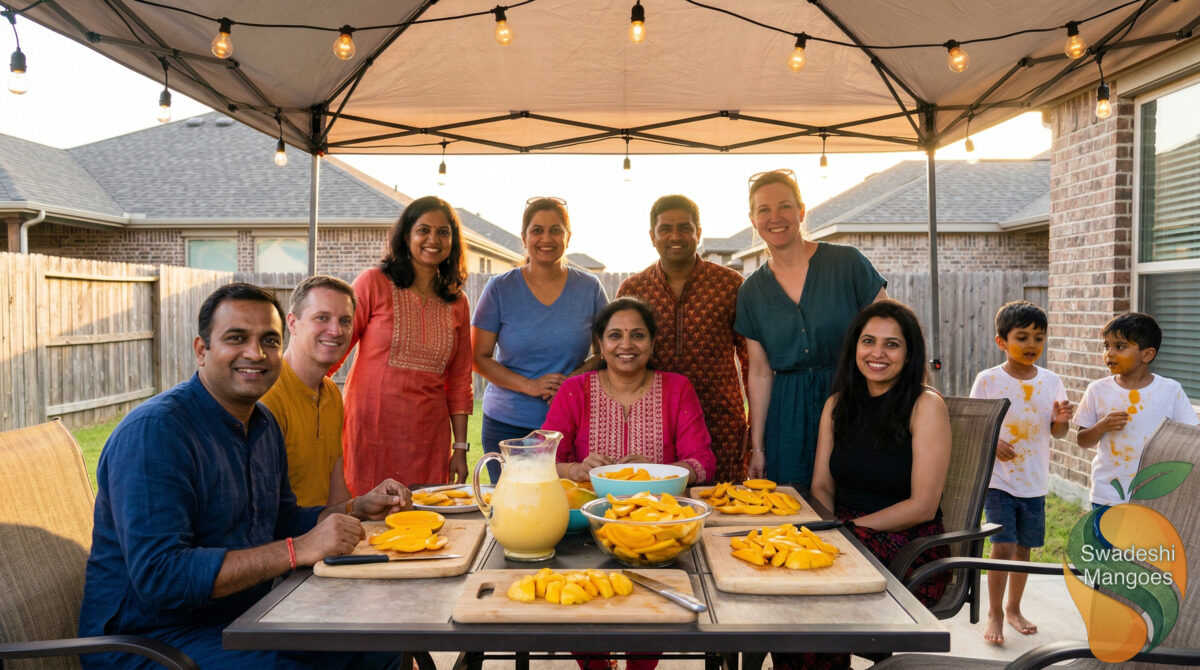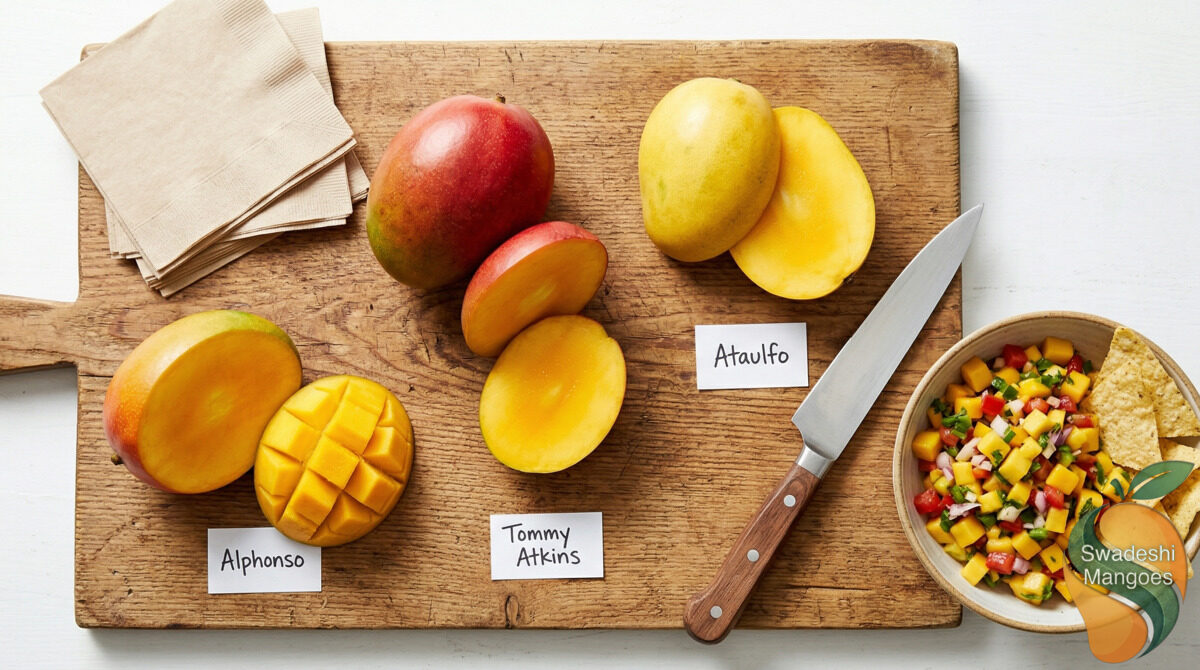
A Texas mango tasting night is a side-by-side sampling of multiple Indian mango varieties at peak ripeness, structured with scorecards and palate cleansers. In Texas, where summer heat runs 90 to 100F from May through July, tasting nights work best indoors with AC, six to eight guests, and all nine varieties prepped no more than two hours before serving.
I hosted my first mango tasting night in Round Rock in 2022 with four varieties and eight guests. By 2025 we were doing all nine varieties, with Houston and Austin customers driving in for the weekend. This playbook is the distilled version of what I have learned over six years of hosting, and it works whether you live in Cedar Park, Frisco, Sugar Land, or Katy.
Why Host a Mango Tasting Night in Texas
Texas summers are long, hot, and built for indoor gatherings once the afternoon sun pushes temperatures past 95F. A tasting night is structured enough to feel like an event, but casual enough that nobody has to cook. For our Indian-American community, it is also a way to introduce friends and neighbors to the nine varieties they have probably never seen outside of a grocery store labeled simply as mango.
The Texas AC Factor
Mango tasting rooms should sit between 68 and 72F. Any warmer and the fruit softens too fast and aromas blur together. Any cooler and the cold dulls flavor. Set your thermostat to 70F an hour before guests arrive. In July, that may mean running the AC harder than usual.
Group Size
Six to eight guests is the sweet spot. Four is too few for conversation, ten gets crowded and the tasting loses structure. One host plus one helper can manage eight comfortably.
The Nine-Variety Lineup
The full lineup includes Alphonso, Kesar, Banginapalli, Chinna Rasalu, Himayath, Suvarna Rekha, Mallika, Dasheri, and Totapuri. Tasters go light to intense, sweet to tart, aromatic to mild.
Suggested Tasting Order
Start with Banginapalli, which is balanced and approachable. Move to Suvarna Rekha, then Dasheri, then Chinna Rasalu. Midpoint: Kesar. Then Himayath, then Mallika, finishing with the two heavyweights, Alphonso and Totapuri. Save Alphonso for last because its aroma lingers on the palate.
Prep Timeline
Here is the exact timeline I use for a 7pm Saturday tasting night at my house in Round Rock.
| Time | Task | Notes |
|---|---|---|
| 3 days before | Check ripeness of all nine varieties | Counter-ripen in paper bags |
| 1 day before | Print scorecards, set AC to 72F | Chill palate cleansers |
| Morning of | Check final ripeness, rotate as needed | Move fully-ripe mangoes to fridge |
| 4pm | Wash hands, sanitize board and knife | Use a non-reactive board |
| 5pm | Cut all nine varieties into labeled wedges | Cover with plastic, refrigerate |
| 6:30pm | Pull mangoes from fridge to temper | Serve at 62 to 65F |
| 7pm | Guests arrive, welcome drink | Start tasting at 7:20pm |
| 9pm | Group discussion, vote | Wrap by 10pm |
Scorecards and Evaluation
Each guest gets a scorecard with nine rows, one per variety. Columns: aroma (1 to 5), sweetness (1 to 5), acidity (1 to 5), texture (smooth, fibrous, juicy), and overall preference rank. I keep the scoring simple because serious sensory language scares off new tasters.
Aroma First
Teach guests to smell before tasting. Cup the mango wedge in the palm, bring it close to the nose, inhale. Alphonso smells of honey and pine. Kesar smells of apricot and rose. Dasheri smells of mint and citrus. This step alone often reshapes preferences.
Texture Matters
Some varieties like Totapuri are fibrous, which some Texans love and some hate. There is no right answer, but the scorecard should capture it. Our Houston customer Meera always ranks Totapuri first because of its tang. My neighbor in Round Rock cannot stand it. Both are correct.
Palate Cleansers
Between varieties, guests need a palate cleanser. The three that work best in Texas summer conditions:
- Plain saltine crackers (not flavored)
- Cold filtered water at room temp, not ice water
- Thin slices of unsalted cucumber
Avoid citrus water, mint, and carbonated drinks. They reset the palate too aggressively and mask the next variety.
Serving Temperature
Serve Indian mangoes at 62 to 65F, which is cool but not cold. Pull from the fridge 30 minutes before serving in an AC-controlled Texas room. If your dining room runs warmer than 75F, use a shallow ice bath under the tasting platter.
Platter Setup
Use a white ceramic platter to show off the range of yellows, oranges, and greens. Arrange wedges in a clockwise circle with small paper flags naming each variety. Place toothpicks beside each wedge so nobody double-dips.
Beverage Pairings
Offer three beverages: sparkling water, an off-dry Riesling, and unsweetened iced chai. Riesling handles the sweetness spectrum better than any red or rose. Iced chai is a surprising complement to Alphonso and Kesar, and it photographs beautifully for Instagram.
Conversation Prompts
Between varieties, I offer simple prompts: What does this remind you of? Would you serve this to a Texan who has never tried Indian mangoes? Which dish would you build around this? At a Frisco tasting last summer, a guest named Raj mentioned that Himayath tasted like his grandmother’s garden in Hyderabad. The whole room went quiet.
Sourcing Mangoes for Your Tasting
Order all nine varieties through our order form at least two weeks ahead of your planned date. We deliver through pickup agents across Austin, Dallas, Houston, San Antonio, and the suburbs of Round Rock, Cedar Park, Pflugerville, Georgetown, Frisco, Plano, Sugar Land, and Katy. Explore the full list of mango varieties before you order.
Ripeness PlanningNot all varieties ripen at the same pace. Alphonso ripens in 2 to 3 Texas summer days. Totapuri can take 5 to 7 days. Start your ripening clock accordingly. See our mango care guide for variety-specific timing.What to Skip
Skip strongly flavored appetizers before the tasting. Skip perfume and scented lotions, which blur aromas. Skip overhead fluorescent lights because they make ripe mango flesh look gray. Use warm incandescent or daylight bulbs.
Wrap and Leftovers
At the end, collect scorecards and tally votes. Post results in your group chat the next day. Leftover mango, which there will be plenty of, goes into a blender with yogurt for a lassi, or onto toast the next morning. See more recipe ideas on the blog.
FAQ
How many mangoes do I need for a Texas tasting night with 8 guests?
Plan for one mango per variety per eight guests, so nine mangoes total. Each mango yields roughly eight generous wedges. If your group skews toward serious fruit lovers, buy two of Alphonso and Kesar because those are the crowd favorites and will run out first. Order two weeks ahead through our Texas pickup network.
Should I serve Indian mangoes cold or at room temperature in Texas?
Serve between 62 and 65F, which is cooler than room temp but warmer than fridge temp. Texas ambient temperatures inside an AC home sit around 72 to 74F, which is slightly too warm for tasting. Pull fruit from the fridge 30 minutes before serving. This range preserves aroma while preventing the fruit from softening during the tasting.
What is the best season for a mango tasting night in Texas?
Late May through mid-July is peak. Alphonso and Kesar arrive first in May, with Banginapalli, Himayath, and the other varieties arriving through June. By late July, the season tapers. Hosts in Austin, Dallas, and Houston should target the first two weekends in June for maximum variety availability.
Can I host a mango tasting outdoors in Texas?
Only before 11am or after 8pm during May, June, and July when daytime temperatures often exceed 95F and mango flesh softens within 20 minutes. Indoor AC hosting is strongly recommended. If you insist on an outdoor tasting in Cedar Park or Sugar Land, use a shallow ice bath under the platter and keep guests in shade.
How long does a mango tasting night typically last?
Plan for 90 to 120 minutes of active tasting plus 30 minutes of arrival and 30 minutes of wrap-up. A well-run nine-variety tasting in a Round Rock living room runs from 7pm to 10pm, with the tasting itself between 7:20pm and 9pm. Longer sessions lead to palate fatigue and blurred scores.
Stories from Past Tasting Nights
My favorite Texas tasting night memory comes from a Plano gathering in June 2024. Eight guests, none of whom had ever tried Alphonso before. By the third variety, two guests were taking notes in a notebook they had brought from home. By the seventh variety, a guest named Anjali declared that Kesar was the mango of her childhood in Ahmedabad and she had not tasted it in twenty years. She cried a little. Her husband ordered a case the next morning. Another night in Cedar Park, a guest who considered himself strictly a Haden mango fan ranked Totapuri last at the start and, after tasting it twice, ranked it third. The structure of a tasting night changes minds in a way that no single-variety sampling can.
Kids at Tasting Nights
Kids six and older can participate with simplified scorecards: just a happy face, neutral face, sad face for each variety. My neighbor’s nine-year-old in Round Rock, Aanya, consistently picks Mallika as her favorite, year after year. Kids tasting nights work best as an afternoon event rather than the evening format, and the fruit should be served smaller cubes rather than wedges.
Budget and Shopping List
For an eight-person, nine-variety Texas tasting night, budget roughly 180 to 220 dollars for the fruit. Add 30 dollars for scorecards, palate cleansers, and beverages, bringing the total to around 210 to 250 dollars. Compared to an equivalent restaurant tasting experience, this is a genuine bargain for what becomes a memorable evening. Paper goods to have on hand: nine small flags or labels, 10 scorecards, 10 pencils, white tasting platter, small water glasses, cheese knife for cutting, cutting board, kitchen scale if you want precision, paper napkins.
Final Thoughts
Hosting a Texas mango tasting night is one of the warmest, most memorable summer gatherings you can put on your calendar. The structure makes it easy, the fruit does the work, and the conversation will last long after the platter is empty. For more on the fruit we deliver, visit our varieties page. For food safety and storage guidance, refer to the USDA and the National Mango Board. For Texas entertaining inspiration, Texas Highways is a good read.