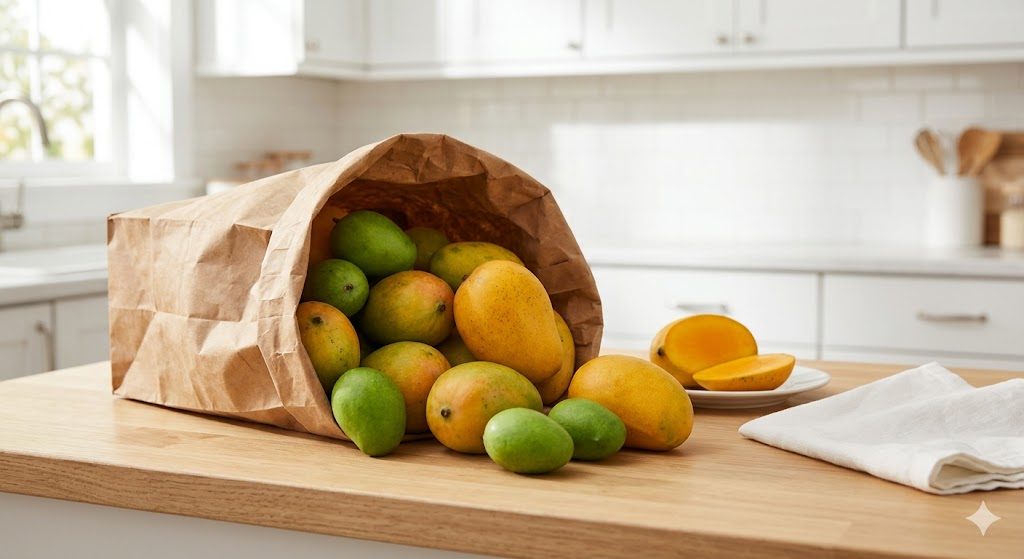
Yes. Export-grade Indian mangoes reaching Texas are objectively safer to eat than most domestic Indian market mangoes. The reason is not that Indian mangoes are unsafe — it’s that the export supply chain applies four layers of protection (registered orchards, hot water fungicidal dip, chlorinated wash, and 400 Gy irradiation) that domestic channels rarely apply. Every box you receive from us carries USDA-APHIS documentation that your Mumbai mandi mango never had.
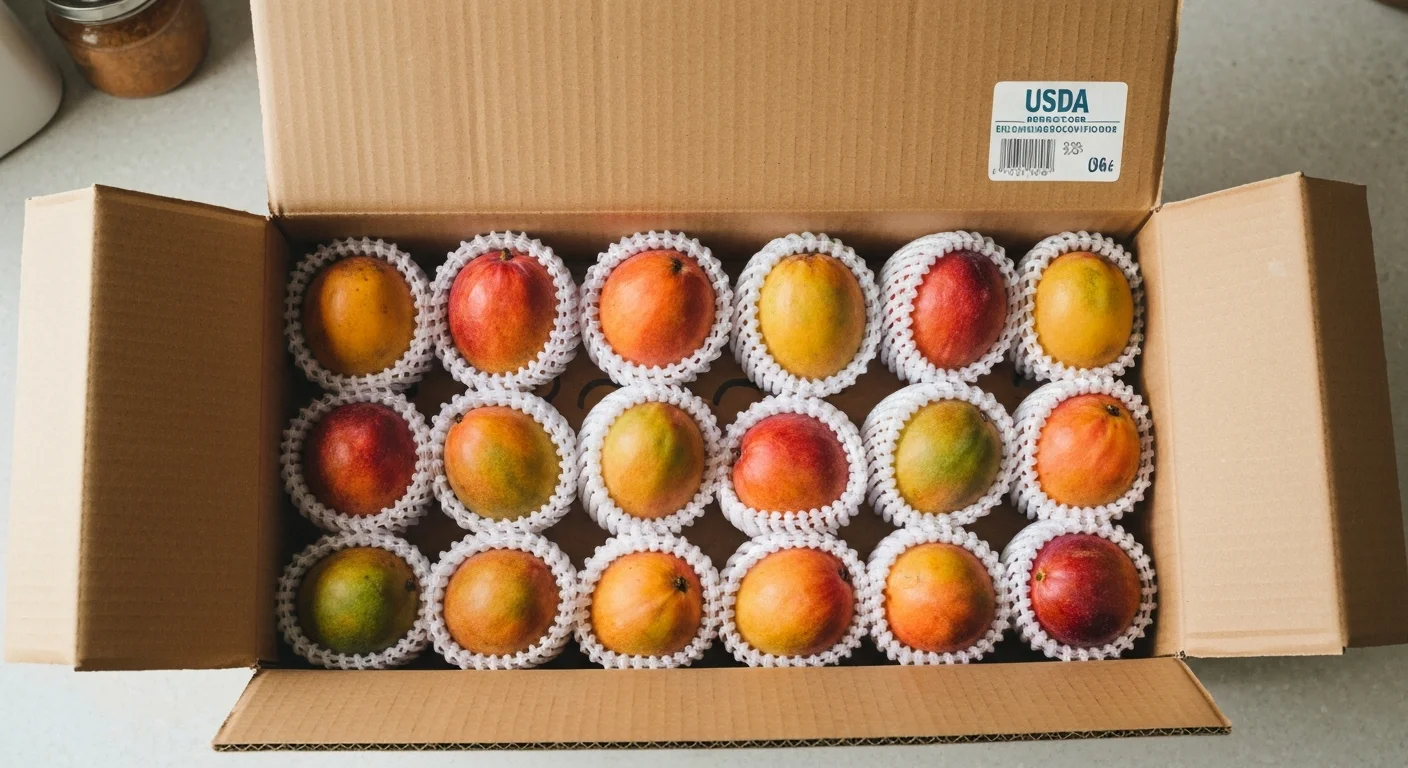
This is a nuanced topic, and the answer surprises most of our customers in Austin, Dallas, Houston, and San Antonio. When we tell people their $50-$60 box is safer than the ₹300 box their cousin ate last week in Hyderabad, they don’t believe us at first. But the data is clear. Let me walk through it honestly — including the places where domestic Indian mangoes beat us (spoiler: flavor, sometimes).
Export Versus Domestic: What “Quality” Actually Means
Export and domestic mangoes are not two grades of the same thing. They are two entirely different handling pipelines. The fruit from the same farm can go through either, and the outcomes diverge sharply.
Export quality means uniformity, appearance, durability, and regulatory compliance. The mango is selected for its ability to survive a 9,000-mile journey and still look and taste good when a Texas family opens the box. Every step is documented.
Domestic quality in India spans the full spectrum — from pristine Mumbai premium supermarket fruit at ₹1,200 per dozen to roadside-vendor mangoes with latex scars at ₹200 per dozen. Both can be delicious. Neither is documented.
The Farm: Registered vs. Unregistered
Export mangoes can only come from orchards registered under the USDA-APEDA preclearance program. These orchards follow Good Agricultural Practices (GAP), document their pesticide use, submit to regular inspections, and can be traced by farm ID.
Domestic market mangoes come from registered and unregistered orchards alike. The ₹200 dozen at your neighborhood market may have been harvested from a GAP-compliant farm or from an uncle’s backyard tree sprayed with whatever was cheapest last month. There is no way to tell.
For our nine-variety lineup — Alphonso, Kesar, Banginapalli, Chinna Rasalu, Himayath, Suvarna Rekha, Mallika, Dasheri, and Totapuri — every single fruit comes from a registered source. We don’t have the option to buy from an unregistered farm even if we wanted to.
Harvest and Handling
This is where most of the real safety difference originates.
Export pipeline:
- Mangoes harvested at precise physiological maturity based on measured Brix and color cues
- Stem trimmed to 0.5 to 1.0 cm retention (a practice we cover in our guide on how to read a mango box label)
- Immediate desapping in inverted racks to prevent latex burn
- Chlorinated wash to remove field bacteria, soil, and pesticide residue
- Hot water fungicidal dip at 52°C for 3-4 minutes to kill anthracnose and post-harvest pathogens
- Optical or weight-based grading to reject damaged fruit
- Individual foam wrap inside ventilated export cartons
- Pre-cooling to 10-13°C before the cold chain begins
Domestic pipeline:
- Mangoes often harvested early to survive slow mandi transit
- Stacked loosely in wicker baskets or crates
- Latex burns visible on 20-40% of the fruit
- Washing is rare and inconsistent
- Hot water fungicidal treatment is rarely performed for domestic retail
- Grading is manual and loose
- Paper or newspaper padding
- No pre-cooling in most small-scale supply chains
The Treatment Table
Here is where the export pipeline pulls ahead dramatically.
| Factor | Export (to USA) | Domestic India |
|---|---|---|
| Stem trim precision | 0.5-1.0 cm, measured | Rough-cut or long |
| Desapping | Mandatory, racks | Inconsistent |
| Chlorinated washing | Required | Often skipped |
| Hot water fungicidal dip (52°C) | Required — kills anthracnose | Rarely performed |
| Optical grading | Strict, computerized | Manual, loose |
| Irradiation (400 Gy+) | Mandatory for US import — eliminates fruit fly and pulp weevil | Not required |
| Cold chain | 10-13°C, unbroken | Frequently broken — ambient 35-42°C |
| Packaging | Individual foam wrap, ventilated | Loose crates, paper padding |
| Traceability | Farm-to-port documentation | Virtually none |
| Pesticide residue testing | FDA MRL-tested, rejected lots destroyed | Inconsistent enforcement |
The Calcium Carbide Problem
This is the single safety risk most Indian domestic consumers do not talk about openly, but it is real and well-documented. Calcium carbide is a compound that releases acetylene gas when exposed to moisture. Acetylene mimics ethylene, the natural ripening hormone in fruit. Wholesalers in some Indian mandis use calcium carbide to force-ripen unripe mangoes in 24-48 hours so they can reach retail at peak season color.
The problem is that commercial-grade calcium carbide contains trace amounts of arsenic and phosphorus. FSSAI (India’s Food Safety and Standards Authority) banned the practice in 2011. Enforcement has improved but remains inconsistent, particularly at smaller wholesale markets. A 2019 study by the Food Safety and Standards Authority found detectable residues in 17% of sampled Indian retail mangoes.
Export mangoes cannot be calcium-carbide-ripened. The USDA-APEDA preclearance program requires tree-maturity harvesting and documented ripening protocols. Irradiation and the treatment chain would also destroy the artificial ripening effect. In 15+ years of Indian mango exports to the US, there has been zero documented case of calcium carbide contamination in an inspected shipment.
When you eat a Swadeshi Alphonso in Austin, you know it was tree-matured, not carbide-forced.
Cold Chain: The Silent Safety Factor
Food safety researchers will tell you the single biggest determinant of fresh produce safety is the cold chain. Keep fruit below 13°C from packhouse to consumer and you suppress 95% of microbial growth risk. Break that chain for even two hours at Texas July temperatures and the risk profile changes.
Export mangoes maintain 10-13°C from India packhouse to Texas agent refrigerator. We cover the full timeline in our shipping timeline post.
Domestic Indian mangoes often sit in ambient 35-42°C summer mandi temperatures for 12-48 hours before reaching retail. That is not the mango’s fault. It is the reality of a distributed agricultural supply chain with limited refrigeration infrastructure in many regions.
Irradiation: The USDA Quarantine Treatment
Every Indian mango entering the US is irradiated at a minimum dose of 400 Gray under USDA-APHIS supervision. This eliminates internal pests including the mango pulp weevil, mango seed weevil, and oriental fruit fly. It does not make the mango radioactive, does not alter the flavor or nutrition in any meaningful way, and is endorsed by the FDA, WHO, and USDA as safe. Read the FDA food irradiation fact sheet for details.
Domestic Indian mangoes are not irradiated. A domestic market mango from Ratnagiri in May can contain viable fruit fly eggs inside the fruit. You will not know unless you spot larvae when you cut it open. The frequency of this is low in practice (most commercial orchards apply field-level pest control) but it is not zero.
Traceability
Every export mango can be traced back to its specific orchard, harvest date, packhouse batch, irradiation facility, treatment date, flight manifest, and US port of entry. If a problem is found, the source can be identified and corrected within days. This is the entire point of the preclearance program.
Domestic Indian mangoes have essentially zero traceability. If a mango gives you a stomachache in Hyderabad, you cannot find the farm, the ripening agent used, or the supply chain stop where something went wrong. This is not unique to mangoes — it is true of most Indian fresh produce sold through traditional markets. It is changing slowly with premium retail chains but the general rule holds.
Where Domestic Mangoes Win
I want to be honest about this because it’s the part most exporters won’t say.
A tree-ripened Ratnagiri Alphonso, bought from a roadside vendor in Maharashtra in May, can taste better than any export-grade Alphonso we ship to Texas. Not “equally good” — better. The reason is simple: it was allowed to ripen on the tree to full sugar development before cutting.
Export mangoes are harvested at physiological maturity but pre-ripeness to survive irradiation, 18-hour air freight, customs, and retail distribution. They ripen in transit or at your kitchen counter in Texas. This is still an excellent mango — intensely flavorful, saffron-orange, fiberless — but it’s not the absolute peak of what the variety can achieve at its tree.
What arrives in your Austin or Houston kitchen is still dramatically better than any grocery store mango available in the US (we’ve written about this in detail), but a Ratnagiri farmer’s kitchen table in May remains the gold standard. That’s the honest reality.
Price Versus Safety Math
Let’s talk money. An export-grade Alphonso box costs $50-$80 in Texas (2026 season pricing $50-$60 reflects import tariff and air-freight fuel surcharges; standard range is $45-$60 with premium varieties up to $80). A premium Mumbai supermarket box costs ₹800-1200 (about $10-15). A ₹300 ($3-4) roadside box in Maharashtra is cheaper still. Many of our customers ask why the US price is 3-10 times higher.
The premium pays for the entire safety chain we’ve just described — registered farms, chlorinated wash, hot water fungicidal dip, irradiation, USDA inspection, cold-chain air freight, individual wrapping, and documented traceability. Those layers don’t exist at the ₹300 price point in India. You get a great-tasting mango but you don’t get the safety verification.
For some families, the tree-ripened flavor justifies the gamble on the ₹300 mango. For others — especially families with young children, pregnant women, or immunocompromised members — the certified, documented, irradiated export mango is the safer choice, even at 3-10× the price. Read our guide on mangoes during pregnancy for more on this.
What This Means for Texas Families
When you buy a Swadeshi Alphonso, Kesar, or Banginapalli box for pickup in Austin, Round Rock, Dallas, Frisco, Houston, Sugar Land, or San Antonio, you’re getting the most safety-verified Indian mango the country exports. This is not marketing language. It is the literal regulatory reality of the USDA preclearance program.
For families who grew up eating Indian mangoes in India and miss that flavor, the export mango recovers about 85-90% of the peak tree-ripened experience with 100% of the regulatory safety. That trade-off is the product we sell.
Practical Advice If You’re in India
For the record, if you’re in India reading this: you can still reduce your domestic mango safety risk significantly.
- Wash thoroughly. Run each mango under water for 30 seconds. Rub with salt or baking soda if you want extra surface cleaning.
- Avoid chemical smells. A ripe mango should smell like mango near the stem. If you detect any chemical or garlic-like smell, skip that fruit. Calcium carbide leaves a garlic-sulfur note.
- Buy from known sources. Farm-direct, family connections, or established premium retailers are safer than open mandi purchases.
- Refrigerate after purchase. Even domestic mangoes benefit from cooling once ripe.
- Inspect inside. If you cut a mango and see tunnels or larvae, discard the entire fruit.
Frequently Asked Questions
Are Indian mangoes sold in Texas safe to eat?
Yes. Every legal Indian mango entering the US goes through USDA-APHIS supervised irradiation at 400 Gy, hot water fungicidal dip, chlorinated wash, and documented traceability. The regulatory safety is significantly higher than typical domestic Indian market mangoes. Millions of Indian mangoes are consumed in the US every season with effectively zero documented food-safety incidents.
What is calcium carbide and are my Swadeshi mangoes affected?
Calcium carbide is a compound used illegally in some Indian domestic markets to force-ripen unripe mangoes. Commercial-grade carbide contains trace arsenic and phosphorus, which is why it’s banned by FSSAI. Export mangoes to the US cannot be carbide-ripened — the USDA preclearance protocol requires tree-maturity harvesting and supervised ripening. Swadeshi mangoes are not carbide-ripened. Ever.
Does irradiation make the mango less safe or nutritious?
No. Food irradiation at 400 Gy is endorsed by the FDA, WHO, USDA, and CDC as safe. The treatment does not make mangoes radioactive, does not leave chemical residues, and does not meaningfully change vitamin or nutrient content. Irradiation actually improves safety by eliminating pathogens and parasites that unirradiated fruit may carry.
Can I really taste the difference between export and domestic Indian mangoes?
Sometimes. Tree-ripened domestic mangoes eaten within hours of harvest can taste 10-15% more intense than export mangoes because sugar development continues until picking. Export mangoes are picked at physiological maturity and ripened in transit, which gives excellent but not absolute peak flavor. Both experiences are deeply satisfying compared to US grocery store mangoes.
Why doesn’t India require the same safety protocols for domestic mangoes?
Regulatory infrastructure, cost, and enforcement capacity. India’s domestic market serves over a billion consumers across thousands of markets. Implementing chlorinated wash, hot water fungicidal dip, cold chain, and irradiation at every step would dramatically increase mango prices and exceed current enforcement capacity. Export pipelines are feasible because volumes are smaller and prices absorb the cost.
Scientific Consensus and Authoritative Citations
If you want to verify any of the safety claims in this article, here is the consensus position of every major food safety body in the world. Irradiation has been studied since the 1950s. More than 500 peer-reviewed studies on food irradiation are indexed in PubMed. More than 60 countries approve irradiation for food.
Government and International Health Bodies
- US Food and Drug Administration (FDA): “Food irradiation is a technology that improves the safety and extends the shelf life of foods.” See the FDA Food Irradiation fact sheet.
- Centers for Disease Control (CDC): “Irradiation does not make foods radioactive, compromise nutritional quality, or noticeably change taste, texture, or appearance.” See the CDC Food Irradiation page.
- USDA Food Safety and Inspection Service: Approves irradiation for pathogen reduction and pest disinfestation. See USDA FSIS Irradiation and Food Safety.
- World Health Organization (WHO): The 1999 Joint FAO/IAEA/WHO Study Group concluded that food irradiated to any dose is safe and nutritionally adequate. WHO Technical Report Series 890, “High-Dose Irradiation: Wholesomeness of Food Irradiated with Doses Above 10 kGy.” See WHO TR 890.
- International Atomic Energy Agency (IAEA): Coordinates international food irradiation research and provides safety guidelines. See IAEA Food Irradiation.
Medical and Scientific Organizations
- American Medical Association (AMA): 1993 House of Delegates resolution, reaffirmed 2004 — endorses food irradiation as safe and effective.
- Academy of Nutrition and Dietetics (formerly American Dietetic Association): Position paper supporting food irradiation as a safe technology that reduces foodborne illness. Published in the Journal of the American Dietetic Association, 2000 and reaffirmed 2009.
- Institute of Food Technologists (IFT): Scientific Status Summary, 2004 — comprehensive scientific review confirming the safety and nutritional adequacy of irradiated foods.
- American Council on Science and Health: Multiple position papers supporting food irradiation as one of the most extensively studied food technologies in history.
Specific to Indian Mango Irradiation
- USDA APHIS, 7 CFR 319.56: The federal regulation specifying 400 Gy minimum dose for Indian mangoes to control fruit fly, mango pulp weevil, and mango seed weevil.
- Federal Register Notice, 2007: Final rule admitting Indian mangoes into the US under the irradiation protocol after 18 years of import ban (1989-2007). See our companion post on why the US banned Indian mangoes for 18 years.
- APEDA (Agricultural and Processed Food Products Export Development Authority of India): Manages USDA-approved irradiation facilities across India.
- Bhabha Atomic Research Centre (BARC): Operates the KRUSHAK facility in Lasalgaon, Maharashtra — India’s first commercial agricultural irradiator and a key node in the mango export chain.
Peer-Reviewed Research
- Farkas, J. and Mohacsi-Farkas, C. (2011). “History and future of food irradiation.” Trends in Food Science & Technology, 22(2-3), 121-126.
- Kume, T., Furuta, M., Todoriki, S., et al. (2009). “Status of food irradiation in the world.” Radiation Physics and Chemistry, 78(3), 222-226.
- Diehl, J.F. (2002). “Food irradiation – past, present and future.” Radiation Physics and Chemistry, 63(3-6), 211-215.
- Multiple studies on irradiated mango quality in Food Chemistry, Postharvest Biology and Technology, and the Journal of Food Science.
The 70-Year Safety Record
Food irradiation has been actively researched since 1947 and commercially used since the 1960s. Astronauts have eaten irradiated food on NASA missions since the Apollo program. Hospital patients on immunocompromised diets routinely receive irradiated meals. Spices, herbs, and tropical fruits sold across the United States have been irradiated for decades. In all that time, across millions of metric tons of irradiated food consumed globally, there is no documented case of consumer harm caused by the irradiation itself.
That track record is the reason the World Health Organization’s 1999 Study Group concluded there is no upper dose limit needed for food safety. Irradiation works at the molecular level on pathogens and pests, leaves no residue, and does not transmit any radioactivity to the food. The science is settled.
The Bottom Line
Export Indian mangoes to the US are not compromised versions of domestic Indian mangoes. They are a different product — one engineered for maximum safety, traceability, and consistency, at the cost of some peak flavor that tree-ripening alone can deliver. For Texas families, that trade-off is the correct one. You get a genuinely premium mango, regulatory safety you cannot replicate at home, and the confidence that every fruit in your box was documented from the orchard to your kitchen.
This is not marketing. It is the regulatory reality of the USDA preclearance program. And it is a real reason to feel good about what we ship.