Tag: akbar

  • Akbar’s 100,000 Mango Trees: Mughal Orchards of Darbhanga

    Akbar’s 100,000 Mango Trees: Mughal Orchards of Darbhanga

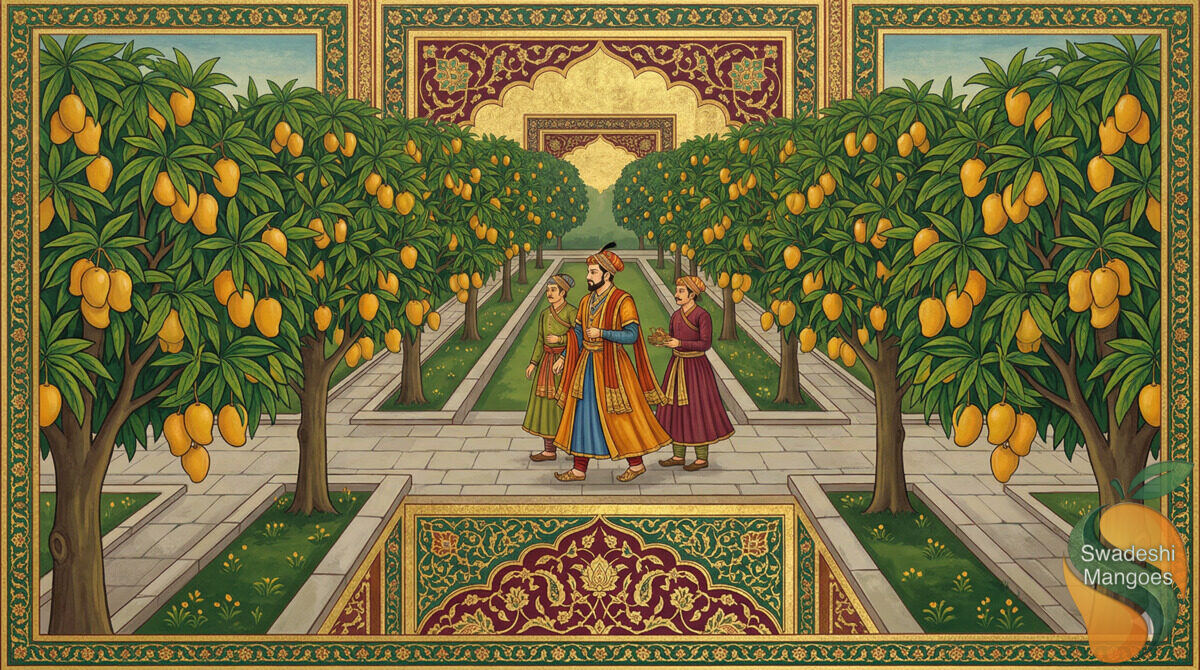
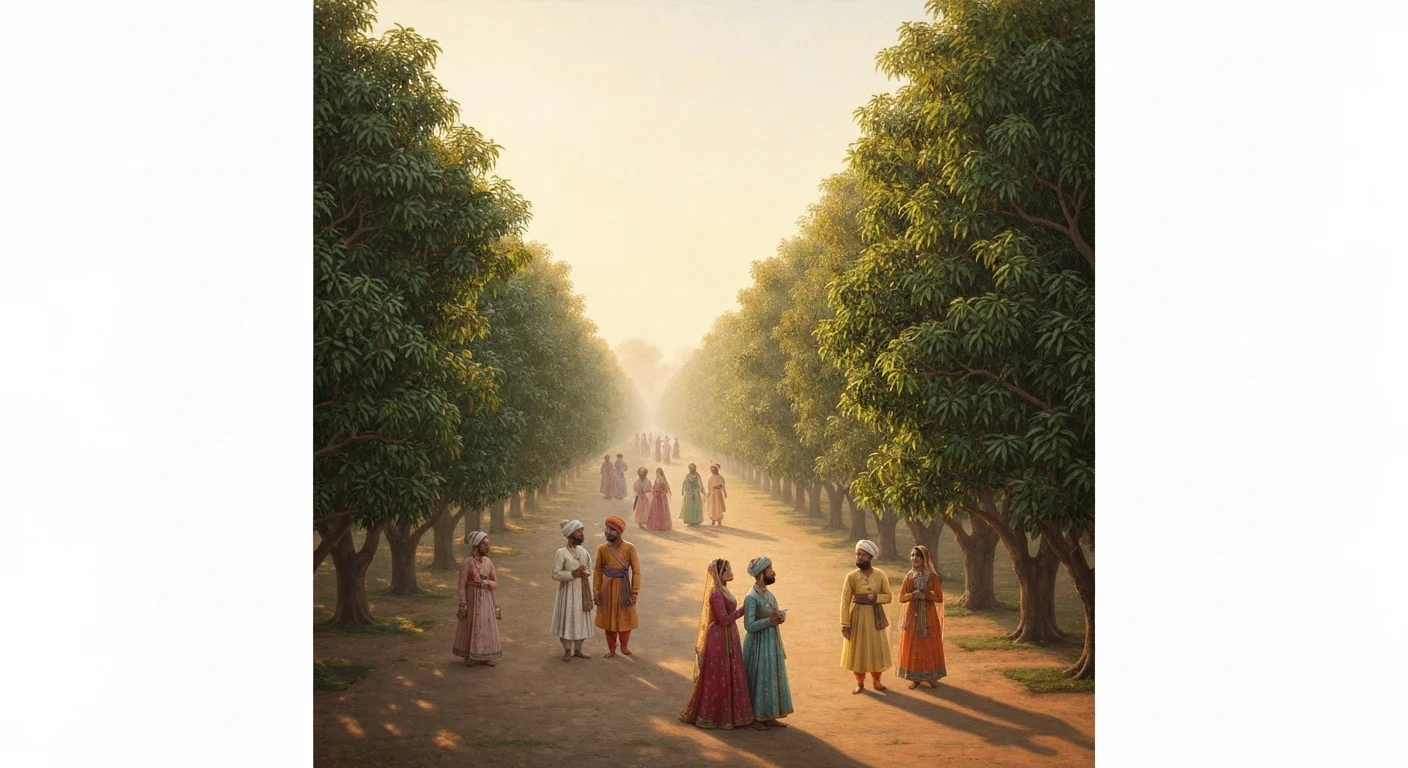
    Sometime in the 1580s, Mughal Emperor Akbar ordered the planting of an orchard containing one hundred thousand mango trees at Darbhanga in what is now Bihar, a site remembered in Persian and Mithila records as the Lakhi Bagh, literally the garden of a hundred thousand. The orchard was both a work of imperial horticulture and a cultural statement, and its lineage of grafted cultivars shaped the mango varieties that Indian-American families in Round Rock, Houston, and Dallas enjoy today through modern import channels.

    The Emperor Who Loved Mangoes

    Abu’l-Fazl ibn Mubarak, Akbar’s court historian, wrote in the Ain-i-Akbari, completed in 1590, that the emperor held the mango in higher regard than nearly any other fruit. Abu’l-Fazl’s chapter on fruits describes mango cultivars by region, documents pickling and preserving techniques, and records Akbar’s personal preference for the fruit of eastern India. Modern translations by scholars including H. Blochmann and H.S. Jarrett remain accessible through archive.org and university libraries.

    Akbar’s Horticultural Ambition

    Mughal rulers from Babur onward had maintained ornamental gardens, but Akbar’s approach was systematic. He ordered the collection of cultivars from across his empire, commissioned grafting experiments, and directed the planting of orchards near strategic centers. The mango, native to the Indian subcontinent and domesticated for roughly four thousand years, was the centerpiece of this program.

    The Lakhi Bagh at Darbhanga

    Darbhanga, in the Mithila region of modern Bihar, was a culturally important city associated with Maithili scholarship and the Raj Darbhanga. According to regional chronicles preserved in the Khuda Bakhsh Oriental Public Library in Patna, Akbar ordered the planting of the Lakhi Bagh during one of his eastern campaigns, possibly around 1580-1590.

    Why One Hundred Thousand

    The number was not merely ornamental. An orchard of that scale guaranteed a continuous supply of ripe fruit across the long mango season, provided material for the royal kitchens and courtly gifts, and created a living demonstration of imperial reach. Courtiers from Kabul to Bengal received mangoes from the Lakhi Bagh, turning the fruit into a diplomatic currency.

    Timeline of Mughal Mango Cultivation

    YearEvent
    1526Babur conquers northern India; notes Indian fruits in Baburnama
    1556-1605Akbar’s reign; expansion of Mughal horticultural program
    c. 1580-1590Lakhi Bagh of 100,000 mango trees planted at Darbhanga
    1590Ain-i-Akbari completed; mango cultivars cataloged
    1627-1658Shah Jahan’s reign; refinement of Malda and Langra cultivars
    1658-1707Aurangzeb exchanges mangoes as diplomatic gifts across the Islamic world

    Grafting: The Real Innovation

    The Lakhi Bagh was not simply one hundred thousand seedling trees. Mughal horticulturists had mastered grafting, the technique of joining a desired cultivar onto a rootstock so that every resulting tree produces identical fruit. Without grafting, mango seeds produce wildly variable offspring. With grafting, an orchard can produce uniform, premium fruit across decades.

    Persian and Sanskrit Horticultural Knowledge

    Mughal gardeners drew on both Persian botanical tradition and older Sanskrit agricultural texts such as the Vrikshayurveda, attributed to Surapala. This fusion of knowledge systems produced techniques that remain in use in Indian orchards today, from Ratnagiri to Krishna District.

    Named Cultivars of the Mughal Era

    Several mango varieties familiar in modern times trace their names and sometimes their lineage to the Mughal period. Langra of Banaras, Malda of Bihar, Dussehri of Lucknow, and Chaunsa, named by emperor Sher Shah Suri after his victory at Chausa in 1539, all have documented origins in this era. Abu’l-Fazl lists several by name.

    The Cultural Prestige of Named Fruit

    To own a Langra tree or serve Malda at a royal banquet was a sign of refinement. The practice of naming cultivars after places, rulers, or physical characteristics took root in this era and continues today in varieties like Alphonso, named for sixteenth-century Portuguese nobleman Afonso de Albuquerque.

    From Mughal Orchard to Texas Table

    The cultivars perfected during the Mughal era are not abstractions; they are living inheritances. When a family in Round Rock or Houston opens a box of Kesar from Gujarat or Langra from Uttar Pradesh, they are eating fruit whose pedigree reaches back to the horticultural systems codified under Akbar and refined by his successors.

    What Swadeshi Mangoes Delivers

    Swadeshi Mangoes sources nine Indian varieties for Texas delivery during the April-July season, including several cultivars with Mughal-era heritage. Our varieties page describes each fruit’s regional origin, and our order form shows current availability. Texas diaspora families in Dallas, Austin, San Antonio, and Houston can taste cultivars whose lineages stretch back more than four centuries.

    What Remains of the Lakhi Bagh Today

    The original Darbhanga orchard did not survive the centuries intact. Subsequent rulers, colonial land revenue systems, and twentieth-century urbanization reduced the site to fragments. Local residents still point to old mango groves in the Mithila region as descendants of the imperial planting, and Bihar’s horticultural department has, at various times, proposed commemorative replanting projects.

    Living Mughal Orchards

    While the Lakhi Bagh itself is largely gone, other Mughal-era orchards persist. The mango groves around Malihabad near Lucknow, famous for Dussehri, include trees that local growers maintain are several hundred years old. These sites function as living museums of subcontinental horticulture.

    Why This History Matters in Texas

    The Indian diaspora in Texas is one of the fastest-growing in the United States, concentrated in the Houston, Dallas-Fort Worth, and Austin-Round Rock regions. For these families, mangoes are not simply fruit; they are edible links to a civilization whose horticultural sophistication predates American statehood by two centuries. Read more historical explorations on our blog.

    Mughal Mango Rituals and Court Life

    The Mughal court treated the mango season as a cultural event. Abu’l-Fazl records that specially selected mangoes were cooled in Himalayan ice, a remarkable logistical achievement in the sixteenth century, and served to the emperor in individual silver bowls. Jahangir, Akbar’s son, continued this tradition and described his own favorite mangoes in the Tuzuk-i-Jahangiri, his memoir, translated by Alexander Rogers and Henry Beveridge in the early twentieth century. Jahangir expressed his preference for certain southern Indian varieties and praised the fruit as the finest in the Mughal realm.

    Mango Gifting as Political Currency

    Sending boxes of named mangoes to allied courts, regional governors, and visiting dignitaries became standard diplomatic practice. The seasonal shipment of Langra, Dussehri, or Malda between Mughal centers signaled political favor and imperial inclusion. Contemporary Indian and Pakistani heads of state continue a version of this tradition today, and Texas diplomats and academic institutions have sometimes been recipients of ceremonial mango shipments coordinated through APEDA.

    From Mughal Horticulture to Modern Indian Agriculture

    The horticultural infrastructure that Akbar and his successors built did not vanish with the empire. Cultivation techniques, grafting knowledge, and orchard designs were preserved through colonial-era agricultural departments, which documented Indian mango varieties in botanical surveys during the nineteenth century. Writers including Sir George Watt, whose Dictionary of the Economic Products of India was published in the 1890s, catalogued hundreds of named cultivars, many tracing their lineage back to Mughal-era patronage.

    Post-Independence Research

    After 1947, institutions like the Indian Agricultural Research Institute in New Delhi, the Central Institute for Subtropical Horticulture in Lucknow, and state agricultural universities continued to maintain germplasm banks of historic Mughal-era cultivars. This institutional memory ensures that cultivars documented by Abu’l-Fazl in 1590 are still recognizable to botanists today, and that the fruit reaching Texas tables is genuinely descended from the orchards of Mughal India.

    The Darbhanga Raj and Regional Preservation

    The Darbhanga Raj, which rose to prominence in Bihar during the seventeenth and eighteenth centuries, preserved Mughal-era horticultural practices in the Mithila region long after the imperial center declined. The Darbhanga royal family maintained mango groves as part of their estate agriculture well into the twentieth century. Some of the older trees documented in regional surveys from the 1950s and 1960s were estimated to be several centuries old, potentially descended from Akbar’s Lakhi Bagh planting.

    FAQ

    Did Akbar really plant one hundred thousand mango trees?
    The Lakhi Bagh at Darbhanga is documented in Mughal-era chronicles and Mithila regional histories. While precise tree counts in premodern records can be approximate, Abu’l-Fazl’s Ain-i-Akbari confirms Akbar’s large-scale horticultural program, and the name Lakhi Bagh literally means the garden of a hundred thousand in Hindi and Persian usage.

    What is the Ain-i-Akbari?
    The Ain-i-Akbari is the third volume of the Akbarnama, a detailed administrative gazetteer of Akbar’s empire compiled by his court historian Abu’l-Fazl and completed around 1590. It contains chapters on administration, revenue, military organization, and extensive descriptions of fruits, including the mango, with regional cultivars and preparation methods.

    Which modern varieties come from the Mughal era?
    Langra, Dussehri, Malda, and Chaunsa are all cultivars with documented origins in the Mughal period. Chaunsa was reportedly named by Sher Shah Suri after his 1539 victory at Chausa, while Dussehri traces to the Malihabad region near Lucknow. These varieties are still cultivated commercially and available for legal US import.

    Can I buy Mughal-heritage mangoes in Texas?
    Yes. Several of the nine varieties sold through Swadeshi Mangoes, including Kesar from Gujarat and Banganapalli from Andhra Pradesh, carry cultivar lineages shaped by Mughal-era grafting and selection. Texas customers in Houston, Dallas, Austin, and Round Rock can order these during the April-July season via our order form.

    Does the Lakhi Bagh still exist?
    The original orchard at Darbhanga did not survive as a single contiguous site. Local residents in the Mithila region point to surviving mango groves as descendants, and Bihar’s horticultural authorities have at times discussed commemorative replanting. Meanwhile, other Mughal-era orchards such as those at Malihabad near Lucknow still produce fruit today.

    External references: Wikipedia: Ain-i-Akbari, Wikipedia: Akbar, APEDA India.
  • Why Indian Mangoes Are Special: 4,000 Years of the King of Fruits

    Why Indian Mangoes Are Special: 4,000 Years of the King of Fruits

    India grows over 1,500 named varieties of mango — more than any other fruit in any country on Earth. Indians have cultivated mangoes for over 4,000 years, and the fruit is woven into the country’s history, art, religion, poetry, and daily life in ways that no other fruit can match. Related: parallels with Texas peach farming.

    If you have ever wondered why your Indian neighbors get so excited about mango season, or why someone would pay $50 for a box of fruit when grocery store mangoes cost $2 each — this is the story behind that passion.


    Ancient Origins: 4,000 Years of Cultivation

    The mango (Mangifera indica) is believed to have been first cultivated in the Indian subcontinent over 4,000 years ago, with wild ancestors originating in northeastern India, Myanmar, and Bangladesh.

    • The Sanskrit word for mango is amra — the root of “aam” in Hindi, which every Indian child learns as one of their first words.
    • The Brhadaranyaka Upanishad (c. 700 BCE), one of the oldest Hindu scriptures, references the mango tree.
    • Buddhist texts (c. 400 BCE) describe mango groves as places of rest and meditation. The Buddha himself was gifted a mango grove — Jivaka’s mango grove in Rajagriha — for meditation.
    • The Chinese Buddhist pilgrim Xuanzang (Hieun Tsang), who visited India in the 7th century CE, documented mango orchards extensively in his travelogues.

    Sources: K.T. Achaya, “Indian Food: A Historical Companion,” Oxford University Press, 1994; “The Upanishads,” translated by Patrick Olivelle, Oxford World’s Classics, 1996; Pali Canon (Vinaya Pitaka).


    The Mughal Era: When Mango Became Royalty

    Mughal miniature painting style illustration of a grand mango orchard with golden fruits

    The Mughal emperors transformed mango cultivation from farming into a refined horticultural science. Their obsession with the fruit gave us many of the varieties we eat today.

    • Emperor Akbar (r. 1556–1605) planted the legendary Lakhi Bagh — a “Garden of 100,000 Trees” — near Darbhanga, Bihar. It was one of the largest mango orchards ever created, documented by his court historian Abu’l-Fazl in the Ain-i-Akbari.
    • The Mughals practiced sophisticated grafting techniques to develop superior varieties. Many of today’s most prized mangoes — Langra, Dasheri, Chausa — trace their origins directly to Mughal-era orchards in Uttar Pradesh.
    • The name “Alphonso” comes from Afonso de Albuquerque, the Portuguese general who established Goa as a colony in 1510. The Portuguese introduced grafting techniques from Brazil, which Indian farmers applied to local mango rootstock to create what became India’s most celebrated variety.
    • The Sufi poet Amir Khusrau (1253–1325) called the mango “Naghza Tarin Mewa Hindustan”“the fairest fruit of Hindustan.”

    Sources: Abu’l-Fazl, “Ain-i-Akbari,” c. 1595; Lizzie Collingham, “Curry: A Tale of Cooks and Conquerors,” Oxford University Press, 2006; Salma Yusuf Husain, “The Mughal Feast,” Roli Books, 2019.


    One Fruit, Many Identities: Regional Mango Culture

    Every Indian state has “its” mango. The variety you grew up eating is not just a preference — it is identity.

    Maharashtra and Gujarat — Alphonso and Kesar Country

    Alphonso (Hapus) from the Ratnagiri and Devgad districts of Maharashtra’s Konkan coast is considered the gold standard. Families eagerly await “Hapus season” every April, and the first aam ras-puri meal marks the official start of summer. Kesar from Junagadh, Gujarat (GI-tagged since 2011) carries its own devoted following.

    Andhra Pradesh and Telangana — Banginapalli Heartland

    Banginapalli (GI-tagged, named after the town in Kurnool district) is the most popular variety in these states. Suvarna Rekha and Himayath (a Hyderabadi household staple) round out the regional favorites. For Telugu families in Texas, finding authentic Banginapalli is a direct connection to home.

    Uttar Pradesh — The Mughal Mango Belt

    The Malihabad region near Lucknow is called the “Mango Belt.” It is home to Dasheri (from Dasheri village), Langra (named after a lame holy man in Varanasi), and Chausa (named after the Battle of Chausa, 1539). Lucknow’s Nawabi culture elevated mango tasting to an art form comparable to wine tasting.

    West Bengal — Poetry and Mangoes

    Himsagar and Langra hold special status in Bengali culture. Mango motifs are painted during Poila Boishakh (Bengali New Year), and Rabindranath Tagore wrote about mango blossoms in his poetry. The aam-er murabba (mango preserve) is a traditional delicacy.

    South India — Totapuri, Neelam, and More

    Totapuri (also called the Bangalore mango) is a dual-purpose variety — used raw for pickles and dal, and ripe for processing and eating. Chinna Rasalu is an Andhra favorite — small but incredibly sweet and aromatic.

    Source: Rosie Llewellyn-Jones, “Lucknow: City of Illusion”; Regional culinary traditions documented by National Horticulture Board of India.


    Mangoes in Indian Art, Literature, and Ritual

    The Paisley Pattern Is Actually a Mango

    Traditional Indian paisley ambi pattern showing the mango shape in jewel tones

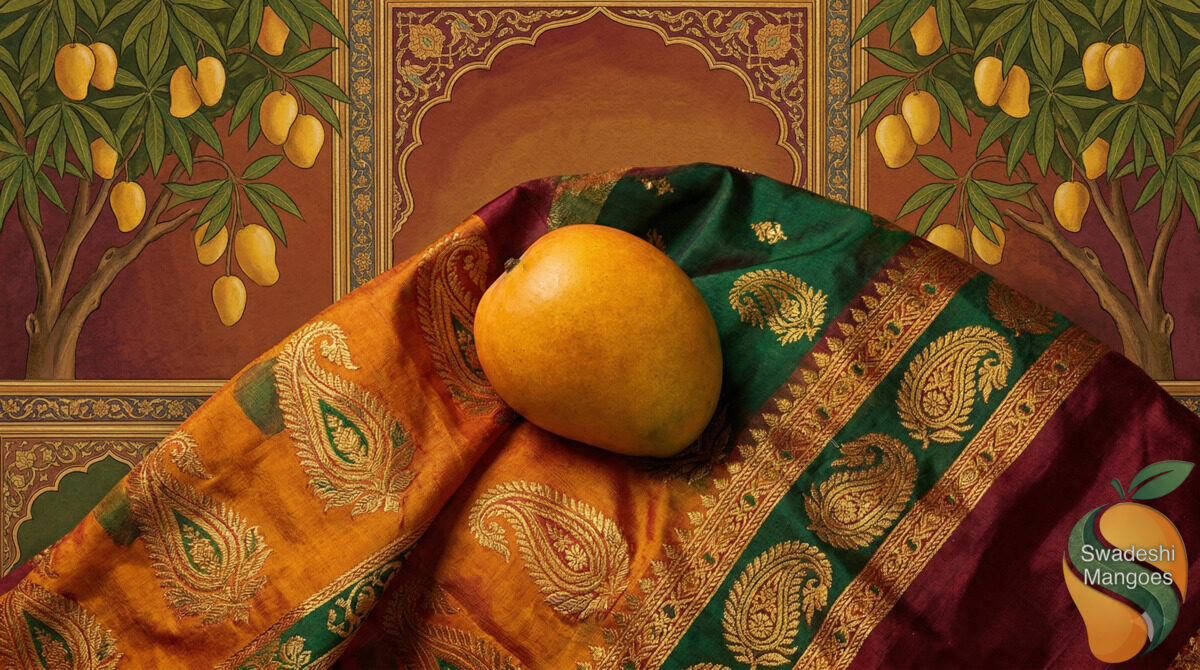
    The paisley motif — called ambi, buta, or kalka in Indian textiles — is derived from the shape of a mango. This design has been woven into Indian fabrics for over 2,000 years and appears on Kashmiri shawls, Banarasi saris, and Mughal architecture. Mango motifs also appear in the Ajanta Cave paintings (2nd century BCE – 5th century CE).

    Source: John Gillow & Nicholas Barnard, “Indian Textiles,” Thames & Hudson; Valerie Reilly, “The Paisley Pattern,” 1987.

    Poets Who Loved Mangoes

    • Kalidasa (c. 4th–5th century CE), the great Sanskrit poet, celebrated the mango blossom in Ritusamhara (The Cycle of Seasons), describing it as a harbinger of spring that intoxicates the cuckoo bird.
    • Mirza Ghalib (1797–1869), the great Urdu poet, was legendarily obsessed with mangoes. When asked what he thought about someone who did not eat mangoes, he reportedly pointed at a passing donkey and replied: “Even donkeys don’t eat mangoes.”

    Sources: Kalidasa, “Ritusamhara,” various translations; Pavan K. Varma, “Ghalib: The Man, The Times,” Penguin India, 1989.

    Mango in Hindu Ritual

    • Mango leaves (toran) are strung over doorways during pujas, weddings, and festivals like Diwali and Ugadi as a symbol of auspiciousness.
    • The pancha pallava (five leaves, often mango) is placed in a water pot (kalash) during Hindu ceremonies.
    • During Ugadi/Gudi Padwa (Hindu New Year in South/West India), raw mango is one of the six tastes in the Ugadi Pachadi dish, representing the bittersweet nature of life.
    • In many regions, the first mango of the season is offered to deities before being consumed by the family.

    Aam Mahotsav — The International Mango Festival

    Organized annually in Delhi since 1987 by the Delhi Tourism Corporation and the National Horticulture Board, the Aam Mahotsav displays over 500–1,000 mango varieties in one place. Competitions include mango-eating contests, mango identification challenges, and best variety awards.


    Why Indian Families in the US Seek Out These Exact Mangoes

    For Indian immigrants and their families, mango season is not just about fruit. It is about memory, identity, and connection.

    Sensory Memory

    Specific mango varieties are tied to childhood summers — school holidays, visits to grandparents’ homes, eating mangoes on the terrace while the ceiling fan whirred overhead. The taste and aroma of an Alphonso or Banginapalli is a direct neural link to those experiences. No supermarket Tommy Atkins will trigger that connection.

    Regional Identity

    Each family has “their” mango. A Maharashtrian family insists on Alphonso. A UP family craves Dasheri or Chausa. A Telugu family needs Banginapalli. Ordering specific varieties is identity expressed through fruit.

    Generational Transmission

    Indian parents in the US want their American-born children to experience the mangoes they grew up with. Making aam ras for kids, teaching them to “suck” a Chausa mango, cutting a Banginapalli “the right way” — these are acts of cultural transmission. The mango becomes a vehicle for passing down food traditions that are harder to replicate abroad.

    The Quality Gap Is Real

    The difference between a Tommy Atkins and an Alphonso is not incremental — it is categorical. Alphonso has roughly 2–3x the sugar content, over 270 volatile aromatic compounds, and a creamy, fiberless texture that supermarket mangoes simply do not have. Indian families are not being “picky.” They are seeking a fundamentally different fruit.

    Source: Litz RE (ed.), “Mango: Botany, Production and Uses,” CAB International, 2009; NPR reporting on “Mango Diplomacy,” 2007.


    “King of Fruits” — More Than a Nickname

    The title “King of Fruits” (Phalon ka Raja in Hindi) is not marketing — it reflects millennia of cultural reverence:

    • India produces approximately 20+ million metric tons of mangoes annually — roughly 40–45% of global production (FAO; National Horticulture Board).
    • The mango is the national fruit of India (also Pakistan and the Philippines).
    • India has historically used Alphonso mango shipments as diplomatic gifts — prime ministers have sent crates to foreign heads of state.
    • The EU’s lifting of an Alphonso import ban in 2015 was treated as a significant diplomatic event, covered by the BBC and international press.
    • Alexander the Great’s army encountered mangoes during the invasion of India in 327 BCE. Arab traders spread it westward. The Portuguese brought it to Africa and Brazil in the 1500s. Every mango in the Western Hemisphere descends from Indian cultivars.

    Frequently Asked Questions

    How many mango varieties exist in India?

    India has over 1,500 named mango varieties. Of these, approximately 30–40 are commercially significant, and 7–10 are regularly exported to the US.

    What does “GI-tagged” mean for Indian mangoes?

    A Geographical Indication (GI) tag certifies that a product originates from a specific region and has qualities unique to that region. GI-tagged Indian mangoes include Banginapalli (Andhra Pradesh, 2017), Gir Kesar (Gujarat, 2011), Dasheri (Uttar Pradesh, 2009), and Jardalu (Bihar, 2018). A GI tag guarantees you are getting the authentic variety from its traditional growing region.

    Why are Indian mangoes considered the best in the world?

    Four thousand years of selective breeding, extreme varietal diversity (1,500+ varieties), unique terroir (India’s tropical climate produces exceptionally high sugar content), and cultural investment in flavor over shelf life combine to make Indian mangoes the global benchmark. Most other countries’ mangoes descend from Indian cultivars but were selected for shipping durability, not taste.


    References

    • Achaya, K.T. Indian Food: A Historical Companion. Oxford University Press, 1994.
    • Abu’l-Fazl ibn Mubarak. Ain-i-Akbari, c. 1595. Translated by H. Blochmann.
    • Collingham, Lizzie. Curry: A Tale of Cooks and Conquerors. Oxford University Press, 2006.
    • Varma, Pavan K. Ghalib: The Man, The Times. Penguin India, 1989.
    • Litz, R.E. (ed.). Mango: Botany, Production and Uses. CAB International, 2009.
    • Alford, Jeffrey & Duguid, Naomi. Mangoes & Curry Leaves. Artisan, 2005.
    • Gillow, John & Barnard, Nicholas. Indian Textiles. Thames & Hudson.
    • Geographical Indications Registry, Chennai: ipindia.gov.in/gi
    • National Horticulture Board of India: Production statistics and Aam Mahotsav documentation
    • FAO Statistical Database: Global mango production data

    Experience the fruit that inspired emperors and poets.

    Order Indian Mangoes in Texas →

    Season: April–July • Explore all varietiesRefer a friend, earn $5

Chat on WhatsApp