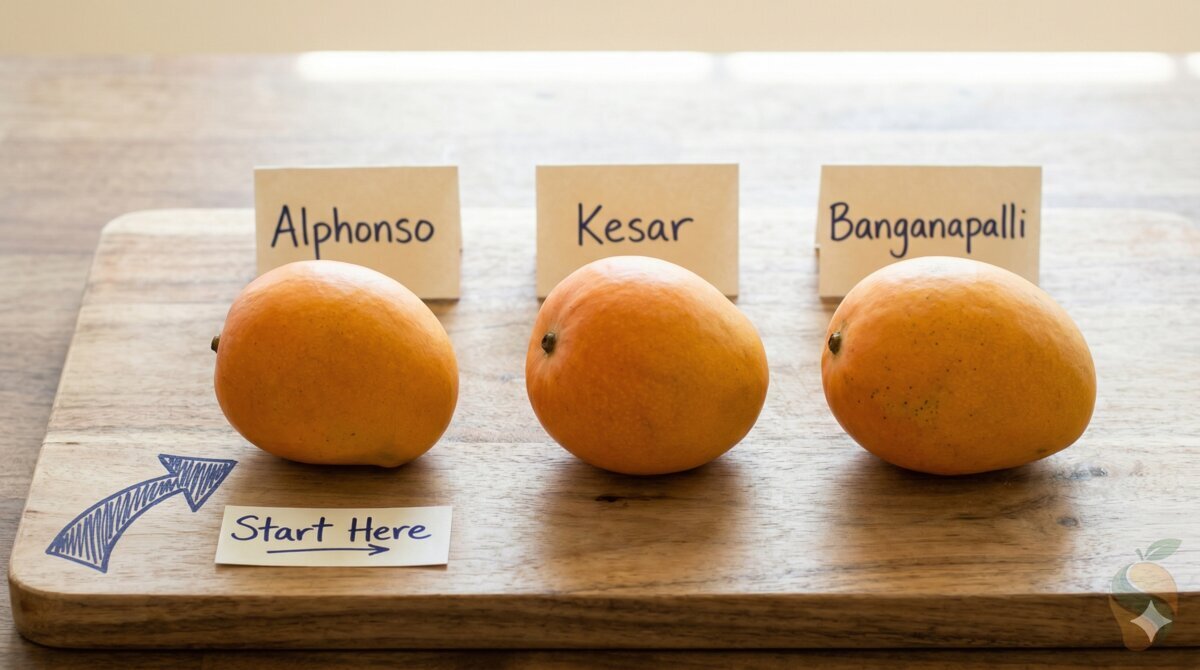
You have heard people talk about Indian mangoes with a reverence usually reserved for religion. You are curious but overwhelmed. There are too many varieties, too many opinions, and everyone has a strong take. This guide is for you.
If you grew up eating grocery store mangoes — Tommy Atkins, Kent, Haden — you have been eating mangoes bred for shelf life, not flavor. Indian mangoes are bred for one thing: taste. The difference is like a winter supermarket tomato versus a sun-warmed heirloom from the vine. Once you try a real Indian mango, there is no going back.
Start Here: The Big Three
There are over 1,000 mango varieties in India. You do not need to know all of them. Start with the three that matter most. For a detailed side-by-side comparison, see our Alphonso vs Banganapalli vs Kesar comparison.
Alphonso — The One Everyone Talks About
If Indian mangoes were a band, Alphonso would be the lead singer. Rich, creamy, zero fiber, deep saffron color. It is the benchmark against which all other mangoes are measured. If you try only one Indian mango, make it this one.
Taste: Buttery, sweet, floral
Texture: Smooth as custard
Best for: Eating fresh, aam ras, ice cream
Alphonso comes from the Ratnagiri and Devgad regions of Maharashtra on India’s western coast. The volcanic soil and microclimate give it a flavor that cannot be replicated anywhere else. When you cut one open, the aroma fills the room — a combination of over 270 volatile compounds, more than most other fruits on Earth.
Kesar — The Aromatic One
Kesar is the mango that fills a room with fragrance when you cut it open. It is slightly less sweet than Alphonso but more aromatic. Many people who try both actually prefer Kesar.
Taste: Sweet with a sharp, heady aroma
Texture: Smooth with minimal fiber
Best for: Lassi, smoothies, eating fresh
Kesar gets its name from “kesar,” the Hindi word for saffron. It originates from Junagadh in Gujarat and has earned a Geographical Indication tag — India’s equivalent of France’s wine appellations. The flavor has a floral-honey character with a slight tartness at the finish. It is also more forgiving than Alphonso in terms of ripening, making it excellent for first-timers.
Banganapalli — The Juicy Giant
The biggest mango you will hold. Banganapalli is all about volume — thin skin, large sliceable flesh, and juice that runs down your chin. It is the crowd-pleaser.
Taste: Sweet, mild, very juicy
Texture: Slightly fibrous but still smooth
Best for: Kids, slicing, shakes
Banganapalli comes from Andhra Pradesh and can weigh up to 350-400 grams — roughly twice the size of an Alphonso. Kids love it because it is easy to slice into cubes and the flavor is sweet without being overwhelming. It also makes the best mango milkshakes because the high juice content blends beautifully.
The Supporting Cast
Once you have tried the big three, there is a whole world to explore:
- Himayath: The “honey mango” — incredibly sweet with a buttery texture. Named “loved by kings” in Urdu. Originated in Hyderabad. Deep orange flesh with caramel undertones unique among mango varieties.
- Mallika: A hybrid with zero fiber and the smoothest texture of any mango. Developed by crossing Neelam and Dasheri — tastes like it was engineered in a dessert lab.
- Totapuri: Tangy and tart. The mango for pickle, chutney, and aam panna. Not sweet enough for eating fresh unless fully ripe. Named for its elongated parrot-beak shape (“tota” means parrot in Hindi).
- Neelam: Small, fragrant, and arrives late in the season when other varieties are done. The season-extender — like the encore at a concert.
- Chinna Rasalu: A beloved Andhra variety with intense sweetness in a small package. Best eaten by squeezing and sucking out the pulp — a truly hands-on mango experience.
- Suvarna Rekha: Named for the golden line along the skin when ripe. A balanced, medium-sweet variety that works well fresh and in recipes.
See our complete Indian mango variety guide for detailed profiles of every variety we carry.
How Indian Mangoes Differ from Grocery Store Mangoes
If you have only eaten mangoes from the produce section, here is the difference:
- Flavor intensity: Grocery store mangoes (Tommy Atkins, Kent) were bred for durability and appearance. Indian mangoes were bred for flavor over centuries. The difference is dramatic.
- Fiber content: Grocery store mangoes have noticeable fiber strands. Premium Indian varieties like Alphonso and Kesar have virtually zero — smooth and custard-like.
- Aroma: Cut a Tommy Atkins and you smell mango. Cut an Alphonso and you smell saffron, honey, citrus, and flowers. The aromatic complexity is on another level.
- Sugar-to-acid ratio: Indian varieties maximize the balance between sweetness and acidity. Each has a distinct profile rather than generic “mango flavor.”
For a deeper look at exactly why the grocery store experience falls short, read our article on why Indian grocery store mangoes do not taste right.
How to Order Your First Box
- If you want the premium experience: Order Alphonso. You will understand the hype.
- If you have kids: Order Banganapalli. Big, easy to eat, crowd-friendly.
- If you want to explore: Order a mixed box with 2-3 varieties and do a tasting.
Visit our order page to place your first order. We deliver to pickup locations across Austin, Dallas, Houston, and San Antonio. Wondering about the price? Our breakdown of why Indian mangoes cost what they cost explains every dollar. For family events, set out three varieties with small cards and let people compare — mango tastings have a way of turning into lively debates.
How to Eat Them
Indian mangoes are shipped slightly firm. Do not eat them immediately. Leave them on the counter at room temperature for 2-3 days until they are fragrant and give slightly when pressed. Then refrigerate for 1 hour before eating — slightly chilled is the perfect temperature.
Cut the cheeks off the seed, score into cubes, and push the skin inside out. Or just bite into it over the sink. No judgment.
There are several traditional methods, and the “right” one depends on the variety:
- The hedgehog cut: Slice the cheeks off, score in a crosshatch pattern, push skin inside out. Cleanest method — works best with Banganapalli and Alphonso.
- The squeeze method: For smaller varieties like Chinna Rasalu, roll and squeeze until the flesh is pulpy, bite off the top, and suck out the juice. Messy, primal, deeply satisfying.
- The aam ras method: Scoop Alphonso or Kesar pulp into a bowl. Add a splash of milk and a pinch of cardamom. Eat with warm puris for the most iconic Indian mango experience.
For detailed ripening and cutting instructions, check our complete mango care guide.
Common First-Timer Mistakes
- Eating them too early: The number one mistake. Indian mangoes arrive firm and need 2-4 days at room temperature. An unripe Alphonso tastes sour and starchy — nothing like the creamy sweetness you were promised. When it gives slightly to pressure and smells fragrant at the stem, it is ready.
- Refrigerating too soon: Cold stops ripening. Only refrigerate after the mango is fully ripe.
- Judging by appearance: Slight brown spots or color variation are normal for naturally ripened fruit and do not affect flavor.
- Comparing to grocery store mangoes: Indian mangoes are much softer when ripe — almost custard-like. This is a feature, not a defect.
- Not ordering enough: Nearly every first-time customer wishes they had ordered more. A box goes faster than you think.
What to Expect
Your first real Indian mango will reset your understanding of what a mango can be. Every mango you have eaten from a grocery store was a rehearsal. This is the performance.
Here is what we hear every season: the first bite is followed by silence. Then a slow nod. Then “where has this been my whole life?” Indian mangoes do not just taste better — they taste different. The complexity, the depth, the way the flavor evolves as you eat from the cheek toward the seed — it is an experience, not just a snack.
Order your first box and join the mango family.
Start Your Mango Journey in Texas
Swadeshi Mangoes delivers to Austin, Dallas, Houston, and San Antonio with 30+ pickup locations. Browse our variety guide to explore all options, check the FAQ page for common questions, or visit the blog for recipes, storage tips, and more.
Frequently Asked Questions
What Indian mango should I try first?
Start with Alphonso — the most universally loved variety with rich, creamy, zero-fiber flesh and a deep saffron color. For exploration, order a mixed box with Alphonso, Kesar, and Banganapalli to experience the range of Indian mango flavors in one order. Most first-timers become repeat customers after their first Alphonso.
Where can I buy Indian mangoes in Texas?
Swadeshi Mangoes delivers fresh, air-shipped Indian mangoes to 30+ pickup locations across Austin, Dallas, Houston, and San Antonio. Mangoes arrive within days of harvest, not weeks, so you get the authentic flavor that grocery stores cannot match. Order online through our order page and select the pickup location closest to you.
How do I know when an Indian mango is ripe?
A ripe Indian mango gives slightly to gentle pressure, like a ripe avocado, and smells intensely fragrant at the stem end. Color varies by variety — Alphonso turns golden orange while Kesar may stay partly green even when ripe — so aroma and feel are more reliable indicators than appearance. Leave mangoes at room temperature for 2-3 days after delivery and visit our ripening guide for detailed instructions on each variety.
Why are Indian mangoes more expensive than grocery store mangoes?
Indian mangoes are air-shipped from India, undergo USDA-required irradiation, and pass through customs inspection before arriving in Texas. Air freight alone costs $12-15 per box. Grocery store mangoes from Mexico travel by truck at a fraction of the cost, but the flavor difference is dramatic. Read our full breakdown of why Indian mangoes cost what they cost to see where every dollar goes.