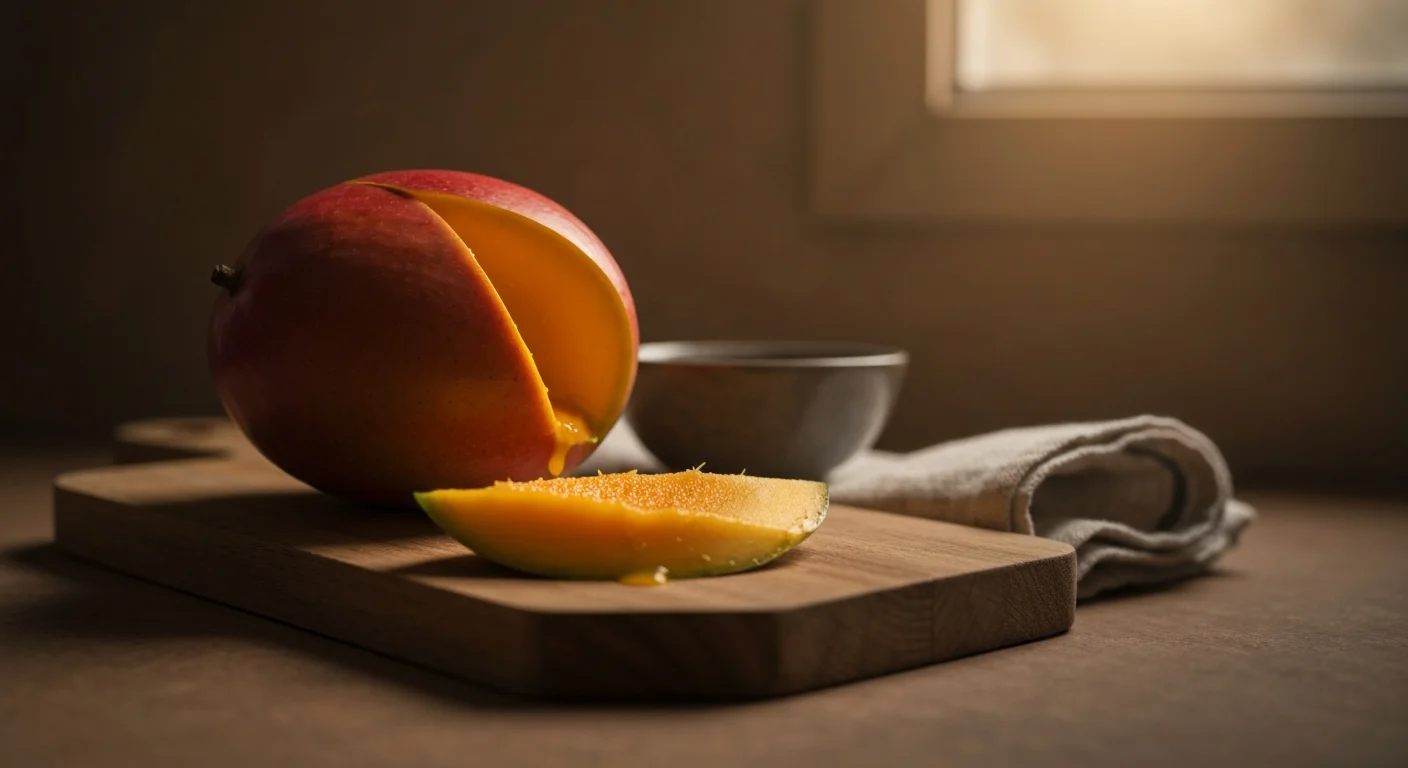
The art of eating an Indian mango is not about forks, plates, or napkins. It’s a ritual with its own rules — and in Andhra Pradesh, the ultimate test is the Nuzvid Rasalu: squeeze, suck, and at the end, the seed must come out white.
Every Indian mango has a proper way to eat it. Most of us don’t learn this from cookbooks. We learn it from our mothers, our grandmothers, and the older cousins who laughed at us when we tried to use a spoon. The ritual is older than we are, older than most cookbooks, and it changes slightly by region, by variety, and by family.
Today I want to share the one I grew up with in Andhra Pradesh — and why, even here in our Texas kitchens, we still do it the same way.
The Nuzvid Rasalu Method: My Childhood’s Ultimate Test
Nuzvid is a small town in Krishna district, Andhra Pradesh. It is famous for one thing: the best Rasalu mangoes in the country. These are small, fiberless, intensely sweet mangoes with thin skin. You’ll find them on our website as Chinna Rasalu — the petite, aromatic variety we ship to Texas during the short May-to-June window.
Here’s how we eat them — and here’s the competition we turned it into as kids:
- Squeeze gently. The mango must be fully ripe. You roll it between your palms for about a minute — not hard enough to break the skin, but firm enough that the flesh inside turns to pulp. You can feel it give way under your fingers.
- Poke a small hole at the top. Just at the stem end, with your thumbnail or a clean knife tip. No bigger than a pea.
- Suck. The pulp comes out through that tiny hole, sweet and silky. No knife, no spoon, no plate.
- Keep squeezing from the bottom. As you suck, you push the pulp up toward the hole. Bottom to top, steady pressure, patient rhythm.
- Finish clean. This is where the competition begins.
In our family, finishing a Nuzvid Rasalu properly meant three things, all of which had to be true at the same time:
- No spillage. Not a drop of juice on the floor, the shirt, or the table.
- Clean hands and fingers. If your palms were sticky when you were done, you had done it wrong somewhere.
- The seed must come out white. Not yellow. Not orange. White.
That last one was the real test. A yellow seed meant you had left pulp behind. You had not squeezed all the way down to the seed. A white seed meant you had gotten every last bit — that the mango had been honored, that nothing was wasted, and that you had done your grandmother’s method right.
My older cousin, Kiran, held the family record for years. He could finish a rasalu in under two minutes, seed bleached clean, not a single drop anywhere. The rest of us were chasing him from age five.
The Three Rules of Proper Mango Eating in Andhra
The Rasalu squeeze is not the only technique — just the most iconic one. Across Andhra and Telangana, the rules we all grew up with were simpler:
Rule one: eat it raw, not cooked. A ripe mango does not need anything added to it. Not sugar, not cream, not lime. If the mango needs help, the mango is not ripe.
Rule two: eat it with your hands. A mango is sensual. You need to feel the skin, the give of the flesh, the slickness of the juice. A fork puts a metal wall between you and the fruit. Nothing good comes from that wall.
Rule three: eat it where spillage is expected. Over a plate at the dining table is acceptable. Over a newspaper on the floor is better. Over the kitchen sink is fine in modern homes. The bathroom is where my uncle Raghu used to eat his — he said the acoustics made the slurping sound more satisfying. Nobody ever questioned him.
Why Forks Are an Insult to a Ripe Mango
When I moved to Texas, I watched Americans eat mangoes with forks. They’d cut them into little cubes, arrange them in bowls, and eat them like a polite fruit salad. No offense to anyone — I’ve been to those brunches too — but a fork turns a mango into just another piece of fruit. And a real Alphonso or Himayath deserves better than “just another piece of fruit.”
The thing about eating a mango with your hands is that you can’t be in a hurry. You have to slow down. You have to commit to getting sticky. You have to accept that for the next ten minutes, you will not be doing anything else. That slowness is part of the flavor. When you rush a mango, it rushes you back.
The Newspaper-on-Floor Method
Back home, when multiple mangoes were being eaten at once — during a family visit, on a Sunday afternoon, or when a whole crate had arrived — we didn’t use the table. We spread a newspaper on the floor of the front room, and everyone sat cross-legged around it.
The oldest person got first pick. The youngest child was allowed to make the most mess. My grandmother would inspect everyone’s seeds at the end. A yellow seed from anyone over the age of ten got a gentle smack and a lecture: “Do you know how long it took to grow this mango? Do you know how many people it passed through to reach you? And you’re throwing away the best part?”
The mangoes came from the packing houses of Andhra in wooden crates wrapped in hay. Each one had been hand-picked and hand-sorted. That lecture was not really about the pulp on the seed. It was about respecting the people, the trees, the rain, the distance, the time.
The Texas Sink Method: Our Plan B
You can’t spread a newspaper on a Texas dining room floor. Or I mean, you can, but the dog will eat it, the kids will track it through the house, and your spouse will have questions. Most of our customers in Austin, Dallas, Houston, and San Antonio have modernized the ritual. Here’s what works:
- Stand over the kitchen sink. This is the Texas version of the newspaper on the floor. The sink catches everything. The juice can go anywhere. Nobody judges.
- Have a paper towel ready. Not for wiping while you eat — for after. Mid-mango wiping breaks the rhythm.
- Roll up your sleeves. Mango juice on a shirt cuff is a stain you will remember for years. I learned this the hard way in a white shirt at my first job in Texas.
- Eat over a deep bowl if you want to sit down. A wide, deep bowl catches the drips. A plate does not. Your grandmother would disapprove of a plate.
Different Rituals for Different Varieties
Not every Indian mango is a Rasalu. Each variety in our nine-variety lineup has its own proper method:
- Alphonso: Too precious to squeeze. Cut it into cheeks, score the flesh with a knife, invert it so the cubes pop up, eat each cube slowly with your fingers. The skin is fragile. The flavor is delicate. This one deserves ceremony.
- Kesar: Can be eaten either way. The pulp is firm enough to slice but sweet enough to squeeze. Most people in Gujarat do both.
- Banginapalli: The hedgehog cut. Firm flesh, zero fiber, holds shape beautifully. You can eat this with a spoon and not feel guilty.
- Chinna Rasalu (Nuzvid Rasalu): The squeeze and suck method. This is the one I described above. Non-negotiable.
- Himayath: Large, thin-skinned, fiberless. Peel by hand, bite directly, let the juice run down your wrist. There is no clean way to eat a Himayath. That is the point.
- Totapuri: Rarely eaten raw. This one is for pickles, chutneys, and juice. If you must eat it fresh, slice it thin and sprinkle salt and chili powder on it.
Teaching Your Texas-Born Kids the Rasalu Rules
My daughter was born in Round Rock. She had never seen a newspaper-on-the-floor mango session. The first time we handed her a rasalu, she tried to eat it with a fork.
We sat her down and taught her the three rules. She was seven. She got juice on her shirt, on the counter, on the dog. The seed came out yellow. She cried.
The next year, she got a better seed. The year after that, her seed came out almost white. By last summer, at eleven, she was inspecting my seed and laughing. “Daddy, look at that. So much pulp left. Thatha would not be proud.”
That is the point of the ritual. It is not really about the mango. It is about slowing down, paying attention, and teaching the next generation that some things are worth doing with your hands. Even if the kitchen is in Texas and the mango flew in from Nuzvid four days ago.
Frequently Asked Questions
What is the Nuzvid Rasalu sucking method?
The Nuzvid Rasalu method is an Andhra tradition: squeeze a fully ripe rasalu mango between your palms to soften the pulp, poke a small hole at the stem end, and suck the pulp out while squeezing from the bottom upward. Done right, the seed comes out white and your hands stay clean.
Why does the seed need to come out white?
A white seed means you extracted every bit of pulp successfully. A yellow or orange seed means you left flavor behind. In Andhra households, this is the family test for whether you ate the mango properly. It’s about skill and respect for the fruit.
Can you use the squeeze method on Alphonso?
No. Alphonso mangoes have delicate skin that tears under pressure, and the flavor profile rewards slow appreciation rather than suck-and-squeeze speed. Alphonso is best cut into cheeks, scored, and eaten cube by cube. Save the squeeze method for Rasalu varieties like our Chinna Rasalu.
Why do Indians prefer eating mangoes by hand?
Eating by hand preserves the slow, sensory ritual that defines mango season. A fork rushes the experience and creates distance from the fruit. Hands let you feel the ripeness, control the juice, and commit fully to the moment. Most Indian families consider this the only proper method.
How do I teach my Texas-born kids this tradition?
Start with our Chinna Rasalu mangoes when they’re fully ripe. Show them the squeeze, the hole, the suck, and the white-seed test. Let them get sticky the first few times. Explain why it matters — that it’s how their grandparents in India did it, and doing it slowly is half the point.
Bring Nuzvid Rasalu to Your Texas Kitchen
We ship Chinna Rasalu mangoes from Nuzvid to pickup points across Austin, Dallas, Houston, and San Antonio during the short May-to-June window. The box comes with firm mangoes — you’ll need to ripen them on the counter for 2-3 days before the squeeze method will work (full ripening guide here).
When you’re ready, stand over the sink. Roll up your sleeves. Teach the kids. Keep score on the seeds. Send us a photo of a perfectly white seed — we’ll put it on the wall.