Tag: banginapalli

  • How to Host a Mango Cutting Party in Your Texas Backyard

    How to Host a Mango Cutting Party in Your Texas Backyard

    In Indian households, mango season is not a solo activity. It is communal. You buy a full crate, invite people over, and eat until everyone is sticky and happy. In Texas, this tradition deserves its own name: the Mango Cutting Party.

    Here is your complete guide to hosting one — whether your backyard is in Plano, Sugar Land, Cedar Park, or Cibolo.


    What Is a Mango Cutting Party?

    Simple: you get a group of friends and family together, open multiple boxes of Indian mangoes, and eat them together. Some people cut them fancy. Some people just squeeze and suck. Kids run around with mango-stained shirts. It is the best kind of mess.

    Think of it as the Indian equivalent of a Texas crawfish boil — except it is sweet, does not require bibs (though you might want them), and the cleanup is easier.


    Planning Checklist

    How Many Mangoes Per Person?

    AudienceMangoes Per PersonNotes
    Adults (Indian, mango-experienced)3–4They will eat more than you think
    Adults (first-timers)2Plus extras for trying different varieties
    Kids (under 12)1–2They will eat half and wear the other half

    Rule of thumb: For 10 guests, order 3–4 boxes. Mix varieties — at least two, ideally three — so people can compare.

    Best Variety Combinations


    Setting Up for Texas Heat

    Texas summers and mango parties are meant for each other — but 98°F heat means your fruit will overripen fast if you do not plan:

    • Shade is essential. Set up under a covered patio, pop-up canopy, or large patio umbrella. Direct Texas sun will turn ripe mangoes to mush in an hour.
    • Ice bath for the extras. Keep uncut mangoes in a large cooler or tub with ice. Pull them out as needed. Cold mango is actually delicious in the heat.
    • Cutting station: Set up a table with 3–4 cutting boards, sharp knives, and a large bowl for peels and seeds. Cover the table with a plastic tablecloth for easy cleanup.
    • Wet towels: Have a stack of damp kitchen towels nearby. Hands will be sticky. This is part of the experience.
    • Newspaper tradition: For the authentic touch, spread newspaper on a picnic table and let people eat over it. It is how it is done in India and it makes cleanup effortless.

    What to Serve Alongside

    Drinks

    • Mango lassi — blend extra mango pulp with yogurt (pre-make a big pitcher)
    • Aam panna — raw mango cooler, perfect for heat (Totapuri works great)
    • Lemonade or agua fresca — for guests who want something lighter
    • Mango margaritas — for the adults (puree mango + tequila + lime + ice)

    Snacks

    • Chaat: Bhel puri, sev puri, or fruit chaat with diced mango mixed in
    • Tortilla chips + mango salsa — for the Tex-Mex crossover
    • Puris — if you want to go full aam ras-puri (and you should)

    Dessert

    • Mango kulfi or mango popsicles (make the night before)
    • Aamrakhand in small cups — rich, cold, and crowd-stopping

    How to Introduce Non-Indian Friends to Indian Mangoes

    Three mango varieties labeled on a cutting board - Alphonso Tommy Atkins and Ataulfo

    This is the best part. Most Americans have only ever eaten Tommy Atkins mangoes. Their minds are about to be blown. Here is how to set it up:

    1. “Forget everything you know about mangoes.” Say this first. Set the expectation that this is a different fruit.
    2. Start with Banginapalli. It is sweet, mild, and fiberless. Nobody dislikes Banginapalli. It is the gateway mango.
    3. Then try Alphonso. The aroma alone will make them understand. Let them smell it before tasting.
    4. Explain the varieties. “This one is from Ratnagiri in Maharashtra. This one is from Kurnool in Andhra Pradesh. Different regions, different flavors.” People love origin stories.
    5. Give them a take-home mango. One mango. They will be back next season ordering their own box.

    Making It a Neighborhood Event

    The best mango cutting parties are the ones where your Indian and non-Indian neighbors sit together, mango juice on their chins, debating which variety is best. Here is how to make that happen:

    • Invite broadly. Post in your neighborhood Facebook group or HOA chat: “Indian mango tasting party this Saturday — all welcome.”
    • Print small cards for each variety with the name, region of origin, and flavor description. People love learning.
    • Do a blind tasting. Number the varieties 1-3. Let people taste and vote. Announce the winner. It is surprisingly fun.
    • Take photos. Share them. Tag @SwadeshiMangoes. We love seeing our mangoes at your parties.

    Quick Party Budget

    ItemFor 10 GuestsFor 20 Guests
    Mango boxes (mixed varieties)3–4 boxes6–8 boxes
    Lassi ingredients$10$15
    Chips + salsa ingredients$10$15
    Newspaper / tableclothFreeFree
    Wet towels$5$5

    Pro tip: Split the cost with friends. Each family brings one box and everyone shares. This is exactly how group ordering through Swadeshi Mangoes works — community pricing keeps it affordable.


    Frequently Asked Questions

    When is the best time to host a mango party?

    May through June is peak mango season when the most varieties are available. Host in the evening (after 6 PM) to avoid the worst Texas heat. The golden hour light also makes for great mango photos.

    Can I host a mango cutting party indoors?

    Absolutely. Spread newspaper or a plastic tablecloth on your kitchen island or dining table. The mess is manageable indoors — just have towels ready.

    How do I make sure my mangoes are ripe for party day?

    Order your mangoes 3–4 days before the party. Ripen at room temperature. On party day, chill them in the fridge for 2 hours before serving. Cold mango in Texas heat is perfection. See our Mango Care Guide for detailed ripening tips.


    Order the mangoes. Invite the neighbors. Start a tradition.

    Order Mango Party Boxes →

    Mix varieties for the best tasting • See all varietiesRefer a friend, earn $5

  • How Indian Mangoes Reach Texas: The USDA Import Process Explained

    How Indian Mangoes Reach Texas: The USDA Import Process Explained

    Every box of Indian mangoes that reaches Texas has traveled over 9,000 miles, passed through multiple government inspections, undergone USDA-mandated treatment, and survived international air freight — all within a window of days, not weeks. The process is fascinating, heavily regulated, and designed to guarantee that the fruit you eat is safe, pest-free, and fresh.

    Here is exactly how it works, from orchard to your pickup point in Austin, Dallas, Houston, or San Antonio.


    Step 1: Harvest and Selection in India

    Infographic showing mango journey from Indian orchard to irradiation to airplane to USDA inspection to Texas delivery

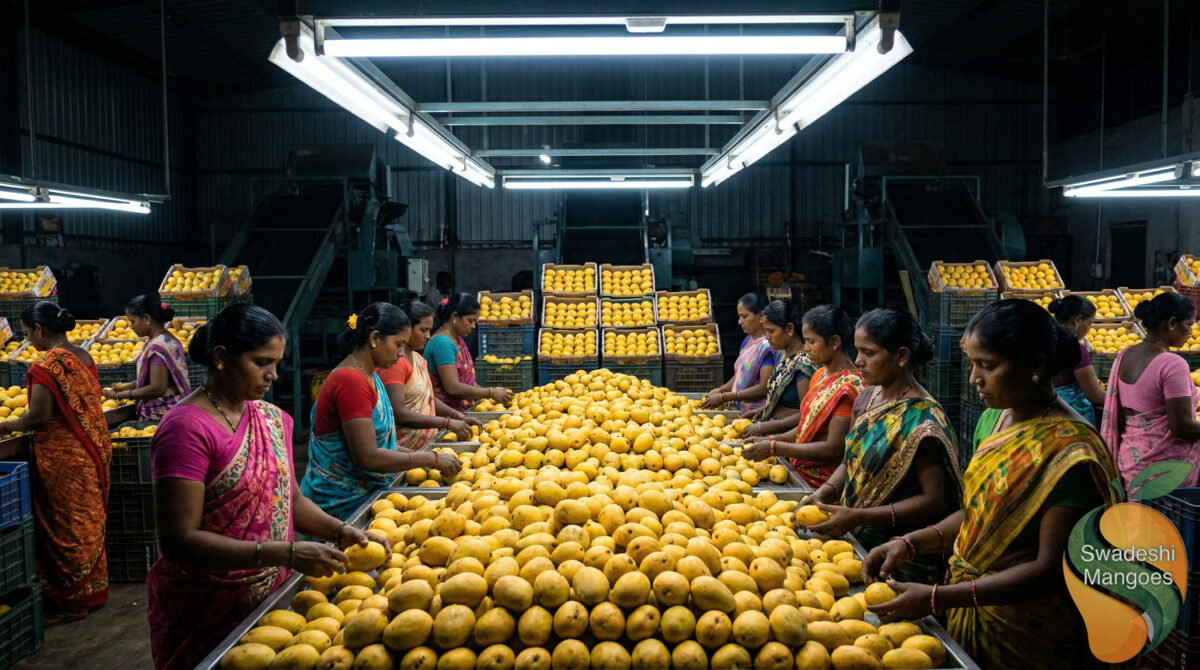
    Indian mangoes destined for the US market are harvested from APEDA-registered orchards (Agricultural and Processed Food Products Export Development Authority). Only the top 10–15% of each harvest qualifies for export.

    • Alphonso is sourced primarily from Ratnagiri and Devgad districts in Maharashtra’s Konkan coast.
    • Banginapalli comes from the Kurnool and Ulavapadu districts of Andhra Pradesh — the official home of its Geographical Indication (GI) tag (registered 2017).
    • Kesar is harvested from the Junagadh and Gir region of Gujarat (GI-tagged since 2011).

    Fruit is hand-picked at the mature but unripe stage — this is intentional. Mangoes picked at full maturity but before ripening survive the journey better and ripen uniformly at their destination.

    Source: APEDA (apeda.gov.in) exporter guidelines; Geographical Indications Registry, Chennai (ipindia.gov.in/gi).


    Step 2: USDA-Mandated Irradiation

    This is the step that makes Indian mango imports to the US possible — and the step that generates the most questions.

    Why Irradiation?

    India is home to fruit fly species (Bactrocera dorsalis and related Tephritidae) that are classified as quarantine pests by USDA-APHIS (Animal and Plant Health Inspection Service). If these pests were introduced to the US, they could devastate American agriculture. Irradiation eliminates this risk.

    How It Works

    Mangoes are exposed to a controlled dose of gamma radiation at 400 Gray (Gy) at USDA-APHIS approved facilities in India. Key facilities include:

    • KRUSHAK (Krushi Utpadan Sanrakshan Kendra) in Lasalgaon, Maharashtra
    • BRIT (Board of Radiation and Isotope Technology) facility in Vashi, Navi Mumbai

    The process takes only minutes and does not:

    • Make the fruit radioactive
    • Change the taste or texture
    • Significantly alter nutritional content
    • Leave any chemical residue

    Is It Safe?

    Food irradiation is endorsed as safe by:

    • World Health Organization (WHO)
    • U.S. Food and Drug Administration (FDA)
    • USDA
    • Centers for Disease Control and Prevention (CDC)

    Over 60 countries approve irradiation for various foods. The technology has been studied for over 50 years.

    Why Not Hot Water Treatment?

    Mexico and several other countries use hot water treatment (VHT) — immersing mangoes in 46.1°C water for 70–90 minutes — as their pest elimination method. This is cheaper than irradiation.

    However, USDA-APHIS has not approved VHT for Indian mangoes. One reason: premium varieties like Alphonso have thin, delicate skin that is particularly sensitive to heat damage. India opted for irradiation during the 2004–2007 trade negotiations specifically to protect Alphonso quality.

    This is also why Indian mangoes cost more than Mexican mangoes — irradiation infrastructure is expensive, and only a few approved facilities exist in India, creating a capacity bottleneck during peak season.

    Source: USDA-APHIS Federal Import Quarantine Orders; 7 CFR 319.56; APHIS Treatment Manual T105; FAO/IAEA reports on food irradiation.


    Step 3: Phytosanitary Certification

    Before leaving India, each shipment must receive a phytosanitary certificate from India’s Directorate of Plant Protection, Quarantine & Storage (DPPQS) under the Ministry of Agriculture. This certifies that:

    • The mangoes come from registered orchards and pack houses
    • Irradiation was performed at a USDA-approved facility
    • The fruit is free of soil, leaves, stems, and visible pest damage
    • All APHIS protocols have been followed

    Irradiated boxes carry the Radura symbol — the international food irradiation logo — along with the treatment facility details.


    Step 4: Air Freight to the United States

    Indian mangoes are air-freighted — not shipped by sea. Sea freight takes 3–4 weeks and would destroy the fruit. Air freight gets mangoes from Mumbai or Hyderabad to US airports in 18–24 hours.

    Common arrival points include:

    • John F. Kennedy International Airport (JFK), New York
    • Newark Liberty International Airport (EWR)
    • O’Hare International Airport (ORD), Chicago

    The air freight cost is a significant portion of the final price — this is why Indian mangoes cost more than Mexican mangoes, which are trucked across the border.


    Step 5: USDA Port-of-Entry Inspection

    Upon arrival in the US, each shipment undergoes inspection by USDA-APHIS Plant Protection and Quarantine (PPQ) officers at the port of entry. They verify:

    • Phytosanitary certificate is valid
    • Irradiation documentation matches the shipment
    • Radura symbol and treatment facility details are on the packaging
    • Random sample inspection for pest evidence

    Only after clearing this inspection are the mangoes released for domestic distribution.


    Step 6: Distribution to Texas

    Once cleared by USDA at the port of entry, mangoes are distributed to regional hubs across the country. For Texas customers ordering through Swadeshi Mangoes, the fruit arrives at our hub in Round Rock, Texas and is immediately organized by variety and order.

    From there, boxes go to our network of 30+ community pickup agents across Austin, Dallas-Fort Worth, Houston, and San Antonio. Customers receive a WhatsApp notification when their order is ready, and pick up directly from their local agent — often within hours of the fruit arriving at our hub.

    This final-mile approach is critical: Indian mangoes are not designed for extended shelf life. The faster they get from our hub to your kitchen, the better they taste.


    India’s Mango Exports to the US: By the Numbers

    MetricData
    India’s total mango production~20–21 million metric tons/year (~45% of global production)
    Percentage exported as fresh fruitLess than 1%
    Fresh mango exports to US (2024 season)Estimated 2,500–3,000 metric tons
    Year-over-year export growth~10–20%
    Year Indian mangoes first entered the US2007
    Top exporting states to USMaharashtra (#1), Uttar Pradesh (#2), Andhra Pradesh (#3), Gujarat (#4)
    APEDA-registered mango exporters200+
    GI-tagged mango varietiesBanginapalli (2017), Gir Kesar (2011), Dasheri (2009), Jardalu (2018), and others

    Sources: APEDA (apeda.gov.in) export statistics; USDA FAS GATS data; National Horticulture Board of India; FAO production statistics.


    GI-Tagged Varieties: Guaranteed Authenticity

    A Geographical Indication (GI) tag works like an appellation for wine — it certifies that a product comes from a specific region with qualities unique to that place. Several Indian mango varieties carry GI tags:

    VarietyRegionGI Year
    BanginapalliKurnool, Andhra Pradesh2017
    Gir KesarJunagadh/Gir, Gujarat2011
    DasheriLucknow, Uttar Pradesh2009
    JardaluBhagalpur, Bihar2018
    Khirsapati (Himsagar)Murshidabad, West Bengal2017
    Laxman BhogMalda, West Bengal2017

    When we say our Banginapalli comes from Kurnool or our Alphonso comes from Ratnagiri, these are not just marketing claims — they are verifiable origins tied to India’s GI registry.

    Source: Geographical Indications Registry, Chennai (ipindia.gov.in/gi).


    Frequently Asked Questions

    Does irradiation make mangoes radioactive?

    No. Irradiation exposes food to controlled energy — similar to how an X-ray passes through your body without making you radioactive. The mangoes do not retain any radiation. This is confirmed by the WHO, FDA, USDA, and CDC.

    Does irradiation affect the taste of Indian mangoes?

    No significant impact on taste has been documented. The irradiation dose used for Indian mangoes (400 Gy) is relatively low. Some studies report slight softening of the fruit, but flavor, aroma, and nutritional content remain intact.

    Why were Indian mangoes banned in the US before 2007?

    They were not specifically “banned” — but the US did not have an approved phytosanitary treatment protocol for Indian mangoes until 2007. The concern was fruit fly contamination. Once irradiation was approved as a treatment method, the trade opened. It took years of bilateral negotiations between USDA-APHIS and India’s DPPQS to establish the protocols.

    Why are Indian mangoes more expensive than Mexican mangoes?

    Three main factors: (1) Air freight from India vs. truck transport from Mexico, (2) Irradiation costs vs. cheaper hot water treatment, and (3) Limited seasonal window (8–12 weeks vs. year-round). The total landed cost per box is significantly higher than domestic alternatives.

    How long do Indian mangoes last after I pick them up?

    Unripe mangoes will ripen in 2–4 days at room temperature. Once ripe, consume within 2–3 days or refrigerate to extend life by another 2–3 days. For storage tips, see our Mango Care Guide.


    References


    9,000 miles of care — from Indian orchards to Texas families.

    Pre-Order Your 2026 Box →

    Limited supply • First come, first served • Explore all varieties

Chat on WhatsApp