Tag: chinna-rasalu

  • Where to Buy Indian Mangoes in Texas (2026): Austin, Dallas, Houston, San Antonio

    Where to Buy Indian Mangoes in Texas (2026): Austin, Dallas, Houston, San Antonio

    Looking for fresh Alphonso, Banginapalli, or Kesar mangoes in Texas? You have options — but they are not all equal. Indian mangoes are seasonal (April–July), supply is limited, and quality varies dramatically depending on the source.

    This guide covers every way to buy Indian mangoes in Texas in 2026, including local delivery services, Indian grocery stores, and online shipping — with honest pros and cons for each.


    Option 1: Swadeshi Mangoes — Local Delivery Across Texas

    Swadeshi Mangoes is a community-driven Indian mango delivery service that brings fresh, USDA-approved mangoes directly to families across Texas. Here is how it works:

    1. Browse varieties on our varieties page — we carry Alphonso, Banginapalli, Kesar, Totapuri, Himayath, Chinna Rasalu, and Suvarna Rekha
    2. Place your order through our city-specific order forms
    3. Pick up locally from a community pickup agent in your area — no shipping delays, no damaged fruit

    Cities We Serve
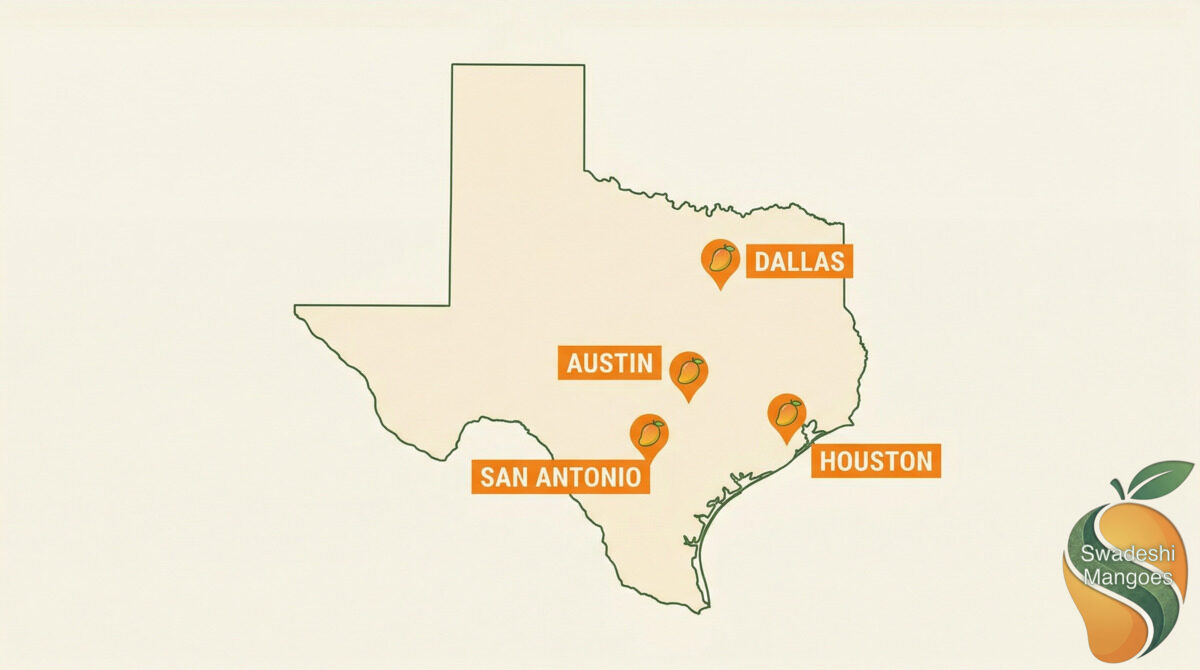
    Map of Texas showing Indian mango delivery cities Austin Dallas Houston San Antonio
    Metro AreaCoverageOrder Form
    AustinAustin, Round Rock, Cedar Park, Pflugerville, Georgetown, LeanderOrder for Austin →
    Dallas-Fort WorthDallas, Plano, Richardson, Frisco, Irving, Coppell, Arlington, Fort WorthOrder for Dallas →
    HoustonHouston, Sugar Land, Katy, Missouri City, Pearland, The WoodlandsOrder for Houston →
    San AntonioSan Antonio, Cibolo, Schertz, New BraunfelsOrder for San Antonio →

    Why Local Pickup Beats Shipping

    • Freshness: Your mangoes go from our hub to your hands in hours, not days. No sitting in a hot delivery truck.
    • No shipping damage: Mangoes are delicate. Boxes shipped cross-country often arrive with bruised or overripe fruit.
    • Community pricing: Group ordering keeps prices lower than individual online shipping.
    • Pickup flexibility: Our agents are community members — they coordinate pickup times that work for your schedule.
    • WhatsApp updates: Get real-time notifications when your order arrives and is ready for pickup.

    Option 2: Indian Grocery Stores in Texas

    During mango season (May–July), many Indian grocery stores in Texas stock limited quantities of Indian mangoes. Availability is unpredictable — you may need to call ahead or visit multiple times.

    Austin Area

    • Indian groceries along N Lamar Blvd and Parmer Lane
    • Specialty stores in the Chinatown Center area

    Dallas-Fort Worth Area

    • India Bazaar — multiple DFW locations (Irving, Richardson, Plano)
    • Patel Brothers — Plano and Irving locations
    • Indian grocery stores along Coit Road, Richardson

    Houston Area

    • Patel Brothers — Hillcroft area and Sugar Land
    • India Grocers — multiple Houston locations
    • Hillcroft Avenue corridor (Houston’s “Mahatma Gandhi District”) — multiple Indian stores

    San Antonio Area

    • India Palace Grocery
    • Specialty Indian stores along UTSA area

    Pros: No pre-ordering needed, can inspect fruit before buying.
    Cons: Limited and unpredictable stock, often only 1-2 varieties (usually Alphonso or Kesar), no guarantee of freshness, higher per-mango pricing, in-store only.


    Option 3: Online National Shippers

    Several companies ship Indian mangoes nationwide from hubs on the East Coast or Midwest:

    ServiceShips FromVarietiesShipping to Texas
    MangoesFromIndia.comEast CoastAlphonso, Kesar2-3 days transit
    Quicklly.comChicagoAlphonso, Kesar, seasonal others2-3 days transit
    Amazon (various sellers)VariesVariesVariable

    Pros: Convenient, no pickup required, wide availability.
    Cons: Shipping adds $15–$30+ per order, transit time in hot weather risks quality, no recourse for bruised/overripe fruit, generally limited to Alphonso and Kesar only.


    What to Look for When Buying Indian Mangoes

    Regardless of where you buy, here is how to ensure quality:

    1. Check the variety name: Make sure you are getting a named Indian variety (Alphonso, Banginapalli, Kesar, etc.) — not generic “Indian mangoes” which could be anything.
    2. Look for USDA irradiation marking: Legally imported Indian mangoes carry a Radura symbol (the international irradiation logo) on the box. If it is missing, the mangoes may not be legally imported.
    3. Firmness is good: Indian mangoes are often shipped slightly firm and should be ripened at home. A rock-hard mango is better than an overripe one — you can ripen it, but you cannot un-ripen it.
    4. Aroma: Even slightly unripe mangoes should have a pleasant fragrance at the stem end. No smell often means the mango was picked too early.
    5. Source transparency: Reputable sellers can tell you which Indian state and orchard district their mangoes come from. Banginapalli from Kurnool, Alphonso from Ratnagiri, Kesar from Junagadh — origin matters.

    For detailed ripening and storage instructions, see our Mango Care Guide.


    Indian Mango Season 2026 Timeline

    VarietyExpected ArrivalPeak Availability
    BanginapalliLate AprilMay
    TotapuriLate AprilMay
    Suvarna RekhaLate AprilMay
    AlphonsoMayMay–June
    KesarMayMay–June
    HimayathMayMay–June
    Chinna RasaluJuneJune–July

    Important: Popular varieties like Alphonso and Kesar sell out quickly. Pre-ordering is the best way to guarantee your box.


    Frequently Asked Questions

    Can I buy Indian mangoes year-round in Texas?

    No. Fresh Indian mangoes are only available from mid-April through mid-July. Outside this window, you can find frozen Indian mango pulp at Indian grocery stores, but fresh fruit is seasonal only.

    Why can’t I find Banginapalli at Patel Brothers?

    Most national retailers focus on the 2–3 most popular varieties (Alphonso, Kesar). Regional varieties like Banginapalli, Himayath, and Chinna Rasalu are harder to source through large retail chains. Swadeshi Mangoes carries these varieties because we serve the Telugu and South Indian community directly.

    How much do Indian mangoes cost in Texas?

    Prices vary by variety and source. Expect approximately $35–$55 per box for most varieties through Swadeshi Mangoes, with Alphonso on the higher end. Indian grocery stores may charge $5–$10 per individual mango. Online shippers add $15–$30 in shipping fees.

    Do you deliver to my area?

    We operate pickup points across Austin, Dallas-Fort Worth, Houston, and San Antonio metro areas, including suburbs like Round Rock, Plano, Richardson, Frisco, Sugar Land, Katy, and more. Check the order form for your city to see available pickup locations.

    How do I know when my variety is available?

    Join our WhatsApp group for your city. We send notifications as each variety arrives throughout the season. You can also check the order form — available varieties are listed when shipments are active.


    References


    Skip the search. Order directly.

    Order Indian Mangoes Now →

    Local pickup in Austin, Dallas, Houston, San Antonio • Refer a friend, earn $5
  • How Indian Mangoes Are Imported to the US: From Orchard to Your Door

    How Indian Mangoes Are Imported to the US: From Orchard to Your Door

    The Journey of Indian Mangoes: From Orchard to Your Door in Texas

    When you bite into a perfectly ripe Alphonso or Kesar mango in Dallas or Houston, you’re tasting the result of a remarkable supply chain that spans thousands of miles. Understanding how Indian mangoes are imported to the US helps you appreciate what goes into every box and why these mangoes taste so different from anything you’ll find in a regular grocery store.

    It Starts in the Orchards

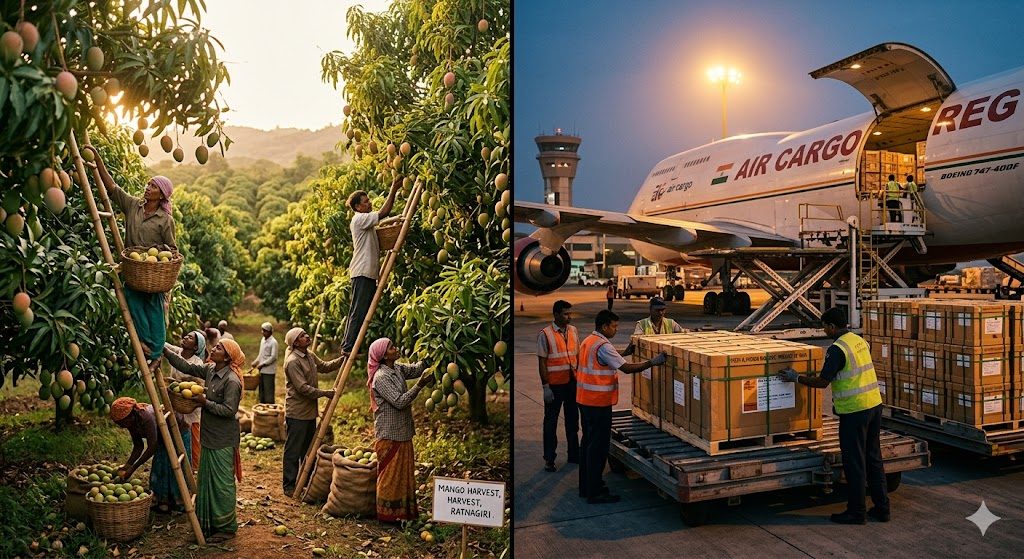
    India is the world’s largest mango producer, growing over 1,500 varieties across diverse climates. The mangoes that make it to the US come from carefully managed orchards in specific regions known for premium quality:

    Mangoes destined for US export must come from USDA-registered orchards and packing houses that meet strict phytosanitary standards. Not every orchard qualifies. The fruit is harvested at the right stage of maturity, firm enough to survive international transit but mature enough to ripen properly at its destination.

    Sorting, Grading, and Packing

    After harvest, mangoes go through a careful selection process:

    1. Sorting – Damaged, undersized, or blemished fruit is removed. Only export-grade mangoes move forward.
    2. Stem cut and desapping – The stem is trimmed to a 0.5-1.0 cm retention, then mangoes are inverted to drain natural sap that can stain the skin and cause spots.
    3. Hot water fungicidal treatment – Mangoes are dipped in 52°C water for 3-4 minutes. This kills surface fungi like anthracnose, which extends shelf life and reduces post-harvest decay. Important: this is a fungicidal step, NOT the USDA quarantine pest treatment.
    4. Bubble wash and air drying – Cool water bubble wash removes residue, followed by air drying.
    5. First sort and grading – Damaged, undersized, or blemished fruit is removed. Only export-grade mangoes move forward, sorted by size, weight, and visual quality.
    6. Packing and pre-cooling – Mangoes are individually wrapped or cushioned in ventilated export cartons (3 kg or 5 kg) and pre-cooled to slow ripening before treatment.
    7. Irradiation at 400 Gy minimum – The USDA quarantine treatment for Indian mangoes. Cartons pass through a Cobalt-60 gamma or electron-beam chamber under USDA APHIS supervision. This eliminates quarantine pests including the mango pulp weevil and fruit fly. Hot water immersion treatment used by Mexican mangoes is NOT approved by USDA for Indian origin.
    8. USDA APHIS joint inspection and NPPO phytosanitary certificate – Indian NPPO inspectors and US APHIS officers stationed at the irradiation facility jointly verify the treatment, then issue the phytosanitary certificate that travels with the shipment.
    9. Grading – Fruit is graded by size, weight, and appearance. Premium grades command the highest prices.
    10. Packing – Mangoes are individually wrapped or cushioned in export-standard boxes designed to minimize bruising during transit.

    Irradiation: The FDA and USDA Requirement

    This is the step that most people are curious about. All Indian mangoes entering the United States must undergo irradiation treatment. This is a non-negotiable requirement from the USDA’s Animal and Plant Health Inspection Service (APHIS) to prevent the introduction of fruit flies and other agricultural pests.

    Here’s what you should know about irradiation:

    • It uses a controlled dose of gamma radiation or electron beam to eliminate insect pests.
    • It does not make the fruit radioactive. This is a common misconception.
    • It does not significantly alter the taste, texture, or nutritional value of the mango.
    • The process is approved by the FDA, WHO, and over 60 countries worldwide.
    • Irradiation facilities in India are USDA-inspected and certified.

    India invested heavily in irradiation infrastructure specifically to enable mango exports to the US. Before irradiation was approved (starting in 2007), Indian mangoes were essentially unavailable in America.

    Air Freight to the United States

    Unlike Mexican or South American mangoes that arrive by ship, Indian mangoes are air-freighted. This is critical for quality. Ship transit would take weeks and destroy the delicate fruit. Air shipping gets mangoes from Indian packing houses to US distribution points in 24-48 hours.

    The mangoes are kept in temperature-controlled conditions throughout the journey. Upon arrival at US ports of entry (typically New York, Chicago, or other major hubs), they undergo USDA inspection before being cleared for distribution.

    Distribution Across Texas

    Once cleared through customs, the mangoes are transported to distribution hubs across the country. This is where Swadeshi Mangoes comes in.

    We coordinate with importers to bring fresh shipments directly to Texas communities. Our local network of pickup locations across Dallas-Fort Worth, Houston, Austin, and San Antonio means you don’t have to rely on whatever happens to show up at your local Indian grocery store.

    Our approach has several advantages:

    • Fresher fruit – Fewer middlemen and faster last-mile delivery means your mangoes have spent less time in transit and storage.
    • Known varieties – You order specific varieties rather than taking whatever is available. Every box is labeled and verified.
    • Better handling – Our agents and pickup coordinators understand that these are premium fruit requiring careful handling.

    Why Indian Mangoes Cost More Than Grocery Store Mangoes

    The price of Indian mangoes reflects the reality of this supply chain:

    • Air freight is significantly more expensive than ocean shipping.
    • Irradiation adds processing cost to every box.
    • USDA compliance requires registered orchards, certified packing houses, and inspections at multiple stages.
    • Limited season and import quotas restrict supply.
    • Premium quality – these aren’t commodity mangoes; they’re the same varieties that command top prices within India itself.

    When you understand the journey, the price makes sense. And once you taste the difference, you understand why thousands of families across Texas order every year.

    Quality and Safety You Can Trust

    Every box of Indian mangoes you receive through Swadeshi Mangoes has passed through multiple layers of quality control and food safety inspection, from the orchard in India to the irradiation facility to US customs. The regulatory framework ensures you’re getting safe, high-quality fruit.

    For tips on getting the best experience once your mangoes arrive, visit our mango care guide. Proper ripening and storage make all the difference.

    Explore the full range of varieties we offer and learn what makes each one special. Have questions about the process? Check our FAQ page for answers.

    Taste the Difference This Season

    There’s a reason Indian mangoes inspire this level of devotion. The flavor of an orchard-fresh Alphonso or Kesar that’s been air-shipped and properly ripened is simply in a different league from anything mass-produced.

    Order your Indian mangoes today and experience the fruit that’s worth the journey.

Chat on WhatsApp