Tag: dasheri

  • Dasheri Mango: Why This North Indian Classic Deserves More Attention

    Dasheri Mango: Why This North Indian Classic Deserves More Attention

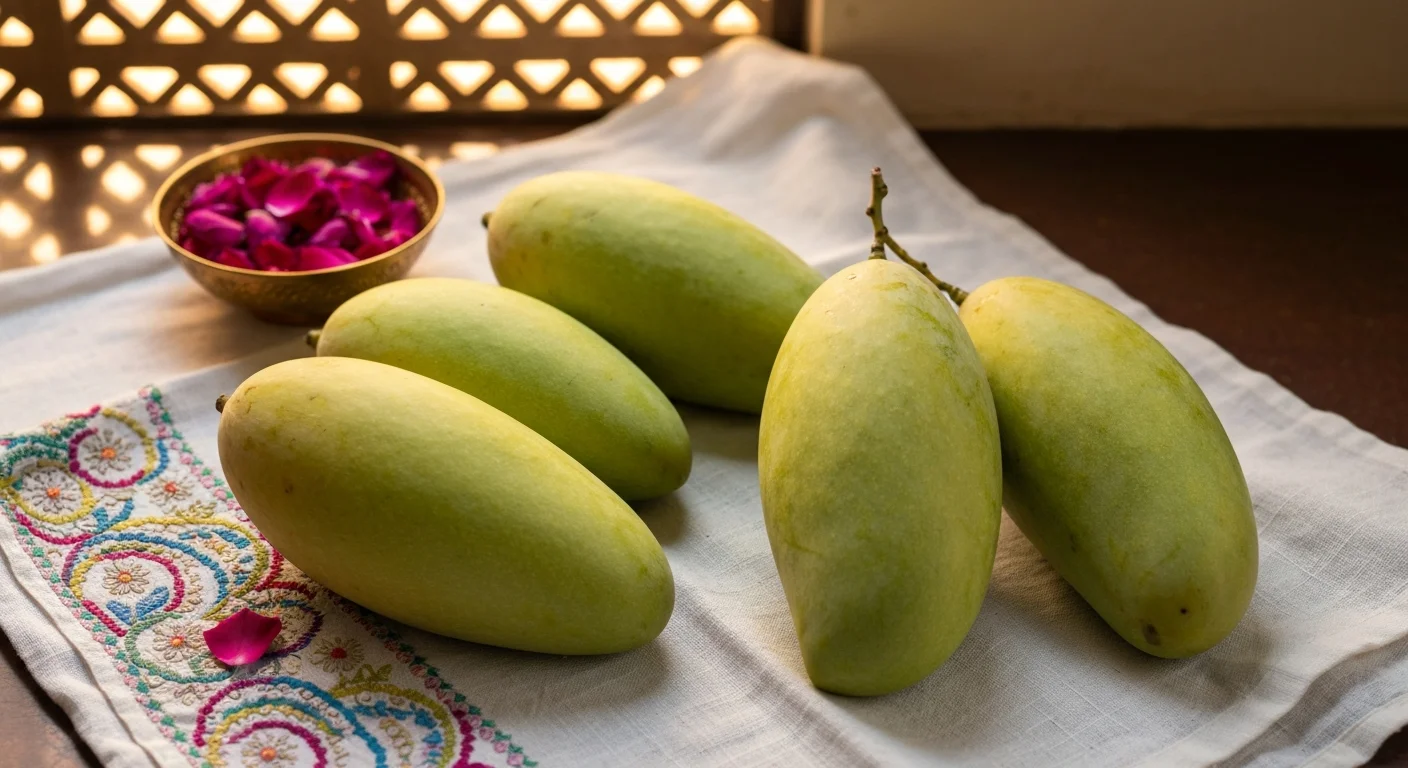
    Dasheri is an elongated, medium-sized North Indian mango originally from the village of Dasheri near Lucknow, Uttar Pradesh, famous for its fiberless pulp, intensely floral aroma, and balanced sweet-tart flavor. The original Dasheri tree, still standing in Malihabad, is over 200 years old and is the mother tree of every Dasheri mango grown today. Each fruit weighs 200-350 grams with Brix readings of 19-21 at peak ripeness. At Swadeshi Mangoes we ship Dasheri from Malihabad orchards to Texas customers each June and July, and it is the single most popular variety among our customers with roots in Uttar Pradesh, Bihar, and Delhi.

    The Mother Tree of Malihabad

    Every Dasheri mango grown in the world today descends from a single tree planted sometime in the mid-18th century in the garden of the Nawab of Lucknow. That original tree still stands in the village of Dasheri, near Kakori and Malihabad, about 25 kilometers northwest of Lucknow. It is roughly 200 years old by conservative estimates, 250 or more by some accounts, and it still produces fruit annually.

    The variety spread from that single specimen through grafting. Every Dasheri orchard in India, from Malihabad to Saharanpur to the Tarai region of Uttarakhand, traces back to cuttings taken from the mother tree. This is not unusual in commercial mango cultivation. Most named varieties are vegetatively propagated, but Dasheri is one of the few where the original specimen is still alive, documented, and in Malihabad’s case, visited by agricultural researchers from ICAR and USDA-ARS.

    Malihabad: The Mango Capital of North India

    Malihabad is a small town in Lucknow district that grows approximately 30,000 hectares of mangoes, roughly 70% of which is Dasheri. The region has a geographical indication (GI) tag from the Government of India, making Malihabad Dasheri a protected designation similar to Champagne or Parmigiano-Reggiano in Europe. APEDA’s export documentation requires that any mango sold internationally under the Malihabad Dasheri label must come from this specific geographic area.

    What Makes Dasheri Different

    Dasheri has three characteristics that distinguish it from South Indian varieties like Alphonso, Banginapalli, or Himayath. First, the shape is distinctly elongated and oblong, with a pointed tip. It does not look like a typical round mango. Second, the aroma is floral and slightly perfumed, with notes of rose, jasmine, and a subtle honey undertone, different from the resinous-floral Alphonso profile. Third, the flavor balances sweetness with a mild tartness, making it less cloying than some South Indian varieties over a large serving.

    The pulp is almost completely fiberless, with a creamy, medium-firm texture. Brix at peak ripeness is 19-21 degrees, slightly lower than the top-sweet varieties but paired with a small amount of citric acid that keeps the flavor balanced. This balance is why Dasheri works so well in both fresh eating and traditional North Indian preparations like aam panna, mango kulfi, and aamras.

    Why North Indians Prefer It

    Taste preferences are regional and shaped by what grew locally during childhood. For customers from Uttar Pradesh, Bihar, Delhi, Haryana, and parts of Madhya Pradesh, Dasheri is the mango of summer memory. South Indian varieties like Alphonso or Banginapalli, while objectively excellent, do not carry the same nostalgic weight. One of our Dallas customers, a surgeon who grew up in Lucknow, put it simply: "Alphonso is the famous one, but Dasheri is home."

    Nutrition and Health Properties

    Dasheri has been studied extensively in Indian nutritional research, partly because of its commercial importance in the North Indian market. A 2021 study published in the Journal of Food Science and Technology measured polyphenol content across 14 Indian cultivars and found Dasheri had the highest total phenolic content of any cultivar tested, at approximately 182 mg GAE per 100 g of pulp.

    NutrientPer 250g fruit% Daily Value
    Calories138 kcal6.9%
    Total sugars29 g
    Vitamin C80 mg89%
    Vitamin A (RAE)102 mcg11%
    Fiber3.5 g13%
    Polyphenols182 mg GAEHighest among Indian cultivars
    MangiferinHighStudied for anti-inflammatory effects

    Mangiferin, the signature polyphenol in mango, has been the subject of multiple PubMed-indexed studies for its anti-inflammatory, antioxidant, and metabolic effects. A 2022 review paper noted that Dasheri and Langra, both North Indian cultivars, consistently rank among the highest-mangiferin mangoes globally. According to a 2023 USDA FoodData Central entry for raw mango, a 250-gram serving of Dasheri provides nearly 90% of the daily recommended vitamin C intake for an adult.

    How to Identify Authentic Malihabad Dasheri

    The GI protection helps, but visual identification is still important for Texas customers. Authentic Malihabad Dasheri has these markers:

    Size, Shape, and Color

    The fruit is elongated, typically 10-12 cm long and 6-8 cm wide at the shoulder, with a distinct pointed tip. Skin color is pale green when unripe, shifting to a soft yellow-gold at peak ripeness, usually with small dark lenticel spots across the surface. Unlike Suvarna Rekha, Dasheri does not develop a red blush. The stem end is relatively flat, not deeply inset.

    How to Ripen Dasheri in Texas

    Dasheri ripens at a moderate pace. We ship from Malihabad at 70-75% maturity, and in a Texas kitchen at 78-82 F, expect 5-7 days from arrival to peak ripeness. The skin color change is subtle, moving from light green to yellow-green to golden yellow. The more reliable indicators are aroma and give.

    A ripe Dasheri smells strongly floral at the stem end, with rose and jasmine notes. The fruit gives moderately under thumb pressure along the entire length, not just at the tip. Because Dasheri has a slightly thicker skin than Alphonso or Chinna Rasalu, the fruit holds its ripeness window for 4-5 days, longer than many premium varieties. Full details in our mango care guide.

    Traditional North Indian Uses

    Dasheri’s balanced sweet-tart profile makes it the preferred variety for three classic North Indian preparations.

    First, aam panna, the cooling summer drink made from underripe mangoes. Green Dasheri, harvested before full ripening, is boiled, pulped, and blended with roasted cumin, black salt, and mint. The result is a tart, slightly savory drink that was historically used to prevent heat stroke in the harsh Lucknow summer. Our Texas customers who have never tried aam panna often request a few underripe Dasheri specifically for this purpose.

    Second, aamras. Ripe Dasheri is pureed with a pinch of saffron and cardamom, served chilled alongside hot puris. The floral aroma of Dasheri shines in this simple preparation in a way that no other variety quite matches. Third, Lucknowi mango kulfi, where Dasheri pulp is reduced with milk, sugar, and a hint of kewra (screw pine) essence, then frozen in traditional conical molds.

    Texas Home Cooking

    One Houston customer, a restaurant owner originally from Kanpur, uses Dasheri exclusively in her kitchen’s seasonal mango menu. She told us the variety holds its flavor through cooking better than Alphonso, which can turn slightly flat when heated. Her mango lassi, made with Dasheri and full-fat yogurt, is currently on the menu at two Houston locations during June and July.

    Dasheri vs. Other Indian Mangoes

    VarietyRegionShapeFlavor ProfileBest Use
    DasheriUP (Malihabad)Elongated, pointed tipFloral, sweet-tartFresh, aamras, kulfi
    AlphonsoMaharashtra (Ratnagiri)Round-ovalIntensely floral, sweetFresh, desserts
    KesarGujarat (Junagadh)RoundBalanced, aromaticLassi, smoothies
    BanginapalliAndhraOval, largeClean, medium-sweetSlicing, salads
    HimayathTelangana (Hyderabad)Elongated, largeComplex, resinousFresh, gifting

    Frequently Asked Questions

    Why is Dasheri called the North Indian Alphonso?

    The nickname comes from Dasheri’s premium status in North India, comparable to Alphonso’s status in Maharashtra and the west coast. Both are fiberless, aromatic, and command premium prices. However, their flavor profiles differ: Alphonso leans intensely floral with high sweetness, while Dasheri balances floral notes with a mild tartness and a more elongated shape.

    Is Malihabad Dasheri GI protected?

    Yes. Malihabad Dasheri received Geographical Indication (GI) protection from the Government of India in 2009, meaning only Dasheri mangoes grown in the designated Malihabad region can legally be sold under that label. APEDA enforces this for international exports. At Swadeshi Mangoes we source directly from Malihabad orchards with documented provenance.

    When is Dasheri available in Texas?

    Dasheri harvest in Malihabad runs from mid-June through late July, and Texas shipments arrive weekly during this window. Pre-orders open in early May at Swadeshi Mangoes, and we deliver across Austin, Dallas, Houston, and San Antonio through our pickup agent network. Late-season availability can extend into early August depending on monsoon timing.

    How does Dasheri differ from Langra?

    Langra is another North Indian mango, often grown in the same region as Dasheri, and the two are frequently compared. Langra retains a green-tinged skin even when ripe, has a slightly more tart profile, and is smaller on average. Dasheri is sweeter and more floral, with a cleaner yellow-gold skin at ripeness. Most home cooks prefer Langra for pickles and Dasheri for fresh eating.

    Can I order Dasheri for pickup in Dallas or Austin?

    Yes. Swadeshi Mangoes operates 30-plus pickup agents across all four major Texas metros. Place your order on our order form, select your nearest agent location, and we will notify you by text or email when your box is ready for pickup. Home delivery is also available in select Texas zip codes.

    Reserve Your Dasheri from the Mother Tree’s Lineage

    Dasheri connects Texas households to a lineage that stretches back to an 18th-century tree in a Lucknow garden. For customers with North Indian roots, it is often the first variety they request. For customers who have only tasted South Indian mangoes, it offers a completely different flavor vocabulary. Head to our order form to reserve your box, browse all nine Indian mango varieties we carry, or read more variety guides on the Swadeshi Mangoes blog. For storage and ripening advice see our mango care guide.

    Additional resources: APEDA Malihabad Dasheri GI documentation, National Mango Board variety library, and PubMed studies on mangiferin and Indian mango polyphenols.
  • The Great Mango Debate: Sucking vs Cutting

    The Great Mango Debate: Sucking vs Cutting

    This is the debate that has divided Indian families for generations. It cuts across state lines, income levels, and education. There is no neutral position. You are either a sucker or a cutter. And before you dismiss this as trivial, understand that this debate has ended friendships, derailed dinner parties, and produced more passionate arguments than most political disagreements. The mango does not care. But its people do.


    Team Suck: The Traditionalists

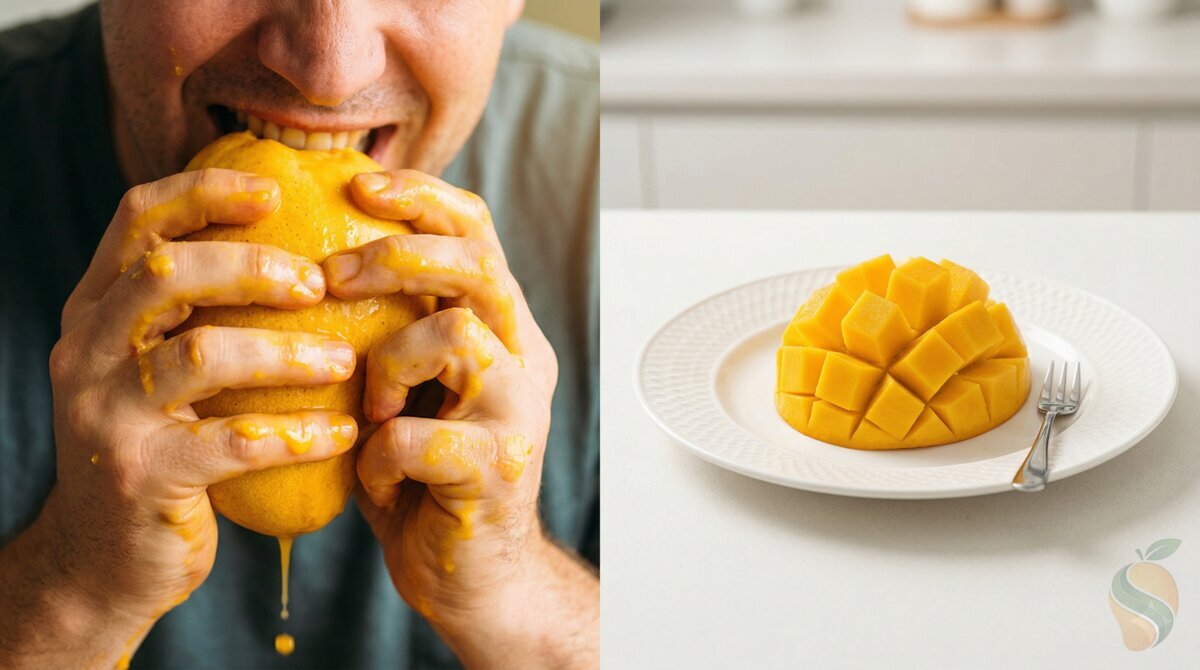
    The method: Roll the mango between your palms until the flesh inside breaks down into pulp. Bite off the tip. Suck the juice directly from the skin like a tropical juice box.

    This is the method that most Indians learn as children, sitting on the floor of a kitchen or veranda with newspaper spread underneath, wearing clothes that were already designated as mango-eating clothes. There is a specific physical memory associated with this method — the give of the skin as the flesh softens under your rolling palms, the resistance of the seed inside, and then the rush of sweet pulp when you bite through the tip. It is not just eating. It is an experience.

    Arguments in favor:

    • This is how God intended mangoes to be eaten
    • Zero dishes to wash
    • Maximum juice extraction — nothing left behind
    • The texture changes with each squeeze and suck — pulpy, then juicy, then stringy near the seed
    • Deeply satisfying on a primal level that cutting cannot replicate
    • It is the only honest way to eat a mango — no pretense, no cutlery, just you and the fruit
    • The warmth of your hands on the fruit releases more aroma, making the flavor more intense
    • You taste the entire mango, including the parts near the skin that are slightly different in flavor from the center

    Arguments against:

    • You will need a shower afterward
    • Cannot be done in public without judgment
    • Not all varieties are suckable — large Banganapalli does not cooperate
    • Your shirt will not survive
    • Urushiol in the mango skin can irritate sensitive lips and cheeks

    Best varieties for sucking: Neelam, Chinna Rasalu, Dasheri — smaller mangoes with soft, juicy flesh that breaks down easily. Chinna Rasalu is perhaps the ultimate sucking mango — small enough to fit in one hand, thin-skinned, intensely sweet, and the flesh breaks down into pure liquid pulp with almost no fiber.

    The technique matters more than people think. You do not just squeeze randomly. You start at the bottom of the mango and work upward, rolling and pressing the flesh away from the seed in a systematic way. Experienced suckers can reduce an entire mango to a flat, empty skin pouch in under two minutes. There is a skill to it. Children learn it from older siblings, who learned it from cousins, who learned it from grandparents. It is passed down like a family recipe — except messier.

    Team Cut: The Civilized

    The method: Slice the mango cheeks off the seed with a knife. Score the flesh into cubes. Invert the skin and eat the cubes or scoop with a spoon.

    This is the method that the rest of the world learned from cooking shows and food blogs. It produces beautiful, photogenic results. The inverted mango cheek with its grid of golden cubes is one of the most recognizable images in food photography. It is clean, controlled, and repeatable.

    Arguments in favor:

    • Clean, elegant, shareable
    • You can actually see and appreciate the color and texture of the flesh
    • Consistent pieces for recipes, salads, and serving
    • Can be done in professional settings without destroying your reputation
    • Better for photography (Instagram does not like sticky faces)
    • Allows you to add lime, chili, or salt to individual pieces
    • Easier to combine with other foods — yogurt bowls, salads, salsas

    Arguments against:

    • Wasteful — pulp left on the seed is the best part
    • Too formal. You are eating a mango, not performing surgery
    • The knife changes the experience from intimate to clinical
    • You miss the textural journey from outer flesh to seed

    Best varieties for cutting: Alphonso, Kesar, Banganapalli — larger mangoes with firm, sliceable flesh. Banganapalli is the cutting champion: large, flat seed, firm flesh that holds its shape, and clean separation from the skin. It was practically designed to be cubed.

    The cutting technique has its own skill ceiling. The key is knowing where the seed is. Indian mangoes have a flat, oblong seed. You want to slice as close to the seed as possible on each side to maximize the flesh you get. A good cutter can remove both cheeks and the two thin side strips with minimal waste, then scrape the seed clean with a knife. The seed scraping, by the way, is where cutters become honorary suckers — most people eat those last bits of flesh directly off the seed over the kitchen sink, when nobody is watching.

    The Regional Divide

    This debate is not random. It follows regional and varietal lines across India, and those preferences travel with families to Texas.

    South India leans heavily toward sucking. Varieties like Chinna Rasalu, Neelam, and Raspuri are small, juicy, and purpose-built for the sucking method. Growing up in Andhra Pradesh or Karnataka, you suck mangoes. It is not a choice. It is how it is done. The varieties are too small and too juicy to cut elegantly, and the flavor is concentrated in a way that is best experienced through direct extraction.

    West India — Maharashtra, Gujarat — is more of a cutting region, largely because the dominant varieties (Alphonso, Kesar) are larger and have firmer flesh. A ripe Alphonso can absolutely be sucked — and many people do — but the flesh is dense enough that cutting produces better results. The Alphonso puree you scoop from a cheek is a different texture from the pulp you suck through a hole in the skin.

    North India splits both ways. Dasheri and Langra are classic sucking mangoes in UP and Bihar. Chausa, which becomes impossibly soft and juicy when ripe, is one of the great sucking mangoes of the world. But Dussheri and Safeda are commonly cut.

    In Texas, you get all of these traditions colliding in one place. A Telugu family and a Marathi family at the same dinner table will eat the same Alphonso in completely different ways. Neither is wrong. Both are right.

    The Secret Third Option: The Hedge Bite

    For the politically moderate: Cut the cheeks off for clean eating, then take the seed to the sink and suck the remaining flesh off privately. Best of both worlds. No witnesses.

    Most Indian adults do this. Few will admit it publicly.

    The hedge bite is the compromise position that satisfies nobody and everybody. You get the clean presentation of cutting — cubes on a plate, civilized, shareable. And then you get the primal satisfaction of sucking the seed clean — the sweetest flesh on the mango is always right next to the seed, a bit fibrous, intensely flavored, the part that cutting can never fully claim. Standing at the sink with mango juice running down your wrists, eating the seed like a cave person, then washing your hands and returning to the table as though nothing happened — this is the adult mango experience.

    Teaching the Next Generation in Texas

    Here is something that matters to Indian families in Texas: how you eat a mango is cultural memory. Kids who grow up cutting mangoes with a knife and fork are not doing anything wrong. But there is something valuable about teaching them the sucking method — it connects them to a way of eating that their grandparents practiced, that their great-grandparents practiced, that carries the physical memory of Indian summers across generations.

    The newspaper on the floor. The old t-shirt pulled on specifically for mango eating. The competition between siblings over who can drain a mango fastest. These are rituals, and rituals matter. If you want your children to understand what mangoes meant to you growing up, you cannot just hand them a plate of cubes. You have to give them the full experience, mess and all.

    Order a box of Chinna Rasalu or Neelam for the sucking experience. Order a box of Alphonso or Banganapalli for cutting. Or do what most families do: order both and let the debate continue at your own dining table.

    The Verdict

    There is no wrong way to eat a mango. There is only your way. The mango does not judge you. It just wants to be eaten.

    But if you grew up sucking mangoes and switched to cutting because society told you to grow up — consider this your permission to go back. Close the curtains. Roll that Alphonso. Bite the tip. Remember who you are.

    And if you have always been a cutter and the sucking people make you uncomfortable — that is fine too. Your scored Alphonso cheek is a work of art. The golden cubes catching the light. The clean lines. The spoon. There is dignity in precision.

    The only truly wrong way to eat a mango is to not eat one at all.

    Order your mangoes and eat them however you want. Browse all Indian mango varieties to find the right ones for your preferred method.

    However You Eat Them in Texas

    Swadeshi delivers mangoes perfect for both sucking and cutting to Austin, Dallas, Houston, and San Antonio. Small varieties like Chinna Rasalu and Neelam are ideal for sucking. Large Banganapalli and Alphonso are perfect for cutting. Check our ripening guide to get them to the perfect stage for either method. Order yours.

    Frequently Asked Questions

    What is the best way to eat an Indian mango?

    There are two main methods: sucking (rolling the mango to break down the pulp, then biting off the tip) and cutting (slicing cheeks off the seed and scoring into cubes). Both are valid. Sucking is traditional, cutting is cleaner. Most people use a combination depending on the variety and setting.

    Which mango varieties are best for sucking vs cutting?

    Small, juicy varieties like Neelam, Chinna Rasalu, and Dasheri are best for sucking. Larger varieties like Alphonso, Banganapalli, and Kesar are better for cutting and slicing. See our varieties page for the full selection.

    What is the hedge bite method?

    The hedge bite is a compromise: cut the cheeks for clean eating, then take the seed to the sink and suck the remaining flesh off in private. Most Indian adults practice this method. It combines the presentation of cutting with the satisfaction of sucking.

Chat on WhatsApp