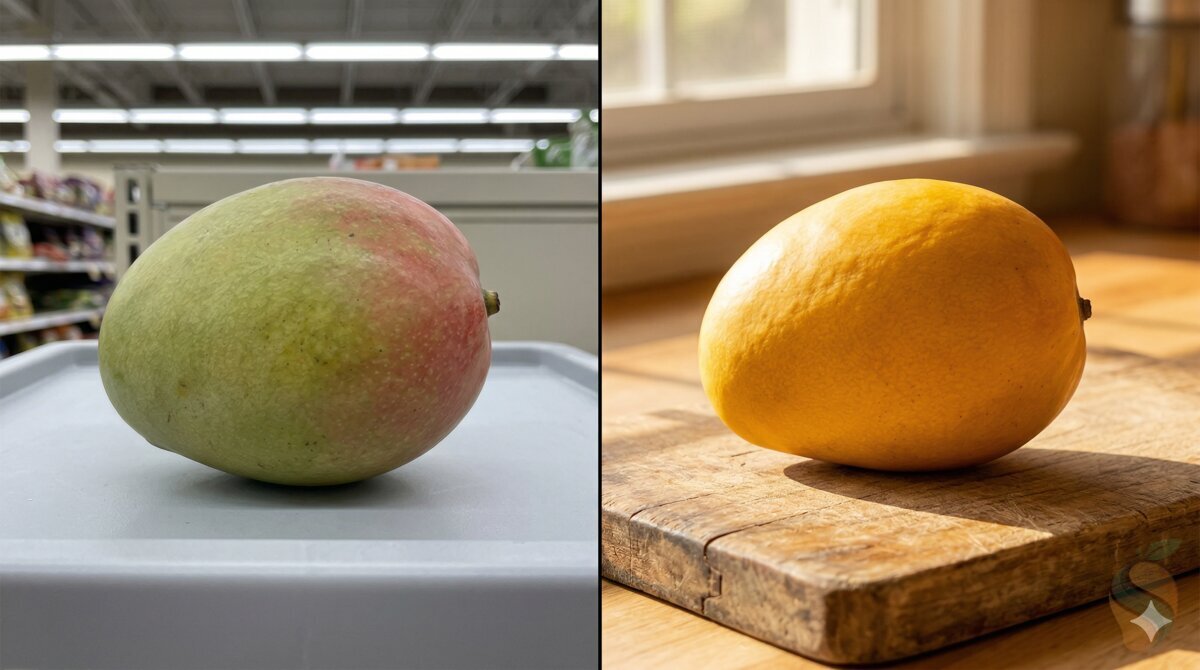
Your American friend has eaten exactly one type of mango in their life: the red-green Tommy Atkins from HEB. They think mangoes are “fine.” They have no idea what they are missing. This is your chance to change a life.
Every Indian person living in America has had this moment. You are eating a perfectly ripe Alphonso, closing your eyes at the flavor, and your coworker or neighbor walks by and says, “Oh, I like mangoes too.” You smile politely, but inside you know the truth: they have never actually tasted a real mango. The Tommy Atkins they buy at the grocery store was bred for one thing — surviving a two-week truck ride from Mexico. Flavor was never part of the equation.
This guide will help you bridge that gap. Whether it is a casual office moment or a full-blown tasting party at your home, here is how to turn your American friends into mango believers.
Start with the Story, Not the Fruit
Do not just hand them a mango. That is like handing someone a raw coffee bean and saying “this is good.”
Start with context: “In India, there are over 1,000 varieties of mangoes, and families fight over which one is best the way Americans fight over BBQ styles. This is the Alphonso — it is basically the wagyu of mangoes.”
Americans understand wagyu. They understand craft beer. They understand “there is a version of this thing that you did not know existed and it will ruin all other versions for you.” Use that framework.
You can also talk about mango season as an event. In India, mango season is not just a time of year — it is a cultural phenomenon. Families plan around it. Markets overflow with dozens of varieties. Arguments break out over whether Alphonso is better than Kesar. Newspaper columns are devoted to predicting the harvest. When you explain that level of passion, your American friend starts to understand this is not just fruit. It is an experience.
If you really want to set the stage, pull up a map. Show them where Ratnagiri is on the western coast of India, where the volcanic soil and coastal humidity create the perfect microclimate for Alphonso mangoes. Show them the Krishnagiri region in Tamil Nadu where Banganapalli grows into those large, golden beauties. When food has geography and story behind it, people pay attention.
The Tasting Setup
Cut a Tommy Atkins (grocery store mango) and an Alphonso side by side. Let them see the difference before they taste it:
- Color: Tommy Atkins pulp is pale yellow. Alphonso is deep saffron orange.
- Fiber: Tommy Atkins has visible strings. Alphonso has zero fiber — it is smooth like custard.
- Aroma: Have them smell both. The Alphonso will fill the room. The Tommy Atkins will smell like… fruit.
- Taste: Let the Alphonso speak for itself.
The side-by-side comparison is important. Without it, they might think “oh, a mango.” With it, they will understand why you spend $45 on a box.
Here is a practical tip for the tasting: cut the mangoes about 10 minutes before serving and leave them uncovered at room temperature. This lets the aroma develop and fill the room before anyone takes a bite. With Alphonso especially, the scent is half the experience. Your friend will smell it before they taste it, and that anticipation makes the first bite land even harder.
If you want to make it even more dramatic, serve the Tommy Atkins first without telling them what comes next. Let them eat it and say “that is pretty good.” Then bring out the Alphonso. The contrast will do all the persuading for you.
The Variety Tour
If you have multiple varieties, set up a mini tasting:
- Start with Banganapalli: Big, juicy, approachable. The “easy drinking” mango.
- Then Kesar: More aromatic, slightly complex. The “interesting one.”
- Finish with Alphonso: The showstopper. Save the best for last.
Give them a palate cleanser between varieties — plain crackers or water. This sounds excessive for fruit. It is not. This is a tasting.
If you can get your hands on more varieties, expand the tour. Chinna Rasalu offers a completely different experience — smaller, incredibly sweet, with a honey-like intensity that surprises people. Himayath brings a more balanced, mildly sweet profile that some first-timers actually prefer because it is less overwhelming. And Totapuri, with its tangy-sweet balance and firm flesh, shows Americans that Indian mangoes are not all about sweetness — they have range.
For the full lineup of what is available each season, check our complete variety guide. Not every variety ships every week, so plan your tasting around what is arriving.
How to Talk About Price Without Apologizing
Your American friend will eventually ask: “How much does a box cost?” Do not flinch. Do not apologize. Frame it correctly.
A box of Alphonso runs about $50-$60 per 3kg box (6-12 mangoes depending on size grade). That is roughly $6 per mango. For context, a single high-end peach at a farmers market in Austin costs $3-4 and weighs a fraction of an Alphonso. A good avocado is $2.50. A pint of high-quality gelato is $8. Indian mangoes are air-shipped from orchards thousands of miles away, pass through USDA irradiation and customs inspection, and arrive at your door within days of harvest. The price is not high — the logistics are extraordinary.
If your friend balks at the price, offer to split a box. Once they taste the difference, they will be ordering their own boxes before the season ends.
Common Reactions (and What They Mean)
- “This doesn’t taste like mango” — Correct. It tastes like GOOD mango. Their reference point is wrong.
- “Why is this so sweet without sugar?” — Because it was tree-ripened, not artificially ripened in a warehouse.
- “Can I have another piece?” — You have won. Share the order link.
- “How much is a box?” — They are about to become a customer. Well done.
There are a few other reactions worth preparing for. Some people will say “this reminds me of something” — and they are right. Alphonso has flavor notes that overlap with peach, apricot, and even honey. That familiarity in an unfamiliar fruit is what hooks people. Others might say “I had no idea mangoes could taste like this,” which is the highest compliment. That is the moment you know their grocery store mango days are over.
Occasionally, someone will ask about the ripening process. This is your chance to explain that Indian mangoes are picked at a specific maturity and naturally ripen during the air-shipping process, unlike grocery store mangoes that are often treated with calcium carbide. If they want to know more about getting their mangoes to perfect ripeness, point them to our ripening and care guide.
Hosting a Full Mango Tasting Party
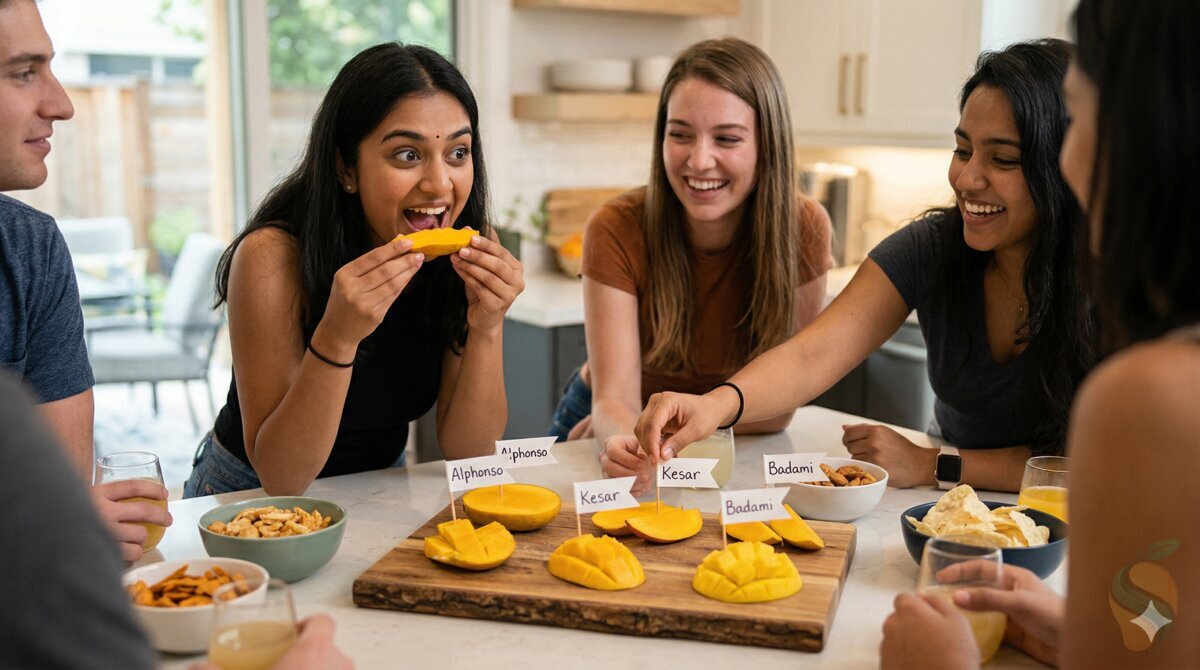
If you want to go beyond a casual introduction and make a real event out of it, here is how to host a proper mango tasting party that your American friends will talk about for months.
Order 3-4 different varieties from our order page. A good combination is Alphonso, Kesar, Banganapalli, and one wildcard like Suvarna Rekha. Plan for about one mango per person per variety — people eat more than you expect once they get going.
Set up a tasting station with each variety labeled. Include a small card for each one with the name, region of origin, and flavor notes. Provide plain water crackers and sparkling water as palate cleansers. If you want to make it interactive, give each guest a scorecard where they rank the varieties. People love voting, and the debate that follows is half the fun.
Pair the tasting with simple accompaniments: a bowl of thick Greek yogurt with cardamom for dipping, some crushed pistachios, and a drizzle of honey. These complement the mango without competing with it. Skip anything with strong flavors — no chocolate, no citrus, nothing that will mask the natural mango flavor.
Beyond the First Tasting: Keeping the Momentum
Once your friend is converted, help them take the next step. Add them to a Swadeshi order group so they can order directly next time. Share the blog for recipes and ideas — mango smoothie bowls, mango lassi, frozen mango desserts. Show them the FAQ page so they understand ordering logistics, pickup locations, and delivery schedules.
The best part about converting a friend is that they become an ambassador too. They will tell their friends, bring mangoes to their office, serve them at their Fourth of July party. One tasting creates a chain reaction. We have seen single customers turn into groups of 20 ordering together by the end of the season.
The Mango Ambassadors
Every Indian family that orders Swadeshi mangoes becomes an ambassador. Your neighbors, coworkers, and friends are one tasting away from understanding what mango season means to 1.4 billion people.
Order an extra box this season — one for you, one for converting your friends. It is the most delicious form of cultural exchange.
Order your ambassador box and spread the mango gospel.
Mango Tastings in Texas
Host a mango tasting for your friends with varieties from Swadeshi Mangoes. We deliver Alphonso, Kesar, Banganapalli, and more to pickup locations in Austin, Dallas, Houston, and San Antonio. See our party hosting guide.
Frequently Asked Questions
What is the best Indian mango for someone who has never tried one?
Start with Alphonso — it is the most universally loved variety with rich, creamy, zero-fiber flesh. For a comparison tasting, add Banganapalli (juicy) and Kesar (aromatic). See our variety comparison.
How are Indian mangoes different from grocery store mangoes?
Indian mangoes like Alphonso are tree-ripened, air-shipped, and contain 10x more flavor compounds than Tommy Atkins mangoes bred for shelf life. Read the full comparison.
How many varieties should I order for a tasting?
Three varieties is the sweet spot for a first-time tasting. Start with Banganapalli, then Kesar, then Alphonso. If you want to go deeper, add Chinna Rasalu or Himayath. Check all available varieties to plan your order.
How do I store mangoes before a tasting party?
Keep mangoes at room temperature until they are fragrant and slightly soft to the touch. Do not refrigerate unripe mangoes — cold stops the ripening process. Once ripe, you can refrigerate for 2-3 days. See our complete ripening guide for detailed instructions.