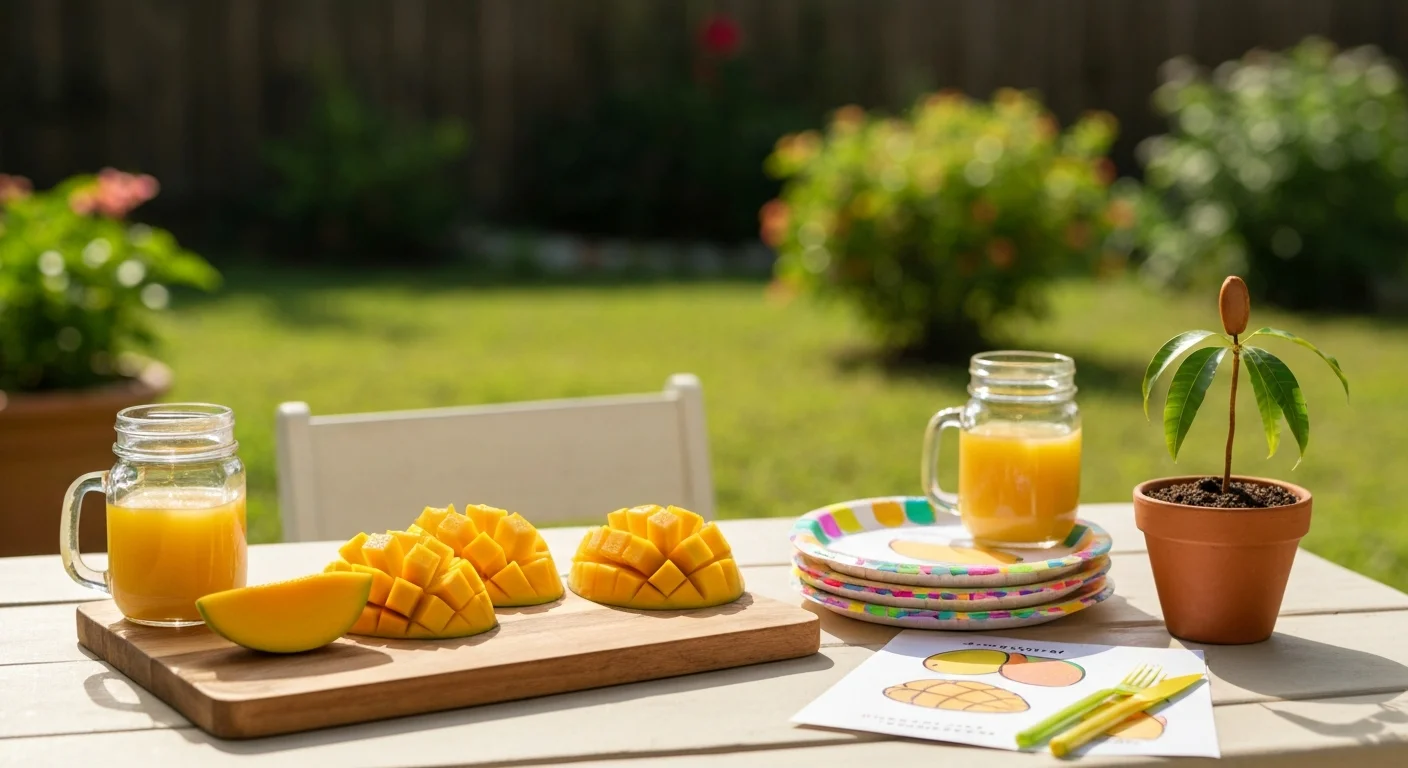
The best kids’ mango activities combine sensory play, simple cooking, and outdoor fun, all of which are ideal for long Texas summer afternoons when temperatures push over 95F and indoor time becomes a creativity test. This list of 10 activities runs from a 15-minute mango popsicle project to a half-day taste-test olympics. Every activity is kid-safe, mess-manageable, and uses 2-3 ingredients. Each includes timing, age range, and what you need to buy ahead. Your kids learn a little food science along the way.
Why Mango Activities Work for Texas Summers
Texas summers from June through August can mean 90+ days above 90F. Pools and sprinklers help, but kids need indoor-and-outdoor alternating activities. Mangoes are perfect because they are sweet enough to motivate cooperation, forgiving enough to handle imperfect technique, and familiar enough that picky eaters recognize them. One customer in Plano told me her 5-year-old who refused all fruit fell in love with Alphonso after a taste-test activity. Food play works.
Activity 1: Mango Popsicles (Ages 3+, 15 min prep)
The gateway activity. Simple, delicious, and freezer-reliable.
- Peel and cube 2 ripe mangoes.
- Blend with 1/2 cup yogurt and 1 tablespoon honey.
- Pour into popsicle molds.
- Freeze 4 hours.
- Run warm water over mold to release.
Let kids help with pouring and the running-water release. Avoid knife work under age 8.
Activity 2: Variety Taste Test Olympics (Ages 5+, 45 min)
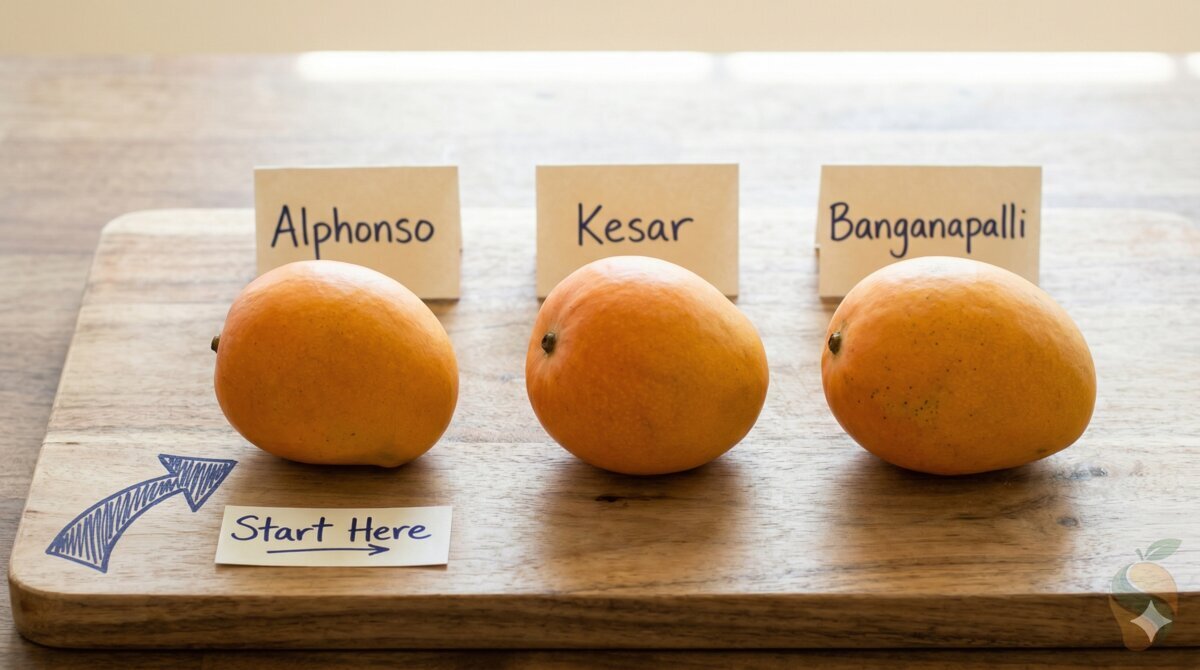
Order 3 or 4 varieties from our mango varieties and run a blind taste test.
- Slice each variety into small cubes.
- Label plates A, B, C, D.
- Kids blind taste and rate sweetness, juiciness, texture.
- Reveal varieties at the end.
- Award a “Golden Mango Medal” to the winner.
One Houston family runs this every summer as a birthday tradition. Kids remember the names of Alphonso and Kesar after one session.
Activity 3: Mango Pit Painting (Ages 4+, 30 min)
After eating the flesh, use the clean pit as a paint stamp.
- Clean the pit and let dry 30 minutes.
- Dip in washable tempera paint.
- Stamp onto paper to create oval fish-scale patterns.
- Add details with markers for fish, dragons, or abstract art.
Activity 4: Mango Lassi Lab (Ages 6+, 20 min)
Teach measurement and flavor balance through mango lassi experiments.
- Provide measuring cups, yogurt, mango pulp, sugar, cardamom, ice.
- Each kid invents their recipe.
- Record ratios in a notebook.
- Blind-taste and pick a favorite.
- Scale up the winning recipe for dinner drinks.
Activity 5: Mango Math (Ages 5-10, 25 min)
Sneak in math practice during snack time.
- Weigh a whole mango (usually 250-350g). Have kids predict weight first.
- Cut and weigh the edible flesh.
- Calculate percent yield.
- Chart results across different varieties.
- Graph sweetness (brix readings with a cheap refractometer if you own one).
Activity 6: Mango Fruit Kabobs (Ages 4+, 20 min)
Outdoor-friendly, colorful, and easy.
- Cube mango, pineapple, strawberries.
- Alternate onto wooden skewers.
- Drizzle with lime juice and a tiny pinch of Tajin for Texas-style flair.
- Serve chilled.
Supervise skewer use for under-7s or substitute with small toothpicks and small cubes.
Activity 7: Backyard Mango Relay (Ages 6+, 45 min)
Burn energy outdoors.
- Set up two teams with a bucket at each end.
- Each kid runs with a mango balanced on a wooden spoon.
- Drop the mango in the far bucket, run back, tag next teammate.
- Winning team eats mango smoothies.
- Use firm (not ripe) mangoes to avoid squashing.
Activity 8: Dried Mango Jewelry (Ages 7+, 1 hour + drying)
A longer project that teaches patience and simple crafting.
- Slice mango thinly (adult only).
- Punch a small hole in each slice with a straw.
- Dry in food dehydrator 8 hours or low oven (150F) for 4 hours.
- String on cotton thread to make edible necklaces.
- Wear for an afternoon, then eat.
Activity 9: Mango Smoothie Bowl Art (Ages 5+, 30 min)
Combines breakfast and creativity.
- Blend 1 mango, 1 frozen banana, 1/4 cup milk into a thick base.
- Spoon into bowls.
- Set out toppings: granola, coconut, chia, fresh berries, mint.
- Kids “paint” designs on the smoothie surface.
- Photo and eat.
Activity 10: Grow-a-Mango Seedling Project (Ages 8+, ongoing)
A multi-week commitment that teaches plant biology.
- Split a mango pit to extract the inner seed (adult only).
- Wrap in damp paper towel and bag.
- Check daily for sprouting (10-14 days).
- Plant in a small pot.
- Log growth in a journal weekly.
- Move to larger pot as it grows.
Texas A&M AgriLife notes that mango seedlings grown indoors in Austin or Dallas can survive for years as houseplants. Fruiting is unlikely without grafting but the plant is beautiful.
Comparison Table: Which Activity Fits Your Day?
| Activity | Time | Mess Level | Indoor/Outdoor | Ages |
|---|---|---|---|---|
| Popsicles | 15 min + freeze | Low | Indoor | 3+ |
| Taste Test | 45 min | Low | Indoor | 5+ |
| Pit Painting | 30 min | High | Either | 4+ |
| Lassi Lab | 20 min | Medium | Indoor | 6+ |
| Mango Math | 25 min | Low | Indoor | 5-10 |
| Fruit Kabobs | 20 min | Low | Either | 4+ |
| Backyard Relay | 45 min | Low | Outdoor | 6+ |
| Dried Jewelry | 1 hr + dry | Low | Indoor | 7+ |
| Smoothie Bowl Art | 30 min | Medium | Indoor | 5+ |
| Seedling Project | Ongoing | Low | Indoor | 8+ |
Texas-Specific Safety Notes
- Austin and San Antonio summer outdoor activities should happen before 10am or after 6pm due to heat index warnings (FDA and Texas A&M AgriLife both emphasize heat safety).
- Always wash mangoes thoroughly before any activity per FDA guidelines.
- Mango skin contains urushiol; kids with poison ivy sensitivity should avoid handling whole unpeeled fruit.
- Check for citrus allergies before adding lime.
- Keep knives locked up; adult supervision required for any cutting under age 8.
Common Mistakes and Myths
- Myth: Kids won’t like unfamiliar varieties. False. Kids often prefer bolder varieties like Alphonso or Kesar once introduced.
- Myth: Mango popsicles need a fancy ice cream maker. False. Silicone molds and a freezer are all you need.
- Mistake: Using over-ripe mangoes for relays. They squish and upset everyone.
- Mistake: Skipping cleanup prep. Mango juice stains Texas limestone counters overnight. Wipe immediately.
- Mistake: Assuming the seedling will fruit quickly. Fruiting takes 5-8 years from seed and rarely matches the parent. Manage expectations with kids.
Building a Summer Schedule
One Austin mom plans a weekly mango activity across June and July. Her rotation:
- Week 1: popsicles + kabobs.
- Week 2: taste test Olympics.
- Week 3: lassi lab + pit painting.
- Week 4: relay day at the park.
- Week 5: dried jewelry + smoothie bowl.
- Week 6: seedling launch.
- Weeks 7-8: ongoing seedling checks + repeat favorites.
Her family orders two boxes a month from our Texas delivery to keep up with consumption.
FAQ
Q: What age can kids start helping cut mangoes?
Around age 8 with close supervision and a butter knife or kid-safe knife; age 10-12 for real paring knives. The spoon method of peeling (see our peeling guide) is the safest for younger kids because it uses a regular tablespoon. For any knife work, adult presence is essential.
Q: How do I keep mango activities clean on light-colored Texas floors?
Lay down washable plastic tablecloths before starting. Use towels under chairs. Do most prep over the sink. Wipe up juice immediately with warm water; mango contains enzymes that set stains within a few hours. For patio activities, hose off the area after.
Q: Can we use frozen mango for these activities?
Yes for popsicles, smoothies, and lassi. Fresh is needed for kabobs, relay, taste tests, and pit painting. A mix of fresh and frozen stretches your budget and keeps activity options open year-round. See our post on fresh vs frozen vs canned.
Q: My child has mango allergies. Are there similar activities with other fruit?
Yes. Peaches, nectarines, and pineapple all substitute well for most activities on this list, especially popsicles, kabobs, and smoothie bowls. Adjust the variety names in taste tests accordingly. Consult your allergist before any new fruit trial.
Q: How many mangoes do I need for a day of activities?
Plan on 1 mango per child per activity, plus 2-3 extras for experiments and taste-test variety. A family of 4 running 3 activities in one day needs approximately 12 mangoes. A 12-count box from our varieties page covers one full activity day with leftovers.
Indoor vs Outdoor: Planning Around the Heat Index
Texas summers drive activity scheduling in a way few other states understand. When the National Weather Service issues a heat advisory in Austin, Houston, or San Antonio, outdoor mango activities should move to early morning (6-9am) or evening (after 6pm). Texas A&M AgriLife publishes heat safety guidance for children, noting that kids under 10 are especially vulnerable to heat-related illness. Indoor activities from this list, popsicles, taste tests, lassi lab, pit painting, fruit kabobs, dried jewelry, smoothie bowl art, and the seedling project, all work perfectly on 100+ degree days. Reserve the backyard relay for cooler mornings or for evening neighborhood block parties where kids rotate between shade and sun.
Birthday Party Variant: The Mango Bash
One Frisco family turned this activity list into a full mango-themed birthday party for their daughter’s 8th. Sequence: guests arrive to a taste-test olympics as an icebreaker (15 min), move to a popsicle-making station (20 min + freeze while playing outside), then a backyard relay (30 min), break for fruit kabobs and lunch (30 min), end with pit painting as a take-home craft (30 min). Total party time: 2.5 hours. Birthday cake: a mango-topped cake with Alphonso glaze. Party favors: a small bag of dried mango slices and a mango seedling in a cup for each child to take home. Texas parents across Dallas, Houston, and San Antonio have copied this format; it is memorable, photogenic, and refreshingly screen-free. Order your supplies from our Texas delivery at least a week ahead to allow ripening, and let the hosts know which of our 9 varieties you want for the taste-test stations. For storage after the party consult mango care.