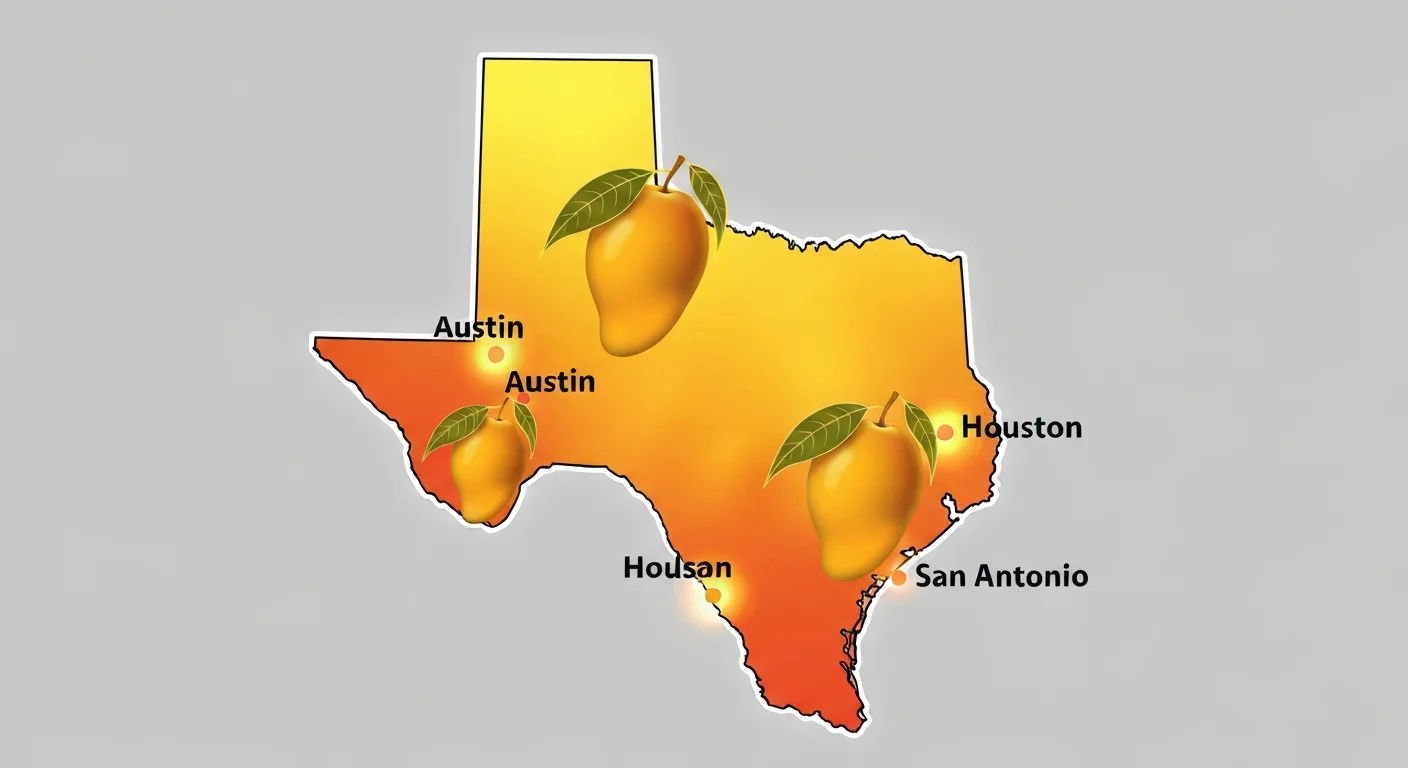
Dallas-Fort Worth leads all Texas metros in Indian mango consumption, with Houston a close second, Austin third, and San Antonio fourth. Based on five seasons of Swadeshi Mangoes order data across Austin, Dallas, Houston, and San Antonio, Frisco and Sugar Land rank as the highest-ordering individual cities in Texas, reflecting the density of Indian-origin families in those neighborhoods.
Why We Publish This Data
People often ask me where in Texas our business is busiest. For years I gave anecdotal answers. This year, for the first time, I pulled five seasons of anonymized order data to put real numbers to the story. The patterns are more interesting than I expected, and they tell a broader story about how the Indian diaspora has distributed itself across Texas.
Before I share the numbers, a caveat. This data reflects Swadeshi Mangoes orders only. It is not a census of Indian mango consumption across all Texas. Many families still buy from Indian grocery stores, and some regions have other vendors. But within our customer base, which now exceeds several thousand Texas households, the geographic patterns are stable season over season.
The Top Line: Texas by Metro
Here is the approximate share of total Swadeshi Mangoes orders across the 2021 to 2025 seasons, rounded to reflect stable patterns:
| Metro | Share of Orders | Primary Cities |
|---|---|---|
| Dallas-Fort Worth | 38 percent | Frisco, Plano, Irving, McKinney, Allen |
| Houston | 31 percent | Sugar Land, Katy, Pearland, Stafford |
| Austin Metro | 24 percent | Round Rock, Cedar Park, Austin, Pflugerville |
| San Antonio | 7 percent | San Antonio, Schertz, Boerne |
What stands out is how closely DFW and Houston are matched. They are the two largest Indian-origin population centers in Texas, and their mango consumption reflects that. Austin is disproportionately strong for its smaller population, which aligns with the tech-driven South Asian migration into the Round Rock and Cedar Park corridor over the past decade.
The Top Individual Cities
When we zoom in from metro level to city level, a cleaner ranking emerges. Here are the top 10 Texas cities by Swadeshi Mangoes order volume:
| Rank | City | Approximate Share |
|---|---|---|
| 1 | Frisco | 13 percent |
| 2 | Sugar Land | 11 percent |
| 3 | Plano | 9 percent |
| 4 | Round Rock | 8 percent |
| 5 | Katy | 7 percent |
| 6 | Cedar Park | 6 percent |
| 7 | Pearland | 5 percent |
| 8 | Austin (Central) | 5 percent |
| 9 | Irving | 4 percent |
| 10 | San Antonio | 4 percent |
Why Frisco Tops the List
Frisco has grown into the epicenter of Indian-origin population in DFW. The Karya Siddhi Hanuman Temple draws devotees from across the region, and Frisco ISD schools report student populations that include a significant South Asian demographic. Our agent network there is the most active in Texas, with pickups running multiple days per week during peak season.
Sugar Land’s Consistency
Sugar Land has been our strongest Houston-area market for five straight seasons. The combination of large-lot suburban homes, proximity to the BAPS Shri Swaminarayan Mandir in Stafford, and a long-established Indian community creates a stable and growing customer base. Sugar Land customers also tend to order in larger quantities, often two to four boxes per order, reflecting multi-generational households.
Variety Preferences by City
One of the most fascinating patterns is how different Texas cities prefer different mango varieties. This maps almost perfectly onto the regional Indian origins of each community.
| City | Top Variety | Likely Community Origin |
|---|---|---|
| Frisco | Kesar | Gujarati |
| Sugar Land | Kesar, Alphonso | Gujarati, Maharashtrian |
| Plano | Alphonso | Maharashtrian, Mumbai-origin |
| Round Rock | Banganapalli | Telugu (AP, Telangana) |
| Cedar Park | Banganapalli, Kesar | Telugu, Gujarati |
| Austin Central | Alphonso, Mallika | Mixed North Indian |
| Katy | Alphonso, Chausa | Punjabi, Maharashtrian |
| Pearland | Banganapalli | Telugu, Tamil |
| San Antonio | Mixed | Mixed smaller community |
The Telugu Belt: Round Rock and Pearland
Banganapalli dominates in Round Rock and Pearland because these cities have significant Telugu-speaking populations from Andhra Pradesh and Telangana. Banganapalli, also called Benishan, is the flagship variety of that region. The Telugu Cultural Association of Austin has a strong presence in Round Rock, and Pearland has multiple Telugu associations and pujas. When a Telugu family orders mangoes, 8 out of 10 times they want Banganapalli. The memory of the fruit is regional.
The Gujarati Corridor: Frisco and Sugar Land
Kesar is the clear favorite in Frisco and Sugar Land, both of which have large Gujarati populations. Kesar is Gujarat’s signature mango, grown in the Junagadh region, and it is central to Gujarati summer food culture. Many Frisco customers specifically request Kesar shipments aligned with Ashadhi or family gatherings.
Growth Patterns Over Five Seasons
Here is what growth looks like, indexed to the 2021 season as our baseline of 100:
| Season | Austin Metro | DFW | Houston | San Antonio |
|---|---|---|---|---|
| 2021 | 100 | 100 | 100 | 100 |
| 2022 | 140 | 125 | 118 | 105 |
| 2023 | 185 | 160 | 148 | 120 |
| 2024 | 245 | 205 | 190 | 140 |
| 2025 (projected) | 310 | 255 | 235 | 165 |
Austin is the fastest-growing metro for Indian mango consumption in Texas. This aligns with external signals: the Indian-American population in Williamson County has grown markedly over the past five years, driven by tech migration from California and direct migration from India into Round Rock, Cedar Park, and Pflugerville.
What the Data Tells Us About the Texas Indian Community
Beyond the mango-specific patterns, these numbers reflect a broader story:
- The Indian-American community in Texas is concentrated in specific suburbs rather than evenly spread.
- Regional Indian identities survive in the diaspora. Gujaratis cluster near each other. Telugus cluster near each other. Food preferences follow accordingly.
- Temple proximity correlates with order volume. Cities near BAPS in Stafford, Karya Siddhi Hanuman in Frisco, Hindu Temple of Greater Austin in Pflugerville, and Sri Meenakshi in Pearland show the strongest ordering.
- Growth is happening in secondary markets too. Georgetown, McKinney, and Schertz are rising.
The APEDA Context
For context, the Agricultural and Processed Food Products Export Development Authority (APEDA), the government body that regulates Indian mango exports to the United States, reports that mango shipments to the US have grown substantially over the past decade. Texas is consistently in the top five destination states by volume, alongside New Jersey, California, New York, and Illinois. Within Texas, our data suggests DFW and Houston absorb the majority of that volume, which matches the demographic distribution of the Indian-American population.
Why Austin Metro Is Catching Up So Quickly
Austin metro’s growth curve deserves its own discussion. Five years ago, Round Rock, Cedar Park, and Pflugerville had modest Indian-American populations concentrated around a few apartment complexes and the Hindu Temple of Greater Austin. Today, these cities are home to tens of thousands of Indian-origin residents, many of whom arrived through tech migration from California or directly from India via H-1B and L-1 visa pathways.
Our Austin pickup agents have reported something specific. A typical new customer in Round Rock or Cedar Park is a younger family, often with children born in Texas, living in a suburban home bought in the past three to five years. These families are actively rebuilding the cultural scaffolding of their childhoods, which includes seasonal Indian mangoes. That rebuilding energy explains why Austin metro order volume has more than tripled since 2021.
Georgetown and Pflugerville: The Next Wave
Georgetown and Pflugerville, once almost rural outposts north of Austin, are the next wave. We opened our first Georgetown pickup location in 2024 with eight committed customers. That number has since grown to 34. If the trend continues, Georgetown will be a fully staffed agent territory by the 2026 season. Pflugerville already has a dedicated agent and is likely to split into two agent territories next year.
Why San Antonio Remains Smaller
San Antonio consistently lands as our smallest Texas metro for mango orders. This is not because Indian families there care less about mangoes. The Indian-American population in San Antonio is significantly smaller than in DFW, Houston, or Austin, and the community is more geographically dispersed. We currently have three agents covering San Antonio, Schertz, and Boerne, and we expect slow, steady growth rather than the explosive growth seen in Austin.
We have also heard consistently from San Antonio customers that they would welcome a local Telugu or Tamil association with stronger event programming. Community infrastructure and mango consumption tend to grow together. Where temples and cultural associations are strong, mango orders follow.
Seasonality Within the Season
Within a single mango season, order volume does not stay flat. It peaks around specific dates tied to both mango ripening cycles in India and cultural calendar events in Texas. Here is what five seasons of data show:
- Late May to early June: First Alphonso shipments trigger a spike, especially in Plano, Katy, and Austin Central.
- Mid to late June: Kesar shipments ramp up, driving orders in Frisco and Sugar Land.
- Early July: Banganapalli peaks, spiking Round Rock, Cedar Park, and Pearland orders.
- Late July: Regional varieties like Chausa, Dasheri, and Langra attract North Indian family orders.
- Mid August: Season tapers. Die-hard fans order final shipments to stretch the year.
We have also noticed that orders spike the week before major festivals like Ashadhi in Gujarati communities, Aadi Perukku in Tamil communities, and Guru Purnima pan-India. Families want fresh mangoes for ritual offerings and festival meals.
What This Means for Our Work
These numbers shape how we plan. We increase pickup agents in growing zip codes. We pre-stock the right varieties based on neighborhood history. When a new customer orders from Katy, we have a strong prior that Alphonso will be a good default. When an order comes from Round Rock, we expect Banganapalli. Data helps us treat every customer like their grandmother already told us what they want. See the varieties we carry, read more analysis on our blog, or place your order at the order form.
FAQ
Why does Dallas-Fort Worth consume more Indian mangoes than Houston?
DFW has a slightly larger and more concentrated Indian-American population, particularly in Frisco, Plano, Irving, and McKinney. The region also has a higher density of Indian grocery stores and temples, which creates a cultural infrastructure that encourages seasonal mango purchasing. Houston is close behind, and the gap between the two metros is narrowing each season.
Which Texas city is growing fastest for Indian mango orders?
Round Rock and Cedar Park, both in the Austin metro, are the fastest-growing markets. Tech migration and direct immigration have tripled the Indian-American population in Williamson County since 2019. Our Austin metro orders have grown 3x since 2021, outpacing DFW and Houston on percentage growth.
Do Texas customers prefer Alphonso or Kesar?
It depends on the city. Plano, Katy, and Austin Central prefer Alphonso, typically reflecting Maharashtrian or Mumbai origins. Frisco and Sugar Land prefer Kesar, reflecting Gujarati heritage. Round Rock and Pearland favor Banganapalli, reflecting Telugu heritage. Statewide, Kesar and Alphonso are roughly tied as the most-ordered varieties.
How does Swadeshi Mangoes decide where to add pickup agents?
We watch zip-code-level order density. When a specific area reaches at least 30 committed customers, we recruit a local volunteer agent. The strongest predictors of a new pickup location are proximity to an existing Indian grocery, distance from a major temple, and presence of a Telugu, Gujarati, Tamil, or Punjabi cultural association.
Is this data representative of all Indian mango consumption in Texas?
Not entirely. Our data reflects Swadeshi Mangoes orders, which skew toward premium varieties and cold-chain freshness. Indian grocery stores still serve a large portion of the Texas market, particularly for budget-conscious buyers. However, the geographic distribution we see is consistent with broader US Census data on Indian-origin populations in Texas metros.