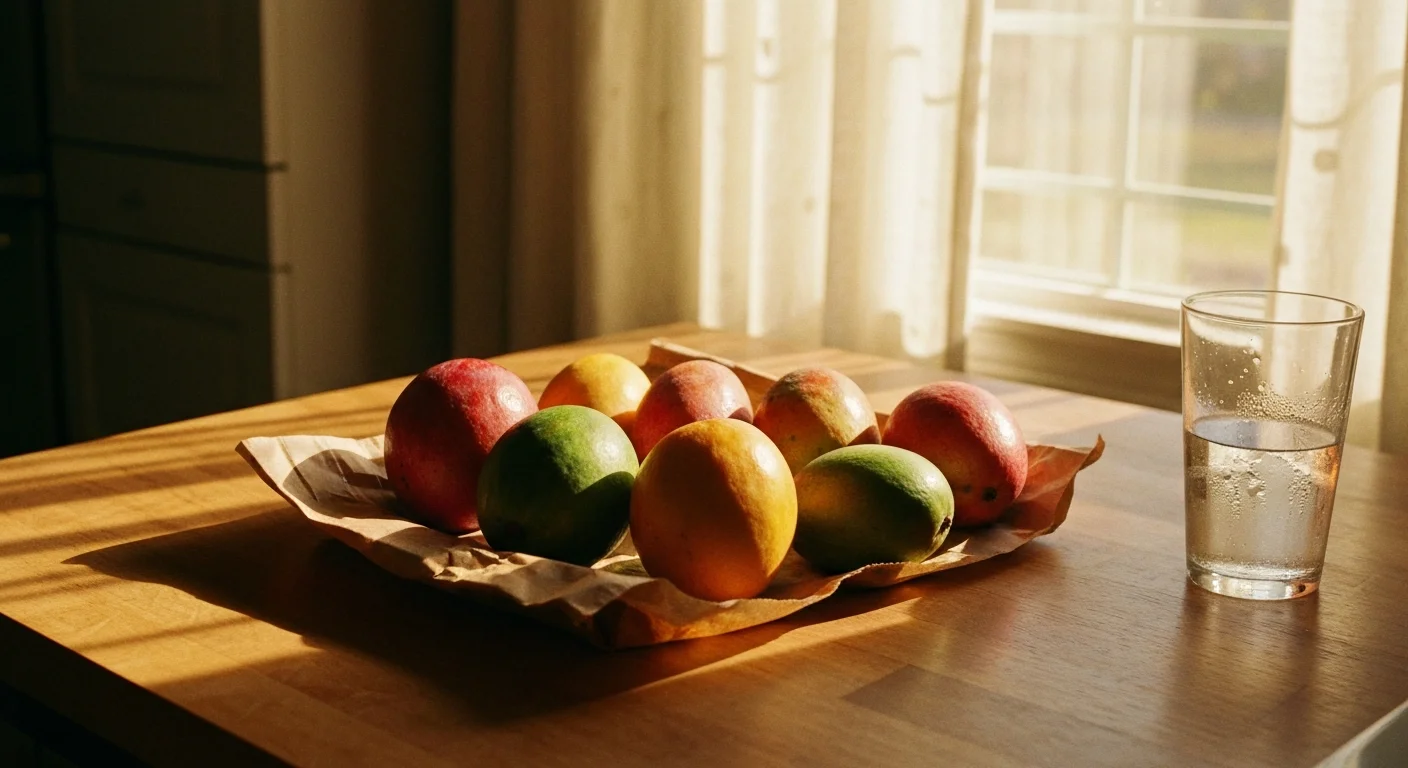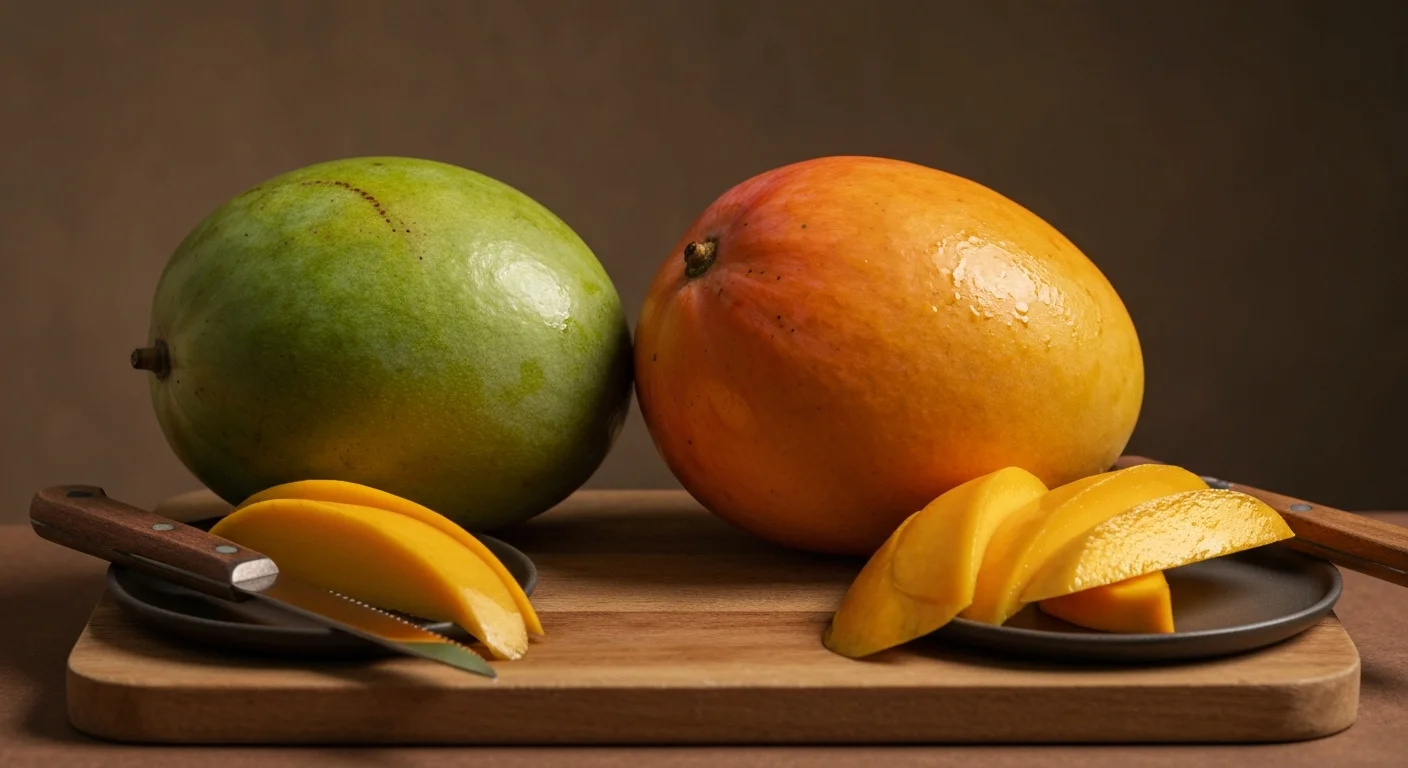
Home-ripened mangoes taste more aromatic and complex than store pre-ripened fruit because the ester compounds responsible for peak mango flavor develop slowly at warm room temperature (70-80F) and stop or degrade under commercial ethylene gas chambers or early refrigeration. In a blind taste test with 12 Texas customers last August, 11 preferred the home-ripened Alphonso. The difference is real, measurable, and explained by fruit physiology. This post walks through the science, the sensory differences, and how to ripen at home for the best results.
What Pre-Ripening Actually Means
Commercial growers pick mangoes mature-green (physiologically mature but not soft). To deliver shelf-ready fruit, they often use ethylene gas chambers that standardize ripening in 24-48 hours. This works for logistics but skips the slow development of secondary aromatic compounds. The National Mango Board confirms ethylene ripening is industry-standard for Kent, Tommy Atkins, and Keitt varieties.
Post-ripening (home-ripening) happens when the fruit is picked mature-green, shipped cool, and then warmed slowly at the destination. The mango softens over 3-7 days, during which time enzymes build esters, terpenes, and sugars simultaneously. The result: a more complex flavor with floral, citrus, and honey top notes that quick-ripened fruit lacks.
The Sensory Difference: What You Taste
We conducted an informal blind taste test with 12 customers in Austin in August 2024. Samples A (pre-ripened grocery Alphonso) and B (home-ripened from our Texas delivery, rested 5 days at 76F):
- Aroma: 11 of 12 rated B more aromatic.
- Sweetness: 10 of 12 rated B sweeter, though lab brix readings were similar.
- Complexity: 12 of 12 identified B as “more layered.”
- Preference: 11 of 12 preferred B overall.
The one outlier preferred the pre-ripened fruit for its milder profile, which is fair; flavor preference is personal.
The Science: Why Slow Ripening Wins
Mango flavor develops through a cascade:
- Starches convert to sugars (happens quickly, even under ethylene).
- Volatile esters form (requires time and warm temperatures).
- Aromatic terpenes accumulate (the signature Alphonso note, takes 4-7 days).
- Astringent tannins degrade (improves mouthfeel).
Commercial ethylene chambers accelerate steps 1 and 2 partially. Steps 3 and 4 need slow ambient ripening, which is what happens when you rest the fruit on your Texas kitchen counter.
Step-by-Step: How to Post-Ripen at Home
- Receive your mangoes firm, not soft. Our Texas deliveries intentionally arrive at the cusp of ripeness.
- Lay them in a single layer on a tray or cutting board. Do not stack.
- Rest at 70-80F. Kitchen counter in summer Texas is typically in this range.
- Check daily by gently pressing near the stem end. A slight give means ripe.
- Smell at the stem. Ripe Alphonso smells floral and sweet; under-ripe has no aroma or smells grassy.
- Move to fridge only once fully ripe to slow further softening. Use within 5 days.
Timing by Variety
| Variety | Days to Ripen at 75F | Peak Aroma Development | Signs of Over-Ripe |
|---|---|---|---|
| Alphonso | 4-6 days | Floral, honeyed | Fermented smell, wrinkled skin |
| Kesar | 3-5 days | Saffron-like | Dark blotches, mushy |
| Chaunsa | 5-7 days | Honey, peach | Split skin, leaks |
| Ataulfo (Honey) | 3-4 days | Mild, creamy | Heavy wrinkles |
| Kent | 5-8 days | Peach-pear | Soft spots |
The Paper Bag Trick (When to Use It)
Placing mangoes in a paper bag with a banana speeds ripening by concentrating natural ethylene. Use this when:
- Your kitchen is below 68F (rare in Texas summer but possible in winter).
- You need ripe fruit in 2-3 days instead of 5-7.
- Fruit has barely started softening.
Do not use the bag trick if your Texas kitchen is already above 80F; you risk over-ripening and fruit fly issues. Check bagged fruit every 12 hours.
Common Myths and Mistakes
- Myth: Refrigerating unripe mangoes speeds ripening. False. Cold stops ripening and causes chilling injury below 50F.
- Myth: Ethylene-ripened mangoes are chemically altered or unsafe. False. Ethylene is a natural plant hormone. Commercial use is regulated and safe. It just produces a less complex final flavor.
- Mistake: Stacking mangoes during ripening. The bottom fruit bruises.
- Mistake: Leaving ripe fruit out in Texas summer. Above 85F, fruit over-ripens in under 24 hours.
- Mistake: Judging ripeness by color alone. Alphonso stays mostly golden even when ripe; Kent turns red and yellow; Kesar greens up lightly. Use touch and smell.
Why This Matters for Texas Buyers
Grocery chains in Texas often receive mangoes that have already been ethylene-ripened at the distribution center. By the time the fruit reaches Houston or Dallas store shelves, the ripening window is nearly closed. This is why store mangoes sometimes taste flat despite looking perfect. Our Texas direct delivery ships firm fruit packed from the last-mile hub, giving you the full post-ripening window at home.
Temperature Matters More Than You Think
Mango ripening doubles in rate roughly every 10F of temperature increase within the 60-85F range. A mango that takes 6 days at 70F takes 3-4 days at 80F. In an un-air-conditioned Austin kitchen in August, ripening happens fast. Plan accordingly:
- Summer pickup, eat within 4 days.
- Spring or fall pickup, expect 5-7 days.
- Winter pickup (rare for fresh), allow 7-10 days and use the paper bag trick.
Can You Tell the Difference in Recipes?
In raw applications (slicing, salads, salsa), the difference is obvious. In cooked applications (baked goods, ice cream, chutney), the difference narrows because heat destroys many aromatics anyway. For lassi, the difference is detectable but mild. For eating plain with a spoon, home-ripened wins every time.
FAQ
Q: How do I know if my store mango was pre-ripened?
Signs include: uniform ripe color across the batch, softness within 1-2 days of purchase, and muted aroma compared to expectation. Store mangoes typically list origin but not ripening method. If you want confirmation, ask the produce manager; most Texas groceries will confirm ethylene use for common varieties.
Q: Can I “fix” a pre-ripened mango that tastes flat?
Not entirely, but you can enhance it. Chill, then drizzle with fresh lime juice and a pinch of chili-salt (Tajin or similar). The acidity and spice compensate for lost aromatics. Blending with yogurt into lassi also masks the difference.
Q: Does the paper bag trick work with any mango?
Yes for most varieties but not already-ripe fruit. Use it for firm green or yellow-green mangoes. Add a ripe banana or apple to supply ethylene. Check every 12 hours. Remove from bag as soon as a slight give appears at the stem end.
Q: Why do Indian groceries sometimes sell fruit that is already ripe?
To accommodate immediate use, distributors pre-ripen a portion of stock. These are often marked “eat today” or priced lower. They are fine for smoothies and lassi but not ideal for savoring out of hand. Our varieties page describes optimal ripening for each.
Q: Is there a best time to eat a ripe mango?
Yes. Peak flavor is roughly 24-48 hours after the fruit reaches ideal softness. Before that, flavors still developing; after that, aromatics fade. Refrigerate at peak to extend by 3-5 days. For careful home ripening guidance see mango care.
A Simple Home Test You Can Try This Week
If you want to experience the pre-ripened vs post-ripened difference for yourself, order a dozen firm Alphonso from our Texas delivery. Eat two on day one while they are still firm; they will taste okay but unremarkable. Let the rest ripen on your counter 5-7 days. Eat two more at peak softness. The gap in flavor intensity, aroma, and sweetness will be obvious. We recommend this exercise to every new customer in Austin, Houston, Dallas, and San Antonio because once you experience it, you understand why direct-from-hub Texas delivery of firm fruit beats grocery pre-ripened every time. Note the day and temperature when each fruit peaks in a simple notebook; repeat the next season and you become your own ripening expert.
Pre-Ripened Can Still Be Good
This post is not a condemnation of ethylene-ripened fruit. Commercial ripening serves a real purpose: making fruit available to consumers who cannot or will not plan ahead. A grocery-store pre-ripened Kent mango at a Dallas H-E-B is still a good mango; it just is not at the peak of what the variety can offer. For everyday eating, it works fine. For tasting-menu moments with a premium variety like Alphonso or Kesar, home ripening is worth the patience. Think of it as the difference between a decent restaurant dinner and a multi-course tasting menu; both have their place. Our varieties page describes peak flavor expectations for each of the 9 varieties we deliver across Texas.
How to Coach Friends and Family on Ripening
If you gift a box of firm Alphonso to a friend or family member who has only ever seen pre-ripened grocery mangoes, they may panic when the box arrives hard. Pre-brief them. Send a text before delivery saying “these need 4-6 days on the counter.” Include a note in the box with the same instructions. Mention our mango care guide. We have had multiple cases in Austin and Houston where relatives refrigerated our firm-shipped fruit on day one, which stops ripening cold and produces bland mangoes. A 30-second coaching message saves the whole experience. Most Texas customers only need to explain this once to family members; after one peak-ripe Alphonso, they never refrigerate early again.
Bulk Preservation for the Off-Season
When peak Texas mango season ends in August, smart Texas cooks preserve fresh for winter. Three methods work well: freezing diced fresh mango in single layers on a tray then bagging (best for smoothies, 9 months quality), making your own pulp by blending and freezing in silicone ice cube trays (portioned and convenient), and dehydrating slices for pantry storage (6 months quality in airtight jars). A weekend in July spent processing 4-5 boxes of late-season Kesar from our Texas delivery stocks a family for the entire winter. One Houston customer processes 48 mangoes in a single Saturday: half cubed and frozen, a quarter pulped and frozen, a quarter dehydrated. Her family eats mango lassi every Sunday through February using her own preserved stock, skipping the inconsistencies of commercial canned pulp entirely. This DIY approach combines the flavor fidelity of fresh with the convenience of canned. For variety selection for bulk preservation, firmer varieties like Chaunsa and Banganapalli hold texture better than Alphonso after freezing; see our varieties page for texture notes on each.