India produces roughly 45 percent of the world’s mangoes, more than twenty million metric tons in a typical year, yet the country exports only around one percent of that output by volume, a total usually well under 50,000 metric tons. The reason is not regulatory failure but a combination of overwhelming domestic demand, fragmented smallholder farming, cold-chain gaps, and the fragility of premium cultivars like Alphonso. Understanding this imbalance explains why the Indian mangoes reaching Texas tables each summer cost what they do, and why the supply feels precious.
The Scale of Indian Production
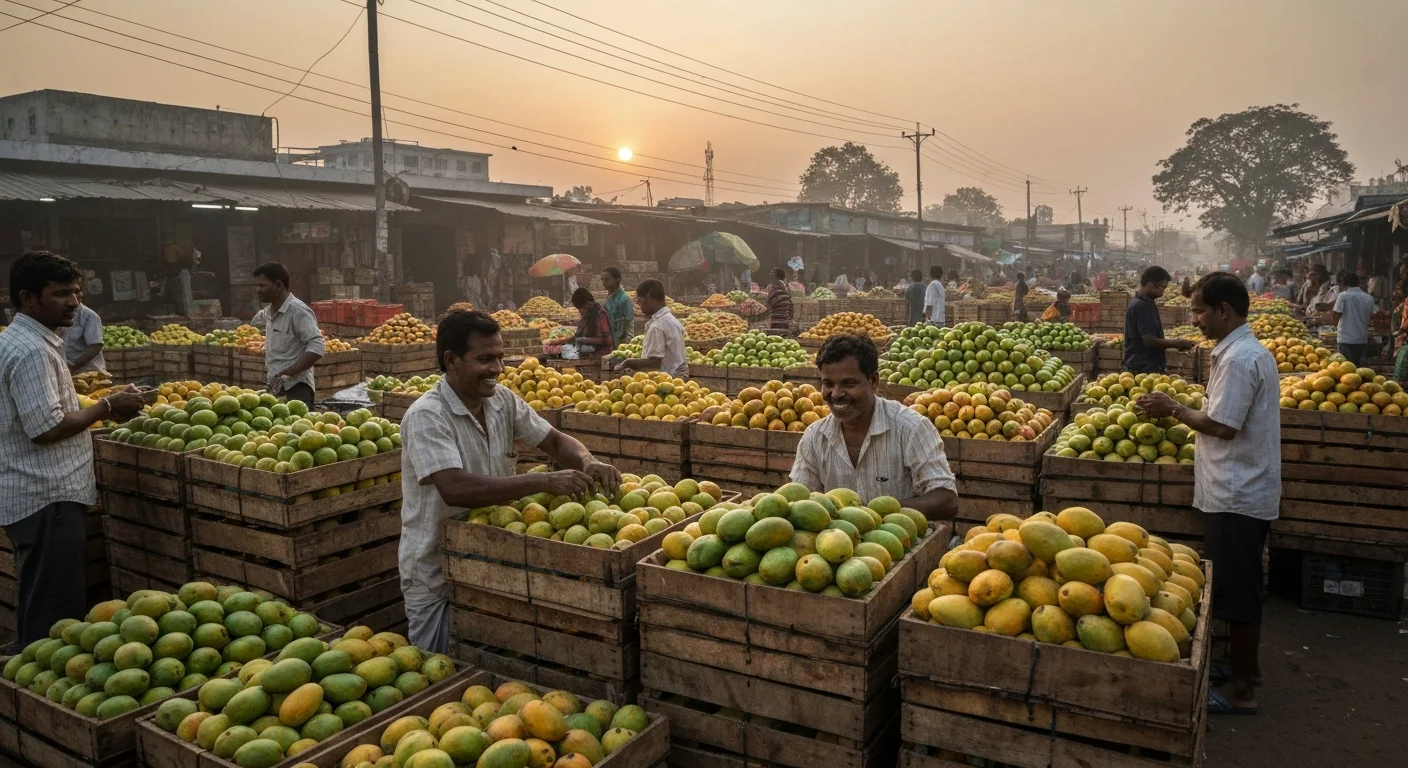
According to data from India’s Ministry of Agriculture and APEDA, the Agricultural and Processed Food Products Export Development Authority, India’s mango output routinely exceeds 20 million metric tons per year across more than 2.3 million hectares of orchard. Uttar Pradesh, Andhra Pradesh, Karnataka, Bihar, and Gujarat are the largest producing states, each contributing millions of tons.
Why the 45 Percent Figure Matters
No other country comes close. China, the second-largest producer, harvests roughly five million tons, and Thailand, Mexico, Pakistan, and Indonesia round out the top ranks. The Food and Agriculture Organization of the United Nations tracks these figures annually, and India has held its dominant share for decades.
Domestic Demand: The Primary Constraint
India is not only the world’s largest producer; it is also the world’s largest consumer. A population of more than 1.4 billion treats mangoes as an essential summer staple. Mango festivals, family rituals, and religious observances all center on the fruit during the April-through-July peak season. Virtually every household in producing states purchases multiple kilograms weekly.
The Math of Consumption
If the average Indian consumer eats even ten to fifteen kilograms of mangoes annually, domestic consumption alone accounts for fifteen to twenty million tons. That leaves only a modest surplus for export, and the surplus must compete with a domestic market that pays promptly and requires no complex logistics.
Fragmented Smallholder Farming
Roughly 85 percent of Indian mango orchards are held by smallholders farming fewer than two hectares. This fragmentation makes export aggregation expensive. Buyers must consolidate fruit from dozens or hundreds of growers, each with variable quality, harvest timing, and post-harvest handling.
Contrast with Mexican Export Orchards
Mexico, by contrast, built its mango export industry around larger commercial orchards with uniform grading, mechanical packing, and direct cold-chain linkages to US distribution centers in Texas and California. This structural difference explains why Mexican mangoes dominate American supermarket shelves while Indian mangoes remain a specialty product.
Timeline: Indian Mango Export Milestones
| Year | Event |
|---|---|
| 1986 | APEDA established to promote agricultural exports |
| 1989 | US bans fresh Indian mango imports over pest concerns |
| 2007 | US ban lifted; Nashik irradiation facility certified |
| 2014 | EU imposes temporary ban over Alphonso pest residues; later lifted |
| 2019 | India crosses 50,000 metric tons exported briefly |
| 2023 | USDA approves additional varieties and facilities for US market |
Cold Chain and Logistics
A mango is a perishable climacteric fruit. Once harvested, it continues to ripen, and without temperature control, it reaches end-of-life within days. India’s cold-chain infrastructure has improved substantially since 2010, but coverage is still uneven, particularly for rural pre-cooling and farm-to-packhouse transport. Industry studies estimate post-harvest losses of 20 to 30 percent across horticulture broadly.
The Irradiation Bottleneck
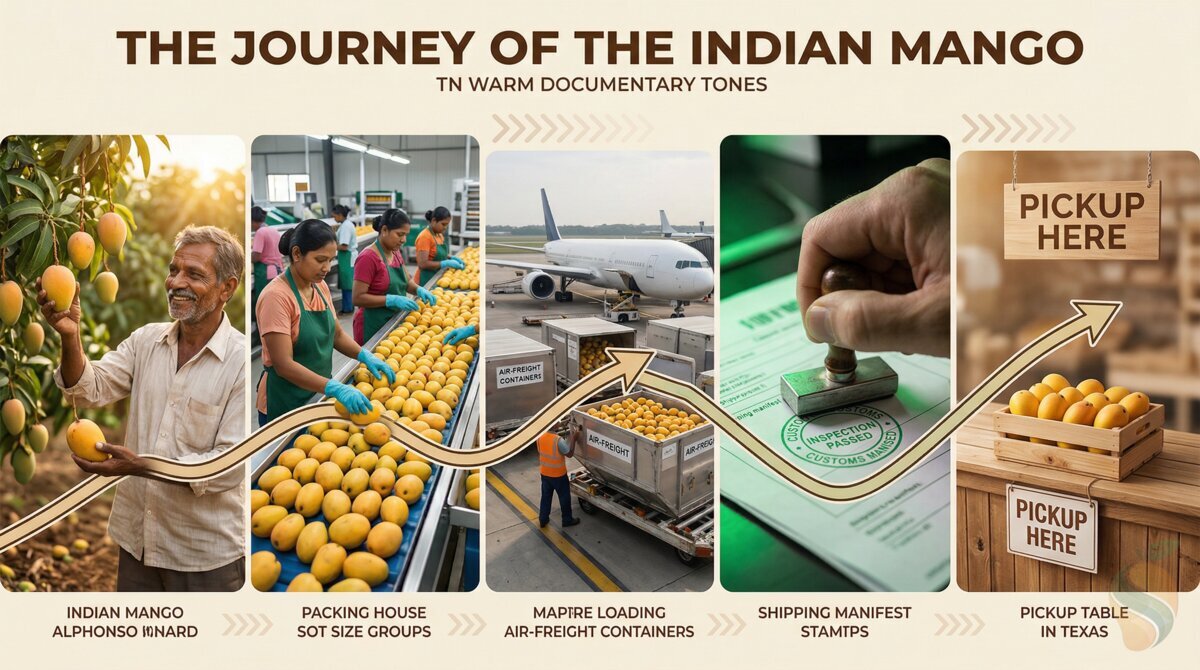
For US-bound shipments, irradiation at Nashik or Bengaluru adds an additional logistical step. Fruit must reach the facility within a narrow ripeness window, pass through dose verification, and then fly to US ports within 24 to 48 hours. Any delay cascades through the supply chain, and capacity limits at certified facilities cap annual US-bound volume.
Price Economics for the Texas Buyer
A kilogram of Alphonso in Mumbai’s Crawford Market might retail for 300 to 600 rupees, roughly four to seven US dollars, at the peak of the season. By the time that same kilogram reaches Round Rock, it has absorbed air freight, irradiation, customs clearance, last-mile distribution, and retail margin. The final Texas price reflects every link in that chain.
Why Direct Delivery Adjusts the Equation
Services like Swadeshi Mangoes compress the supply chain by coordinating bulk imports and delivering directly to Texas customers in Houston, Dallas, Austin, San Antonio, and the Round Rock area. Cutting intermediaries reduces cost relative to grocery retail while preserving quality. Our order form displays current pricing, and our varieties page describes each cultivar’s seasonal window.
Why the 1 Percent Will Not Become 10 Percent Soon
Several structural factors keep Indian exports modest. Domestic demand continues to grow with India’s population. Climate change is stressing mango-producing regions, particularly in the Konkan coast where Alphonso is grown. Labor shortages in rural orchards are beginning to affect harvest timing. And premium cultivars are inherently difficult to scale.
What Would Change the Picture
Expanded irradiation capacity, improved cold-chain networks, farmer aggregation cooperatives, and harmonized phytosanitary standards across importing countries would all push the export share upward. Industry observers at APEDA have set targets for 2030 but acknowledge that reaching them requires sustained public and private investment.
The Implication for Texas Families
Every box of Alphonso or Kesar arriving in Texas passes through the narrow bottleneck that the one-percent figure represents. When a diaspora family in Plano or Katy unpacks a carton in June, they are consuming a genuinely scarce commodity, one that most of India keeps for itself. That scarcity shapes seasonal ritual, price, and appreciation.
Supply Expectations
Texas customers often ask why Indian mangoes are unavailable in October or why a particular variety sells out quickly. The answer lies in the export economics. India’s harvest is brief, the export surplus is small, and Texas is just one of many destinations competing for it. Read related supply-chain pieces on our blog.
State-by-State Production Dynamics
India’s mango production is spread unevenly across agro-climatic zones. Uttar Pradesh produces the largest volume, concentrated around Malihabad’s Dussehri belt near Lucknow, but much of that output is consumed regionally and in Delhi’s wholesale markets. Andhra Pradesh and Telangana produce vast quantities of Banganapalli and Totapuri, with a significant share going to pulp processing for canned concentrate rather than fresh export. Maharashtra’s Konkan coast produces relatively modest volumes of Alphonso but generates disproportionate export revenue because of the variety’s premium pricing. Gujarat’s Kesar belt in Junagadh and Amreli districts supplies both domestic and export markets, particularly to Gulf countries and, increasingly, Texas.
Why Some Varieties Never Leave India
Many of India’s most prized regional cultivars, including Malda of Bihar, Himsagar of West Bengal, and various local Karnataka varieties, are almost never exported. Their shelf life is too short, their harvest windows are too narrow, or their cultivation is too concentrated in areas without packhouse infrastructure. For Texas diaspora families from these regions, this means certain childhood favorites may remain accessible only during visits to India. The nine varieties available through Swadeshi Mangoes are chosen specifically for their combination of flavor, shelf life, and compatibility with the irradiation and air-freight supply chain.
The Role of Air Freight Capacity
Fresh Indian mango exports to the US rely almost entirely on air freight, since ocean shipping transit times exceed the fruit’s post-irradiation shelf life. Limited cargo capacity on direct flights from Mumbai, Delhi, and Bengaluru to US hubs like Newark, Chicago, and Dallas creates a structural bottleneck. When passenger air traffic between India and the US dropped sharply during the 2020 COVID-19 disruption, mango imports contracted correspondingly. Cargo-only flights operated by carriers such as Emirates SkyCargo, Qatar Airways Cargo, and United have since stabilized the supply chain, though premium perishable freight remains expensive.
Dallas-Fort Worth as a Texas Entry Point
While most US-bound Indian mangoes historically cleared through New York’s JFK, Dallas-Fort Worth International Airport has grown as a secondary gateway. Direct and one-stop routings via European or Gulf hubs land at DFW, where customs clearance and cold-chain handoff occur before last-mile delivery to Texas retailers and specialty importers. This logistical shift has shortened transit times for Austin, Round Rock, Houston, and San Antonio customers by several hours compared with routings via the East Coast.
Climate Change and Future Output
The Konkan Alphonso region has experienced increasingly erratic weather patterns over the past decade, with unseasonal rains, hailstorms, and temperature swings damaging flowering cycles. Research published by the Indian Institute of Horticultural Research documents declining Alphonso yields in certain micro-regions. Similar climate stress affects Gujarat’s Kesar belt. These pressures will likely constrain export growth even as demand rises, making premium varieties genuinely rarer for Texas and other international buyers.
FAQ
How much of the world’s mango supply does India produce?
India produces approximately 45 percent of the world’s mangoes, more than twenty million metric tons annually across 2.3 million hectares. According to FAO and India’s Ministry of Agriculture data, no other country comes close. China, the next largest producer, harvests roughly one-quarter of India’s volume in a typical year.
Why does India export so few mangoes?
Domestic demand consumes the vast majority of Indian mango production. The country’s 1.4 billion consumers treat mangoes as a seasonal staple, purchasing heavily from April through July. After domestic consumption, only a small surplus remains for export, and that surplus must navigate cold-chain, irradiation, and phytosanitary hurdles before reaching foreign markets like Texas.
What is APEDA?
APEDA is the Agricultural and Processed Food Products Export Development Authority, established by the Indian government in 1986 to promote and regulate agricultural exports. APEDA oversees packhouse certification, traceability systems, and bilateral protocols for mangoes, grapes, and other premium exports, including the US-bound Indian mango trade under USDA APHIS rules.
Why are Indian mangoes more expensive in Texas than Mexican ones?
Indian mangoes travel further, require cobalt-60 irradiation treatment at certified facilities like Nashik, and come from fragmented smallholder orchards that cost more to aggregate. Mexican mangoes benefit from larger commercial orchards, shorter transport distances, and no irradiation requirement. The price differential reflects these structural logistical factors.
Will Indian mango exports to the US grow?
Modest growth is likely, driven by expanded irradiation capacity, additional packhouse certifications, and increasing US diaspora demand. APEDA has set export targets for 2030, but domestic Indian demand continues to absorb most production. Texas families should expect Indian mangoes to remain a seasonal specialty rather than a year-round commodity.
External references: APEDA India, FAO, USDA APHIS, Wikipedia: Mango production in India.