
Tag: varieties

  • Mango Skincare: 3 DIY Face Masks That Actually Work

    Mango Skincare: 3 DIY Face Masks That Actually Work

    Before mango face masks became a $30 product at Sephora, Indian women were using fresh mango pulp on their skin for centuries. The science backs them up — mangoes are genuinely great for skin. Here are three DIY masks using mangoes that are slightly past their eating prime.

    What makes mango effective as a skincare ingredient is that it contains the same active compounds — Vitamin C, alpha-hydroxy acids, and retinoids — found in expensive serums, but in a whole-food form that your skin absorbs beautifully. The mango actually contains a broader spectrum of beneficial compounds because it delivers them in their natural, synergistic form rather than as isolated chemicals.


    Why Mango Works for Skin

    Mango pulp contains:

    • Vitamin C: Brightens skin and promotes collagen production
    • Vitamin A (beta-carotene): Reduces dark spots and evens skin tone
    • Alpha-hydroxy acids (AHAs): Natural chemical exfoliant that removes dead skin cells
    • Antioxidants: Fight free radical damage from sun exposure

    The best part: slightly overripe mangoes that are too soft to eat are perfect for face masks. The higher sugar content and softer texture make them easier to apply and more potent.

    Mangoes also contain enzymes called proteases that gently break down dead skin cells — similar to professional enzyme peels. This enzymatic action is gentler than mechanical scrubbing and works at the cellular level, which is why mango face masks leave skin feeling genuinely renewed rather than just temporarily smooth.

    Which Mango Varieties Work Best for Skincare

    Any ripe mango will work, but certain varieties have properties better suited for specific skin concerns:

    • Alphonso: Highest beta-carotene content of any Indian variety. Best for brightening and anti-aging masks. Produces the smoothest, creamiest pulp.
    • Kesar: Excellent for sensitive skin due to balanced acidity. The natural sugars provide gentle humectant properties, drawing moisture into the skin.
    • Banginapalli: Higher water content makes it ideal for hydrating masks. The larger fruit means more pulp per mango.
    • Chinna Rasalu: Concentrated nutrients and strong aroma make the mask experience pleasant.

    Mask 1: The Brightening Glow Mask

    Best for: Dull, tired skin

    Ingredients:

    • 2 tablespoons ripe Alphonso pulp
    • 1 tablespoon honey
    • 1 teaspoon turmeric powder

    Method: Mash the mango until smooth. Mix in honey and turmeric. Apply to clean face, avoiding the eye area. Leave for 15 minutes. Rinse with lukewarm water.

    What it does: The Vitamin C in mango brightens, honey moisturizes and has antibacterial properties, and turmeric reduces inflammation. Your face will feel softer and look noticeably brighter.

    The science: Vitamin C inhibits tyrosinase, the enzyme responsible for melanin production, interrupting the pigmentation that causes dark spots. Honey is a natural humectant that draws moisture from the air into your skin and contains mild antibacterial properties that help with acne. Turmeric’s curcumin is one of the most studied anti-inflammatory compounds in nature. Together, these three ingredients address dullness, dryness, and inflammation simultaneously.

    Pro tip: Use this mask in the evening. Turmeric can leave a faint yellow tint on lighter skin tones that fades within hours. For best results, use twice a week for three weeks — you should notice a visible difference in brightness.

    Mask 2: The Exfoliating Scrub

    Best for: Textured skin, clogged pores

    Ingredients:

    • 2 tablespoons ripe mango pulp
    • 1 tablespoon oatmeal (ground into a powder)
    • 1 teaspoon yogurt

    Method: Mix all ingredients into a paste. Gently massage onto face in circular motions for 2 minutes. Leave for 10 minutes. Rinse off.

    What it does: The natural AHAs in mango dissolve dead skin cells while oatmeal provides gentle physical exfoliation. Yogurt adds lactic acid for extra brightening. Do this once a week maximum.

    The science: This mask combines chemical and physical exfoliation. The AHAs loosen bonds between dead skin cells, allowing them to be removed without harsh scrubbing. Ground oatmeal is soft enough to polish without creating micro-tears (unlike sugar scrubs or walnut shell scrubs). Oatmeal also contains avenanthramides — anti-inflammatory compounds that calm the skin during exfoliation. The lactic acid in yogurt is one of the gentlest AHAs available, exfoliating while simultaneously hydrating.

    Pro tip: For stubborn texture or blackheads, steam your face for 5 minutes before applying. This opens pores and allows the acids to penetrate more deeply. After rinsing, splash with cold water to close pores.

    Mask 3: The Hydration Mask

    Best for: Dry skin, especially after sun exposure

    Ingredients:

    • 2 tablespoons ripe mango pulp
    • 1 tablespoon mashed avocado
    • 1 teaspoon coconut oil

    Method: Blend all ingredients until smooth. Apply a thick layer to face and neck. Relax for 20 minutes. Rinse with cool water.

    What it does: Mango provides vitamins, avocado provides fatty acids, and coconut oil locks in moisture. This is essentially a natural version of a $60 hydrating sheet mask.

    The science: Dry skin results from a compromised lipid barrier that cannot hold water. Avocado’s oleic acid penetrates the skin and repairs the barrier from within. Coconut oil acts as an occlusive, preventing water loss through evaporation. Mango delivers Vitamin C and antioxidants that promote collagen synthesis. This three-layer approach (repair, seal, nourish) is what expensive moisturizers aim to replicate.

    Pro tip: This mask is especially effective in Texas summers when AC dries out your skin and sun exposure damages the barrier. Apply after a day at the pool or a long afternoon outdoors. You can leave it on for up to 30 minutes for very dry skin.

    Bonus: Mango Body Scrub for Summer

    Ingredients:

    • Half a ripe mango (any variety — Banginapalli gives the most pulp)
    • Half cup of brown sugar
    • 2 tablespoons melted coconut oil
    • Juice of half a lime

    Method: Mash the mango and mix with brown sugar, coconut oil, and lime juice. In the shower, massage onto damp skin in circular motions, focusing on elbows, knees, and heels. Rinse thoroughly. Pat dry and apply lotion while skin is still damp.

    What it does: Sugar provides physical exfoliation, mango delivers vitamins and enzymes, coconut oil moisturizes, and lime juice brightens and tones. Your skin will feel impossibly smooth for days. The lime also helps even out tan lines — a common Texas concern.

    Tips for DIY Mango Masks

    • Patch test first: Apply a small amount to your inner wrist and wait 30 minutes. If no irritation, proceed.
    • Use overripe mangoes: They are softer, smoother, and more concentrated. Do not waste a perfect eating mango on your face.
    • Apply to clean skin: Remove makeup and wash your face first.
    • Follow with moisturizer: After rinsing the mask, apply your regular moisturizer while skin is still slightly damp.
    • Store leftover mixture in the fridge: It keeps in a sealed container for up to 48 hours. Cold masks feel refreshing on hot Texas days.
    • Avoid the eye area: Natural AHAs can sting. Leave a wide margin around the eyes.
    • Be consistent: One mask will make your skin feel nice for a day. A weekly routine over 4-6 weeks produces visible, lasting improvements in tone, texture, and hydration.

    Do not throw away that overripe mango — put it on your face instead.

    Order mangoes for eating and skincare this season. Check our variety guide to pick the perfect mango for your skin type.

    Use Overripe Mangoes from Your Texas Order

    Got a mango that is too soft to eat? Do not throw it away — put it on your face. Swadeshi delivers naturally ripened Indian mangoes to Austin, Dallas, Houston, and San Antonio. Browse our blog for more mango tips, or check the FAQ page for ordering questions.

    Frequently Asked Questions

    Is mango good for skin?

    Yes. Mango pulp contains Vitamin C (brightening), Vitamin A (dark spot reduction), and natural AHAs (exfoliation). These compounds are the same active ingredients found in high-end skincare products.

    Can I use any mango variety for face masks?

    Yes, any ripe Indian mango works. Overripe mangoes are actually better for masks — softer texture, higher sugar content, and more concentrated nutrients. Alphonso and Kesar produce the smoothest pulp.

    How often should I use a mango face mask?

    For the brightening and hydration masks, twice a week is ideal. For the exfoliating scrub, limit to once a week. Consistency over 4-6 weeks produces the most visible results.
  • How to Read a Mango Box Label: Grades, Origins, and What They Mean

    How to Read a Mango Box Label: Grades, Origins, and What They Mean

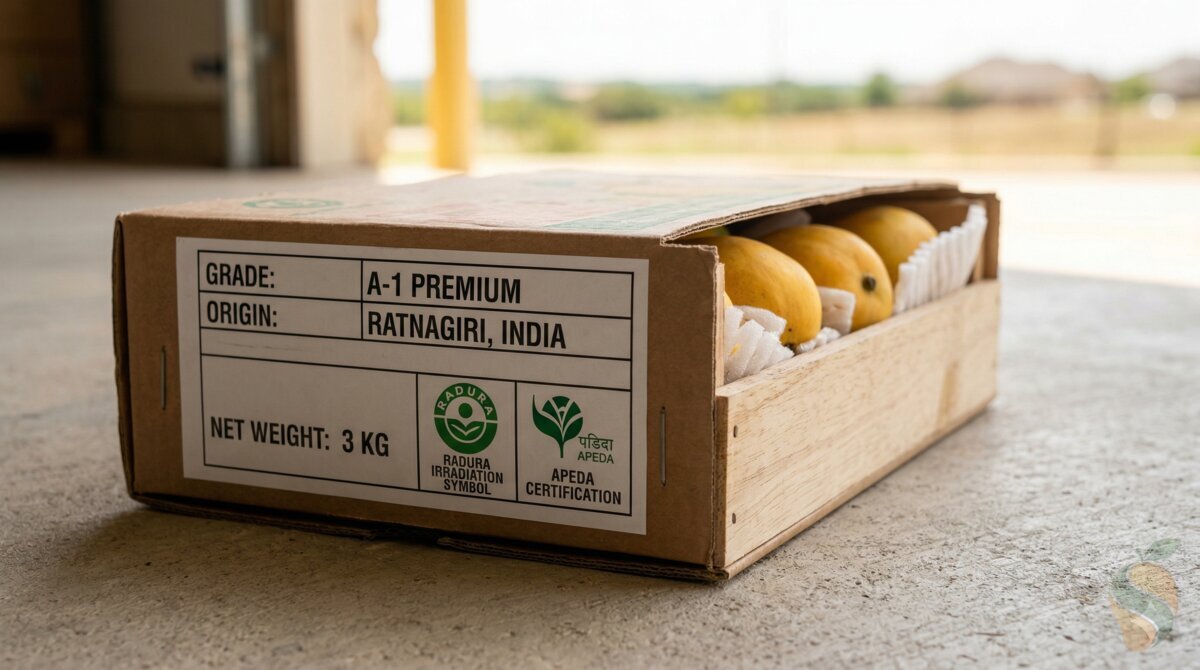
    Your mango box has arrived and there is text printed on the side. A grade, a region name, a weight, maybe a certificate number. Most people ignore it. But this information tells you exactly what you are getting — and whether it is worth the price. Once you know how to read a mango box label, you will never look at a box the same way again. It is the difference between buying blindly and buying with confidence.


    The Origin Label

    The most important piece of information on the box. For Alphonso, look for:

    • “Ratnagiri” or “Devgad” — These are the two premium Alphonso-growing regions in Maharashtra. Alphonso from here has a GI (Geographical Indication) tag, similar to Champagne from France. This is the real deal.
    • “Valsad” or “Gujarat”Kesar mangoes from this region are the authentic ones. Junagadh and Gir are the premium sub-regions.
    • “Krishnagiri” or “Salem” — South Indian varieties like Banganapalli and Imam Pasand come from these Tamil Nadu/Andhra Pradesh regions.

    If the box does not mention a specific region, it is a yellow flag. Premium exporters always label the origin because it adds value.

    Here is why origin matters so much: Indian mangoes are not commodities. An Alphonso from Ratnagiri and an Alphonso from somewhere else in Maharashtra are the same cultivar but different products. Ratnagiri has specific laterite soil, coastal humidity, and temperature patterns that produce the distinctive Alphonso flavor profile — the saffron-colored flesh, the creamy texture, the complex aroma. Alphonso grown outside this belt is still Alphonso, but it often lacks the depth that makes Ratnagiri fruit special.

    The same principle applies across all premium varieties. Kesar from Gir Junagadh versus Kesar from elsewhere in Gujarat. Banganapalli from its home district in Andhra Pradesh versus Banganapalli grown in other states. The label tells you whether you are getting the original or a regional copy. Both are real mangoes. One is the benchmark.

    The Grade

    Indian mango exporters use a grading system based on size and quality:

    • Grade A / Premium / Super: Largest, most uniform mangoes. No blemishes, consistent size. These are the most expensive.
    • Grade B / Regular: Slightly smaller or with minor cosmetic imperfections. Taste is identical to Grade A — the difference is purely visual.
    • Commercial grade: Mix of sizes, may have sap marks or small spots. Good for making pulp, pickle, or smoothies.

    If you are eating fresh, Grade A gives the best presentation. If you are making recipes, save money and go with Grade B.

    There is an important distinction that most consumers miss: grading is done at the export facility based on visual inspection and sizing. It does not reflect sweetness, ripeness, or flavor. A Grade B Alphonso that is perfectly ripe will taste better than a Grade A Alphonso that is slightly underripe. The grade tells you about appearance and uniformity, not about eating quality. So if you see a Grade B box at a lower price and you are planning to eat the mangoes at home rather than present them as a gift, you are getting the same flavor for less money.

    Some exporters use their own naming conventions — “Premium,” “Super Premium,” “Royal,” “King” — instead of standard A/B grades. These are marketing terms that roughly correspond to the standard system but are not standardized across the industry. When in doubt, look at the count (number of mangoes per box) rather than the grade name. Fewer mangoes per box means larger individual mangoes, which generally indicates a higher grade.

    The Count

    Many boxes display a count — the number of mangoes inside. This number is more informative than most people realize.

    For Alphonso in a standard 3 kg box:

    • 6-8 count: Large mangoes. Premium grade. Each mango weighs 375-500 grams.
    • 9-12 count: Medium mangoes. Standard grade. Each mango weighs 250-333 grams.
    • 12-15 count: Smaller mangoes. Often labeled regular or commercial. Each mango weighs 200-250 grams.

    Lower count means larger mangoes and usually a higher price. But here is the practical truth: a 12-count box of medium Alphonso often provides a better eating experience than a 6-count box of jumbo Alphonso. Medium-sized mangoes tend to ripen more evenly and have a higher flesh-to-seed ratio than very large ones. The seed does not grow proportionally with the flesh, so a medium mango gives you roughly the same amount of seed and more evenly distributed flesh.

    The Weight

    Boxes are typically labeled in kilograms:

    • 3 kg box: Standard size. Contains 6-9 mangoes depending on variety and grade.
    • 5 kg box: Larger box. 10-15 mangoes. Better value per mango.

    The count varies because mango size varies. A 3 kg box of large Grade A Alphonso might have 6 mangoes. The same weight in smaller Grade B might have 9.

    Weight labels refer to net weight — the weight of the mangoes themselves, not including the box, padding, or wrapping. Some exporters pack slightly over the labeled weight to account for moisture loss during transit. If you weigh your box at home and it comes in slightly under the labeled weight, that is normal — the mangoes lose a small amount of moisture during the 5-7 day journey from India to your doorstep.

    Also pay attention to what the weight label says about the box format. Some exporters label by “dozen” (12 mangoes regardless of weight) while others label by weight (3 kg regardless of count). These two systems produce very different value propositions. A dozen small Alphonso might weigh 2.5 kg. A 3 kg box might contain only 7 large ones. Always check both the weight and the count to understand what you are actually getting.

    The Irradiation Mark

    Look for the green Radura symbol — a circle with a plant inside it. This confirms the mangoes underwent USDA-required irradiation treatment. All legally imported Indian mangoes must have this symbol. If it is missing, question the source.

    The Radura symbol is not optional for Indian mangoes sold in the United States. It is a federal requirement under FDA regulations. If someone is selling you Indian mangoes without this symbol, one of two things is happening: either the mangoes were not legally imported (which means they bypassed USDA phytosanitary requirements), or the labeling is incomplete (which means the seller is not following FDA rules). Either way, it is a red flag.

    The irradiation process itself is straightforward. Mangoes are exposed to a controlled dose of ionizing radiation at a USDA-approved facility, which eliminates fruit fly larvae that could pose an agricultural risk to US farms. The treatment does not make the fruit radioactive, does not leave residues, and has been approved as safe by the FDA, WHO, and FAO. It may cause a slight reduction in Vitamin C content — on the order of 5-10% — but does not meaningfully affect flavor or texture for most consumers.

    Phytosanitary Certificate Number

    The box may have a certificate number referencing the APEDA (Agricultural and Processed Food Products Export Development Authority) approval. This means the shipment passed Indian export inspection.

    APEDA certification is India’s side of the import equation. It confirms that the mangoes were grown, processed, and packed according to export standards. The phytosanitary certificate verifies that the shipment was inspected for pests and diseases before leaving India. Having this number on the box means the mangoes went through a legitimate export channel with proper documentation at both ends.

    For consumers, the phytosanitary certificate number is less important than the origin label or grade. But it is a marker of legitimacy. An exporter who puts the certificate number on the box is one who went through proper channels and has nothing to hide. It is a small detail that signals professionalism.

    Date Codes

    Some exporters stamp a harvest or pack date. If you can find it, this tells you how fresh the mangoes are. Ideally, the pack date should be no more than 5-7 days before you receive them.

    Date codes on mango boxes are not standardized. Some exporters use the packing date, some use the ship date, and some use the irradiation treatment date. The most useful date to know is the packing date, which tells you when the mangoes were packed into the box at the export facility. From that date, add 2-3 days for irradiation and customs clearance, plus 1-2 days for domestic shipping, and you have a rough idea of the mango’s total journey time.

    If you find a date code and the mangoes in your box are still quite firm, do not panic. Mangoes are harvested mature-green and ripen after packing. A mango that was packed 5 days ago and is still firm simply means it was packed at an earlier maturity stage and needs a few more days at room temperature. Refer to our ripening guide for instructions on bringing them to perfect ripeness.

    Red Flags to Watch For

    Not all mango boxes are created equal. Here are warning signs that something might be off:

    • No origin region listed: Premium mangoes always state where they are from. A box that just says “Indian Alphonso” without naming Ratnagiri or Devgad may contain Alphonso from a less premium region.
    • No Radura symbol: As mentioned above, this is legally required. Its absence raises questions about import legitimacy.
    • Suspiciously low price: If Alphonso is being sold at half the going rate, the mangoes are either lower grade than claimed, from a non-premium region, or not actually Alphonso. Genuine Ratnagiri Alphonso has a floor price driven by real farming and export costs.
    • Damaged or wet box: The box should be dry and intact. Moisture damage suggests the mangoes were stored improperly or one or more mangoes inside have overripened and leaked. Open carefully and inspect each mango individually.
    • Artificial uniformity: If every single mango in a box looks absolutely identical in size, color, and shape, some exporters achieve this by mixing mangoes from different batches. This is not harmful but means your box may include mangoes at different ripeness stages.

    How to Compare Boxes When Shopping

    If you are buying Indian mangoes from a store or vendor and have multiple boxes to choose from, here is what to look at in order of importance:

    1. Origin: Specific region named on the box.
    2. Pack date: More recent is better.
    3. Grade and count: Match to your intended use (eating fresh vs. recipes).
    4. Box condition: Dry, intact, no crushed corners.
    5. Smell: Gently smell the box near the air holes. You should detect a faint, sweet mango aroma. No smell could mean the mangoes are very green. A fermented or sour smell means at least one mango inside has overripened.

    When you order from a trusted source, you do not have to do this detective work — the selection is done for you. But knowing how to read the label makes you a more informed consumer, and it helps you appreciate the care that goes into getting a box of mangoes from a farm in India to your hands in Texas.

    What Swadeshi Boxes Look Like

    Every Swadeshi Mangoes box comes with clearly labeled variety, origin, grade, and weight. We source from verified farms and can tell you exactly which orchard your mangoes came from. Ask your pickup agent — they know the details.

    We believe in full transparency because we believe informed customers are loyal customers. When you know that your Alphonso came from a specific farm in Ratnagiri, that it was packed on a specific date, and that it was air-shipped through a USDA-approved facility, you can trust what you are eating. That trust is what brings families back season after season.

    Order your next box and read the label like a pro. Visit our FAQ page for more questions about mango sourcing, grading, and delivery.

    Swadeshi Mangoes: Full Transparency

    Every Swadeshi box is labeled with variety, origin, grade, and weight. We source from verified farms and deliver to Austin, Dallas, Houston, and San Antonio. Ask your pickup agent about the origin of your specific batch. Browse all available varieties or head to the order page to place your order for the season.

    Frequently Asked Questions

    What does the Radura symbol on a mango box mean?

    The green Radura symbol (circle with a plant inside) indicates the mangoes underwent USDA-required irradiation treatment. All legally imported Indian mangoes must display this symbol. It confirms the fruit is safe and compliant with US import regulations.

    What mango grades are available?

    Grade A (Premium/Super) are the largest, most uniform mangoes with no blemishes. Grade B (Regular) are slightly smaller with minor cosmetic imperfections but identical taste. Commercial grade includes mixed sizes suitable for recipes and pulp. Swadeshi delivers Grade A export-quality mangoes.

    Does the origin region on the box really matter?

    Yes. Alphonso from Ratnagiri has a GI tag for a reason — the specific soil and climate produce a distinct flavor profile. Alphonso grown in other regions of India tastes different. The same applies to Kesar from Junagadh and Banganapalli from Andhra Pradesh. Origin is the single most important quality indicator on the box.

    What does the count on a mango box mean?

    The count indicates how many mangoes are inside. A lower count means larger individual mangoes (higher grade). A 3 kg box with 6 mangoes has larger fruit than a 3 kg box with 12 mangoes. Both weigh the same, but the size and presentation differ.

Chat on WhatsApp