“$50 for a box of mangoes? I can buy mangoes at Walmart for a dollar each.”
2026 season pricing note: The standard range for an Indian mango box has been $45-$60. This season we are pricing $50-$60 due to import tariff increases and elevated air-freight fuel surcharges. Premium varieties like select Alphonso can reach $80. The breakdown below uses representative figures.
Year-over-year context: Indian mango prices in the US have risen 5-10% annually since 2018, driven by higher Indian export costs, shipping fuel surcharges, US import tariffs, and rising labor costs at every link in the supply chain. A box that cost $35 in 2018 commonly retails for $50-$60 in 2026. This is consistent with broader food inflation and is not unique to Indian mangoes.
Fair question. Here is where your money actually goes — and why the price is what it is.
If you have ever ordered Indian mangoes and then had to explain the price to your spouse, your friends, or that one coworker who saw the box on your desk, this article is for you. The price of Indian mangoes in America is not arbitrary, and it is not inflated. It is the result of a supply chain that stretches across 9,000 miles, two governments, multiple inspections, and a race against ripeness. Let us walk through every dollar.
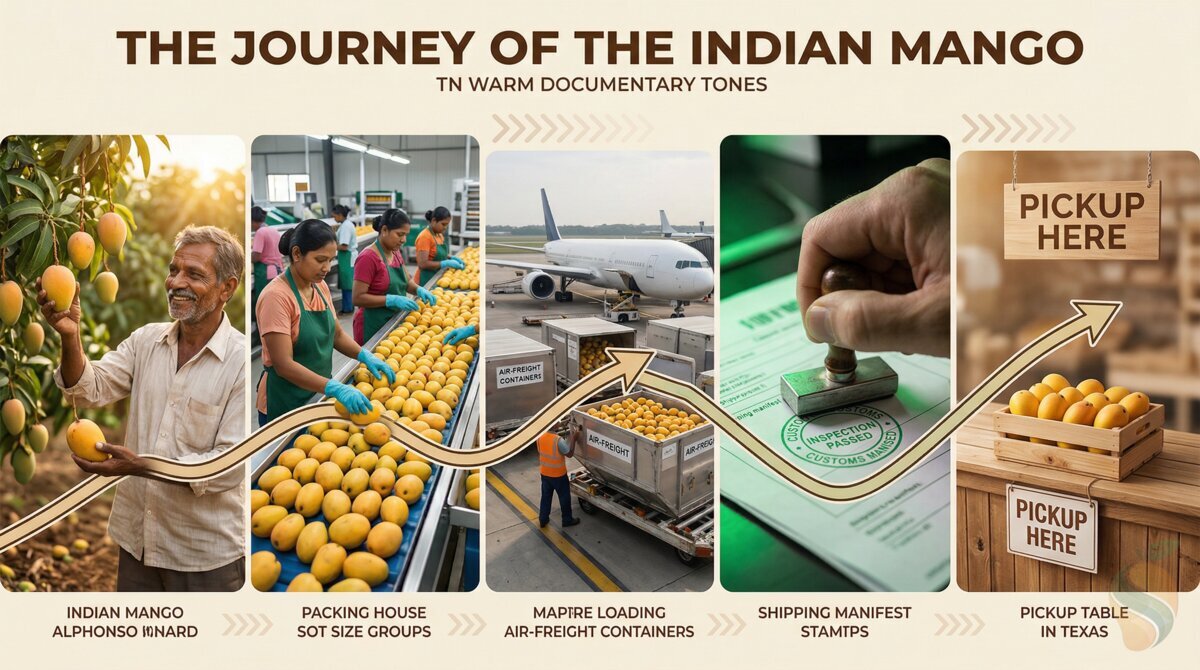
The Journey of a $50 Box
Let us trace the cost of a single box of Alphonso mangoes from an orchard in Ratnagiri, Maharashtra to your pickup location in Austin, Texas.
Farm Gate Price: ~$8-10
The farmer receives roughly $8-10 per box of export-grade Alphonso. Only about 30-40% of a harvest qualifies for US export — the rest goes to domestic Indian markets or processing. This is true whether the variety is Kesar from Gujarat or Banganapalli from Andhra Pradesh. Export-grade means specific size, zero blemishes, and proper maturity.
To put this in perspective, a mango farmer might tend 200-500 trees, but the harvest window is only 6-8 weeks. Each tree produces fruit once a year. The farmer has to manage the orchard for 12 months — watering, fertilizing, protecting against pests — for a single harvest season. And of that harvest, only the top tier makes it to the export carton. The rest sells domestically at lower prices or goes to pulp processing. Farming export-grade mangoes is not a path to easy money.
Sorting and Packing: ~$2-3
Each mango is hand-inspected, sorted by size and ripeness, then packed in cushioned export cartons. The packing houses in Ratnagiri and Krishnagiri employ skilled workers who can assess a mango’s readiness by touch in seconds.
The grading process is strict. A mango that is too small, has a minor blemish, or shows early signs of overripeness gets rejected from the export line. The cushioned cartons are specifically designed for air freight — they are lighter than domestic packing but sturdier, with individual slots that prevent the mangoes from touching each other during transit. This specialized packaging costs more than the simple crates used for domestic distribution.
USDA-Required Irradiation: ~$3-4
Every Indian mango entering the US must undergo irradiation treatment at a USDA-approved facility in India. This kills any fruit fly larvae and is a non-negotiable import requirement. The treatment facility charges per box, and there are only a handful of approved facilities in India.
The irradiation step is often the bottleneck. There are only about 5-6 USDA-approved irradiation facilities in all of India, and during peak season, every exporter is competing for treatment slots. The mangoes must be treated within a specific window after harvest — too early and they have not developed enough, too late and they will overripen before reaching the US. This timing pressure means exporters sometimes pay premium rates for slot availability, which gets passed through to the final price.
Air Freight: ~$24-28 per box (2026)
This is the biggest single cost. Mangoes cannot be shipped by sea — they would rot. In 2026, air cargo from India to the US costs approximately Rs. 600 per kilogram (roughly $7 per kg at current exchange rates). A standard 4.2 kg box runs about $24-28 in air freight alone — that is close to half the retail price of a box. Just a few years ago, this was $12-14 per box. The increase is driven by fuel surcharges, reduced cargo capacity on India-US routes, and seasonal demand during the summer travel rush.
Air freight rates fluctuate with fuel prices, seasonal cargo demand, and available capacity. During mango season, which coincides with the summer travel rush, cargo space on India-to-US routes is at a premium. The mangoes fly in the belly of commercial passenger aircraft alongside suitcases and other cargo. They are temperature-sensitive, so they need to be loaded and unloaded quickly. Any delay on the tarmac — a flight cancellation, a customs hold at the origin airport, a rerouting — can mean an entire shipment of mangoes ripening faster than planned.
Compare this to Mexican mangoes at your grocery store: they travel by truck, a journey that takes 1-2 days and costs a fraction of air freight per kilogram. That single difference in transportation mode accounts for most of the price gap between a $1 Tommy Atkins and a $6 Alphonso.
US Customs and FDA Inspection: ~$2-3
Every shipment is inspected upon arrival. Documentation, phytosanitary certificates, irradiation certificates, FDA prior notice — the regulatory compliance costs add up.
The paperwork is extensive. Each shipment requires a phytosanitary certificate from India’s plant quarantine authority, an irradiation treatment certificate from the USDA-approved facility, FDA prior notice filed electronically before the shipment arrives, and a customs declaration. If any document is missing or incorrect, the shipment gets held. Held shipments mean mangoes sitting in a warehouse ripening while paperwork gets sorted out — and sometimes that means partial or total loss of the shipment. The importers factor this risk into their pricing. For a closer look at the full journey from orchard to doorstep, read our article on how Indian mangoes are imported to the US.
Domestic Logistics: ~$3-5
Getting the mangoes from the port of entry (typically New Jersey or Chicago) to Texas involves cold chain trucking or domestic air freight. Texas is far from the typical entry points.
Most Indian mango shipments enter the US through Newark or Chicago, which are the airports with the most direct flights from India. Texas is a secondary destination, which means the mangoes need another leg of transportation — either a refrigerated truck (cheaper but slower, 2-3 days) or a domestic flight (faster but adds cost). Every hour in transit is an hour closer to overripeness, so the logistics team has to balance speed against cost constantly. The cold chain cannot break at any point: airport tarmac, truck loading dock, distribution center, delivery vehicle. One lapse and you get mushy mangoes.
Local Operations: ~$5-7
Pickup location coordination, agent commissions, quality checks, customer communication, WhatsApp group management, order processing, payment handling. Running a seasonal fresh fruit delivery operation is not cheap.
This line item covers the work that happens after the mangoes arrive in Texas. Our agents at each pickup location inspect every box before handing it to customers. They coordinate pickup windows, manage last-minute schedule changes, handle quality complaints, and process returns on the rare occasions when a box is not up to standard. The WhatsApp groups for each pickup location need daily management during season — shipping updates, ripeness tips, schedule changes. This is human labor, not automation, because mango customers deserve personal attention, not chatbots. We also provide a detailed mango care and ripening guide so every customer gets the best experience from their box.
Total Cost: $35-47 per box
At $50-$60 retail, the margin is thin. This is not a high-profit business — it is a community service that sustains itself.
To be direct: the margin on a box of Indian mangoes in Texas is somewhere between $3 and $8 depending on the week, the variety, and the logistics costs that week. Some weeks, when air freight spikes or a shipment gets delayed and we have to absorb losses, the margin disappears entirely. This is not a tech startup with 80% margins. It is a perishable goods operation where the product has a shelf life measured in days, not months.
Why Grocery Store Mangoes Are Cheaper
The Tommy Atkins mangoes at Walmart come from Mexico or Brazil by truck or ship — not air freight. They are bred for shelf life, not flavor. Their transportation cost is a fraction of air-shipped Indian mangoes.
You are not comparing the same product. A $1 grocery store mango and a $7 Alphonso are as different as boxed wine and a good Bordeaux.
Here is another way to think about it: Tommy Atkins was developed in the 1920s in Florida. It was selected for its disease resistance, its ability to survive long-distance shipping, and its attractive red-green color. Flavor was not a priority. It was bred for logistics. Alphonso, by contrast, has been cultivated for centuries specifically for taste, aroma, and texture. It is fragile, perishable, and difficult to transport. You are paying the price of caring about flavor over convenience. If you have ever wondered why grocery store Indian mangoes taste so bland, that article explains the supply chain failures in detail.
How Indian Mango Pricing Compares to Other Premium Foods
When people question the $45-$60 price tag, it helps to compare it against other specialty foods Americans regularly buy without blinking:
- A pint of high-end ice cream (Jeni’s, Salt and Straw): $10-12
- A pound of high-quality coffee beans: $18-25
- A bottle of decent wine: $15-30
- A single high-end peach at a farmers market: $3-4 each
- Japanese strawberries at a specialty store: $15-20 for a small box
- Honeycrisp apples: $3-4 per pound
A box of Alphonso at $50-$60 gives you 6-12 mangoes depending on size grade, which yields enough fruit for a week of desserts, smoothies, and straight eating. On a per-serving basis, it is comparable to or cheaper than most premium food items. The sticker shock comes from seeing “$50-$60” as a single number, but break it down and it is $6 per mango — less than a fancy latte.
Is It Worth It?
A box of Alphonso contains 6-12 mangoes depending on size grade. At $50-$60, that is about $5-$10 per mango. Each mango is a genuine, air-shipped, USDA-inspected, tree-ripened Indian mango that tastes exactly like it would in Mumbai or Hyderabad.
You are not paying for fruit. You are paying for logistics, compliance, freshness, and authenticity.
For many of our customers, it is also about something less tangible: the taste of home. The experience of cutting open an Alphonso and having the kitchen fill with that unmistakable aroma, the same one you remember from summers at your grandparents’ house — whether it was an Alphonso, a Himayath, or a Kesar — that is not something you can put a price on. A $1 Tommy Atkins from Walmart will never give you that moment. A box of Alphonso from Ratnagiri will, every single time.
If you are new to Indian mangoes and not sure if the price is justified, start with our first-timer’s guide to Indian mangoes and then order one box. Just one. Cut one open, smell it, taste it, and then decide whether it was worth the price. We have never had a first-time customer tell us it was not.
For more information about our varieties, pricing, and pickup locations, visit our FAQ page or browse all available varieties.
Frequently Asked Questions
Why are Indian mangoes more expensive than grocery store mangoes?
Indian mangoes are air-freighted (not shipped by sea), undergo USDA-required irradiation, and pass through customs inspection. Air freight alone costs approximately $24-28 per box in 2026 (up from $12-14 a few years ago). Grocery store mangoes from Mexico travel by truck at a fraction of the cost.
How much does a box of Indian mangoes cost in Texas?
A standard 3kg box of Alphonso costs $50-$60, containing 6-12 mangoes (size-dependent). That works out to about $5-$10 per mango depending on size — delivered fresh to pickup locations across Texas.
Are there ways to save on Indian mango orders?
Ordering multiple boxes at once reduces the per-box logistics cost. Many of our customers also organize group orders through their community, workplace, or apartment complex, which helps with pickup coordination. Visit our order page for current pricing and available varieties.
Why do mango prices vary week to week?
Air freight rates, harvest volume, and demand all fluctuate during the season. Early season and late season tend to have slightly higher prices due to limited supply. Peak season (mid-April through May) typically offers the best value because supply is highest. Check our blog for weekly availability updates.