Tag: fiber

  • Indian Mangoes vs Mexican Mangoes: What’s the Real Difference?

    Indian Mangoes vs Mexican Mangoes: What’s the Real Difference?

    Indian mangoes are sweeter (16-22 Brix vs 12-16), creamier, fiberless, and contain up to 4x more beta-carotene than Mexican varieties — though they cost more and are only available April through July.

    If you have only eaten mangoes from your local grocery store in Texas, you have likely had a Mexican mango — most commonly Tommy Atkins, Ataulfo (Honey), or Kent. They are decent fruit. But if you have ever tasted an Alphonso, Banginapalli, or Kesar from India, you know the difference is not subtle. It is categorical.

    This guide breaks down the real differences between Indian and Mexican mangoes — in taste, texture, nutrition, availability, and price — so you can decide which is right for your family.


    Side-by-Side Comparison

    FeatureIndian MangoesMexican Mangoes
    Common Varieties in USAlphonso, Banginapalli, Kesar, Dasheri, Totapuri, Chinna RasaluTommy Atkins, Ataulfo (Honey), Kent, Haden, Francis
    TasteIntensely sweet, complex flavor with floral and saffron notesMildly sweet to sweet-tart, simpler flavor profile
    AromaHighly aromatic (270+ volatile compounds in Alphonso)Mild aroma
    TextureCreamy, buttery, fiberless (Alphonso, Banginapalli)Firm, sometimes fibrous (Tommy Atkins), smooth (Ataulfo)
    Sugar Content16–22 Brix (Alphonso can reach 22%)12–16 Brix
    Beta-CaroteneUp to 2,740 mcg/100g (Alphonso)~640 mcg/100g (generic)
    Fiber in PulpNone to minimalModerate to high (Tommy Atkins)
    Availability in USSeasonal: April–July onlyYear-round (peak Feb–Sep)
    Import MethodAir-freighted, USDA irradiation requiredTrucked overland, hot water treatment
    Price (per box)$35–$80 depending on variety$1–$3 per mango at grocery stores
    Named Varieties1,500+ in India~20 commercial varieties in Mexico
    Heritage4,000+ years of cultivationIntroduced by Portuguese/Spanish in 1600s

    Taste: Why Indian Mangoes Are in a Different League

    The most significant difference is flavor complexity. Indian mango varieties have been selectively bred for thousands of years — not for shelf life or shipping durability, but for taste.

    • Alphonso has over 270 volatile aromatic compounds that create its signature rich, honeyed, almost floral flavor. It is sometimes described as having notes of citrus, peach, and saffron simultaneously (Litz, “Mango: Botany, Production and Uses,” CAB International, 2009).
    • Kesar has a pronounced saffron-like aroma that is unmistakable — hence the name (“kesar” means saffron in Hindi).
    • Banginapalli is the “crowd-pleaser” — its sweetness is clean and straightforward with zero fiber, making it approachable for first-time Indian mango eaters.

    In contrast, Tommy Atkins — which makes up roughly 80% of mangoes sold in US grocery stores — was actually selected primarily for its shelf life and visual appeal (deep red skin), not its taste. This is why many Americans think mangoes are “just okay.” They have never tasted a mango bred for flavor.

    The Mexican Ataulfo (Honey mango) is the closest supermarket option to an Indian mango — creamy, sweet, and low-fiber — but it still lacks the aromatic complexity and sweetness intensity of Alphonso or Kesar.


    Texture: Fiberless vs. Fibrous

    Close-up of creamy Alphonso mango pulp being scooped with a spoon showing zero fiber

    One of the biggest complaints about supermarket mangoes is the stringy fiber that gets stuck in your teeth. This is primarily a Tommy Atkins and Haden problem.

    Most premium Indian varieties are completely fiberless:

    • Alphonso — Buttery, custard-like texture. You can scoop it with a spoon.
    • Banginapalli — Smooth, juicy, sliceable. Perfect for cutting into cubes.
    • Kesar — Smooth and pulpy with minimal fiber.
    • Chinna Rasalu — Small but incredibly smooth and aromatic.

    If you or your kids have avoided mangoes because of the fibrous texture, Indian varieties will change your mind.


    Nutrition: Indian Varieties Win on Beta-Carotene

    Indian mango cultivars — particularly Alphonso and Kesar — contain dramatically higher levels of beta-carotene (provitamin A) compared to Mexican varieties:

    VarietyBeta-Carotene (mcg/100g)Origin
    Alphonso~2,740India (Maharashtra)
    Kesar~2,000–2,500India (Gujarat)
    Generic Mango (USDA)640US market average
    Tommy Atkins~400–600Mexico/Brazil
    Ataulfo (Honey)~600–800Mexico

    Beta-carotene converts to Vitamin A in the body and is essential for eye health, immune function, and skin health. A single Alphonso mango can provide close to a full day’s Vitamin A requirement for a child. For a deeper dive into mango nutrition science, see our guide to the health benefits of Indian mangoes.

    Source: Vasant P. et al., Journal of Food Science and Technology, 2012; Varakumar et al., Food Chemistry, 2017; USDA FoodData Central.


    Why Are Indian Mangoes More Expensive?

    The price difference is significant — and it is real. Here is where the cost comes from:

    1. Air Freight: Indian mangoes are flown 9,000+ miles from India to the US. Mexican mangoes are trucked across the border. Learn more about how Indian mangoes are imported to the US.
    2. USDA Irradiation: Every Indian mango must undergo irradiation at USDA-approved facilities in India before export. Mexico uses cheaper hot water treatment.
    3. Limited Season: Indian varieties are available for only 8–12 weeks per year. Mexican mangoes are available nearly year-round.
    4. Demand vs. Supply: India exports less than 1% of its mango production. The Indian diaspora in the US creates intense demand for limited supply.
    5. Quality Selection: Export-grade Indian mangoes are the top 10–15% of the harvest. Only the best fruit makes the journey.

    Is it worth it? For families who grew up eating Alphonso or Banginapalli, the answer is obvious. For newcomers, one box will tell you why Indian mangoes are called the “King of Fruits.”


    Which Indian Mango Should You Try First?

    If you are used to supermarket mangoes and want to experience the Indian difference:

    • Start with Banginapalli if you want approachable sweetness, large fruit, and a fiberless texture your whole family will love.
    • Try Alphonso if you want the ultimate, once-in-a-lifetime mango experience — the world’s most celebrated variety.
    • Go with Kesar if you love aromatic fruits and want to make mango lassi, aam ras, or smoothies that taste like nothing you have had before.
    • Explore Totapuri if you enjoy cooking — it is ideal for pickles, chutneys, and mango dal.

    See our complete varieties page for detailed profiles of every variety we carry.


    Frequently Asked Questions

    Are Indian mangoes available year-round in the US?

    No. Indian mangoes are seasonal, available from approximately mid-April through mid-July. This limited window is part of what makes them special — and it is why demand spikes every spring. Pre-ordering is recommended since popular varieties sell out quickly. Check our 2026 Indian mango season guide for Texas for exact arrival dates and variety schedules.

    Why don’t grocery stores carry Indian mangoes?

    Some specialty Indian grocery stores do carry them seasonally. However, the irradiation requirement, short shelf life, air freight costs, and limited supply make mass retail distribution challenging. Community-based delivery services like Swadeshi Mangoes can offer better freshness and pricing through group orders.

    Are Indian mangoes safe to eat? What about irradiation?

    Absolutely. USDA-mandated irradiation is endorsed by the World Health Organization (WHO), FDA, and USDA as safe. It eliminates quarantine pests without leaving any residue or altering nutritional content. Over 60 countries approve irradiation for food safety.

    Is the Ataulfo (Honey) mango similar to Indian mangoes?

    Ataulfo is the closest supermarket variety to an Indian mango — it is smooth, sweet, and relatively low-fiber. However, it lacks the aromatic intensity and higher beta-carotene content of Indian varieties like Alphonso and Kesar. Think of Ataulfo as a “good everyday mango” and Alphonso as a “special occasion mango.”

    Can I buy Indian mangoes in Austin, Dallas, Houston, or San Antonio?

    Yes. Swadeshi Mangoes delivers fresh, USDA-approved Indian mangoes across all major Texas metros including Austin, Dallas, Houston, and San Antonio. Visit our order page to browse available varieties.


    References


    Ready to taste the difference?

    Order Indian Mangoes in Texas →

    Season: April–July • Refer a friend and earn $5Explore all varieties

  • Health Benefits of Indian Mangoes: Nutrition Facts Backed by Science

    Health Benefits of Indian Mangoes: Nutrition Facts Backed by Science

    Indian mango varieties like Alphonso contain up to 2,740 mcg of beta-carotene per 100g — over 4x the USDA baseline — along with 36mg vitamin C, 1.6g fiber, and powerful antioxidants including mangiferin.

    Indian mangoes are not just the most flavorful fruit you will eat this summer — they are also one of the most nutrient-dense. Varieties like Alphonso, Banginapalli, and Kesar contain significantly higher levels of beta-carotene, vitamins, and antioxidants than the generic supermarket mangoes most Americans are used to.

    At Swadeshi Mangoes, we believe knowing what you are eating matters. Here is a complete, science-backed breakdown of why Indian mangoes deserve a spot in your family’s diet.


    Mango Nutrition Facts: What’s in 100g of Fresh Mango?

    The following data is from the USDA FoodData Central (NDB #09176, “Mangos, raw”), with Indian variety-specific notes from the National Institute of Nutrition (NIN), Hyderabad and Indian Council of Agricultural Research (ICAR).

    NutrientPer 100g (USDA Baseline)% Daily Value
    Calories60 kcal
    Carbohydrates15.0 g5%
    Dietary Fiber1.6 g6%
    Vitamin C36.4 mg40%
    Vitamin A (RAE)54 mcg6%
    Beta-Carotene640 mcg
    Folate (B9)43 mcg11%
    Vitamin B60.119 mg7%
    Vitamin E0.9 mg6%
    Potassium168 mg5%
    Copper0.111 mg12%

    Important: The USDA baseline reflects generic supermarket mangoes (typically Tommy Atkins or Kent). Indian varieties like Alphonso contain significantly more beta-carotene — up to 2,740 mcg per 100g, which is over 4 times the USDA baseline (Vasant P. et al., Journal of Food Science and Technology, 2012).


    How Indian Mango Varieties Compare Nutritionally

    Nutrient HighlightAlphonsoBanginapalliKesar
    Beta-Carotene~2,740 mcg/100g~640 mcg/100g~2,000–2,500 mcg/100g
    Calories70–74 kcal/100g~60 kcal/100g~65 kcal/100g
    Sugar Content16–17g/100g13–14g/100g~15g/100g
    Vitamin C~36 mg/100g~30–35 mg/100g~35 mg/100g
    FiberNone (fiberless)None (fiberless)Minimal
    StandoutHighest beta-caroteneBest pulp-to-seed ratioRich total carotenoids

    Source: Varakumar et al., Food Chemistry, 2017; NIN Hyderabad cultivar analyses. For a full flavor and texture comparison between these three popular varieties, see our Alphonso vs Banginapalli vs Kesar guide.


    Indian mango health benefits infographic showing vitamin A, vitamin C, digestion, and heart health
    Key health benefits of Indian mangoes at a glance

    6 Science-Backed Health Benefits of Indian Mangoes

    1. Related: the science of mangoes and metabolic health. Related: elevate your Banginapalli experience with savory-sweet pairings. Powerful Immune Support

    A single cup of mango (~165g) delivers about 66% of your daily Vitamin C requirement. Vitamin C is a proven immune modulator — it strengthens epithelial barriers and enhances the activity of neutrophils and lymphocytes, your body’s front-line defenders.

    Beyond Vitamin C, mango polyphenols have been shown to modulate inflammatory markers in laboratory studies.

    Reference: Carr & Maggini, “Vitamin C and Immune Function,” Nutrients, 2017 (PMID: 29099763); Edirisinghe et al., Molecular Nutrition & Food Research, 2011.

    2. Exceptional for Eye Health

    Indian mangoes — especially Alphonso — are among the richest fruit sources of beta-carotene (provitamin A) available. Your body converts beta-carotene into retinol, essential for rhodopsin production and night vision. Alphonso delivers roughly 18 times more beta-carotene than an apple and nearly 40 times more than a banana.

    Mangoes also contain lutein and zeaxanthin, carotenoids that accumulate in the retina and help protect against age-related macular degeneration.

    Reference: Abdel-Aal et al., “Dietary Sources of Lutein and Zeaxanthin Carotenoids,” Nutrients, 2013 (PMID: 23571649).

    3. Digestive Health — Better Than Fiber Supplements

    A clinical trial at Texas A&M University found that daily mango consumption was more effective than an equivalent amount of fiber from psyllium (Metamucil) for relieving chronic constipation. The researchers attributed this to the interaction between mango polyphenols and gut bacteria — not just the fiber content.

    Mangoes also contain natural digestive enzymes called amylases that help break down complex carbohydrates.

    Reference: Kim et al., “Mango Supplementation Improves Constipation,” Molecular Nutrition & Food Research, 2018 (PMID: 29377594).

    4. Heart-Healthy Potassium and Polyphenols

    Mangoes provide 168 mg of potassium per 100g, which supports healthy blood pressure. A 2018 pilot study found that consuming 2 cups of mango daily for 6 weeks reduced systolic blood pressure in lean adults.

    Mangiferin, a polyphenol concentrated in Indian mango varieties, has demonstrated lipid-lowering effects in published research.

    Reference: Lucas et al., FASEB Journal, 2018; Muruganandan et al., Journal of Ethnopharmacology, 2005 (PMID: 15740886).

    5. Skin Health and UV Protection

    Vitamin C is a required cofactor for collagen synthesis — the protein that keeps skin firm and elastic. Combined with Vitamin A (which supports skin cell turnover) and mangiferin (which has demonstrated UV-protective properties in cell models), mangoes support skin health from multiple angles.

    Reference: Pullar et al., “The Roles of Vitamin C in Skin Health,” Nutrients, 2017 (PMID: 28805671); Telang et al., Pharmacognosy Reviews, 2013 (PMID: 24347919).

    6. Blood Sugar Friendly (Despite the Sweetness)

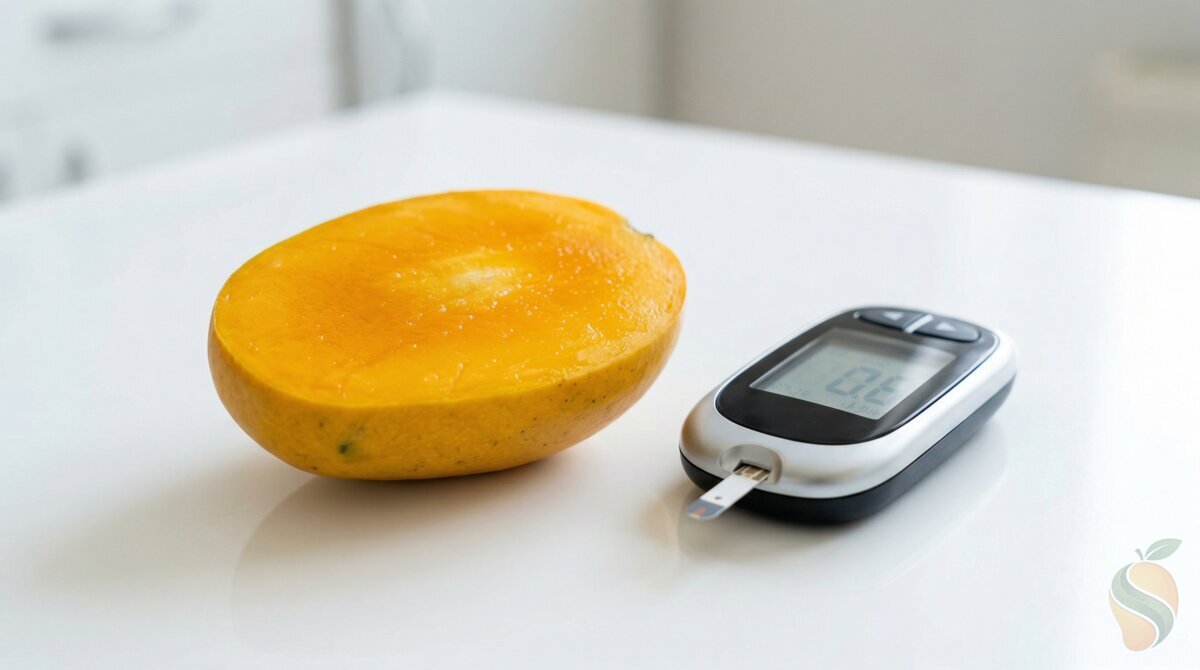
    This surprises many people: despite their sweetness, mangoes have a glycemic index of 51 (medium). A study on obese individuals found that freeze-dried mango supplementation actually improved glucose tolerance. This is attributed to mangiferin and the fruit’s natural fiber matrix, which moderates sugar absorption. We explore this topic in depth in our article on mangoes and diabetes research.

    Reference: Evans et al., “Mango Supplementation Improves Blood Glucose,” Nutrition and Metabolic Insights, 2014 (PMID: 25210462).


    How Mangoes Compare to Other Popular Fruits

    Per 100gMangoAppleBananaBlueberryOrangeStrawberry
    Vitamin A (mcg)54333111
    Beta-Carotene (mcg)640272632717
    Vitamin C (mg)36.44.68.79.753.258.8
    Folate (mcg)4332063024
    Potassium (mg)16810735877181153
    Calories605289574732

    Key takeaway: Mango dominates in Vitamin A, beta-carotene, and folate. Indian Alphonso mangoes push beta-carotene to ~2,740 mcg — making them one of the richest fruit sources of provitamin A available anywhere. For a detailed side-by-side breakdown, see our Indian mangoes vs Mexican mangoes comparison.

    Source: USDA FoodData Central.


    Indian Mangoes for Kids and Pregnant Women

    For Pregnant Women

    • Folate: One cup of mango (~165g) provides approximately 71 mcg of folate — about 18% of the recommended 400 mcg daily intake. Folate is critical for neural tube development in the first trimester (MRC Vitamin Study, Lancet, 1991).
    • Safe Vitamin A: Unlike retinol supplements (which can be harmful in excess during pregnancy), the beta-carotene in mangoes is the safe, plant-based form. Your body only converts what it needs.
    • Iron Absorption: The Vitamin C in mango enhances absorption of non-heme iron from plant foods — important since iron-deficiency anemia affects approximately 40% of pregnant women globally (WHO).
    • Constipation Relief: The Texas A&M study on mango and constipation is directly relevant — constipation is one of the most common pregnancy complaints.
    • Note: Women with gestational diabetes should account for mango’s sugar content (about 23g per cup) within their carbohydrate budget.

    For Children

    • Vitamin A Powerhouse: The WHO identifies Vitamin A deficiency as a leading cause of preventable childhood blindness. A single Alphonso mango (~200g edible pulp) can provide nearly 100% of a child’s daily Vitamin A requirement.
    • Natural vs. Processed Sugar: Mango delivers its sugar within a fiber and polyphenol matrix that moderates glycemic response — making it a far better snack than processed alternatives with comparable calories.
    • Growth Support: Copper (12% DV per 100g) supports iron metabolism and connective tissue development. Folate supports DNA synthesis during rapid growth phases.
    • Kid-Friendly: The naturally sweet, fiberless texture of Banginapalli and Alphonso makes them easy for even picky eaters to enjoy. No stringy fibers, no tartness — just smooth, sweet fruit.

    The Mangiferin Advantage: Why Indian Varieties Stand Out

    Mangiferin is a polyphenol unique to the mango family. It is concentrated in the peel, bark, and kernel, but is also present in the pulp — especially in Indian cultivars like Alphonso. Research has documented multiple bioactivities:

    • Antioxidant: Scavenges free radicals and reduces oxidative stress markers
    • Anti-inflammatory: Reduces NF-kB pathway activation (Garcia-Rivera et al., Pharmacological Research, 2011)
    • Anti-diabetic: Improved insulin sensitivity in Type 2 diabetes models (Sellamuthu et al., Journal of Medicinal Food, 2013)
    • Gut Health: Modulated gut microbiota composition, increasing beneficial Bifidobacteria (Kim et al., Molecular Nutrition & Food Research, 2018)
    • Neuroprotective: Early animal studies show potential in reducing amyloid-beta aggregation (relevant to Alzheimer’s research)

    A comprehensive review of mangiferin’s bioactivities was published in Molecules (Imran et al., 2017, PMID: 28291784).


    Frequently Asked Questions

    Are mangoes fattening?

    No. A 100g serving of mango contains only 60 calories and 0.38g of fat. The natural sugars are delivered within a polyphenol and fiber matrix that moderates absorption. Studies have shown mango consumption can actually improve glucose tolerance in overweight individuals.

    Which Indian mango variety is the healthiest?

    Alphonso leads in beta-carotene content (up to 2,740 mcg/100g), making it the best choice for Vitamin A. Kesar is a close second with high total carotenoid levels. All Indian varieties are nutritionally superior to generic supermarket mangoes.

    How many mangoes can I eat per day?

    Most nutritionists recommend 1–2 mangoes per day as part of a balanced diet. This provides significant vitamins and antioxidants without excessive sugar intake. One medium Indian mango contains roughly 150–180 calories and about 30–35 grams of natural sugar. For individuals managing diabetes or watching carbohydrate intake, consult your doctor about appropriate portion sizes.

    Are Indian mangoes safe? What about irradiation?

    Yes. All Indian mangoes imported to the US undergo USDA-mandated irradiation at approved facilities. This treatment eliminates pests while preserving nutritional integrity. The process is endorsed by the WHO, FDA, and USDA as safe for food. Learn more about the import process.

    How many calories in an Indian mango?

    An Indian mango contains approximately 60 kcal per 100g based on USDA data, with one medium Alphonso containing approximately 150–180 calories. Indian varieties like Alphonso and Kesar have similar calorie counts to grocery store mangoes, but deliver significantly more vitamins and antioxidants per serving.

    Are mangoes good for gut health?

    Research from Texas A&M University found that mango consumption improved gut bacteria diversity and reduced intestinal inflammation markers. The fiber and polyphenols in Indian varieties like Alphonso support healthy digestion when consumed as part of a balanced diet.


    References

    • USDA FoodData Central: “Mangos, raw” (NDB #09176)
    • Carr AC, Maggini S. “Vitamin C and Immune Function.” Nutrients, 2017. PMID: 29099763
    • Kim H, et al. “Mango Polyphenolics and Chronic Constipation.” Molecular Nutrition & Food Research, 2018. PMID: 29377594
    • Evans SF, et al. “Mango Supplementation and Blood Glucose.” Nutrition and Metabolic Insights, 2014. PMID: 25210462
    • Imran M, et al. “Mangiferin: A Comprehensive Review.” Molecules, 2017. PMID: 28291784
    • Abdel-Aal EM, et al. “Dietary Sources of Lutein and Zeaxanthin.” Nutrients, 2013. PMID: 23571649
    • Vasant P, et al. “Carotenoid Content of Alphonso Mango.” Journal of Food Science and Technology, 2012.
    • Varakumar S, et al. “Total Carotenoids in Indian Mango Cultivars.” Food Chemistry, 2017.
    • National Institute of Nutrition (NIN), Hyderabad — Indian mango cultivar nutrition data
    • World Health Organization — Vitamin A Deficiency and Iron-Deficiency Anemia statistics

    Ready to add the healthiest mangoes to your family’s diet?

    Order Fresh Indian Mangoes →

    Available April–July • Delivery across Texas • Explore all varieties

Chat on WhatsApp