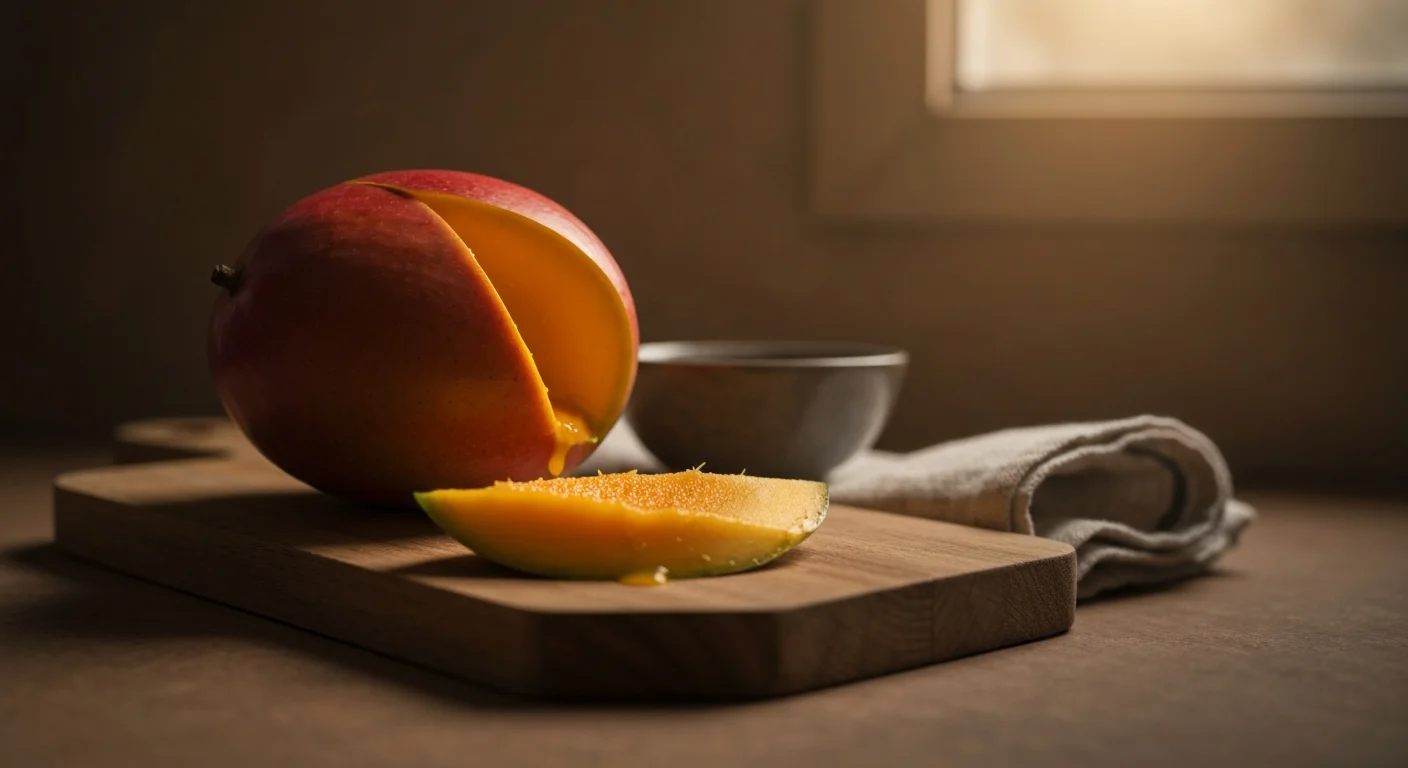

In 2018, researchers at Texas A&M University published a study that surprised the nutrition world: daily mango consumption was more effective than an equivalent dose of fiber from psyllium (Metamucil) for relieving chronic constipation. The mechanism was not the fiber — it was the interaction between mango polyphenols and gut bacteria.
Three thousand years earlier, Ayurvedic practitioners had already classified ripe mangoes as a fruit that “kindles digestive fire” and promotes healthy elimination.
This is not a coincidence. This is convergence — two very different systems arriving at the same truth about the same fruit, separated by millennia.
What Ayurveda Says About Mangoes and Digestion
In Ayurveda, foods are classified by their effect on the three doshas — Vata (air/movement), Pitta (fire/metabolism), and Kapha (earth/structure). Mangoes have a nuanced profile:
| Mango State | Ayurvedic Effect | Practical Meaning |
|---|---|---|
| Ripe mango | Pacifies Vata, mildly increases Pitta and Kapha | Promotes smooth digestion and regular elimination. Best eaten in moderation. |
| Raw/green mango | Stimulates Agni (digestive fire), pacifies Pitta when prepared as aam panna | Aids appetite and digestion. Raw mango drinks cool the body in summer. |
Ayurvedic texts recommend eating ripe mangoes:
- After soaking in water for 30 minutes (to reduce excess heat)
- With milk (to balance the fruit’s warming quality)
- In moderation (excess can aggravate Kapha, causing congestion)
- Not on an empty stomach (the natural sugars are better absorbed with other food)
These are not random rules. They are 3,000 years of observational data about how the human body responds to this specific fruit.
Reference: Charaka Samhita and Sushruta Samhita — classical Ayurvedic texts; Lad, Vasant. “The Complete Book of Ayurvedic Home Remedies.” Three Rivers Press, 1998.
What Modern Science Found: The Texas A&M Study
The landmark 2018 study by Kim et al. at Texas A&M enrolled adults with chronic constipation and compared two groups over 4 weeks:
- Group 1: 300g of mango daily (~2 cups)
- Group 2: An equivalent amount of dietary fiber from psyllium
Results: The mango group showed significantly greater improvement in constipation symptoms than the fiber group — despite both groups consuming the same amount of fiber.
The key finding: Mango’s benefit was not from fiber alone. The researchers identified that mango polyphenols (including gallic acid, gallotannins, and mangiferin) interacted with gut bacteria to:
- Reduce intestinal inflammation markers
- Increase beneficial Bifidobacteria populations
- Improve the Firmicutes-to-Bacteroidetes ratio — a marker of gut health that is increasingly linked to overall metabolic health
In other words, mango was working as a prebiotic — feeding the good bacteria in ways that isolated fiber could not.
Reference: Kim H, et al. “Mango Polyphenolics Reduce Inflammation in Intestinal Colitis.” Molecular Nutrition & Food Research, 2018. PMID: 29377594
Where Ayurveda and Science Agree
| Claim | Ayurvedic View | Modern Evidence |
|---|---|---|
| Ripe mango aids elimination | “Pacifies Vata” — Vata governs movement in the body including bowel function | Texas A&M study: mango > fiber supplements for constipation relief |
| Mango supports digestive fire | “Kindles Agni” — improves appetite and digestion | Mango contains amylase enzymes that break down starches; polyphenols stimulate gut motility |
| Raw mango cools the body | Aam panna pacifies Pitta in summer heat | Raw mango is rich in organic acids and vitamin C that support hydration and electrolyte balance |
| Excess mango causes problems | “Aggravates Kapha” — too much leads to heaviness/congestion | High sugar content (13-17g/100g) can cause GI discomfort in excess. Moderation is supported by clinical guidelines. |
| Mango with milk is beneficial | Balances mango’s heating quality | The combination provides both prebiotics (from mango) and probiotics (if using cultured dairy) — a synbiotic effect |
The Mangiferin Factor
Mangiferin is a polyphenol found predominantly in mango — especially in Indian varieties like Alphonso. It is concentrated in the peel, bark, and kernel, but is present in the pulp as well.
Published research on mangiferin’s gut-related effects includes:
- Anti-inflammatory: Reduced NF-kB pathway activation, a key driver of intestinal inflammation (Garcia-Rivera et al., Pharmacological Research, 2011)
- Microbiome modulation: Increased Bifidobacteria and improved gut barrier function (Kim et al., 2018)
- Anti-diabetic (gut-mediated): Improved insulin sensitivity, potentially through gut-brain axis signaling (Sellamuthu et al., Journal of Medicinal Food, 2013)
Indian mango varieties contain higher levels of mangiferin in the pulp compared to commercial Western varieties like Tommy Atkins — another reason why the specific variety matters for health benefits.
Reference: Imran M, et al. “Mangiferin: A Comprehensive Review.” Molecules, 2017. PMID: 28291784
Practical Tips: How to Eat Mangoes for Gut Health
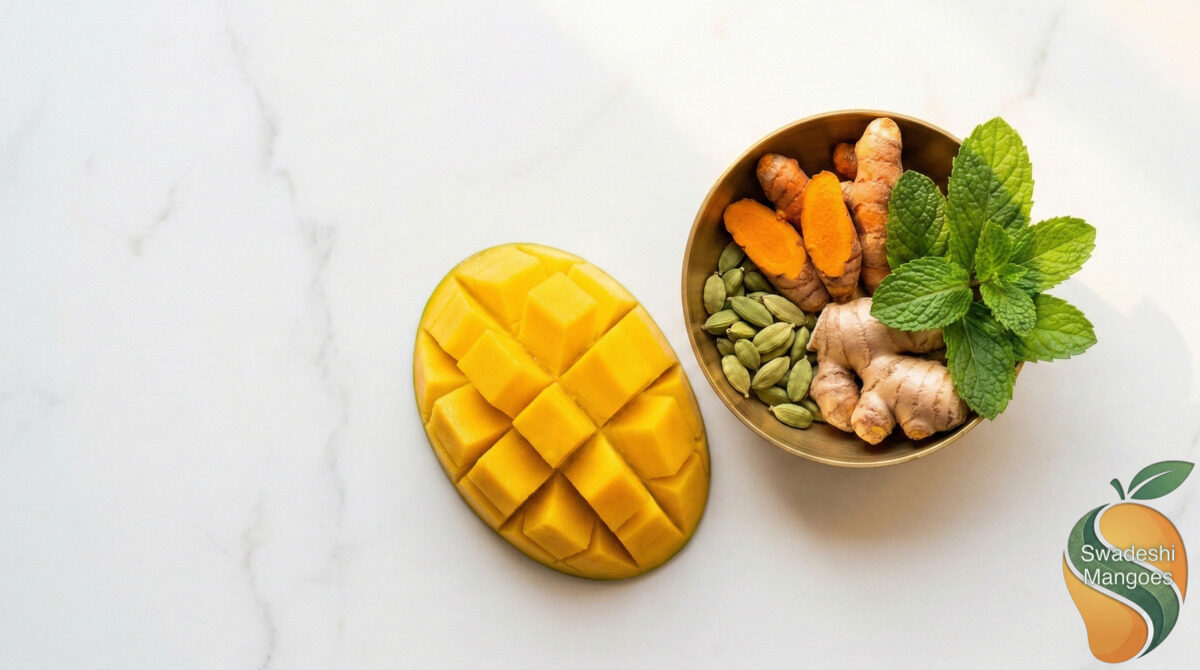
Combining Ayurvedic wisdom with modern research, here is a practical approach:
- Eat ripe mangoes regularly during season — the polyphenol-gut bacteria interaction builds over time. Consistency matters more than quantity.
- Pair with fermented dairy — mango lassi or mango with yogurt creates a natural synbiotic: prebiotic polyphenols from mango + probiotic bacteria from yogurt.
- Do not skip the pulp near the skin — mangiferin concentration is highest near the peel. When eating Indian varieties like Alphonso, scoop close to the skin.
- Drink aam panna in summer — raw mango drinks support hydration and digestive function, just as Ayurveda prescribes. Use Totapuri for the best tartness.
- Moderate your intake — both Ayurveda and modern nutrition agree: 1–2 mangoes per day is optimal. More can cause digestive discomfort from excess sugar.
Frequently Asked Questions
Can mangoes cause digestive problems?
In excess, yes — the high natural sugar content can cause bloating or loose stools in some people. Both Ayurveda (“aggravates Kapha”) and modern dietetics agree that moderation is key. 1–2 mangoes per day is the recommended range.
Which mango variety is best for gut health?
Varieties with higher polyphenol content offer more prebiotic benefit. Alphonso has the highest documented mangiferin levels among common Indian varieties. However, all Indian mango varieties contain beneficial polyphenols.
Is mango good for IBS?
Mango is a medium-FODMAP fruit. People with IBS may tolerate half a mango per serving. The polyphenol benefits are real, but individual tolerance varies. Consult your gastroenterologist if you have active IBS symptoms.
References
- Kim H, et al. “Mango Polyphenolics and Chronic Constipation.” Molecular Nutrition & Food Research, 2018. PMID: 29377594
- Imran M, et al. “Mangiferin: A Comprehensive Review.” Molecules, 2017. PMID: 28291784
- Garcia-Rivera D, et al. “Anti-inflammatory Properties of Mangiferin.” Pharmacological Research, 2011. PMID: 21473914
- Sellamuthu PS, et al. “Mangiferin and Insulin Sensitivity.” Journal of Medicinal Food, 2013. PMID: 23514231
- Lad, Vasant. The Complete Book of Ayurvedic Home Remedies. Three Rivers Press, 1998.
- Charaka Samhita — classical Ayurvedic text on dietary classification
- Achaya, K.T. Indian Food: A Historical Companion. Oxford University Press, 1994.
Feed your gut the fruit it was designed for.
Full nutrition guide • Browse varieties

Swadeshi Mangoes
Swadeshi Mangoes is a community-driven Indian mango pickup network operated by Swadeshi Central TX LLC, headquartered in Round Rock, Texas. We bring authentic, USDA-inspected Indian mangoes — Alphonso, Banginapalli, Kesar, and more — to families through local pickup in multiple US cities, every season since 2025.