Tag: texas

  • What Texas Peach Farmers and Indian Mango Growers Have in Common

    What Texas Peach Farmers and Indian Mango Growers Have in Common

    Every May, thousands of Texans drive to Fredericksburg, Stonewall, and Gillespie County for one reason: Hill Country peaches. They pass dozens of roadside stands. They argue about which orchard is best. They buy a full crate and eat half of it on the drive home.

    Every May, thousands of Indian families in Texas check their WhatsApp groups for one message: “Alphonso arriving this week.” They pre-ordered weeks ago. They argue about which variety is best. They pick up a full box and eat half of it before dinner.

    Two communities. Two fruits. The same love story.


    The Season Is Everything

    Both Texas peaches and Indian mangoes share a fundamental truth: the season is short, and that is what makes it sacred.

    Texas PeachesIndian Mangoes
    SeasonMay–AugustApril–July
    PeakJuneMay–June
    How long you wait11 months11 months
    Can you get them year-round?Not the real onesNot the real ones

    You can buy peaches at H-E-B in December. They come from Chile. They taste like cold water. Every Texan knows these are not real peaches. They are just round objects that look like peaches.

    You can buy mangoes at Kroger in January. They come from Mexico. They taste like mild sweetness wrapped in fiber. Every Indian knows these are not real mangoes.

    In both cases, the grocery store version is a reminder of what you are missing, not a substitute for what you want.


    Family Farms vs. Industrial Agriculture

    The best Texas peaches come from small family orchards — some of them three or four generations old. Jenschke Orchards. Marburger Orchard. Vogel Orchard. These families know their trees by name. They pick by hand. They sell at the roadside stand their grandfather built.

    The best Indian mangoes come from small family orchards too — some of them older than Texas itself. The Banginapalli orchards in Kurnool, Andhra Pradesh. The Alphonso groves in Ratnagiri, Maharashtra. The Kesar farms in Junagadh, Gujarat. These families have grown the same varieties for generations. They graft by hand. They grade each fruit individually.

    In both traditions, the relationship between grower and eater is personal. Texans return to the same peach stand every year. Indian families buy from the same vendor every season. Trust is built over years, not transactions.


    The Variety Debate

    Ask a Texan which peach is best and prepare for a fight. Loring? Red Globe? Harvester? June Gold? Everyone has an opinion. Everyone is right. Everyone else is wrong.

    Ask an Indian which mango is best and prepare for a longer fight.

    • A Maharashtrian will say Alphonso and look at you like the question is absurd.
    • A Telugu person will say Banginapalli and explain why size and sweetness ratio matters.
    • A Gujarati will say Kesar and describe the saffron aroma in poetic detail.
    • Someone from UP will name three varieties you have never heard of and explain that none of the southern mangoes even qualify.

    These debates are never resolved. They are never meant to be. The argument is the tradition.


    People Drive Hours for the Real Thing

    Texans drive 2–3 hours from Austin, Dallas, or Houston to Hill Country peach stands. They pass perfectly good grocery stores the entire way. They do this because they know: the peach at the roadside stand and the peach at the supermarket are not the same fruit.

    Indian families in Texas coordinate pickups across metro areas, check WhatsApp at midnight for delivery updates, and drive across town to meet a pickup agent in a parking lot. They do this because they know: the Alphonso from Ratnagiri and the Tommy Atkins from Mexico are not the same fruit.

    Both communities understand something that convenience culture tries to make us forget: the best things are worth the effort.


    What We Can Learn from Each Other

    If you are a Texan who has never tried an Indian mango, think of it this way: it is the difference between a grocery store peach from Chile and a tree-ripened Fredericksburg peach, warm from the sun. That difference? Indian families experience it with mangoes. The Indian varieties are to supermarket mangoes what Hill Country peaches are to imported ones.

    If you are an Indian family who has never been to Hill Country peach country, consider this your sign. The drive is beautiful. The peaches are extraordinary. And you will recognize something familiar in those roadside stands — the same love of seasonal fruit, the same pride in what the land produces, the same insistence that this year’s crop is special.

    Texas and India are closer than you think. Sometimes all it takes is a fruit to see it.


    Both Traditions, One Texas Summer

    Wooden crate with Texas peaches and Indian mangoes with Texas flag and Indian tricolor ribbon

    Here is the beautiful overlap: Texas peach season and Indian mango season happen at exactly the same time. May through July. You do not have to choose. Your kitchen can have a box of Fredericksburg peaches and a box of Ratnagiri Alphonsos sitting on the counter, both ripening in the Texas heat.

    That is a Texas summer worth having.


    Add Indian mangoes to your Texas summer.

    Order Fresh Indian Mangoes →

    Season: April–July • 7 varieties • Pickup across Texas

  • The Mango That Made My Amma Cry: Why One Bite Takes Us Back to India

    The Mango That Made My Amma Cry: Why One Bite Takes Us Back to India

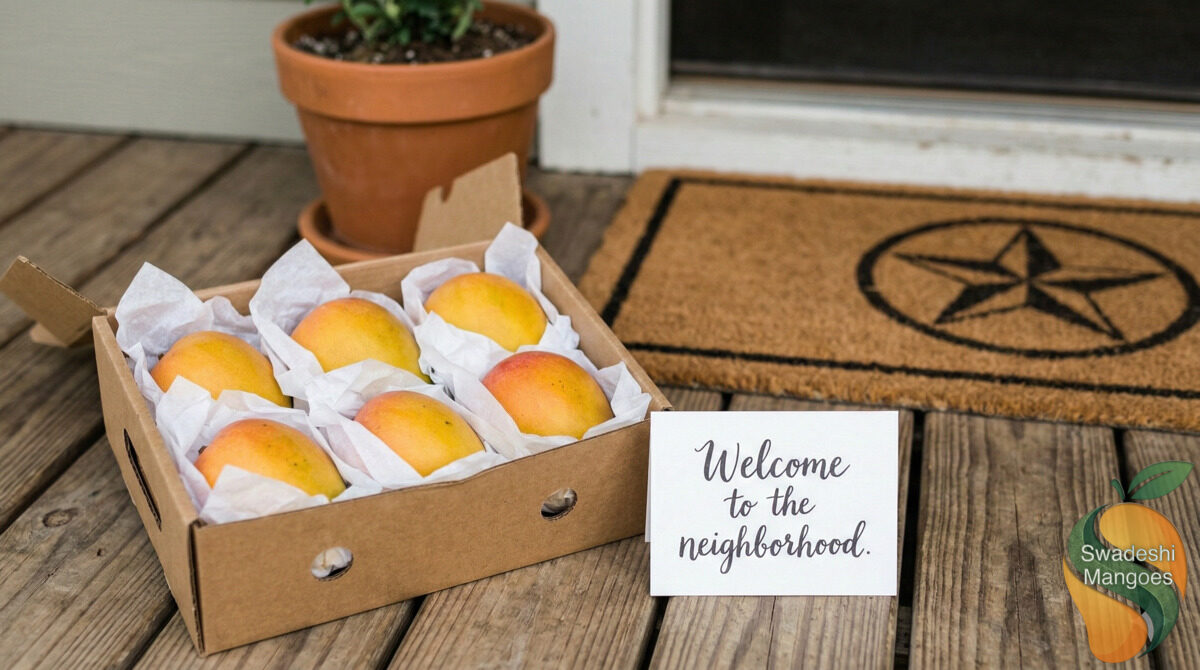
    She was standing in the kitchen in Round Rock, Texas. The box had arrived that morning — six Alphonso mangoes wrapped in tissue paper, each one the size of her fist. She picked one up, held it to her nose, and closed her eyes.

    Then she started crying.

    Not sad crying. The other kind. The kind that happens when something you thought you had lost comes back to you all at once — a smell, a taste, a whole summer compressed into a single breath.

    This is a story about mangoes. But really, it is a story about home.


    The Newspaper on the Floor

    Mango peels and seeds on newspaper after family mango eating session - Indian childhood nostalgia

    If you grew up in India, you do not need me to explain this. But I will try, for those who did not.

    Every April, the mangoes would arrive. Not from a store — from a relationship. Your father knew a vendor. Your uncle had a tree. Someone’s colleague’s cousin had an orchard in Ratnagiri or Kurnool or Junagadh. The mangoes came in wooden crates packed with straw, and the whole house smelled like summer the moment the lid came off.

    The eating ritual was specific:

    • Spread newspaper on the floor (the dining table was too small for what was about to happen)
    • Everyone sits cross-legged
    • Each person gets a mango — not a slice, a whole mango
    • You squeeze it gently until the flesh loosens inside the skin
    • Bite off the tip and suck the juice directly
    • The juice runs down your arms to your elbows
    • Nobody cares

    The ceiling fan whirred overhead. Cricket commentary played on the radio. Someone always said, “This year’s mangoes are not as good as last year’s.” Someone else always disagreed. This was the annual mango debate — as important as any family tradition.

    After the mangoes, you washed your hands and face at the kitchen sink, and the drain smelled sweet for the rest of the afternoon.


    What You Lose When You Move 9,000 Miles Away

    When Indian families move to America, they bring their recipes, their festivals, their languages. They set up temples. They join WhatsApp groups. They find Indian grocery stores. They manage to recreate most of their life.

    But the mangoes? The mangoes are the one thing that cannot be substituted.

    You go to H-E-B or Kroger. You buy what they call a “mango.” It is red and green and hard and has the word “Mexico” on the sticker. You cut it open. It is pale, fibrous, and tastes like a mango trying to be a mango. It is not the same thing. It is not even close.

    A Tommy Atkins mango and an Alphonso are not different levels of the same fruit. They are different fruits that happen to share a name.

    So for years — sometimes decades — Indian families in Texas go without. The mango-shaped hole in their summers becomes just another thing they quietly accept about living in America. Another small loss in the long accounting of immigration.


    The First Box

    Then one day, someone in your WhatsApp group posts: “Fresh Alphonso and Banginapalli available for pickup in Austin this weekend.”

    You think it cannot be real. You have been disappointed before. You order anyway — one box, just to see.

    The mangoes arrive. You open the box.

    And there it is. The smell. Not a hint of it. Not an approximation. The actual smell — the one that has been living in a locked room in your memory for fifteen years. It comes out all at once. The kitchen in your parents’ house. The newspaper on the floor. Your grandmother’s hands.

    You cut one open. The pulp is deep saffron-orange. No fiber. You taste it.

    It is real. It is the same mango.

    And that is when you understand why your amma cried.


    It Is Never Just Fruit

    For Indian families in America, Indian mangoes are:

    • A time machine. One bite and you are seven years old on your grandmother’s terrace in Hyderabad.
    • An identity marker. A Maharashtrian family needs Alphonso. A Telugu family needs Banginapalli. A Gujarati family needs Kesar. Your mango is your state, your language, your people.
    • A generational bridge. You are not just eating a mango. You are showing your American-born child what summer in India tastes like. You are teaching them to suck the juice from the skin, just like your father taught you.
    • A community ritual. When the mangoes arrive, you text your neighbors. You bring a box to your friend’s house. You eat them together, standing around the kitchen island, and for twenty minutes nobody is talking about work or school or mortgages.

    It is never just fruit. It is proof that 9,000 miles and twenty years cannot erase who you are.


    Why We Do This

    At Swadeshi Mangoes, we do not think of ourselves as a delivery service. We think of ourselves as the people who bring the box that makes your amma cry.

    Every season — April through July — we bring seven varieties of authentic Indian mangoes to families across Texas. We work with orchards in Kurnool, Ratnagiri, and Junagadh. Every mango is USDA-inspected, air-freighted, and delivered through our network of 30+ community pickup agents in Austin, Dallas, Houston, and San Antonio.

    We do this because we are the same family. We know what that first bite means. We know what you are really tasting when you close your eyes.

    You are tasting home.


    This season, bring the memory back.

    Order Your Mango Box →

    April–July • 7 varietiesRefer a friend, earn $5

Chat on WhatsApp