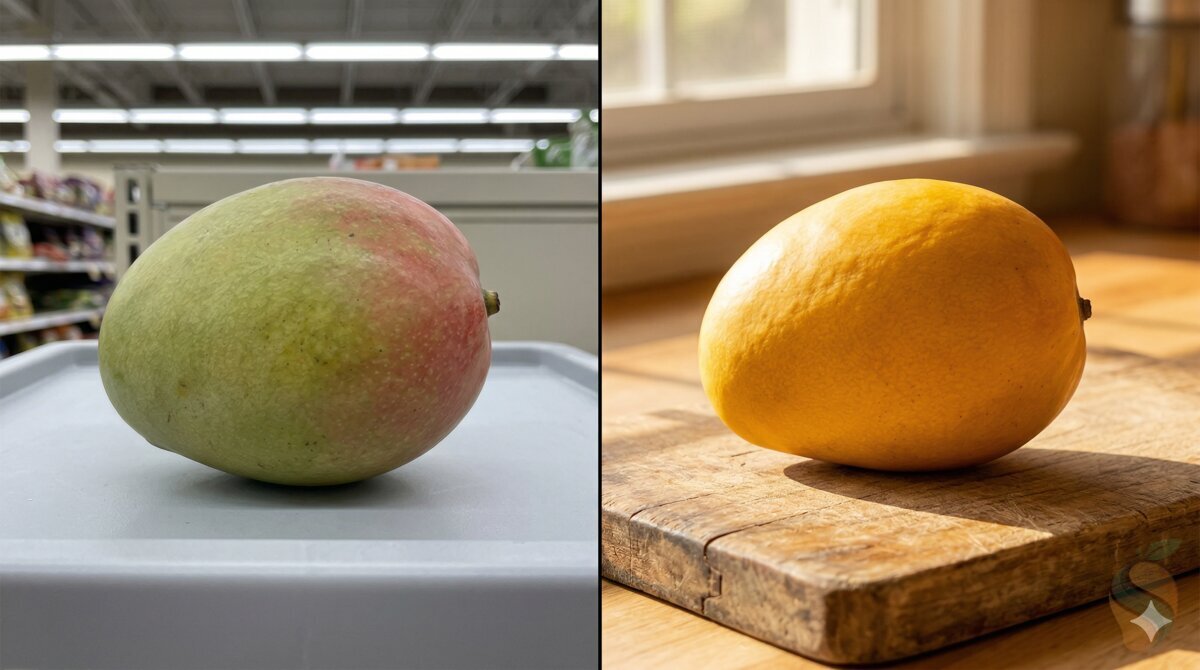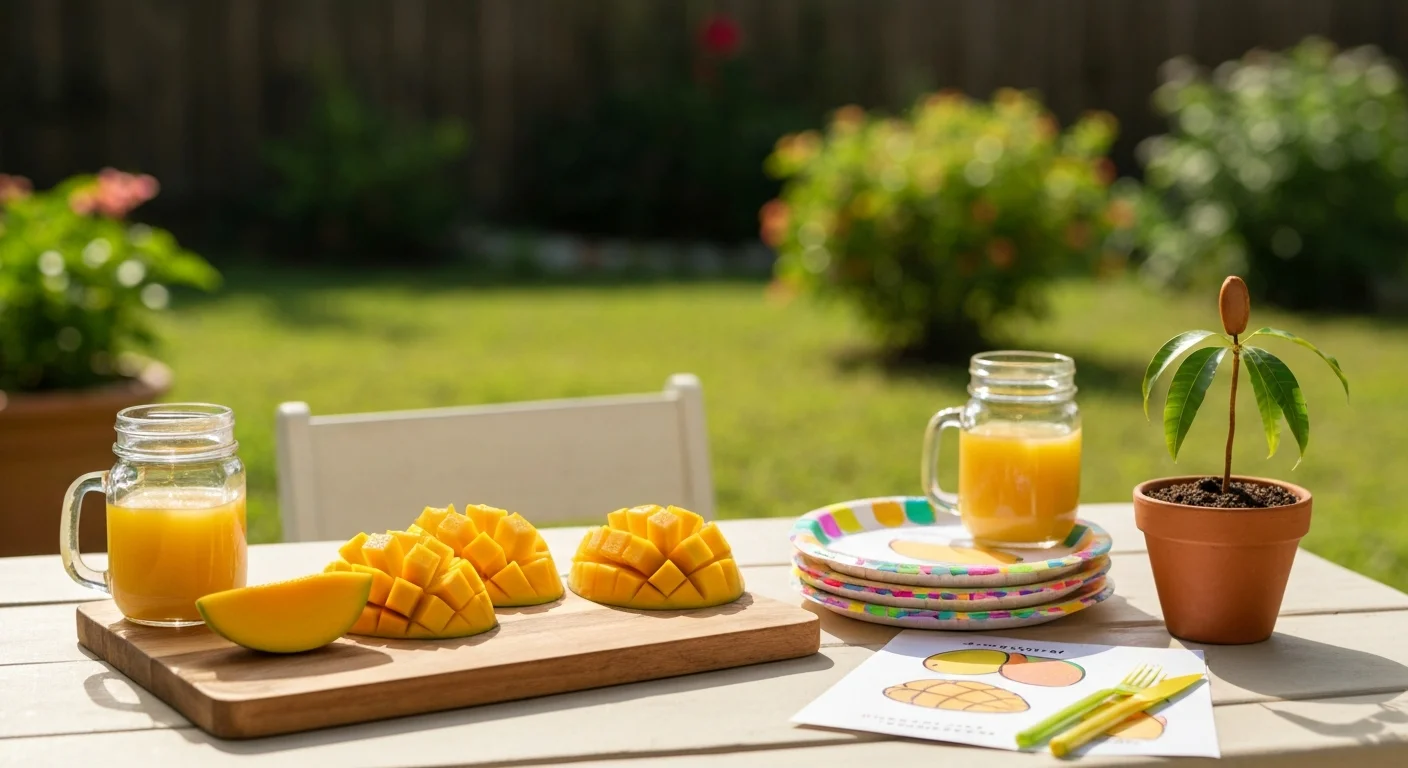
Cobalt-60 gamma irradiation is an FDA-approved, USDA-required phytosanitary treatment that exposes packaged Indian mangoes to ionizing radiation at a minimum absorbed dose of 400 Gray, neutralizing fruit fly larvae and weevils without cooking the fruit, altering its flavor, or leaving any residue. It is the specific technology that ended the 1989-2007 US ban on Indian mango imports, and every Alphonso, Kesar, or Banganapalli mango sold legally in Texas has passed through a cobalt-60 chamber at an APHIS-certified facility before boarding its flight to the United States.
What Cobalt-60 Actually Is
Cobalt-60 is a radioactive isotope of the metal cobalt produced by bombarding stable cobalt-59 with neutrons inside a nuclear reactor. It emits high-energy gamma rays as it decays, with a half-life of 5.27 years. The isotope has been used in medicine since the 1950s, when it replaced older radium therapy for cancer treatment, and in food processing since the 1960s.
How Gamma Rays Kill Pests
Gamma rays penetrate fruit, packaging, and pallets, depositing tiny amounts of energy that damage the DNA of insect larvae. At 400 Gray, the dose required by USDA APHIS for mango imports, adult flies cannot reproduce and larvae cannot mature. The fruit itself, whose cells are far less sensitive to ionizing radiation than insect cells, remains biologically intact.
The FDA Regulatory Framework
The FDA first approved food irradiation in 1963 for wheat flour, expanded it to spices and poultry through the 1980s, and by 1986 had established comprehensive regulations under 21 CFR 179. The regulation authorizes irradiation for pest control in fresh fruits and vegetables at doses up to 1,000 Gray. Learn more directly from the FDA’s food irradiation resources.
International Scientific Consensus
The World Health Organization, the Food and Agriculture Organization of the United Nations, and the International Atomic Energy Agency jointly concluded in 1980 that food irradiated up to 10 kilogray is safe. The American Medical Association, the American Dietetic Association, and the Institute of Food Technologists have issued similar endorsements.
The Nashik Facility: Where Texas Mangoes Are Treated
The Krushak irradiation plant in Lasalgaon, Nashik district of Maharashtra, is the flagship facility for US-bound Indian mango exports. Operated under India’s Board of Radiation and Isotope Technology, Krushak was the first Indian food-irradiation facility to receive USDA APHIS certification in 2007. A second facility in Bengaluru followed, expanding capacity for southern varieties like Banganapalli.
The Treatment Sequence
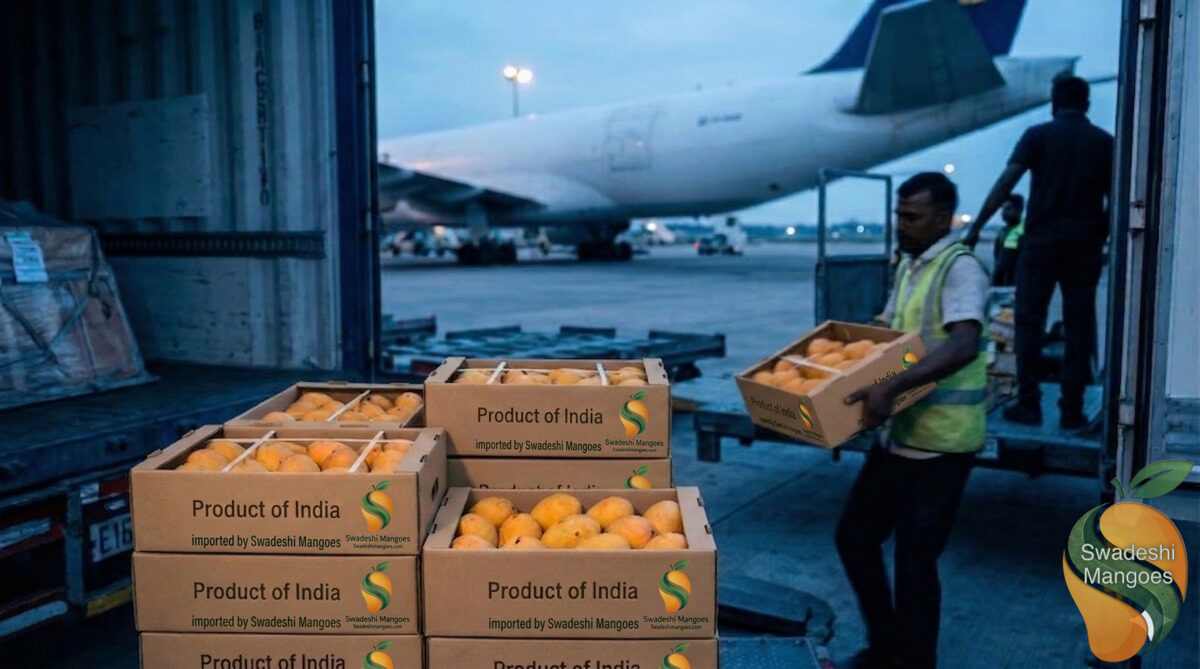
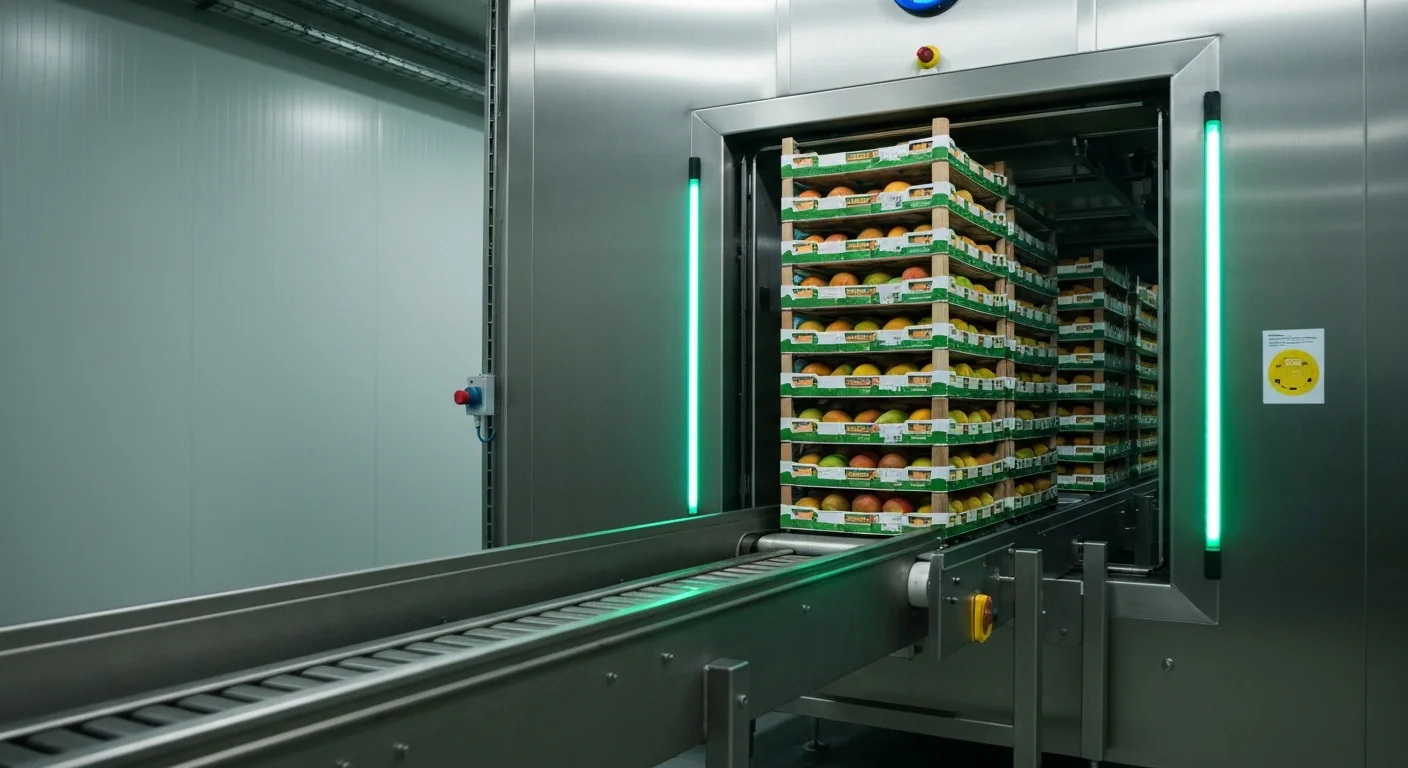
Mangoes arrive at the packhouse from orchards across Ratnagiri, Devgad, Junagadh, and Krishna District. They are washed, graded, and packed in USDA-approved fiberboard cartons. The cartons move on a conveyor through the shielded irradiation chamber, where cobalt-60 sources raise and lower through the product zone. Dosimetry strips inside each pallet confirm the absorbed dose. Certified pallets are then sealed, manifested, and loaded onto flights bound for US ports of entry.
Timeline of Food Irradiation Approval
| Year | Milestone |
|---|---|
| 1963 | FDA approves irradiation of wheat flour |
| 1980 | WHO, FAO, and IAEA joint committee declares irradiation safe up to 10 kGy |
| 1986 | FDA finalizes 21 CFR 179 regulations for food irradiation |
| 2002 | USDA APHIS issues framework for irradiation as phytosanitary treatment |
| 2007 | Krushak Nashik certified; Indian mangoes return to US market |
| 2015 | Additional Indian packhouses certified, expanding varieties available in Texas |
What Irradiation Does Not Do
Despite persistent myths, irradiated food does not become radioactive. The energy of gamma rays from cobalt-60 is below the threshold required to alter atomic nuclei in the food. A mango that has passed through the chamber contains no more radioactivity after treatment than it did when it left the orchard.
Taste, Nutrition, Texture
At the 400-Gray dose used for phytosanitary treatment, no detectable change occurs in sugar content, organic acid profile, or volatile aroma compounds. Studies from the Bhabha Atomic Research Centre and USDA partners have confirmed that Alphonso pulp texture, Kesar aroma, and Banganapalli sweetness are all preserved. Vitamin C loss is negligible at this dose.
Why the Green FDA Radura Symbol Appears
US law requires that irradiated foods sold at retail carry the green radura symbol, a stylized petal-in-circle mark defined in 21 CFR 179.26. Indian mangoes sold in Texas grocery stores and through direct-delivery services display this symbol on each carton. The symbol is not a warning; it is a disclosure, signaling that the fruit has undergone an approved treatment.
What Consumers Should Know
Families in Round Rock, Houston, and Dallas often ask whether irradiated fruit is safe for children or pregnant women. The answer, supported by decades of FDA review, is yes. Irradiated produce is routinely served in hospitals, to immunocompromised patients, and aboard International Space Station missions.
Irradiation and the Texas Supply Chain
Every Indian mango delivered by Swadeshi Mangoes to Texas households passes through cobalt-60 treatment at Nashik or another APHIS-certified facility. From the orchard in Ratnagiri to the doorstep in Round Rock, the fruit is handled under documented chain-of-custody standards. Browse what is currently available on our varieties page, place an order via our order form, and consult our mango care guide for ripening tips once the box arrives.
Why Texas Customers Should Care About the Science
Understanding irradiation transforms the way diaspora families relate to Indian mangoes. What once was a product of mystery and scarcity is now a product of transparent science and international regulation. That transparency is part of why the 2007 reopening has held for nearly two decades without a single pest-related incident in the United States.
Dosimetry: Proving the Treatment Worked
A cobalt-60 treatment is only as trustworthy as its dosimetry. Each pallet passing through the irradiation chamber at Nashik or Bengaluru carries dosimeter strips that record absorbed dose. These strips use radiochromic film that changes color in proportion to the gamma dose received. After treatment, laboratory technicians read the strips against calibrated standards traceable to national measurement institutes, and only pallets that meet the minimum 400-Gray threshold across all measurement points are certified for US export.
Audit Trails and APHIS Inspectors
USDA APHIS stations its own inspectors at Indian irradiation facilities during the export season. These inspectors verify packhouse procedures, witness treatments, review dosimetry records, and seal pallets with tamper-evident tags. The chain of custody continues from the Indian facility to the US port of entry, where customs officers verify the seals before releasing shipments into domestic distribution. This layered oversight is why Texas consumers can trust that a Ratnagiri Alphonso bought in Round Rock is both safely treated and accurately labeled.
The Environmental Case for Irradiation
Compared with the alternatives once considered, hot-water dips, vapor-heat treatment, and methyl bromide fumigation, cobalt-60 irradiation has the smallest environmental footprint per kilogram of fruit treated. Methyl bromide is a regulated ozone-depleting substance under the Montreal Protocol. Hot-water dips damage delicate cultivars. Vapor-heat consumes large amounts of energy. Irradiation uses minimal water, generates no atmospheric emissions, and relies on a long-lived radioactive source that produces minimal waste over its operational life.
Why the FDA Prefers Outcome-Based Standards
The FDA framework for food irradiation focuses on outcome verification rather than prescribing a single technology. Any treatment that achieves the phytosanitary outcome of neutralizing quarantine pests while preserving fruit quality and consumer safety is eligible for evaluation. Cobalt-60 gamma irradiation has proven to be the most practical technology for subcontinental mango exports, but the regulatory door remains open to newer treatments such as electron-beam irradiation should they mature for this use case. Texas consumers, whether in Round Rock suburbs or downtown Austin, ultimately benefit from this flexibility.
FAQ
Does irradiation make mangoes radioactive?
No. The gamma rays emitted by cobalt-60 do not have enough energy to change the atomic nuclei of food. An irradiated mango contains no induced radioactivity whatsoever, and scientific consensus from the FDA, WHO, and IAEA has held this position for more than forty years with rigorous verification.
Why is irradiation required for Indian mangoes but not Mexican ones?
Mexican mango orchards are not host to the Oriental fruit fly, mango seed weevil, or mango pulp weevil, the three quarantine pests that triggered the US import ban on Indian fruit. Each country’s mango imports to the US follow a treatment protocol matched to its specific pest profile, determined by USDA APHIS risk assessments.
Does irradiation change the flavor of Alphonso or Kesar?
Studies from the Bhabha Atomic Research Centre and US partner labs confirm that at the 400-Gray phytosanitary dose, sugars, acids, aroma volatiles, and texture all remain within the normal variation range of unirradiated fruit. Experienced tasters cannot reliably distinguish irradiated Alphonso from untreated Alphonso in blind panels.
Is the FDA radura symbol a warning?
No. The green radura symbol is a disclosure required by 21 CFR 179.26 to inform consumers that the product has undergone an approved irradiation treatment. It is analogous to pasteurization labeling on dairy. The symbol confirms regulatory compliance and does not imply any safety concern.
How long has food irradiation been used commercially?
Commercial food irradiation began in the 1960s with spices and has expanded steadily. The FDA approved it broadly in 1986, and it is now used on poultry, beef, shellfish, produce, and spices worldwide. More than sixty countries have approved at least one irradiated food application, making it one of the most-studied food safety technologies.
External references: FDA food irradiation, USDA APHIS, IAEA, Wikipedia: Food irradiation.

Swadeshi Mangoes
Swadeshi Mangoes is a community-driven Indian mango pickup network operated by Swadeshi Central TX LLC, headquartered in Round Rock, Texas. We bring authentic, USDA-inspected Indian mangoes — Alphonso, Banginapalli, Kesar, and more — to families through local pickup in multiple US cities, every season since 2025.