Nearly every Indian adult remembers the mango tree of their childhood because that tree was the first place they learned about waiting, sharing, theft, family, and seasons. For the Indian diaspora in Texas, from Austin to Houston, the memory of that tree is often the strongest living thread back to the country they left. Swadeshi Mangoes was built, in part, to honor those memories.
The Tree at My Grandmother’s House
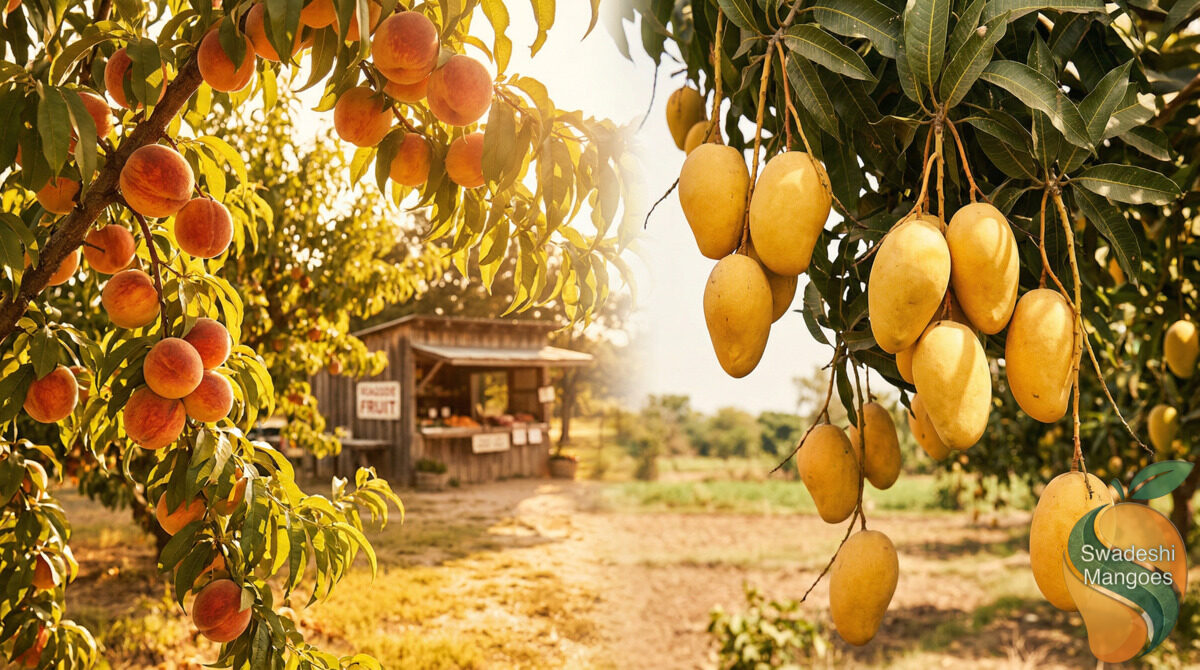
My earliest memory is not my first day of school. It is the mango tree at my grandmother’s house in a village outside Vijayawada, Andhra Pradesh. I was four years old. The tree was ancient, older than my grandmother, and its lowest branch was a chair where generations of children had sat. I remember the smell of the heat rising from the mud courtyard, the sound of the cicadas, and my grandmother standing in the kitchen doorway with a stainless steel plate, calling us for our afternoon mango.
Every Indian adult I have met in Texas has a version of this story. The details change. The location shifts from Kerala to Bengal to Punjab. But the tree is always there. I started Swadeshi Mangoes in Round Rock in part because I realized that when a customer in Frisco tastes a proper Banganapalli for the first time in twenty years, they are not tasting a fruit. They are tasting their childhood.
Why the Mango Tree Was the Center of the Indian Home
To understand why the mango tree occupies such a singular place in Indian memory, you have to understand what it was in practical terms. In most Indian villages and even in older urban neighborhoods, the mango tree was:
- The only source of shade in a courtyard that regularly reached 110 degrees F.
- The social center of the household, where relatives sat on cots.
- A food source that required zero money.
- A playground, climbing structure, and hiding spot for children.
- A calendar. When it flowered, summer was coming. When the fruit fell, summer was ending.
In a Texas context, this would be the equivalent of the family porch, the grocery store, the basketball hoop, and the calendar all combined into one living structure. My customer Srinivas, who lives in Plano now, described it best: “In America, we have furniture. In India, we had the mango tree.”
The Tree as Teacher
Indian children learned lessons from the mango tree that no school could teach. You learned patience because the fruit ripened in its own time. You learned sharing because one tree fed an extended family of 15. You learned hierarchy because the best-ripened fruit went to the eldest. You learned negotiation because you had to convince your cousin to hand over the yellow one. And you learned grief, because every May a few of the green ones would fall before their time.
The Ramayana and the Memory of the Mango Grove
The cultural weight of the mango tree goes much deeper than family nostalgia. In the Ramayana, Lord Rama and Sita spent part of their exile in a mango grove in the forest of Panchavati. The description of that grove, of Sita plucking ripe mangoes and offering them to Rama, is one of the oldest written references to the fruit.
Kalidasa, the great Sanskrit poet, wrote extensively about the mango blossom as a harbinger of love. In his play Abhijnanasakuntalam, the heroine Sakuntala is described as tender as a new mango leaf. When we grew up listening to these stories, the mango tree in our own courtyard became, in a subtle way, an extension of the mythology. It was not just a tree. It was a character in the larger Indian story.
The Great Mango Raids of Childhood
No memoir of the Indian mango tree would be complete without the universal confession: we all stole mangoes from someone else’s tree. I am not proud of it, but I once climbed my neighbor Ramayya’s wall at age six, snatched three green mangoes, and ran.
My customer Anjali in Cedar Park, originally from Kolkata, told me a story that I think about often. Her grandfather was a strict man who rarely smiled. One summer, she and her cousins organized a full raid on his mango tree, using a bedsheet as a net to catch falling fruit. He caught them. They expected a thundering scolding. Instead, he laughed until he cried and said, “I did the same thing to my father at your age.” That, she told me, was the only time she saw him laugh in his entire life.
Why Stolen Mangoes Taste Better
There is a running joke across Indian culture that a stolen mango tastes sweeter than a bought one. This is partly rebellion, partly adrenaline, partly the fact that unripe, salt-dipped, freshly plucked mangoes are a specific Indian delicacy. The raw mango with salt and chili powder is its own food group. Every Indian adult in Texas, no matter how elevated their dinner table, still misses this tangy, juvenile food.
The Loss of the Tree, the Arrival of the Memory
Here is the quiet tragedy of the Indian diaspora in Texas. Many of us grew up with a mango tree in our childhood courtyard. Very few of us can grow one in our Austin or Dallas backyard. The climate, while warm, is wrong. The soil is wrong. The varieties that would survive the Texas winter do not produce the Alphonso, the Kesar, the Banganapalli, the Dasheri, or the Chausa we remember.
So the tree, for us, lives in memory. When my daughter was three, I tried to describe my grandmother’s mango tree to her. I realized I could not. The size, the smell, the specific yellow of the ripe fruit against the green leaves, the sound of the branches creaking under the weight of the fruit, cannot be translated. The only way I could give her even a fragment of that experience was by ensuring that every summer, real Indian mangoes arrived at our dinner table in Round Rock.
Why This Became Swadeshi Mangoes
This is why our business exists. When a father in Sugar Land opens a box of Kesar mangoes and cuts one for his son, he is not just offering fruit. He is saying, “This is what my mother used to give me. This is where I come from.” We now deliver across Austin, Round Rock, Cedar Park, Pflugerville, Dallas, Frisco, Plano, Houston, Sugar Land, Katy, Pearland, and San Antonio through more than 30 pickup agents, and every box that leaves our hands carries a little of someone’s grandmother with it.
The Texas Diaspora Remembers
I have collected stories from customers for five seasons now. Here are a few, told with first names only and permission:
- Kavitha (Austin): Her grandmother in Hyderabad would hide the ripest Banganapalli for her alone. When she opened her first Swadeshi box in Texas, she wept.
- Arun (Houston): He and his brother would race up the tree every morning. The loser had to pick up the fallen fruit for chutney. He orders Totapuri every year because that was their tree.
- Shailaja (Dallas): Her father passed away in 2019. The last conversation they had was about the Alphonso season. She orders a box in his memory every year.
- Ramesh (San Antonio): He grew up in a Mumbai chawl with no tree. His mother would buy one mango and slice it into seven pieces for the family. He orders seven mangoes in her memory.
Table: Mango Varieties and the Regions They Recall
| Variety | Home Region | Childhood Association |
|---|---|---|
| Alphonso | Maharashtra, Goa | Grandmother’s wooden crate |
| Kesar | Gujarat, Saurashtra | Ramadan and Navratri meals |
| Banganapalli | Andhra Pradesh | Summer vacations at nana’s village |
| Dasheri | Uttar Pradesh, Lucknow | Grandfathers and afternoon naps |
| Langra | Bihar, Varanasi | Monsoon and temple prasad |
| Chausa | Punjab, UP | Late-summer weddings |
| Himsagar | Bengal | Pre-monsoon school holidays |
| Totapuri | South India | Chutneys and pickles |
| Mallika | Pan-Indian hybrid | Modern family gardens |
Keeping the Memory Alive in Texas
We cannot plant the tree of our childhood in our Texas backyards. But we can do the next best thing. We can source the varieties that grew on those trees, we can deliver them in a cold chain that protects their flavor, and we can hand them to our children with the stories that came with them. Visit our varieties page to see the mangoes we source, or our mango care page for tips on ripening. Place your seasonal order through the order form, and read more diaspora stories on our blog.
FAQ
Why is the mango tree such a strong memory for Indian adults?
The mango tree was the physical and emotional center of most Indian homes before urbanization. It was food, shade, playground, and gathering space combined. Because Indian childhoods were spent outdoors and near family, the tree became the anchor for core memories: summer holidays, grandparents, siblings, first climbs, and first tastes of ripe fruit.
Can I grow an Indian mango tree in Texas?
Indian mango varieties generally require tropical climates and struggle with Texas winters, even in South Texas. Some hardier cultivars can survive in Houston or San Antonio with careful winter protection, but they rarely produce the specific flavor profile of Alphonso, Kesar, or Banganapalli. Most Texas Indian families source fresh fruit seasonally rather than grow their own.
What is the best variety to share with children who have never been to India?
Kesar and Alphonso are the best introductions because of their sweetness, buttery texture, and manageable fiber content. Children who have only tasted American or Mexican mangoes are often amazed at the complexity. Banganapalli is another excellent introduction. Visit our varieties page to choose based on your family’s regional background.
Do you source mangoes from specific regions to match family memories?
Yes. We work with growers across Maharashtra, Gujarat, Andhra Pradesh, and other regions to source authentic regional varieties. When a customer tells us they grew up in Lucknow, we point them to Dasheri. When someone grew up near Ratnagiri, we recommend Alphonso. Variety matters because memory is regional.
How do I share my childhood mango story with Swadeshi?
We love hearing customer stories. You can email us through our contact page or message us when placing your order. Every season, we feature a handful of anonymized diaspora stories on our blog. Your memory helps preserve a shared cultural history for the next generation of Texas-born Indian kids.

Swadeshi Mangoes
Swadeshi Mangoes is a community-driven Indian mango pickup network operated by Swadeshi Central TX LLC, headquartered in Round Rock, Texas. We bring authentic, USDA-inspected Indian mangoes — Alphonso, Banginapalli, Kesar, and more — to families through local pickup in multiple US cities, every season since 2025.