Tag: family

  • How to Host a Mango Cutting Party in Your Texas Backyard

    How to Host a Mango Cutting Party in Your Texas Backyard

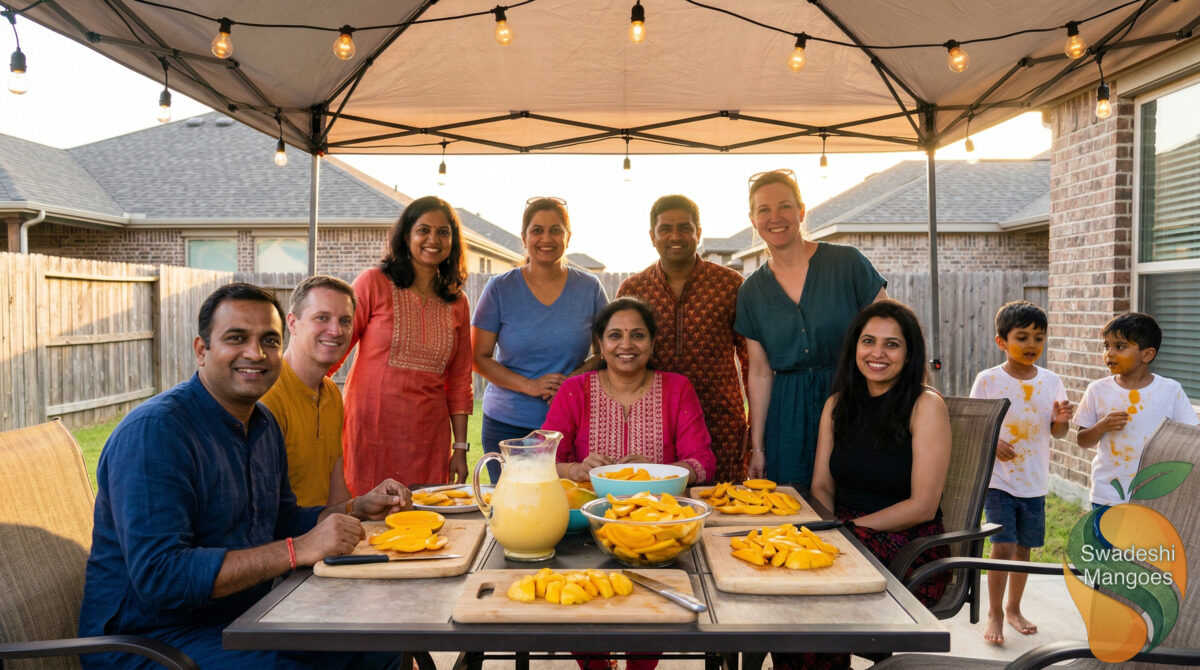
    In Indian households, mango season is not a solo activity. It is communal. You buy a full crate, invite people over, and eat until everyone is sticky and happy. In Texas, this tradition deserves its own name: the Mango Cutting Party.

    Here is your complete guide to hosting one — whether your backyard is in Plano, Sugar Land, Cedar Park, or Cibolo.


    What Is a Mango Cutting Party?

    Simple: you get a group of friends and family together, open multiple boxes of Indian mangoes, and eat them together. Some people cut them fancy. Some people just squeeze and suck. Kids run around with mango-stained shirts. It is the best kind of mess.

    Think of it as the Indian equivalent of a Texas crawfish boil — except it is sweet, does not require bibs (though you might want them), and the cleanup is easier.


    Planning Checklist

    How Many Mangoes Per Person?

    AudienceMangoes Per PersonNotes
    Adults (Indian, mango-experienced)3–4They will eat more than you think
    Adults (first-timers)2Plus extras for trying different varieties
    Kids (under 12)1–2They will eat half and wear the other half

    Rule of thumb: For 10 guests, order 3–4 boxes. Mix varieties — at least two, ideally three — so people can compare.

    Best Variety Combinations


    Setting Up for Texas Heat

    Texas summers and mango parties are meant for each other — but 98°F heat means your fruit will overripen fast if you do not plan:

    • Shade is essential. Set up under a covered patio, pop-up canopy, or large patio umbrella. Direct Texas sun will turn ripe mangoes to mush in an hour.
    • Ice bath for the extras. Keep uncut mangoes in a large cooler or tub with ice. Pull them out as needed. Cold mango is actually delicious in the heat.
    • Cutting station: Set up a table with 3–4 cutting boards, sharp knives, and a large bowl for peels and seeds. Cover the table with a plastic tablecloth for easy cleanup.
    • Wet towels: Have a stack of damp kitchen towels nearby. Hands will be sticky. This is part of the experience.
    • Newspaper tradition: For the authentic touch, spread newspaper on a picnic table and let people eat over it. It is how it is done in India and it makes cleanup effortless.

    What to Serve Alongside

    Drinks

    • Mango lassi — blend extra mango pulp with yogurt (pre-make a big pitcher)
    • Aam panna — raw mango cooler, perfect for heat (Totapuri works great)
    • Lemonade or agua fresca — for guests who want something lighter
    • Mango margaritas — for the adults (puree mango + tequila + lime + ice)

    Snacks

    • Chaat: Bhel puri, sev puri, or fruit chaat with diced mango mixed in
    • Tortilla chips + mango salsa — for the Tex-Mex crossover
    • Puris — if you want to go full aam ras-puri (and you should)

    Dessert

    • Mango kulfi or mango popsicles (make the night before)
    • Aamrakhand in small cups — rich, cold, and crowd-stopping

    How to Introduce Non-Indian Friends to Indian Mangoes

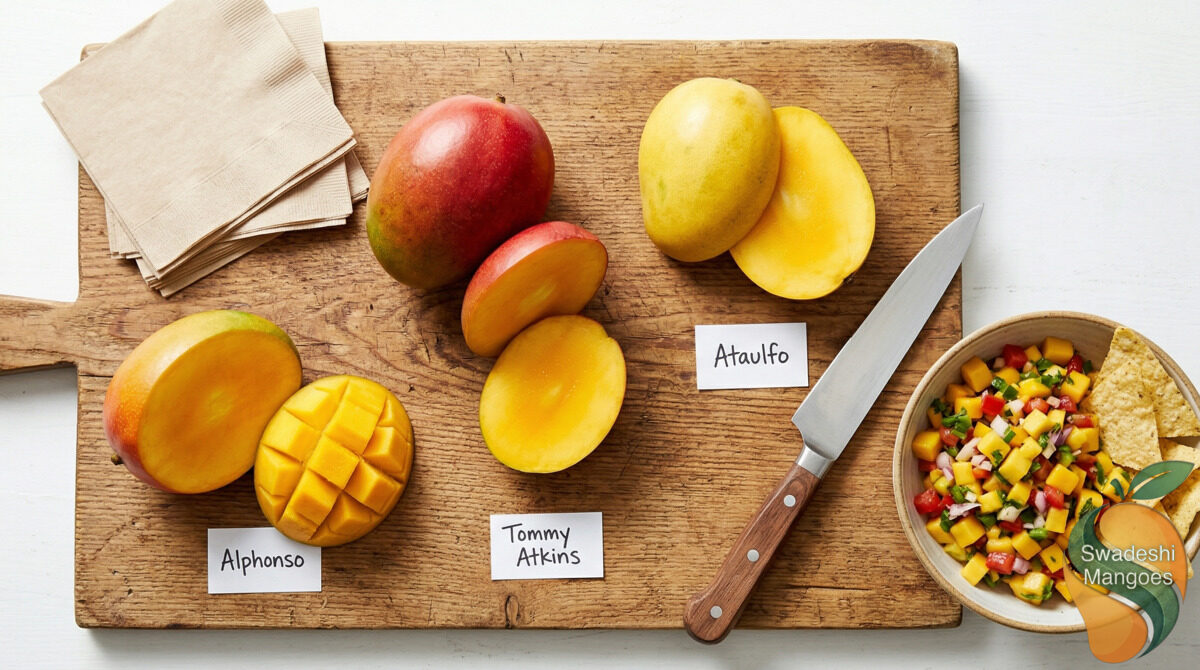
    Three mango varieties labeled on a cutting board - Alphonso Tommy Atkins and Ataulfo

    This is the best part. Most Americans have only ever eaten Tommy Atkins mangoes. Their minds are about to be blown. Here is how to set it up:

    1. “Forget everything you know about mangoes.” Say this first. Set the expectation that this is a different fruit.
    2. Start with Banginapalli. It is sweet, mild, and fiberless. Nobody dislikes Banginapalli. It is the gateway mango.
    3. Then try Alphonso. The aroma alone will make them understand. Let them smell it before tasting.
    4. Explain the varieties. “This one is from Ratnagiri in Maharashtra. This one is from Kurnool in Andhra Pradesh. Different regions, different flavors.” People love origin stories.
    5. Give them a take-home mango. One mango. They will be back next season ordering their own box.

    Making It a Neighborhood Event

    The best mango cutting parties are the ones where your Indian and non-Indian neighbors sit together, mango juice on their chins, debating which variety is best. Here is how to make that happen:

    • Invite broadly. Post in your neighborhood Facebook group or HOA chat: “Indian mango tasting party this Saturday — all welcome.”
    • Print small cards for each variety with the name, region of origin, and flavor description. People love learning.
    • Do a blind tasting. Number the varieties 1-3. Let people taste and vote. Announce the winner. It is surprisingly fun.
    • Take photos. Share them. Tag @SwadeshiMangoes. We love seeing our mangoes at your parties.

    Quick Party Budget

    ItemFor 10 GuestsFor 20 Guests
    Mango boxes (mixed varieties)3–4 boxes6–8 boxes
    Lassi ingredients$10$15
    Chips + salsa ingredients$10$15
    Newspaper / tableclothFreeFree
    Wet towels$5$5

    Pro tip: Split the cost with friends. Each family brings one box and everyone shares. This is exactly how group ordering through Swadeshi Mangoes works — community pricing keeps it affordable.


    Frequently Asked Questions

    When is the best time to host a mango party?

    May through June is peak mango season when the most varieties are available. Host in the evening (after 6 PM) to avoid the worst Texas heat. The golden hour light also makes for great mango photos.

    Can I host a mango cutting party indoors?

    Absolutely. Spread newspaper or a plastic tablecloth on your kitchen island or dining table. The mess is manageable indoors — just have towels ready.

    How do I make sure my mangoes are ripe for party day?

    Order your mangoes 3–4 days before the party. Ripen at room temperature. On party day, chill them in the fridge for 2 hours before serving. Cold mango in Texas heat is perfection. See our Mango Care Guide for detailed ripening tips.


    Order the mangoes. Invite the neighbors. Start a tradition.

    Order Mango Party Boxes →

    Mix varieties for the best tasting • See all varietiesRefer a friend, earn $5

  • The Mango That Made My Amma Cry: Why One Bite Takes Us Back to India

    The Mango That Made My Amma Cry: Why One Bite Takes Us Back to India

    She was standing in the kitchen in Round Rock, Texas. The box had arrived that morning — six Alphonso mangoes wrapped in tissue paper, each one the size of her fist. She picked one up, held it to her nose, and closed her eyes.

    Then she started crying.

    Not sad crying. The other kind. The kind that happens when something you thought you had lost comes back to you all at once — a smell, a taste, a whole summer compressed into a single breath.

    This is a story about mangoes. But really, it is a story about home.


    The Newspaper on the Floor

    Mango peels and seeds on newspaper after family mango eating session - Indian childhood nostalgia

    If you grew up in India, you do not need me to explain this. But I will try, for those who did not.

    Every April, the mangoes would arrive. Not from a store — from a relationship. Your father knew a vendor. Your uncle had a tree. Someone’s colleague’s cousin had an orchard in Ratnagiri or Kurnool or Junagadh. The mangoes came in wooden crates packed with straw, and the whole house smelled like summer the moment the lid came off.

    The eating ritual was specific:

    • Spread newspaper on the floor (the dining table was too small for what was about to happen)
    • Everyone sits cross-legged
    • Each person gets a mango — not a slice, a whole mango
    • You squeeze it gently until the flesh loosens inside the skin
    • Bite off the tip and suck the juice directly
    • The juice runs down your arms to your elbows
    • Nobody cares

    The ceiling fan whirred overhead. Cricket commentary played on the radio. Someone always said, “This year’s mangoes are not as good as last year’s.” Someone else always disagreed. This was the annual mango debate — as important as any family tradition.

    After the mangoes, you washed your hands and face at the kitchen sink, and the drain smelled sweet for the rest of the afternoon.


    What You Lose When You Move 9,000 Miles Away

    When Indian families move to America, they bring their recipes, their festivals, their languages. They set up temples. They join WhatsApp groups. They find Indian grocery stores. They manage to recreate most of their life.

    But the mangoes? The mangoes are the one thing that cannot be substituted.

    You go to H-E-B or Kroger. You buy what they call a “mango.” It is red and green and hard and has the word “Mexico” on the sticker. You cut it open. It is pale, fibrous, and tastes like a mango trying to be a mango. It is not the same thing. It is not even close.

    A Tommy Atkins mango and an Alphonso are not different levels of the same fruit. They are different fruits that happen to share a name.

    So for years — sometimes decades — Indian families in Texas go without. The mango-shaped hole in their summers becomes just another thing they quietly accept about living in America. Another small loss in the long accounting of immigration.


    The First Box

    Then one day, someone in your WhatsApp group posts: “Fresh Alphonso and Banginapalli available for pickup in Austin this weekend.”

    You think it cannot be real. You have been disappointed before. You order anyway — one box, just to see.

    The mangoes arrive. You open the box.

    And there it is. The smell. Not a hint of it. Not an approximation. The actual smell — the one that has been living in a locked room in your memory for fifteen years. It comes out all at once. The kitchen in your parents’ house. The newspaper on the floor. Your grandmother’s hands.

    You cut one open. The pulp is deep saffron-orange. No fiber. You taste it.

    It is real. It is the same mango.

    And that is when you understand why your amma cried.


    It Is Never Just Fruit

    For Indian families in America, Indian mangoes are:

    • A time machine. One bite and you are seven years old on your grandmother’s terrace in Hyderabad.
    • An identity marker. A Maharashtrian family needs Alphonso. A Telugu family needs Banginapalli. A Gujarati family needs Kesar. Your mango is your state, your language, your people.
    • A generational bridge. You are not just eating a mango. You are showing your American-born child what summer in India tastes like. You are teaching them to suck the juice from the skin, just like your father taught you.
    • A community ritual. When the mangoes arrive, you text your neighbors. You bring a box to your friend’s house. You eat them together, standing around the kitchen island, and for twenty minutes nobody is talking about work or school or mortgages.

    It is never just fruit. It is proof that 9,000 miles and twenty years cannot erase who you are.


    Why We Do This

    At Swadeshi Mangoes, we do not think of ourselves as a delivery service. We think of ourselves as the people who bring the box that makes your amma cry.

    Every season — April through July — we bring seven varieties of authentic Indian mangoes to families across Texas. We work with orchards in Kurnool, Ratnagiri, and Junagadh. Every mango is USDA-inspected, air-freighted, and delivered through our network of 30+ community pickup agents in Austin, Dallas, Houston, and San Antonio.

    We do this because we are the same family. We know what that first bite means. We know what you are really tasting when you close your eyes.

    You are tasting home.


    This season, bring the memory back.

    Order Your Mango Box →

    April–July • 7 varietiesRefer a friend, earn $5

Chat on WhatsApp