Tag: ripening

  • How to Pick the Perfect Mango at Pickup Day

    How to Pick the Perfect Mango at Pickup Day

    You have driven across town, found the pickup spot, and now you are standing in front of a table of mango boxes. They all look the same. How do you know which ones are perfectly ripe and which ones need a few more days?

    This guide will make you the most confident person at the pickup location. After eight seasons of handling thousands of mango boxes across Texas, we have seen every stage of ripeness and every mistake people make when selecting fruit.

    Selecting Indian mangoes is a different skill from picking supermarket fruit. These are not the Tommy Atkins or Kent mangoes you find at HEB or Kroger. Indian varieties like Alphonso, Kesar, and Banganapalli have different textures, different ripening patterns, and different visual cues. Once you learn what to look for, you will never second-guess yourself at pickup again.


    The Squeeze Test (Most Reliable)

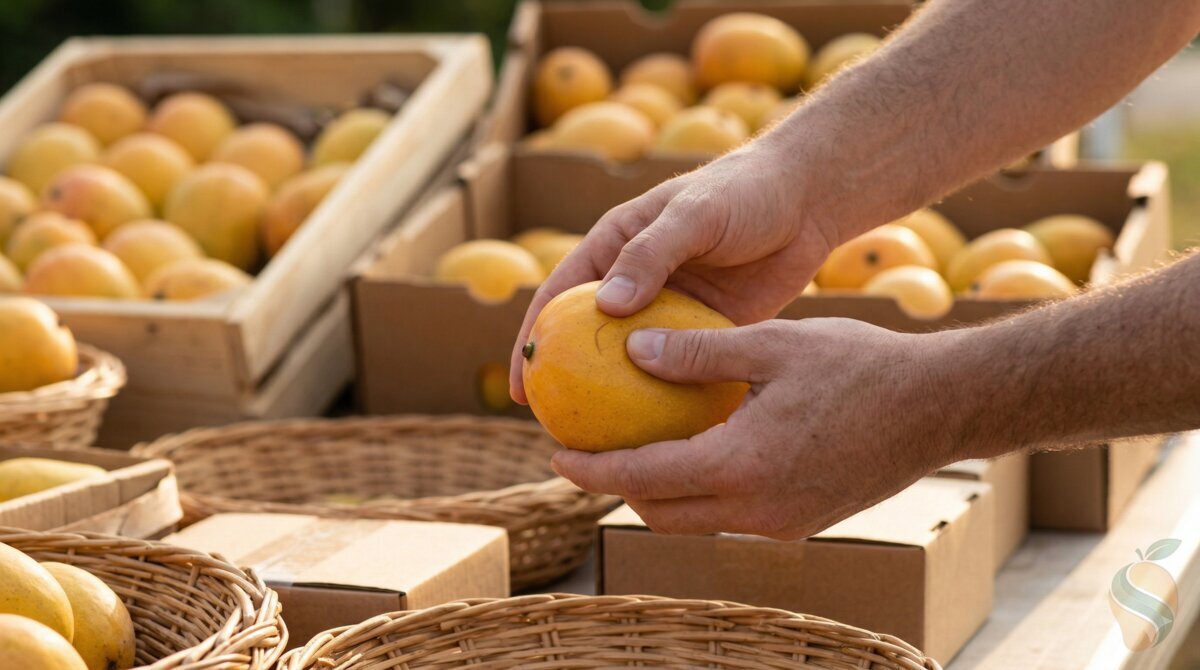
    Hold the mango gently in your palm and press lightly with your thumb. You are looking for three stages:

    • Firm with no give: Needs 2-3 more days at room temperature. Good if you want to eat later in the week.
    • Slight give, like a ripe avocado: Perfect. Eat within 24-48 hours.
    • Very soft, fingers sink in easily: Overripe for slicing but perfect for smoothies, lassi, or aam ras.

    Do not squeeze hard. Mangoes bruise easily and the bruised spot will turn brown. Press near the center of the mango rather than the narrow ends — the stem end and the tip ripen at different rates, so the middle gives you the most accurate reading.

    The squeeze test varies by variety. An Alphonso at peak ripeness will feel softer than a ripe Totapuri, which maintains a firmer texture even when fully ready. A ripe Chinna Rasalu will be noticeably soft and almost pudding-like inside.

    The Smell Test (Most Enjoyable)

    Hold the mango near the stem end and inhale. A ripe Alphonso smells like a tropical perfume — floral, sweet, with hints of citrus and honey. A ripe Kesar has a sharper, more aromatic sweetness.

    No smell at all? Not ripe yet. Give it 2-3 days on the counter.

    Smells fermented or alcoholic? Too far gone. Skip that one.

    The smell test is the most reliable indicator for people new to Indian mangoes. You do not need any experience to recognize the difference between “no aroma” and “incredible tropical fragrance.” When an Alphonso is truly ripe, you can smell it from a foot away.

    Each variety has its own scent signature. Banganapalli has a clean, honeyed sweetness without the floral notes. Himayath offers a rich, musky aroma that is deeper and more complex. Suvarna Rekha has a bright, almost citrusy fragrance. Over time, you will learn to identify varieties by smell alone.

    The Color Guide by Variety

    Color is tricky because each variety ripens to a different shade:

    • Alphonso: Turns deep golden-orange when ripe. Green patches mean it needs more time.
    • Banganapalli: Stays mostly yellow even when ripe. Look for uniform color without dark spots.
    • Kesar: Develops a warm orange-yellow with a slight blush. The greener it is, the more time it needs.
    • Totapuri: Stays green-yellow even when fully ripe. Rely on squeeze and smell, not color.
    • Neelam: Turns from green to bright yellow. Small size but the aroma gives it away.

    Color is unreliable on its own because ripening and color change are two separate biological processes. A mango can develop full color before sugars have fully converted, or taste perfectly sweet while still showing green patches. Always combine color with the squeeze and smell tests. Our ripening guide has photos of each variety at different stages.

    The Weight Test

    Pick up two mangoes of the same size. The heavier one has more juice and pulp. A mango that feels light for its size may have dried out or been stored too long.

    This test is particularly useful for Banganapalli, which is a large mango with a generous flesh-to-seed ratio. A ripe Alphonso should feel noticeably heavy for its compact size, almost like a small water balloon. If a mango feels hollow compared to its neighbors, choose a different one.

    What to Avoid

    • Wrinkled skin: The mango has dehydrated. It may still taste fine but the texture will be mealy.
    • Large dark spots: These are bruises that have gone bad. Small freckles are normal.
    • Oozing near the stem: Fermentation has started. Leave it.
    • Sap burns: Dark, rough patches from sap exposure during harvest. Cosmetic only — does not affect taste.

    Sap burns are extremely common on Indian mangoes and have zero impact on flavor or safety. Many first-time buyers mistake them for rot, but they are purely cosmetic — cut the mango open and you will find perfect, bright orange flesh underneath. Small freckles are also natural. Indian mangoes are not waxed or treated with fungicides like commercial supermarket mangoes, so they show more variation. Think of it like buying heirloom tomatoes — the imperfect-looking ones often taste the best.

    Planning Your Week Around the Ripening Curve

    When you pick up a box, not every mango will be at the same stage — and that is a good thing. Day one and two, eat the mangoes that already give slightly to the squeeze test. By day three and four, the mid-stage mangoes will have caught up — ideal for sharing with guests or making mango desserts. By day five through seven, the firmest mangoes will finally be at peak ripeness.

    This staggered approach means fresh, perfectly ripe mangoes every day instead of a feast-or-famine situation. If everything is ripening faster than you can eat it, move the firmest ones to the refrigerator — just make sure they have already started ripening first. Never refrigerate a fully unripe mango, as cold permanently stalls sugar development. Our mango care page has the full protocol.

    Pro Tip: Pick a Mix

    Grab some firm ones and some slightly soft ones. The firm mangoes will ripen over the next 3-4 days, giving you fresh mangoes all week instead of having to eat everything on day one.

    Place unripe mangoes in a paper bag with a banana to speed up ripening. Never refrigerate unripe mangoes — cold stops the ripening process permanently. For the full details on storage and ripening at home, read our guide on how to store and ripen Indian mangoes.

    If you are ordering multiple varieties, eat your Alphonso and Kesar first — they are best at peak ripeness. Save Totapuri for last since it holds firmness longer. Banganapalli is excellent for freezing — cut into chunks, freeze on a tray, then bag for smoothies and ice cream all summer.

    First-Timer Tips: What to Expect at Pickup

    If this is your first time, you will receive a notification with the pickup time and location. When you arrive, our agent will have your order ready. The mangoes come in branded boxes, typically containing six to twelve mangoes depending on variety and size.

    Do not be surprised if the mangoes feel firmer than you expected. Indian mangoes are harvested mature but slightly unripe so they survive the journey from India to Texas — you ripen them at home over 2-3 days. Ask your agent to open a box so you can see and smell the mangoes before you leave. If this is your first time trying Indian mangoes, our first-timer’s guide covers which variety to start with, how to eat them, and common mistakes to avoid. Also check our variety guide to learn what makes each variety unique, and our FAQ page for first-timer questions.

    At the Swadeshi Pickup

    Our pickup agents can help you select the right box. If you are new to Indian mangoes, ask your agent to show you the squeeze and smell test in person. They have been handling hundreds of boxes and know exactly what ripe looks like for each variety.

    Many of our agents grew up eating these varieties in India and can tell you the best way to enjoy each one.

    Ready to put your selection skills to the test? Order your box for the next pickup.

    Pickup Locations Across Texas

    Swadeshi Mangoes has 30+ pickup locations across Austin, Dallas, Houston, and San Antonio. Use our order form to find the nearest pickup spot — our map shows the closest location to you automatically.

    Frequently Asked Questions

    How do I know if an Indian mango is ripe?

    Gently squeeze the mango — a ripe mango gives slightly like a ripe avocado. Smell the stem end — a ripe Alphonso has a strong floral, sweet aroma. If there is no smell, it needs 2-3 more days at room temperature. Visit our mango care page for a detailed ripening guide.

    Can I return mangoes if they are not ripe?

    Mangoes are shipped slightly firm so they ripen at home. Leave them on the counter for 2-3 days. If a mango is damaged or does not ripen properly, contact your pickup agent for a replacement.

    How should I store mangoes after pickup?

    Keep unripe mangoes at room temperature, away from direct sunlight. Once they reach your desired ripeness, move them to the refrigerator to slow further ripening. Ripe mangoes last 3-5 days in the fridge. Never refrigerate fully unripe mangoes — the cold halts sugar development permanently.
  • How Indian Mangoes Reach Texas: The USDA Import Process Explained

    How Indian Mangoes Reach Texas: The USDA Import Process Explained

    Every box of Indian mangoes that reaches Texas has traveled over 9,000 miles, passed through multiple government inspections, undergone USDA-mandated treatment, and survived international air freight — all within a window of days, not weeks. The process is fascinating, heavily regulated, and designed to guarantee that the fruit you eat is safe, pest-free, and fresh.

    Here is exactly how it works, from orchard to your pickup point in Austin, Dallas, Houston, or San Antonio.


    Step 1: Harvest and Selection in India

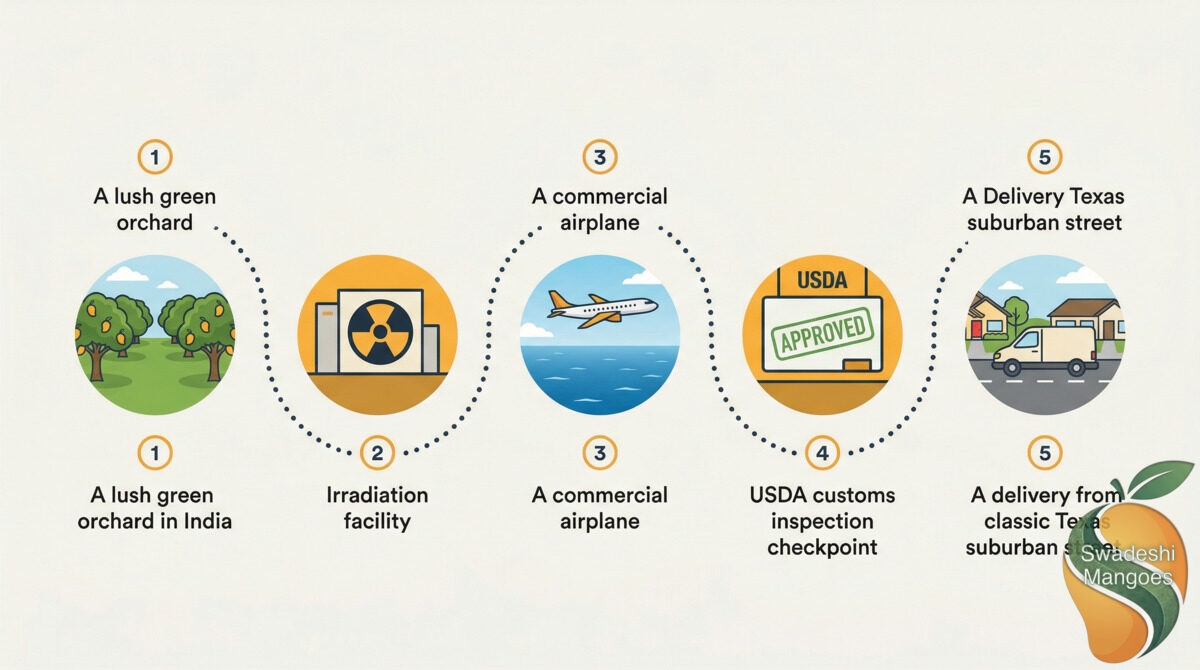
    Infographic showing mango journey from Indian orchard to irradiation to airplane to USDA inspection to Texas delivery

    Indian mangoes destined for the US market are harvested from APEDA-registered orchards (Agricultural and Processed Food Products Export Development Authority). Only the top 10–15% of each harvest qualifies for export.

    • Alphonso is sourced primarily from Ratnagiri and Devgad districts in Maharashtra’s Konkan coast.
    • Banginapalli comes from the Kurnool and Ulavapadu districts of Andhra Pradesh — the official home of its Geographical Indication (GI) tag (registered 2017).
    • Kesar is harvested from the Junagadh and Gir region of Gujarat (GI-tagged since 2011).

    Fruit is hand-picked at the mature but unripe stage — this is intentional. Mangoes picked at full maturity but before ripening survive the journey better and ripen uniformly at their destination.

    Source: APEDA (apeda.gov.in) exporter guidelines; Geographical Indications Registry, Chennai (ipindia.gov.in/gi).


    Step 2: USDA-Mandated Irradiation

    This is the step that makes Indian mango imports to the US possible — and the step that generates the most questions.

    Why Irradiation?

    India is home to fruit fly species (Bactrocera dorsalis and related Tephritidae) that are classified as quarantine pests by USDA-APHIS (Animal and Plant Health Inspection Service). If these pests were introduced to the US, they could devastate American agriculture. Irradiation eliminates this risk.

    How It Works

    Mangoes are exposed to a controlled dose of gamma radiation at 400 Gray (Gy) at USDA-APHIS approved facilities in India. Key facilities include:

    • KRUSHAK (Krushi Utpadan Sanrakshan Kendra) in Lasalgaon, Maharashtra
    • BRIT (Board of Radiation and Isotope Technology) facility in Vashi, Navi Mumbai

    The process takes only minutes and does not:

    • Make the fruit radioactive
    • Change the taste or texture
    • Significantly alter nutritional content
    • Leave any chemical residue

    Is It Safe?

    Food irradiation is endorsed as safe by:

    • World Health Organization (WHO)
    • U.S. Food and Drug Administration (FDA)
    • USDA
    • Centers for Disease Control and Prevention (CDC)

    Over 60 countries approve irradiation for various foods. The technology has been studied for over 50 years.

    Why Not Hot Water Treatment?

    Mexico and several other countries use hot water treatment (VHT) — immersing mangoes in 46.1°C water for 70–90 minutes — as their pest elimination method. This is cheaper than irradiation.

    However, USDA-APHIS has not approved VHT for Indian mangoes. One reason: premium varieties like Alphonso have thin, delicate skin that is particularly sensitive to heat damage. India opted for irradiation during the 2004–2007 trade negotiations specifically to protect Alphonso quality.

    This is also why Indian mangoes cost more than Mexican mangoes — irradiation infrastructure is expensive, and only a few approved facilities exist in India, creating a capacity bottleneck during peak season.

    Source: USDA-APHIS Federal Import Quarantine Orders; 7 CFR 319.56; APHIS Treatment Manual T105; FAO/IAEA reports on food irradiation.


    Step 3: Phytosanitary Certification

    Before leaving India, each shipment must receive a phytosanitary certificate from India’s Directorate of Plant Protection, Quarantine & Storage (DPPQS) under the Ministry of Agriculture. This certifies that:

    • The mangoes come from registered orchards and pack houses
    • Irradiation was performed at a USDA-approved facility
    • The fruit is free of soil, leaves, stems, and visible pest damage
    • All APHIS protocols have been followed

    Irradiated boxes carry the Radura symbol — the international food irradiation logo — along with the treatment facility details.


    Step 4: Air Freight to the United States

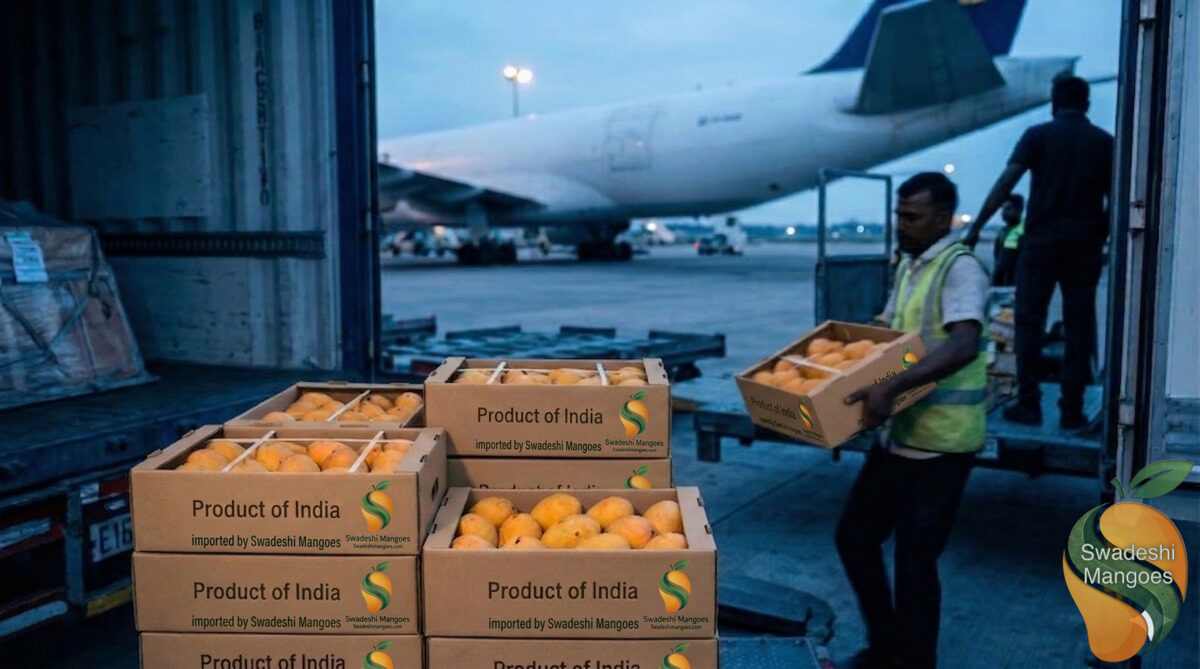
    Indian mangoes are air-freighted — not shipped by sea. Sea freight takes 3–4 weeks and would destroy the fruit. Air freight gets mangoes from Mumbai or Hyderabad to US airports in 18–24 hours.

    Common arrival points include:

    • John F. Kennedy International Airport (JFK), New York
    • Newark Liberty International Airport (EWR)
    • O’Hare International Airport (ORD), Chicago

    The air freight cost is a significant portion of the final price — this is why Indian mangoes cost more than Mexican mangoes, which are trucked across the border.


    Step 5: USDA Port-of-Entry Inspection

    Upon arrival in the US, each shipment undergoes inspection by USDA-APHIS Plant Protection and Quarantine (PPQ) officers at the port of entry. They verify:

    • Phytosanitary certificate is valid
    • Irradiation documentation matches the shipment
    • Radura symbol and treatment facility details are on the packaging
    • Random sample inspection for pest evidence

    Only after clearing this inspection are the mangoes released for domestic distribution.


    Step 6: Distribution to Texas

    Once cleared by USDA at the port of entry, mangoes are distributed to regional hubs across the country. For Texas customers ordering through Swadeshi Mangoes, the fruit arrives at our hub in Round Rock, Texas and is immediately organized by variety and order.

    From there, boxes go to our network of 30+ community pickup agents across Austin, Dallas-Fort Worth, Houston, and San Antonio. Customers receive a WhatsApp notification when their order is ready, and pick up directly from their local agent — often within hours of the fruit arriving at our hub.

    This final-mile approach is critical: Indian mangoes are not designed for extended shelf life. The faster they get from our hub to your kitchen, the better they taste.


    India’s Mango Exports to the US: By the Numbers

    MetricData
    India’s total mango production~20–21 million metric tons/year (~45% of global production)
    Percentage exported as fresh fruitLess than 1%
    Fresh mango exports to US (2024 season)Estimated 2,500–3,000 metric tons
    Year-over-year export growth~10–20%
    Year Indian mangoes first entered the US2007
    Top exporting states to USMaharashtra (#1), Uttar Pradesh (#2), Andhra Pradesh (#3), Gujarat (#4)
    APEDA-registered mango exporters200+
    GI-tagged mango varietiesBanginapalli (2017), Gir Kesar (2011), Dasheri (2009), Jardalu (2018), and others

    Sources: APEDA (apeda.gov.in) export statistics; USDA FAS GATS data; National Horticulture Board of India; FAO production statistics.


    GI-Tagged Varieties: Guaranteed Authenticity

    A Geographical Indication (GI) tag works like an appellation for wine — it certifies that a product comes from a specific region with qualities unique to that place. Several Indian mango varieties carry GI tags:

    VarietyRegionGI Year
    BanginapalliKurnool, Andhra Pradesh2017
    Gir KesarJunagadh/Gir, Gujarat2011
    DasheriLucknow, Uttar Pradesh2009
    JardaluBhagalpur, Bihar2018
    Khirsapati (Himsagar)Murshidabad, West Bengal2017
    Laxman BhogMalda, West Bengal2017

    When we say our Banginapalli comes from Kurnool or our Alphonso comes from Ratnagiri, these are not just marketing claims — they are verifiable origins tied to India’s GI registry.

    Source: Geographical Indications Registry, Chennai (ipindia.gov.in/gi).


    Frequently Asked Questions

    Does irradiation make mangoes radioactive?

    No. Irradiation exposes food to controlled energy — similar to how an X-ray passes through your body without making you radioactive. The mangoes do not retain any radiation. This is confirmed by the WHO, FDA, USDA, and CDC.

    Does irradiation affect the taste of Indian mangoes?

    No significant impact on taste has been documented. The irradiation dose used for Indian mangoes (400 Gy) is relatively low. Some studies report slight softening of the fruit, but flavor, aroma, and nutritional content remain intact.

    Why were Indian mangoes banned in the US before 2007?

    They were not specifically “banned” — but the US did not have an approved phytosanitary treatment protocol for Indian mangoes until 2007. The concern was fruit fly contamination. Once irradiation was approved as a treatment method, the trade opened. It took years of bilateral negotiations between USDA-APHIS and India’s DPPQS to establish the protocols.

    Why are Indian mangoes more expensive than Mexican mangoes?

    Three main factors: (1) Air freight from India vs. truck transport from Mexico, (2) Irradiation costs vs. cheaper hot water treatment, and (3) Limited seasonal window (8–12 weeks vs. year-round). The total landed cost per box is significantly higher than domestic alternatives.

    How long do Indian mangoes last after I pick them up?

    Unripe mangoes will ripen in 2–4 days at room temperature. Once ripe, consume within 2–3 days or refrigerate to extend life by another 2–3 days. For storage tips, see our Mango Care Guide.


    References


    9,000 miles of care — from Indian orchards to Texas families.

    Pre-Order Your 2026 Box →

    Limited supply • First come, first served • Explore all varieties

Chat on WhatsApp