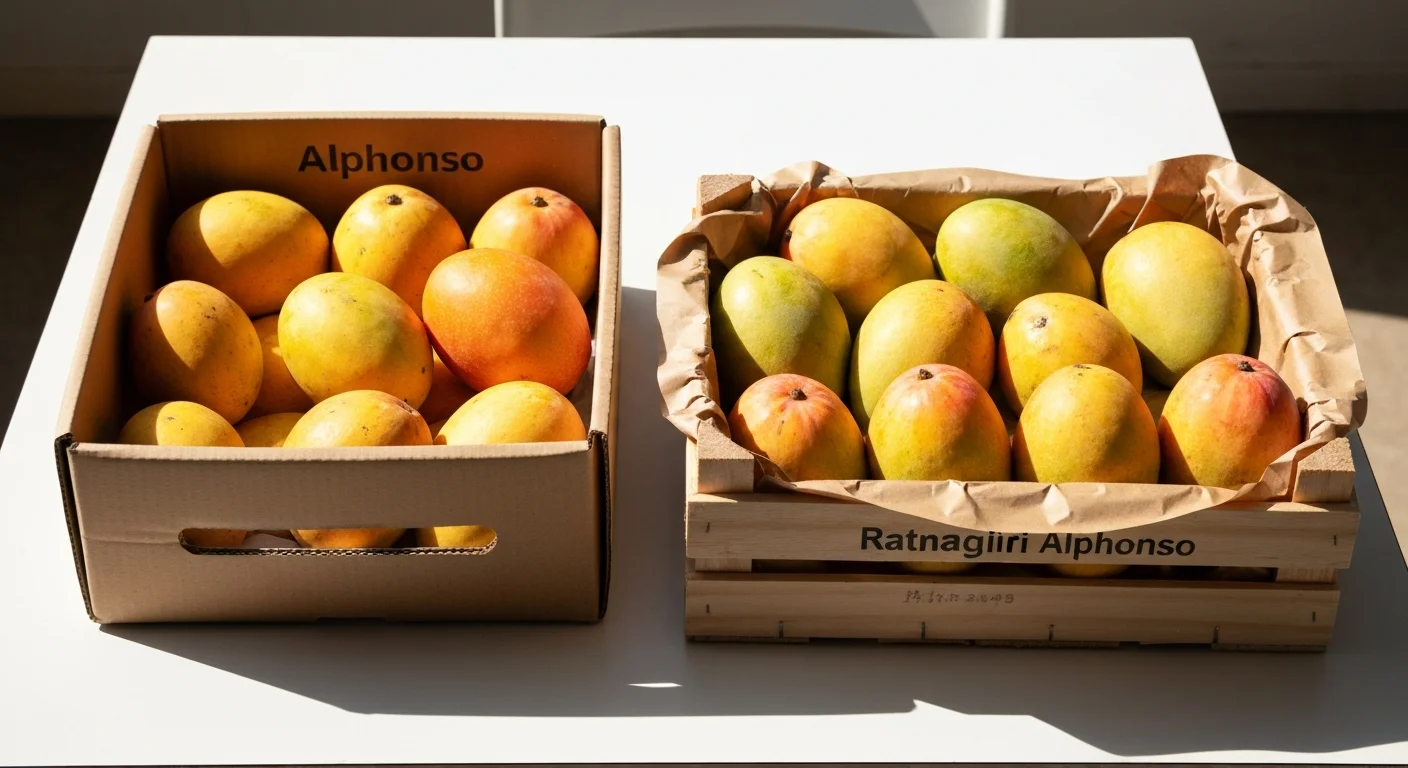
Direct answer: Authentic Alphonso mangoes from India are small (about 150-300 grams), oval with a distinctive curved beak, have a golden saffron skin with a faint green tinge at the stem, release a strong floral aroma, and carry a USDA APHIS phytosanitary certificate with the Indian origin noted on the box. If a Texas Indian grocery store is selling large uniform yellow mangoes as Alphonso for $2-3 each, you are almost certainly buying a Mexican or Peruvian lookalike variety sold under the Alphonso name. Real Alphonso costs the importer roughly $35-50 per 3kg box wholesale, so retail below $30 per box is a red flag.
We have watched this problem grow every year across Texas. As demand for Alphonso explodes in Austin, Dallas, Houston, and San Antonio Indian communities, less scrupulous retailers relabel cheaper Ataulfo, Manilas, and other yellow mangoes as Alphonso. The customer pays a premium and gets a disappointing eating experience that hurts the reputation of authentic Indian mango. Here is how to protect yourself.
What Makes a Mango a True Alphonso
True Alphonso (also called Hapus) is grown in specific regions of Maharashtra, India, primarily Devgad, Ratnagiri, and surrounding Konkan coastal areas. The variety is genetically distinct and carries unique flavor compounds including terpinolene and furanones that produce its signature taste. The USDA permits importation only when the fruit passes irradiation treatment at 400 Gy minimum dose under the APHIS preclearance program.
If the box does not have a USDA APHIS phytosanitary certificate and irradiation sticker, it cannot legally be imported from India. That means the mango is either smuggled (rare and illegal) or it is not actually from India.
The 7 Tests to Spot a Fake
- Size test: Real Alphonso weighs 150-300 grams. If the mango is larger than your fist, it is probably Ataulfo or Keitt.
- Shape test: Real Alphonso has a distinctive curved oval shape with a slight beak. Imposters are usually flatter or more elongated.
- Color test: Real Alphonso shows gold-yellow with a saffron blush, often with a faint green tinge at the stem even when ripe. Uniform bright yellow suggests Mexican Ataulfo.
- Skin texture: Real Alphonso skin is thin, smooth, and slightly waxy. Imposter skin is often thicker and duller.
- Aroma test: Real Alphonso smells intensely floral and perfumed. If there is no smell at the stem, walk away.
- Price check: Wholesale Alphonso imports cost $35-50 per 3kg box. Retail boxes below $30 are suspicious.
- Paperwork check: Ask to see the USDA APHIS phytosanitary certificate and irradiation label. Legitimate importers display these proudly.
The Lookalike Varieties Most Often Mislabeled
Here are the most common imposters we see in Texas Indian grocery stores.
| Imposter variety | Origin | Key difference from Alphonso | Typical price (3kg) |
|---|---|---|---|
| Ataulfo (Honey, Champagne) | Mexico | Smaller, elongated, deeper yellow, no floral aroma | $15-20 |
| Manila | Mexico, Philippines | Slender shape, thinner flesh | $12-18 |
| Kent | Florida, Mexico, Peru | Much larger, red-green skin, mild flavor | $10-15 |
| Keitt | Mexico, US | Very large, green skin, firm flesh | $10-14 |
| Tommy Atkins | Mexico, Central America | Red-green skin, fibrous, mild | $8-12 |
How to Inspect a Box Before Buying
When you walk into a Texas Indian grocery store during mango season, follow this five-step inspection.
- Find the physical box, not just the loose fruit on display. Check the label for country of origin, variety, and importer name.
- Look for the USDA APHIS treatment sticker or irradiation label. This is usually a green or blue sticker with a batch number.
- Check for the phytosanitary certificate number printed on the box.
- Pick up individual mangoes. Feel the weight, check the shape, smell the stem.
- If the store cannot produce documentation and the fruit fails 2 or more of the 7 tests, do not buy.
The USDA APHIS Preclearance Story
Since 2007, Indian mangoes have been allowed into the US under a strict USDA APHIS preclearance program. Every shipment must be irradiated at an approved Indian facility at a minimum dose of 400 Gy and accompanied by a phytosanitary certificate. Learn more at the USDA APHIS website.
This paperwork trail is why legitimate Indian mango importers like us at Swadeshi Mangoes can prove provenance. Ask your Texas retailer to show the same documentation. If they cannot, that is your answer.
Customer Story: The $35 Lesson
Last July, a customer in Plano sent us photos of a box she bought at a local Indian store labeled Alphonso for $35. The mangoes were enormous, uniformly bright yellow, and odorless. She paid a premium and got Mexican Ataulfo. After tasting our authentic Devgad Alphonso at a Dallas pickup, she understood the difference immediately. The saffron blush, the floral aroma, the thin skin, the specific Konkan sweetness are not reproducible in Mexican varieties.
Why Price Tells the Truth
Alphonso economics are brutal. The Konkan coast produces limited volume. Irradiation adds cost. Air freight from Mumbai to Dallas or Houston runs $4-6 per kg. USDA inspection at port of entry takes time and money. By the time a legitimate 3kg box lands in a Texas pickup, the true wholesale cost is $35-50. Anyone selling below $30 is cutting corners somewhere, and the most common corner to cut is variety substitution.
Mistake to Avoid: Trusting the Sticker Alone
Some unscrupulous retailers stick Alphonso labels on boxes of Ataulfo. The sticker is not proof. The USDA APHIS phytosanitary certificate, the irradiation label with batch number, and the fruit characteristics are proof. If any of these are missing or inconsistent, the sticker means nothing.
How to Support Legitimate Suppliers
When you buy from direct-to-consumer Indian mango suppliers who can show documentation, you protect the entire supply chain. You also get fruit at peak ripeness, because direct shipments skip the weeks of cold storage that grocery imports endure. Our Texas pickup model cuts days off the timeline and gives you access to the same Devgad Alphonso growers supply to Mumbai customers.
Texas-Specific Retail Patterns to Watch
Certain Texas Indian grocery store patterns correlate strongly with imposter sales. Watch for these red flags. First, loose fruit in open bins with no origin box visible is almost always relabeled Mexican fruit. Second, mangoes displayed next to the produce misters are not Alphonso because Alphonso’s thin skin dislikes moisture. Third, deeply discounted end-of-day Alphonso is suspicious because real Alphonso sells out fast. Fourth, boxes without a Hindi or Marathi producer label on the side are often drop-shipped imposters. Walk the Texas Indian grocery aisles with these cues in mind and you will spot problems instantly.
The Taste Test That Settles Every Debate
If color, shape, and smell tests leave doubt, the taste test is decisive. Real Alphonso has a sweetness level that measures around 22-24 Brix (roughly the sugar concentration), with distinct floral notes, a buttery mouthfeel, and almost no fiber. Ataulfo measures 18-20 Brix with a simpler honey sweetness and slightly more fiber. Once you have tasted authentic Alphonso side by side with Ataulfo, the difference is impossible to miss. We encourage first-time Texas customers to order a small authentic box specifically to calibrate their palate against whatever grocery store mangoes they have been buying.
Reporting Mislabeled Fruit
If you believe a Texas retailer is systematically mislabeling mangoes, you can report to the FDA via their consumer complaint portal and to the Texas Department of Agriculture. Include photos of the fruit, the store signage, the receipt, and any shipping box labels visible. Consumer reports drive enforcement, and the broader Indian mango community in Texas benefits when fraud is documented and corrected. We have seen several Texas retailers quietly clean up their labeling after customer complaints reached management.
Frequently Asked Questions
Are Ataulfo mangoes the same as Alphonso?
No. Ataulfo is a Mexican variety also called Honey or Champagne mango. It is genetically distinct from Alphonso, grown in Mexico, and typically costs one-third the price. Ataulfo is a fine mango on its own merits but it is not Alphonso, and stores selling it as Alphonso are misrepresenting the product.
Can real Alphonso be grown in Texas or Florida?
Alphonso trees exist in small numbers in Florida and California, but the variety requires the specific Konkan coastal climate of Maharashtra to develop its signature flavor. Texas-grown Alphonso is rare, low-yielding, and does not reach commercial scale. Any Alphonso in a Texas grocery store almost certainly originated in India.
What does the USDA APHIS sticker look like?
The sticker is typically a green, blue, or yellow label printed with USDA APHIS, a batch number, the treatment type (irradiation), and the origin country. It is usually affixed to the outside of the 3kg box rather than individual fruit. Ask the retailer to show the original shipping box with the sticker intact.
Why are some Alphonso boxes marked Devgad and others Ratnagiri?
Devgad and Ratnagiri are two neighboring regions in Maharashtra that produce Alphonso. Connoisseurs debate which is better, but both are authentic. Devgad Alphonso tends to be slightly smaller with more intense flavor, while Ratnagiri Alphonso is often slightly larger. Both carry full USDA documentation.
Is it illegal to sell mislabeled mangoes in Texas?
Misrepresenting the variety or origin of food violates FDA labeling rules and can also violate Texas Deceptive Trade Practices statutes. Enforcement is inconsistent, so consumer vigilance is the best defense. Report suspected fraud to the FDA and keep receipts and photos as evidence.
Buy authentic Alphonso with full documentation directly from us. Visit our order form, see our mango care guide, or read more on our blog. Also see our phytosanitary certificate guide.

Swadeshi Mangoes
Swadeshi Mangoes is a community-driven Indian mango pickup network operated by Swadeshi Central TX LLC, headquartered in Round Rock, Texas. We bring authentic, USDA-inspected Indian mangoes — Alphonso, Banginapalli, Kesar, and more — to families through local pickup in multiple US cities, every season since 2025.