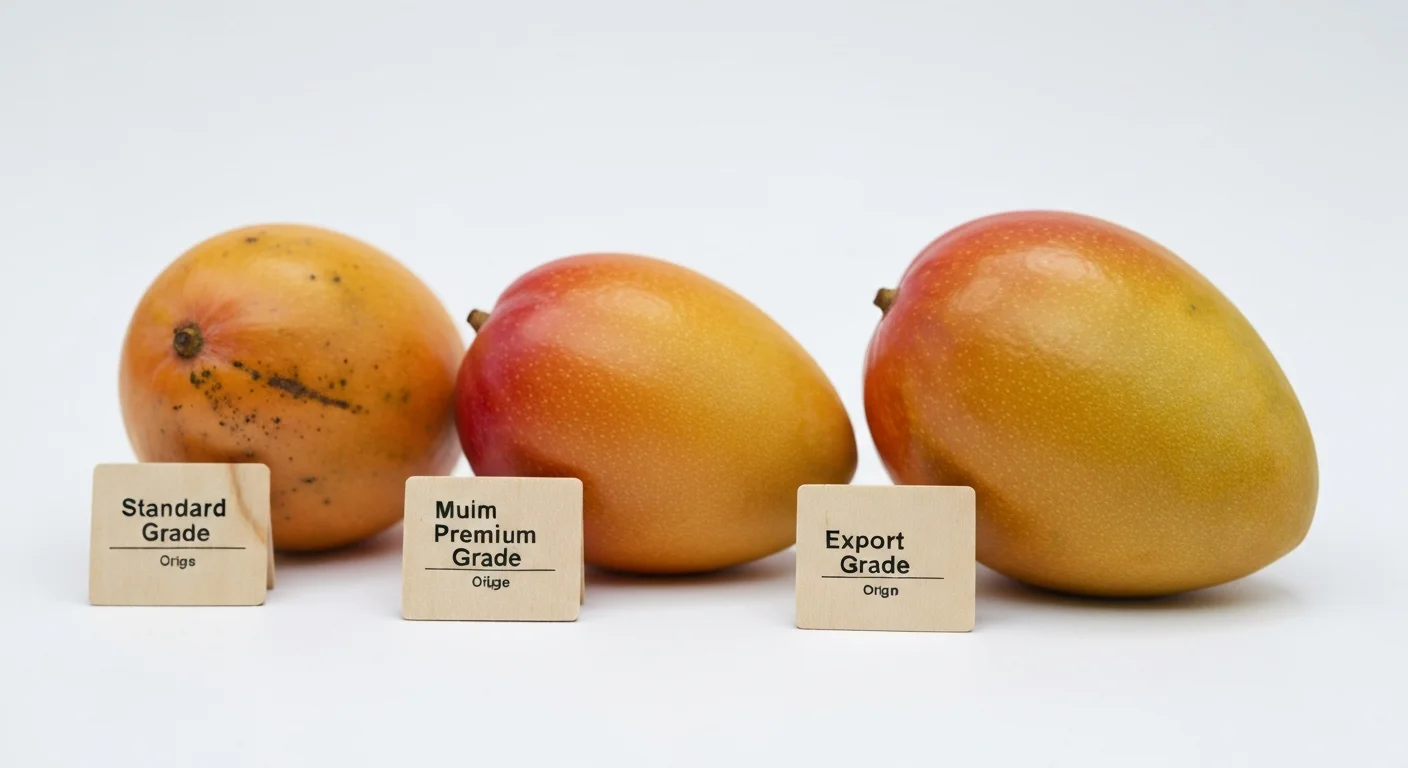
Mango boxes cost more when they contain larger fruit, uniform size, fewer blemishes, and a shorter supply chain. Grading is determined by four factors: average fruit weight, size uniformity, skin condition, and variety. Export-grade (A) mangoes average 250-350 grams per fruit with near-flawless skin; domestic grade (B) allows minor blemishes and size variation; utility grade is used for pulp. A $50 box of 6 large mangoes and a $90 box of 6 premium-grade mangoes are not the same product, and this post explains exactly why.
Why Grading Exists in the First Place
One customer in Houston asked me last season, “Why is your Alphonso twice the price of the Alphonso at the Indian grocery?” The honest answer: what we call Alphonso and what a bulk wholesaler calls Alphonso pass through very different grading lanes. The USDA maintains voluntary grade standards for imported tropical fruit, and Indian and Pakistani exporters apply their own grading at the source. The spread between the best and the average fruit in a single orchard can be 2-3x in retail price.
The Four Grading Factors
1. Average Fruit Weight
Weight per fruit is the single biggest price driver. A 300-gram Alphonso has roughly twice the usable flesh of a 150-gram one, and it costs the exporter nearly the same to pack and ship. Exporters grade into buckets:
- Extra Large: 350g+
- Large: 275-349g
- Medium: 200-274g
- Small: 150-199g
- Pulp grade: under 150g or oversized (450g+)
2. Size Uniformity
A box with 12 identical-sized mangoes signals tight grading. A box with visible size variation (300g next to 180g) costs less because it was not sorted as carefully. Uniformity matters for ripening: same-sized mangoes ripen at the same rate, which is critical when you order for a Dallas wedding or a San Antonio family gathering.
3. Skin Condition and Blemishes
The export-grade standard allows virtually no blemishes. Domestic-grade allows up to 10% surface area with minor sapburn (dark spots from sap drying on skin), small scars, or superficial scrapes. Utility-grade accepts more. Note: blemishes on the skin rarely affect flavor. A scarred mango often tastes identical to a perfect one, which is why some Texas customers specifically ask us for “B-grade” at a discount for lassi-making.
4. Variety and Origin
Alphonso from the Ratnagiri-Devgad belt of Maharashtra commands the highest premium in the world. Kesar from Gir, Gujarat; Chaunsa from Multan, Pakistan; and Banganapalli from Andhra Pradesh all carry appellation-like premiums. A generic “Alphonso” from a non-specified region often sells at half the price of authenticated Ratnagiri fruit.
What the Grade Labels Actually Mean
| Grade | Avg. Weight | Uniformity | Blemishes Allowed | Typical Use |
|---|---|---|---|---|
| Export A / Premium | 275-350g | Tight | None visible | Gift boxes, specialty retail |
| Export B / Standard | 200-275g | Moderate | Minor, under 5% | Retail boxes |
| Domestic / Home | 175-250g | Loose | Up to 10% | Wholesale, restaurants |
| Utility / Pulp | Any | Unsorted | Significant | Juice, pulp, frozen |
How to Read a Box Label (Step by Step)
- Find the variety and origin on the box face. “Ratnagiri Alphonso” is a premium; “Alphonso” alone is ambiguous.
- Count the fruits and check the declared weight. A 4-kg box with 12 mangoes averages 333g each (premium). A 4-kg box with 16 mangoes averages 250g (standard).
- Look for a grade stamp (often A, AA, or Export printed on the box).
- Inspect three random fruits at pickup for skin condition.
- Check packing date, usually printed inside the lid. Mangoes ripening 5+ days after packing degrade faster.
Why the Same Variety Varies in Price
Within the Alphonso category alone, you may see:
- $95/dozen for Ratnagiri export-grade, airfreighted, hand-picked.
- $65/dozen for Maharashtra standard-grade, sea-freight, mixed orchards.
- $40/dozen for unspecified-origin, B-grade, wholesale channel.
All three are labeled “Alphonso.” Only the first one is what connoisseurs mean by the name.
Common Myths and Mistakes
- Myth: Bigger is always better. False. Alphonso quality peaks at 250-300g. Overly large fruit (450g+) often has more fiber and less intense flavor.
- Myth: Perfect skin means perfect taste. Skin condition is an indicator, not a guarantee. Internal quality (sweetness, aroma) correlates loosely with exterior.
- Mistake: Buying by price alone. A $40 box that yields only 8 usable mangoes costs more per edible fruit than a $60 box of 12.
- Mistake: Assuming higher price equals better variety. Kesar at peak season can taste richer than mediocre Alphonso at twice the price.
- Myth: All imported mangoes are the same. Grading, origin, and supply chain vary enormously.
What Swadeshi Mangoes Deliver in Texas
For transparency: we grade our Texas deliveries by variety, average weight, and inspected skin condition on pickup. Every box we ship to Austin, Houston, Dallas, San Antonio, and Plano is hand-counted and weighed. Our Alphonso boxes target 275g+ average, and our Kesar boxes target 225g+. We reject shipments that arrive with more than 5% bruising. See all 9 varieties on the varieties page and order through our delivery form.
How Texas Supply Chains Affect Grading
Texas imports most of its Indian and Pakistani mangoes through the ports of Newark, Los Angeles, and Chicago, which adds 4-7 days of transit before the fruit reaches Houston or Dallas. This extra time compresses shelf life and means lower-grade fruit degrades faster. High-grade export fruit is packed with extra care, often individually wrapped in tissue, which protects it through the long cold chain to Texas. When you pay extra, part of what you are buying is logistical robustness, not just orchard quality.
FAQ
Q: Is there an official USDA grade for mangoes?
The USDA publishes voluntary grading standards for fresh mangoes but most imported fruit uses the exporter country’s grading system (Indian APEDA or Pakistani PHDEC). The USDA standards cover defects, maturity, and size but are rarely applied mandatorily at import.
Q: Why are some Indian Alphonsos banned or delayed at US ports?
The USDA requires irradiation treatment of Indian mangoes to prevent pest import. Delays occur when irradiation facilities at origin are backlogged. Approved shipments carry certification visible on the export box, and reliable Texas importers source only from compliant packhouses.
Q: Can I buy B-grade mangoes at a discount?
Sometimes. Ask your Texas importer if they offer domestic-grade boxes for juicing, lassi, or jam. The flavor is often identical to A-grade; only the appearance differs. We occasionally offer B-grade bulk boxes to Texas customers making large volumes of pulp.
Q: How do I tell if I am getting the grade I paid for?
Weigh the box and divide by fruit count to check average weight. Inspect three fruits for blemishes. Check the box for origin stamps and packing date. If a $90 box yields 220g-average mangoes with visible bruising, you were overcharged. Your Texas delivery receipt should specify expected weights.
Q: Do higher grades ripen differently?
Yes. Tighter-graded, uniformly sized fruit ripens at a predictable rate (3-5 days in Texas summer countertop conditions). Mixed-grade boxes ripen unevenly, with smaller fruit softening 1-2 days before larger. Plan accordingly for family gatherings in Austin or Houston. For ripening guidance, see our mango care page.
The Hidden Costs of Lower Grades
A cheaper box can cost you more in the end. If 2 of 12 fruits arrive bruised beyond use, your effective per-fruit cost rises 20%. If ripening is uneven and you miss the peak on 3 more, effective cost rises further. We have seen Texas customers save $20 on a domestic-grade box only to throw away a third of the contents. When calculating value, count usable fruit, not total fruit. In our experience delivering across Austin, Houston, Dallas, San Antonio, Plano, Frisco, and the greater Metroplex, tighter-graded boxes always outperform cheaper boxes on edible-yield basis for premium varieties like Alphonso and Kesar. For juicing and pulp-making, domestic grade remains a rational choice.
Premium Origins: What the Labels Really Mean
A few origin labels carry genuine premium status and are worth knowing. Ratnagiri and Devgad on Maharashtra’s coast produce the finest Alphonso in the world; prices for export-grade Ratnagiri can run 30-50% above generic Maharashtra Alphonso. Gir in Gujarat is the Kesar heartland. Multan in Pakistan is the Chaunsa capital. Banganapalle in Andhra Pradesh gives its name to the variety sold as Banganapalli or Safeda. When a Texas importer sources directly from these origins, the fruit commands a price premium that is honest, not inflated. When a Texas retailer labels a generic Indian mango with these regions without documentation, you are paying for a story that may not be true. Ask for country and region of origin at purchase, and whenever possible, pick suppliers who can trace back to the packhouse.
Seasonal Grading Shifts
Grading standards tighten and loosen across the season. Early-season Alphonso (late March, early April) is often smaller and receives a more generous size grade because orchards want to move fruit. Peak season (mid-April through June) delivers tightest grading. Late season (July, August) loosens again as remaining fruit is smaller. One Texas customer who orders weekly through June and July notices the size drop and budgets accordingly; she buys premium grade early for gifting and domestic grade late for her pulp freezer stock. Understanding this cycle lets you optimize for your specific use. For a view of each week’s offering see our Texas delivery form, and for specific variety recommendations browse the varieties page. Between Texas delivery seasons, frozen and canned pulp take over the pantry role.

Swadeshi Mangoes
Swadeshi Mangoes is a community-driven Indian mango pickup network operated by Swadeshi Central TX LLC, headquartered in Round Rock, Texas. We bring authentic, USDA-inspected Indian mangoes — Alphonso, Banginapalli, Kesar, and more — to families through local pickup in multiple US cities, every season since 2025.