Ship mangoes via USPS Priority Mail or UPS 2-Day Air, use firm (not soft) fruit, individually wrap each mango in tissue or newspaper, pad with a rigid insulating liner, include 1-2 frozen gel packs (not dry ice for whole fruit), and aim for 48-hour delivery max. Most US states allow interstate mango shipments, but California, Arizona, and Florida restrict imports due to agricultural inspection. Ship Monday through Wednesday to avoid weekend warehouse holds. This guide covers the complete packing protocol and regulations.
The Short Answer: Can You Ship Mangoes?
Yes, you can ship mangoes domestically in the US with proper packaging. No federal law prevents a private citizen from mailing fresh fruit state-to-state in most cases. However, three states have agricultural import restrictions:
- California: strict on out-of-state fruit imports via the California Department of Food and Agriculture. Personal shipments of cut fruit are often returned.
- Arizona: similar restrictions, particularly for citrus.
- Florida: restrictions on imported mangoes from non-USDA-cleared origins.
For the other 47 states, shipping whole fresh mangoes is legal. Refer to the USDA for state-by-state restrictions and to the USPS shipping guidelines for mail-ability rules.
Why Shipping Fresh Mangoes Is Hard
Mangoes are climacteric fruit, meaning they continue ripening after harvest. Shipping a perfectly ripe mango is a recipe for mush. The goal: ship firm fruit that arrives still firm-to-slightly-soft, allowing the recipient 2-4 days of post-shipment ripening. Temperature control matters: mangoes suffer chilling injury below 50F and over-ripen above 85F. Target in-transit temperature of 55-70F.
Step-by-Step Packing Protocol
- Select firm mangoes. Slight green tint, solid feel, no soft spots. Never ship ripe fruit.
- Inspect each fruit for nicks or sap spots. Skip bruised ones.
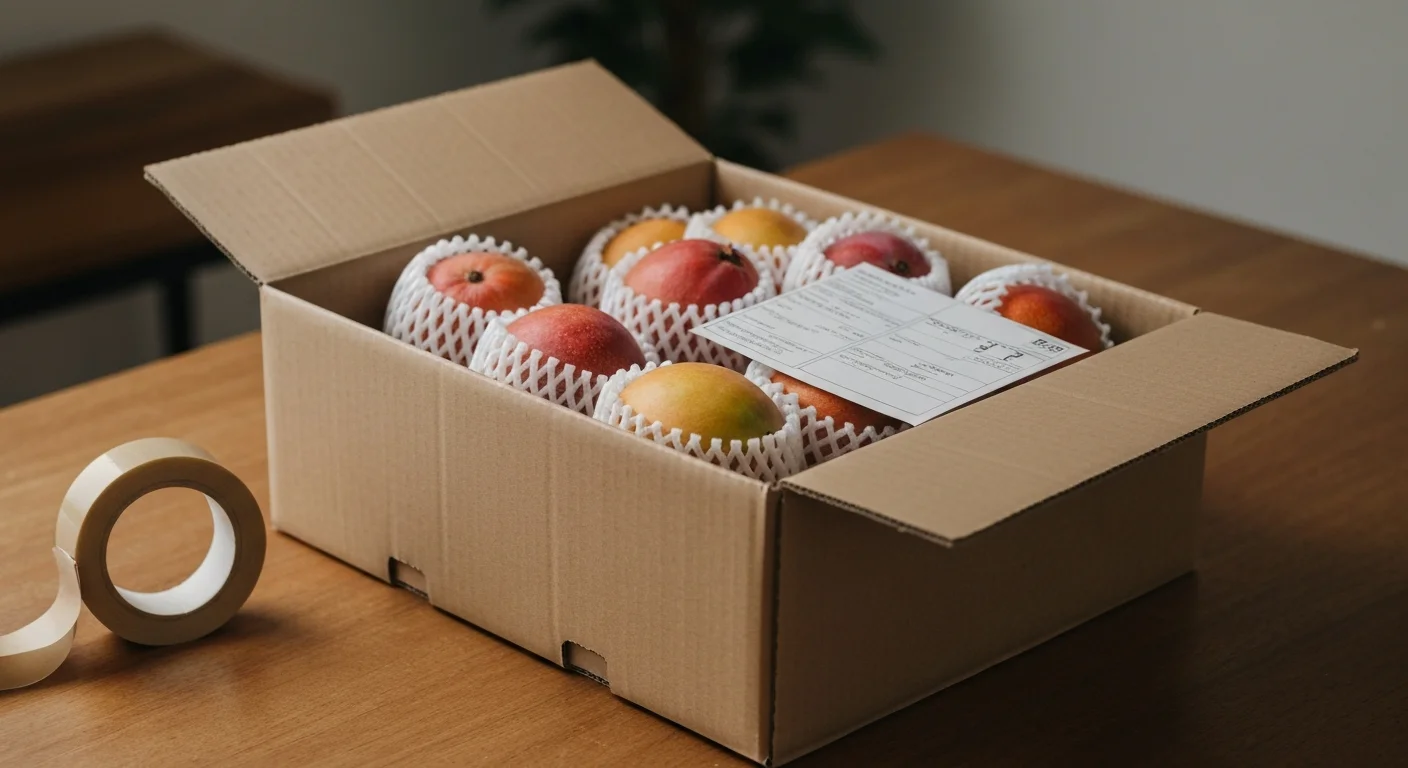
- Wrap each mango individually in two layers of tissue paper or clean newspaper.
- Line the box with a foam insulating sheet or corrugated cardboard lining.
- Add a gel ice pack (not dry ice) at the bottom, wrapped in newspaper to prevent direct contact with fruit.
- Nestle the mangoes in a single layer. For more than 6 fruits, use a rigid divider to make two layers.
- Fill voids with crumpled paper or air pillows. Mangoes must not shift.
- Add a second gel pack on top for summer shipments above 85F outside temperature.
- Seal the box with reinforced packing tape across all seams.
- Mark the box “Perishable – Handle with Care – Fresh Fruit.”
- Include a note inside with ripening instructions for the recipient.
USPS vs UPS vs FedEx: Which Is Best?
| Carrier | Best Service | Est. Cost (6 mangoes, TX to NY) | Delivery Time | Pros | Cons |
|---|---|---|---|---|---|
| USPS | Priority Mail Express | $40-65 | 1-2 days | Weekend delivery, flat rate boxes | Variable handling |
| USPS | Priority Mail | $18-35 | 2-3 days | Affordable, predictable | Not guaranteed |
| UPS | 2nd Day Air | $45-80 | 2 days | Guaranteed, tracked closely | Costly |
| FedEx | 2Day | $50-85 | 2 days | Strong cold-chain | Costly, limited Saturday |
For Texas shippers, USPS Priority Mail from Austin, Houston, or Dallas reaches most US addresses in 2-3 days. This is the sweet spot for cost and speed with firm-packed fruit.
Should You Use Dry Ice?
Generally, no, for whole fresh mangoes. Dry ice (-109F) causes chilling injury that ruins the fruit. Use dry ice only if shipping already-frozen mango pulp or puree, in which case:
- Follow USPS rules (max 5 lb per package for air transport).
- Label the box with IATA dry ice marking and UN 1845.
- Do not seal airtight; CO2 must vent.
For whole fresh fruit, gel ice packs maintain 45-70F for 24-36 hours and are the right tool.
Seasonal Timing for Texas Shippers
- April-June: optimal. Cool enough nights, fresh Indian mangoes in peak supply from our Texas delivery.
- July-August: possible but hot. Add extra gel packs; ship overnight only.
- September-October: good temperatures, declining supply.
- November-March: fresh supply limited; shipping frozen pulp is more practical.
How to Ship to a Friend: A Real Example
One customer in San Antonio ships 6 Alphonso mangoes to her daughter in Seattle every June. Her routine:
- Orders a dozen firm mangoes on Monday.
- Picks up Tuesday morning at our hub.
- Packs Tuesday evening (6 for shipping, 6 for her household).
- Ships USPS Priority Mail Wednesday morning.
- Daughter receives Friday or Saturday, rests fruit 3-4 days, eats peak-ripe the following week.
Her total cost per shipment: $22 (USPS) plus $6 (gel packs and insulating materials). Her daughter’s mangoes arrive perfect every time.
Common Myths and Mistakes
- Myth: You cannot ship fresh fruit at all. False, with proper packing and compliant destination states.
- Myth: Use dry ice for everything perishable. False. Dry ice ruins fresh fruit.
- Mistake: Shipping ripe mangoes. They always arrive bruised or mushy.
- Mistake: Shipping on a Thursday or Friday. Weekend warehouse holds mean Monday delivery for perishables. Ship Monday to Wednesday.
- Mistake: Skipping insurance. USPS Priority includes $100 coverage; UPS offers declared value up to $100 at no extra charge. Add coverage on high-value gift boxes.
- Mistake: Ignoring state rules. A package returned by California agriculture inspection is a total loss.
What to Include for the Recipient
Include a handwritten note explaining:
- Current ripeness of the fruit.
- Expected days until peak.
- Storage guidance (counter until ripe, fridge after).
- A link to mango care if they are a first-time Alphonso recipient.
Cost Calculation Worksheet
For a 6-mango gift box from Houston to a relative in Illinois:
- USPS Priority Mail Medium Flat Rate Box: $22
- Insulating liner (foil-lined): $4
- 2 gel ice packs: $6
- Tissue paper, tape, packing filler: $3
- Mangoes (6 Alphonso): varies
- Shipping total (excluding fruit): $35
When Shipping Fails: Recovery
If a package arrives with bruised or over-ripe fruit, file a claim immediately with the carrier. Photograph the box exterior, interior, and the damaged fruit. USPS and UPS both process perishable claims within 14-21 days. Most importers (including us) will not replace customer-initiated shipments but may offer discounted replacement boxes for future attempts.
FAQ
Q: Can I ship mangoes internationally from Texas?
Extremely limited. Most countries restrict fresh fruit imports due to pest risk. Canada and Mexico allow some fresh fruit but require inspection and documentation. International shipping of Indian-origin mangoes faces additional hurdles. For international gifts, consider shipping frozen pulp or canned products instead.
Q: Do USPS flat rate boxes work for mango shipping?
Yes. The Medium Flat Rate Box (11×8.5×5.5 inches) holds 6-8 mangoes plus insulation and gel packs. The Large Flat Rate Box holds 12-14. The flat rate pricing benefits heavy loads; fruit is dense. Always reinforce seams with extra tape.
Q: Is it legal to ship mangoes to California?
Personal shipments of small quantities are often accepted if declared, but California’s agricultural inspection may refuse or return them. Commercial shipments require USDA clearance and inspection. For personal gifts to California, call the California Department of Food and Agriculture beforehand or choose a different gift.
Q: How many mangoes can fit in a USPS Priority Mail box?
Medium Flat Rate holds 6-8 individually wrapped mangoes with room for insulation. Large Flat Rate holds 12-14. Oversized regional or custom boxes can hold 24+ but become expensive and harder to pack tightly. Our Texas pickup offers 6- and 12-count sizes sized for these boxes.
Q: What happens if my mangoes freeze in transit?
Chilling injury (not full freezing) happens below 50F and causes pitted skin, gray flesh patches, and loss of flavor. Full freezing below 32F destroys cell structure. Avoid winter shipments through northern states. If a package is delayed in a cold hub, notify the recipient to inspect carefully upon arrival.
Labeling and Documentation Tips
On the outside of every perishable shipment, mark clearly: “Perishable – Fresh Fruit – Do Not Freeze – Do Not X-Ray.” Carriers may still x-ray for security but the label reduces unnecessary handling. Include your return address prominently so a delayed package can be returned rather than held. Inside the box, tape a printed card with the recipient’s phone number, your phone number, packing date, and ripening instructions. If the carrier delays the package and the recipient is unreachable, customer service can call you. We recommend this for every Texas-origin gift shipment we help customers plan. Keep tracking numbers and carrier claims information in a note on your phone during the 72-hour delivery window.
Gifting Beyond Just Fruit
A mango gift box from Texas is not just fruit; it is a story. Include a short handwritten card describing the variety, the orchard origin, and a favorite recipe. Customers in Houston, Austin, San Antonio, and Dallas frequently tell us their out-of-state relatives appreciate the thoughtful note more than the fruit itself. Some add a small jar of homemade mango chutney or a Texas-themed trinket (a cedar sachet, a pressed Bluebonnet card) to round out the gift. The presentation matters. For variety selection guidance when choosing what to send from Texas, review our varieties page, and prep for shipping week using the tips on our mango care guide. Our Texas order form lets you pick firm-ripeness fruit specifically tagged for shipping purposes.
Working with a Local Texas Mail Center
Private shipping centers like UPS Store, FedEx Office, and Pak Mail often charge a packing fee on top of carrier rates. For a gift shipment of 6-12 mangoes, expect $10-20 for packing plus the carrier rate. This may be worth it for complicated destinations or if you are shipping dry ice with frozen pulp. For whole fresh fruit, self-packing at home with the materials in this guide is cheaper and often results in better quality because you control the fruit selection, wrapping, and timing. Keep a small shipping kit at home: a few flat-rate boxes, a roll of reinforced packing tape, gel packs in the freezer, foam insulating liners, and tissue paper. Replenish once a season. The whole kit costs $20-30 and lasts for 5-10 shipments.

Swadeshi Mangoes
Swadeshi Mangoes is a community-driven Indian mango pickup network operated by Swadeshi Central TX LLC, headquartered in Round Rock, Texas. We bring authentic, USDA-inspected Indian mangoes — Alphonso, Banginapalli, Kesar, and more — to families through local pickup in multiple US cities, every season since 2025.